
DNA Protein synthesis Review of Terms and Facts
- Slides: 14
DNA Protein synthesis
Review of Terms and Facts • A chromosome is a structure in the nucleus of a cell consisting essentially of one long thread of DNA that is tightly coiled. • DNA, composed of nucleotides, provides the blueprint for the synthesis of proteins by the arrangement of nitrogenous bases. • The code for a particular amino acid (the base unit of proteins) is determined by a sequence of three base pairs on the DNA molecule. • A gene is a specific location on a chromosome, consisting of a segment of DNA, that codes for a particular protein. • The particular proteins coded by the DNA on the genes determine the characteristics of an organism. • Each chromosome consists of hundreds of genes determining the many proteins for an individual organism. • DNA can function as the code of life for protein synthesis or the process of DNA replication, which ensures that every new cell has identical DNA.
DNA Replication • DNA replication is carried out by a series of enzymes. The first enzyme unzips the two strands of DNA that compose the double helix, separating paired bases. • Each base that is exposed can only bond to its complementary base. • Adenine (A) can only bond to thymine (T) • Cytosine (C) can only bond to guanine (G) • Each of the separated strands serves as a template for the attachment of complementary bases, forming a new strand, identical to the one from which it was “unzipped”. • The result is two identical DNA molecules.
Protein Synthesis There are three types of RNA and each is used during protein synthesis. 1. messenger RNA (m. RNA) used during Transcription 2. ribosomal RNA (r. RNA) and transfer RNA (t. RNA) used during Translation. • When a particular protein is needed, the cell must make the protein through the process of protein synthesis. DNA molecules (which contain the code) do not leave the nucleus of the cell, but protein synthesis must occur in the ribosomes which are located outside of the nucleus in the cytoplasm. Therefore, the code must be carried from the nucleus to the cytoplasm.
m. RNA • Each three-base nucleotide sequence on the m. RNA is called a codon. Each codon specifies a particular amino acid that will be placed in the chain to build the protein molecule. • The sequence of m. RNA nucleotides determines the order of the amino acids in the protein chain which, in turn, distinguishes one protein from another in structure and function.
t. RNA • Another type of RNA, transfer RNA (t. RNA), is vital in assembling amino acids into the correct sequence for the required protein by transferring amino acids to the ribosomes when needed. • There are twenty different types of t. RNA molecules, one for each amino acid. At one end of each t. RNA is an anticodon site, which has the 3 -nucleotide bases complementary to the codon of m. RNA. • The other end of the t. RNA molecule has a specific amino acid attached determined by the anticodon.
Transcription • Transcription is the process by which a portion of the molecule of DNA is copied into a complementary strand of RNA. Through the process of transcription, the DNA code is transferred out of the nucleus to the ribosomes.
Transcription continued • Through a series of chemical signals, the gene for a specific protein is turned on. An enzyme (RNA polymerase) attaches to the exact location on the DNA molecule where the gene is found, causing the two strands of DNA to separate at that location. • Complementary RNA nucleotide bases bond to the bases on one of the separated DNA strands.
Transcription yet again… • Nucleotides of RNA bond together, forming a single-stranded molecule of RNA that peels away from the DNA strand. This is called messenger RNA (m. RNA). The two DNA strands rejoin. • The messenger RNA (m. RNA) is formed complementary to one strand of DNA. • · The m. RNA strand leaves the nucleus and goes through the nuclear membrane into the cytoplasm of the cell.
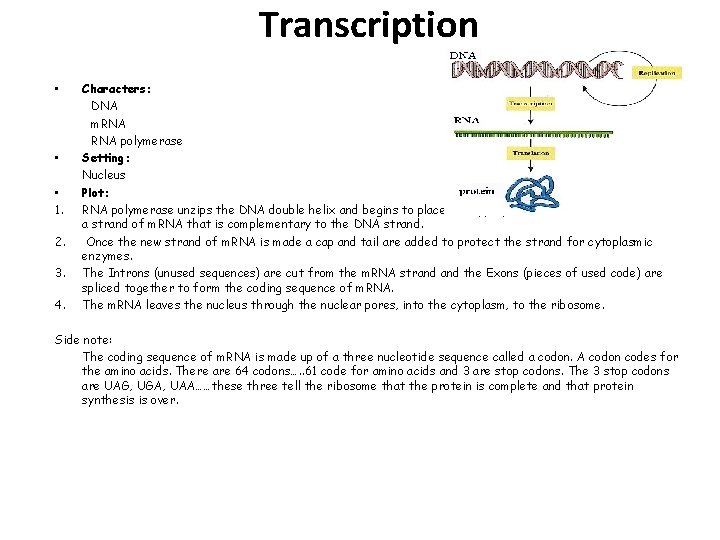
Transcription • • • 1. 2. 3. 4. Characters: DNA m. RNA polymerase Setting: Nucleus Plot: RNA polymerase unzips the DNA double helix and begins to place the appropriate nucleotide bases to form a strand of m. RNA that is complementary to the DNA strand. Once the new strand of m. RNA is made a cap and tail are added to protect the strand for cytoplasmic enzymes. The Introns (unused sequences) are cut from the m. RNA strand the Exons (pieces of used code) are spliced together to form the coding sequence of m. RNA. The m. RNA leaves the nucleus through the nuclear pores, into the cytoplasm, to the ribosome. Side note: The coding sequence of m. RNA is made up of a three nucleotide sequence called a codon. A codon codes for the amino acids. There are 64 codons…. . 61 code for amino acids and 3 are stop codons. The 3 stop codons are UAG, UGA, UAA……these three tell the ribosome that the protein is complete and that protein synthesis is over.
Translation • Translation is the process of interpreting the genetic message and building the protein. This begins when the m. RNA attaches to a ribosome, which contains proteins and ribosomal RNA (r. RNA), and is found in the cytoplasm. • The function of ribosomes is to assemble proteins according to the code that the m. RNA brings from the DNA.
Translation. . the Process • The translation process takes place as follows: • The t. RNA with its attached amino acid pairs to the codon of the m. RNA attached to a ribosome. (codon to anticodon) When a second t. RNA with its specific amino acid pairs to the next codon in sequence, the attached amino acid breaks from the first t. RNA and attaches to the amino acid of the second t. RNA. •
Translation continued • The ribosome forms a peptide bond between the amino acids, and an amino acid chain begins to form. • The empty t. RNA moves off and picks up another matching amino acid from the cytoplasm in the cell. • This sequence is repeated until the ribosome reaches a stop codon on the m. RNA, which signals the end of protein synthesis.
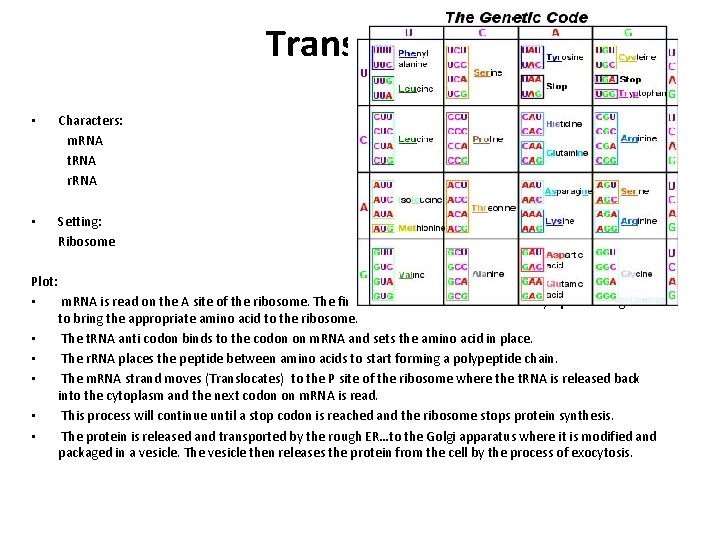
Translation • Characters: m. RNA t. RNA r. RNA • Setting: Ribosome Plot: • m. RNA is read on the A site of the ribosome. The first codon is read and t. RNA in the cytoplasm is signaled to bring the appropriate amino acid to the ribosome. • The t. RNA anti codon binds to the codon on m. RNA and sets the amino acid in place. • The r. RNA places the peptide between amino acids to start forming a polypeptide chain. • The m. RNA strand moves (Translocates) to the P site of the ribosome where the t. RNA is released back into the cytoplasm and the next codon on m. RNA is read. • This process will continue until a stop codon is reached and the ribosome stops protein synthesis. • The protein is released and transported by the rough ER…to the Golgi apparatus where it is modified and packaged in a vesicle. The vesicle then releases the protein from the cell by the process of exocytosis.