
DNA Mutations Biology Chapter 10 HOW DOES IT

DNA Mutations Biology Chapter 10
HOW DOES IT HAPPEN? ? ? Environmental Influences such as: Chemicals or UV Rays Inherited: mutations can be passed down from parent to offspring During copying of DNA, mistakes can occur
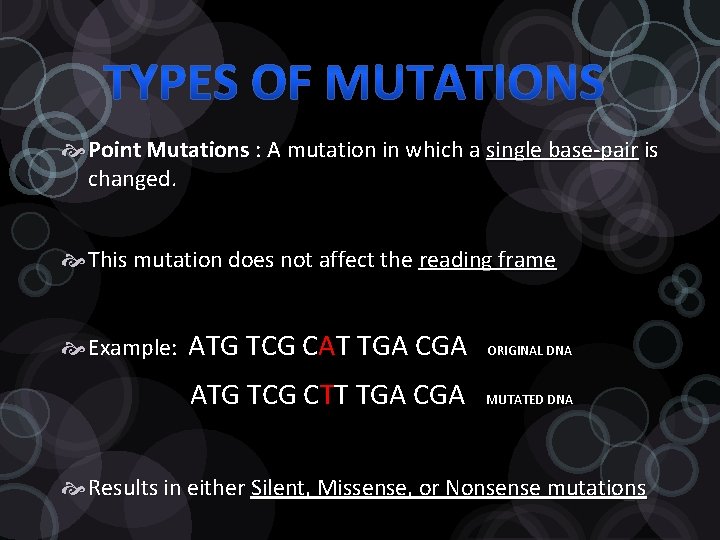
Point Mutations : A mutation in which a single base-pair is changed. This mutation does not affect the reading frame Example: ATG TCG CAT TGA CGA ORIGINAL DNA ATG TCG CTT TGA CGA MUTATED DNA Results in either Silent, Missense, or Nonsense mutations
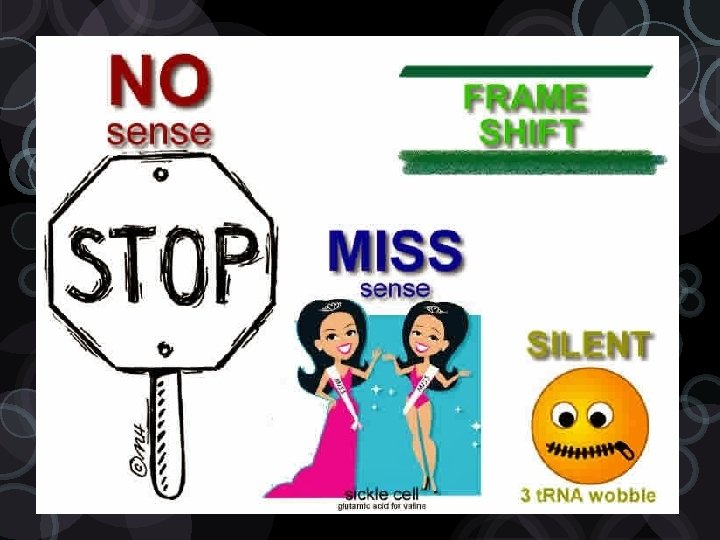
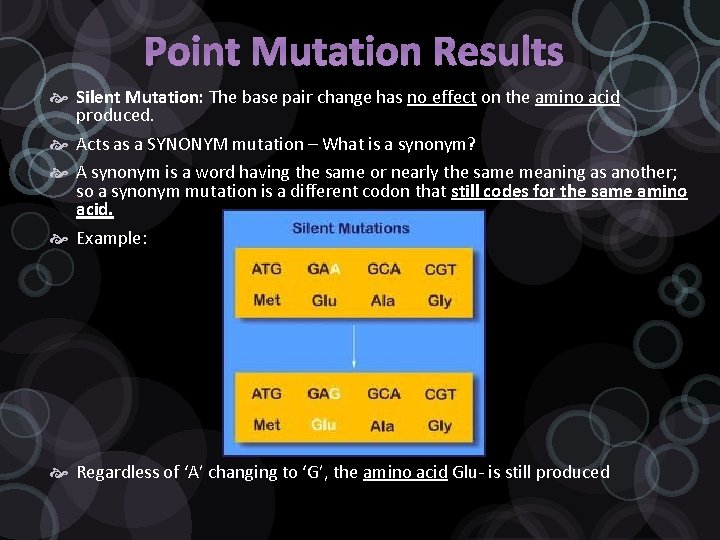
Point Mutation Results Silent Mutation: The base pair change has no effect on the amino acid produced. Acts as a SYNONYM mutation – What is a synonym? A synonym is a word having the same or nearly the same meaning as another; so a synonym mutation is a different codon that still codes for the same amino acid. Example: Regardless of ‘A’ changing to ‘G’, the amino acid Glu- is still produced
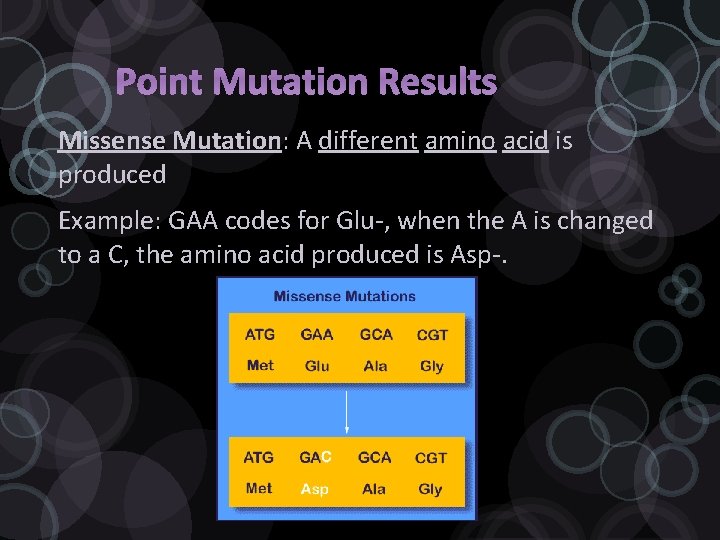
Point Mutation Results Missense Mutation: A different amino acid is produced Example: GAA codes for Glu-, when the A is changed to a C, the amino acid produced is Asp-.
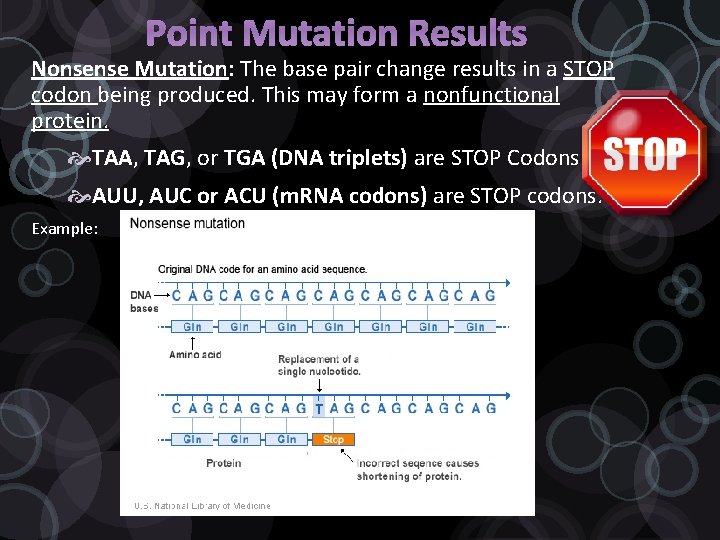
Point Mutation Results Nonsense Mutation: The base pair change results in a STOP codon being produced. This may form a nonfunctional protein. TAA, TAG, or TGA (DNA triplets) are STOP Codons AUU, AUC or ACU (m. RNA codons) are STOP codons. Example:
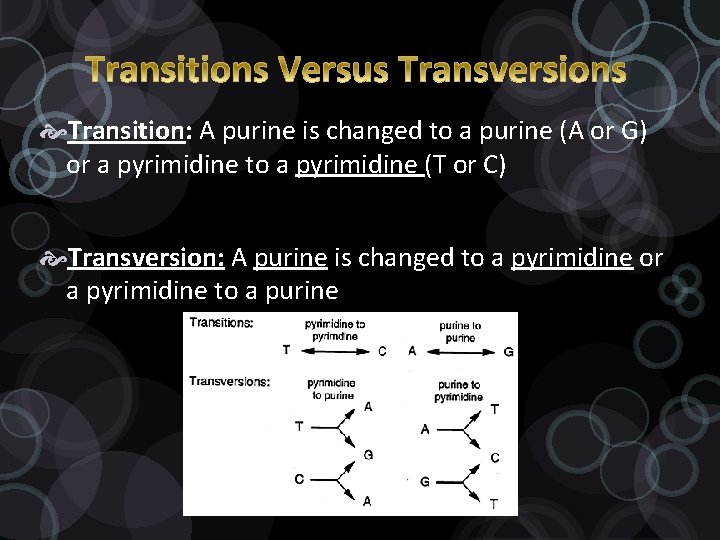
Transition: A purine is changed to a purine (A or G) or a pyrimidine to a pyrimidine (T or C) Transversion: A purine is changed to a pyrimidine or a pyrimidine to a purine
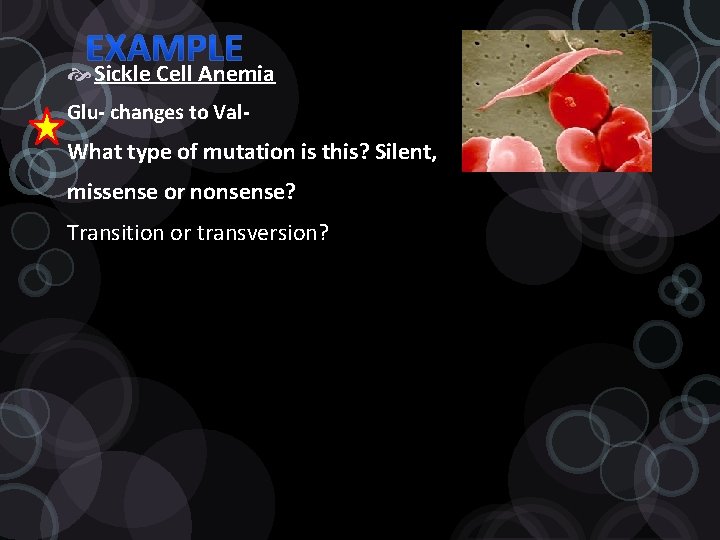
Sickle Cell Anemia Glu- changes to Val- What type of mutation is this? Silent, missense or nonsense? Transition or transversion?
Frame shift Mutations Frame shift mutations: The reading frame is altered Example: Original The fat cat ate the wee rat. Frame Shift The fat caa tet hew eer at. Types: Deletions, Insertions, Duplications of base pairs
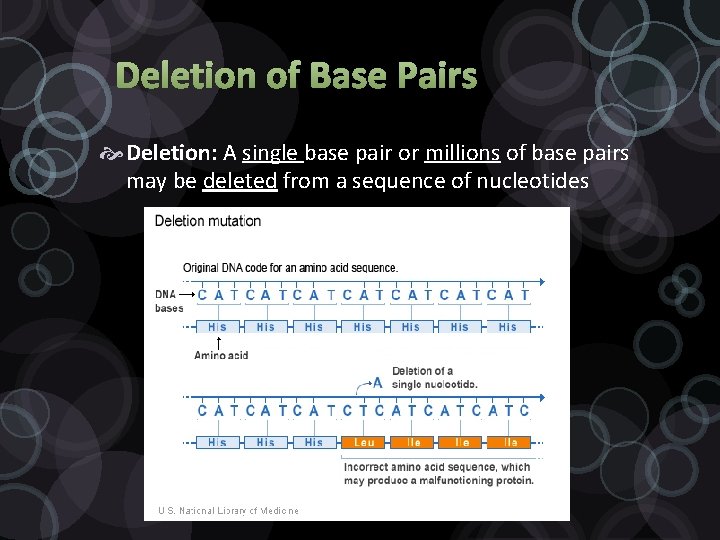
Deletion of Base Pairs Deletion: A single base pair or millions of base pairs may be deleted from a sequence of nucleotides
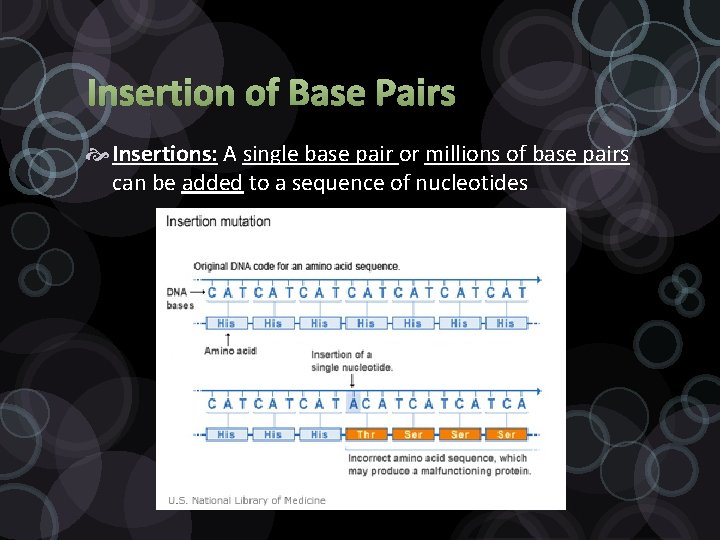
Insertion of Base Pairs Insertions: A single base pair or millions of base pairs can be added to a sequence of nucleotides
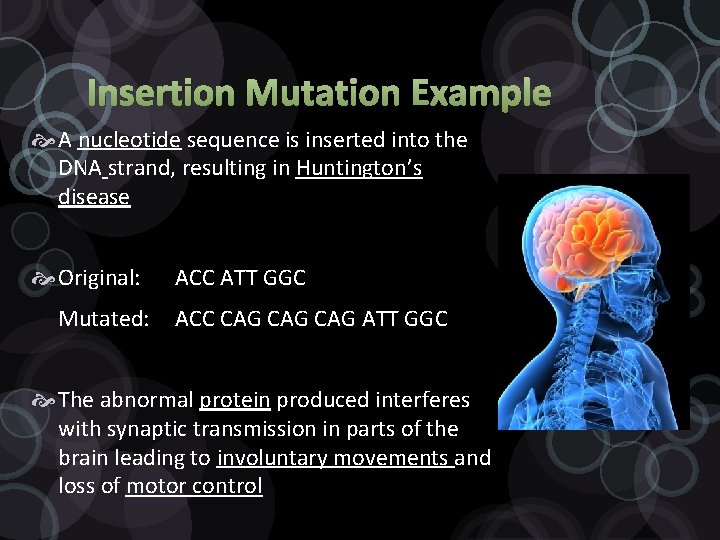
Insertion Mutation Example A nucleotide sequence is inserted into the DNA strand, resulting in Huntington’s disease Original: Mutated: ACC ATT GGC ACC CAG CAG ATT GGC The abnormal protein produced interferes with synaptic transmission in parts of the brain leading to involuntary movements and loss of motor control
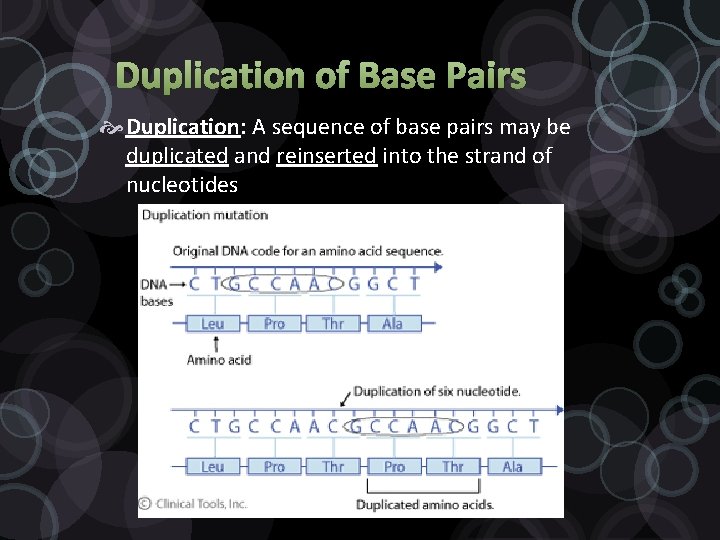
Duplication of Base Pairs Duplication: A sequence of base pairs may be duplicated and reinserted into the strand of nucleotides
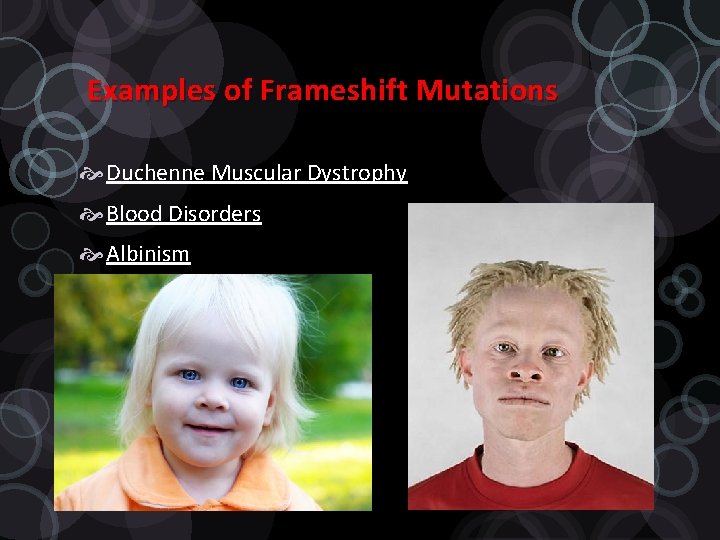
Examples of Frameshift Mutations Duchenne Muscular Dystrophy Blood Disorders Albinism
What is more severe? Frameshift or Point Mutations? Frameshift Mutations Alters the reading frame, thus affecting all proteins created after the point of mutation Mostly fatal Point Mutations Does not affect the reading frame, with the chance of not affecting the protein being made Can still be fatal to the carrier, but not always
Good Mutations? Mutation of gene CCR 5 – deletion of 32 pairs of nucleotides. Leads to resistance of HIV. Stemmed from the bubonic plague Mutation of red blood cells leads to sickle cell anemia. Leads to malaria resistance A mutation on protein Apo-AIM helps remove cholesterol from arteries, thus leading to less heart disease risk. Defective myostatin genes leads to immense muscle strength NTRK 1 gene mutation results in loss of all pain and sensations.
CHROMOSOMAL MUTATIONS Occurs during CROSSING-OVER of Prophase I in meiosis. Types of chromosomal mutations: 1. Translocations 2. Inversions 3. Deletions 4. Duplications
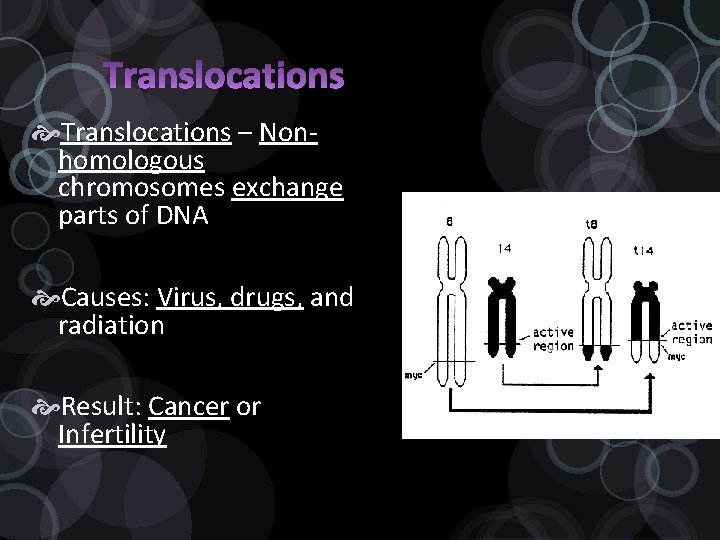
Translocations – Nonhomologous chromosomes exchange parts of DNA Causes: Virus, drugs, and radiation Result: Cancer or Infertility
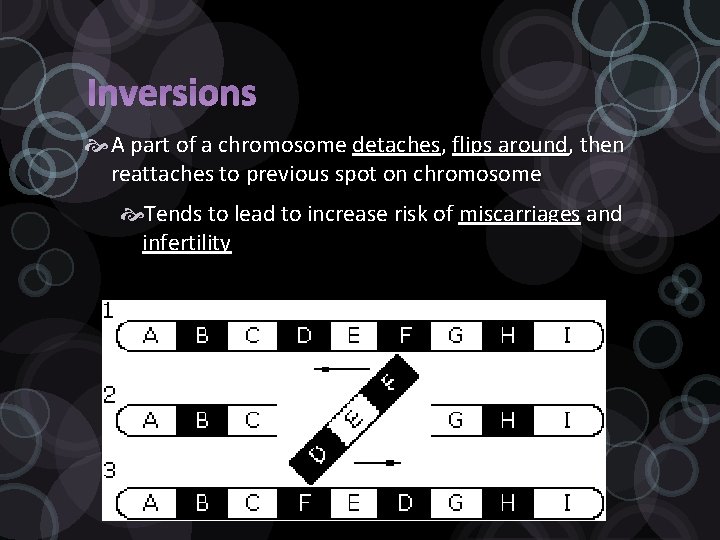
Inversions A part of a chromosome detaches, flips around, then reattaches to previous spot on chromosome Tends to lead to increase risk of miscarriages and infertility
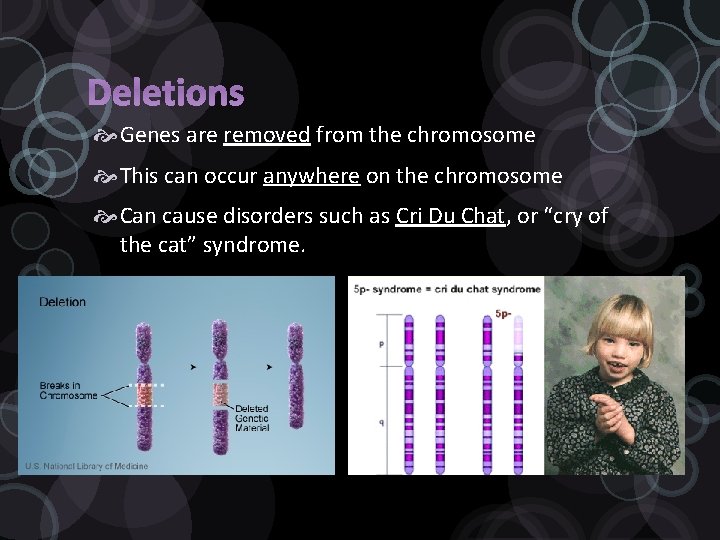
Deletions Genes are removed from the chromosome This can occur anywhere on the chromosome Can cause disorders such as Cri Du Chat, or “cry of the cat” syndrome.
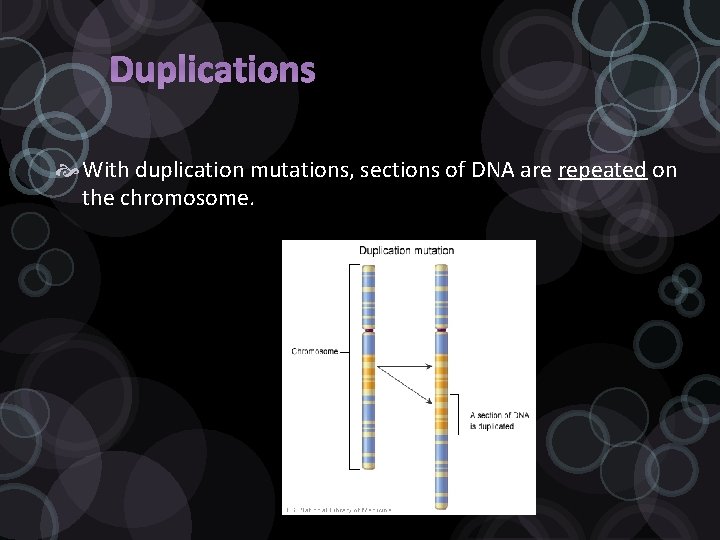
Duplications With duplication mutations, sections of DNA are repeated on the chromosome.
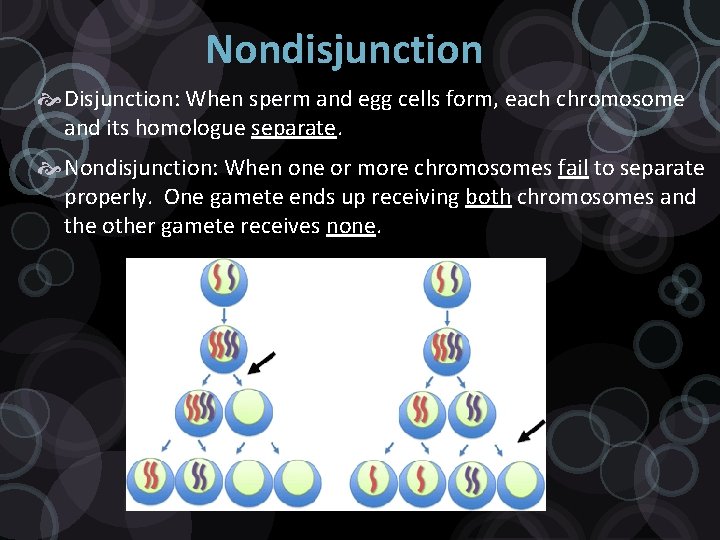
Nondisjunction Disjunction: When sperm and egg cells form, each chromosome and its homologue separate. Nondisjunction: When one or more chromosomes fail to separate properly. One gamete ends up receiving both chromosomes and the other gamete receives none.
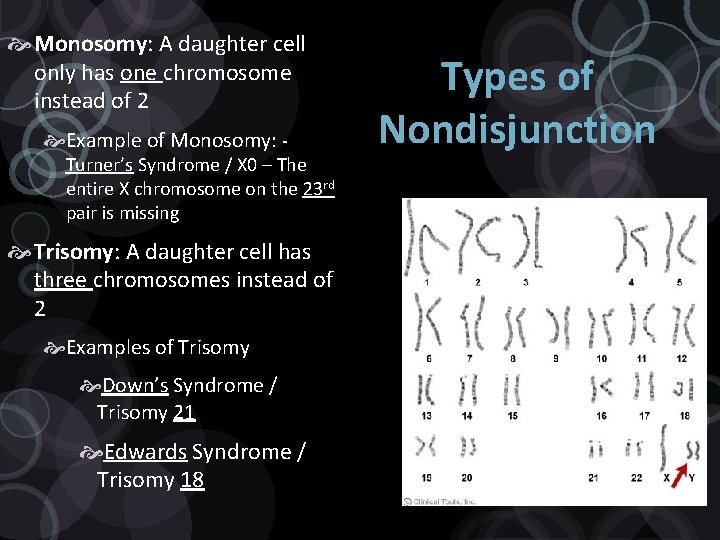
Monosomy: A daughter cell only has one chromosome instead of 2 Example of Monosomy: - Turner’s Syndrome / X 0 – The entire X chromosome on the 23 rd pair is missing Trisomy: A daughter cell has three chromosomes instead of 2 Examples of Trisomy Down’s Syndrome / Trisomy 21 Edwards Syndrome / Trisomy 18 Types of Nondisjunction
- Slides: 25