
DNA Mutation Dr Henny Saraswati M Biomed What
DNA Mutation Dr. Henny Saraswati, M. Biomed
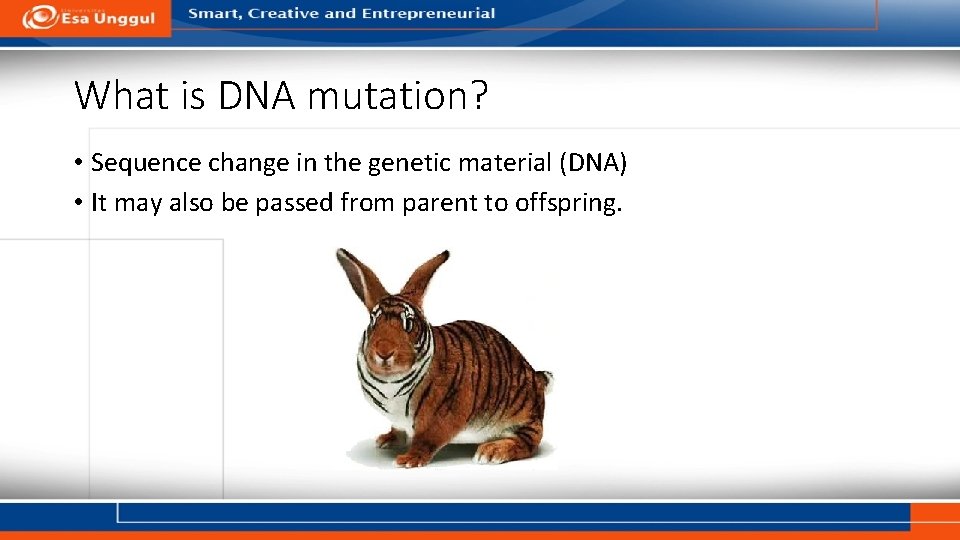
What is DNA mutation? • Sequence change in the genetic material (DNA) • It may also be passed from parent to offspring.

Sequence Change Normal Mutation

Types of Mutation • Point Mutation • a change in one base in the DNA sequence. www. yourgenome. org

Types of Mutation • Substitution • when one or more bases in the sequence is replaced by the same number of bases (for example, a cytosine substituted for an adenine). www. yourgenome. org

Types of Mutation • Inversion • when a segment of a chromosome is reversed end to end. www. yourgenome. org

Types of Mutation • Insertion • when a base is added to the sequence www. yourgenome. org

Types of Mutation • Deletion • when a base is deleted from the sequence www. yourgenome. org
Effect of Mutation • Silent mutation • mutation that do not alter the amino acid sequence of the polypeptide even though the nucleotide sequence has changed How? Mutation occur in certain bases within a codon, such as the third base, so that the specific amino acid is not changed

Effect of Mutation • Missense mutation • base substitutions in which an amino acid change does occur Example Sickle-cell anemia the amino acid is changed from a glutamic acid to valine. This alters the structure and function of the hemoglobin protein. One consequence of this alteration is that the red blood cells sickle under conditions of low oxygen
Effect of Mutation • Nonsense mutation • a change from a normal codon to a stop codon What will happen: This terminates the translation of the polypeptide earlier than expected, producing a truncated polypeptide
What is the name of organism that have mutation • Mutant

Organisme with mutation will…… Ø Have no change neutral mutation Ø Will decrease the chances of survival and reproduction deleterious mutation Ø Experiencing death on the cell or organism lethal mutation
Mutation can occur in germ cell or somatic cell • Germ cell refers to cells that give rise to the gametes such as eggs and sperm • A germ-line mutation can occur directly in a sperm or egg cell, or it can occur in a precursor cell that produces the gametes • If a mutant gamete participates in fertilization, all cells of the resulting offspring will contain the mutation
Mutation can occur in germ cell or somatic cell • Somatic cell comprise all cells of the body excluding the germ-line cells • Examples include muscle cells, nerve cells, and skin cells. • Mutations can also happen within somatic cells at early or late stages of development


Example of somatic mutation

Cause of mutation • Geneticists categorize the cause of mutation in one of two ways : 1. Spontaneous mutations are changes in DNA structure that result from abnormalities in biological processes at early or late stages of development 2. induced mutations are caused by environmental agents (mutagen)

Examples of Spontaneous mutation • Abnormalities in crossing over can produce mutations such as deletions, duplications, translocations, and inversions • Aberrant segregation of chromosomes during meiosis can cause changes in chromosome number • DNA polymerase can make a mistake during DNA replication by putting the wrong base in a newly synthesized daughter strand • Normal metabolic processes may produce chemicals within the cell that can react directly with the DNA and alter its structure.

Examples of Induced mutation • Chemical agents chemical substances may cause changes in the structure of DNA • Example : sodium azide, benzene • Physical agents physical phenomena such as UV or X-rays can damage the DNA
DNA Repair • DNA repair systems are vital to the survival of all organisms • If DNA repair systems did not exist, spontaneous and environmentally induced mutations would be so prevalent that few species, if any, would survive • Living cells contain several DNA repair systems that can fix different types of DNA alterations •

DNA Repair • In most cases, DNA repair is a multistep process : 1. one or more proteins in the DNA repair system detect an irregularity in DNA structure 2. the abnormality is removed by the action of DNA repair enzymes 3. normal DNA is synthesized via DNA replication enzymes.


DNA Repair System 1. Damage Bases can be directly repaired • A second type of repair system, called base excision repair (BER), involves the function of a category of enzymes known as DNA N-glycosylases. • This type of enzyme can recognize an abnormal base and cleave the bond between it and the sugar in the DNA backbone, creating an apurinic or apyrimidinic site

DNA Repair System 2. Base Excision Repair Removes a Damaged Base In a few cases, the covalent modification of nucleotides by mutagens can be reversed by specific cellular enzymes • Example : Saccharomyces cerevisiae, and most plants produce an enzyme called photolyase that can repair thymine dimers by splitting the dimers, which returns the DNA to its original condition
DNA Repair System 3. Nucleotide Excision Repair Systems Remove Segments of Damaged DNA • An important general process for DNA repair is the nucleotide excision repair (NER) system. • In NER, several nucleotides in the damaged strand are removed from the DNA, and the intact strand is used as a template for resynthesis of a normal complementary strand • NERis found in all eukaryotes and prokaryotes, although its molecular mechanism is better understood in prokaryotic species.
- Slides: 26