
DNA Ligase IV is Specialized to Join Damaged
- Slides: 1
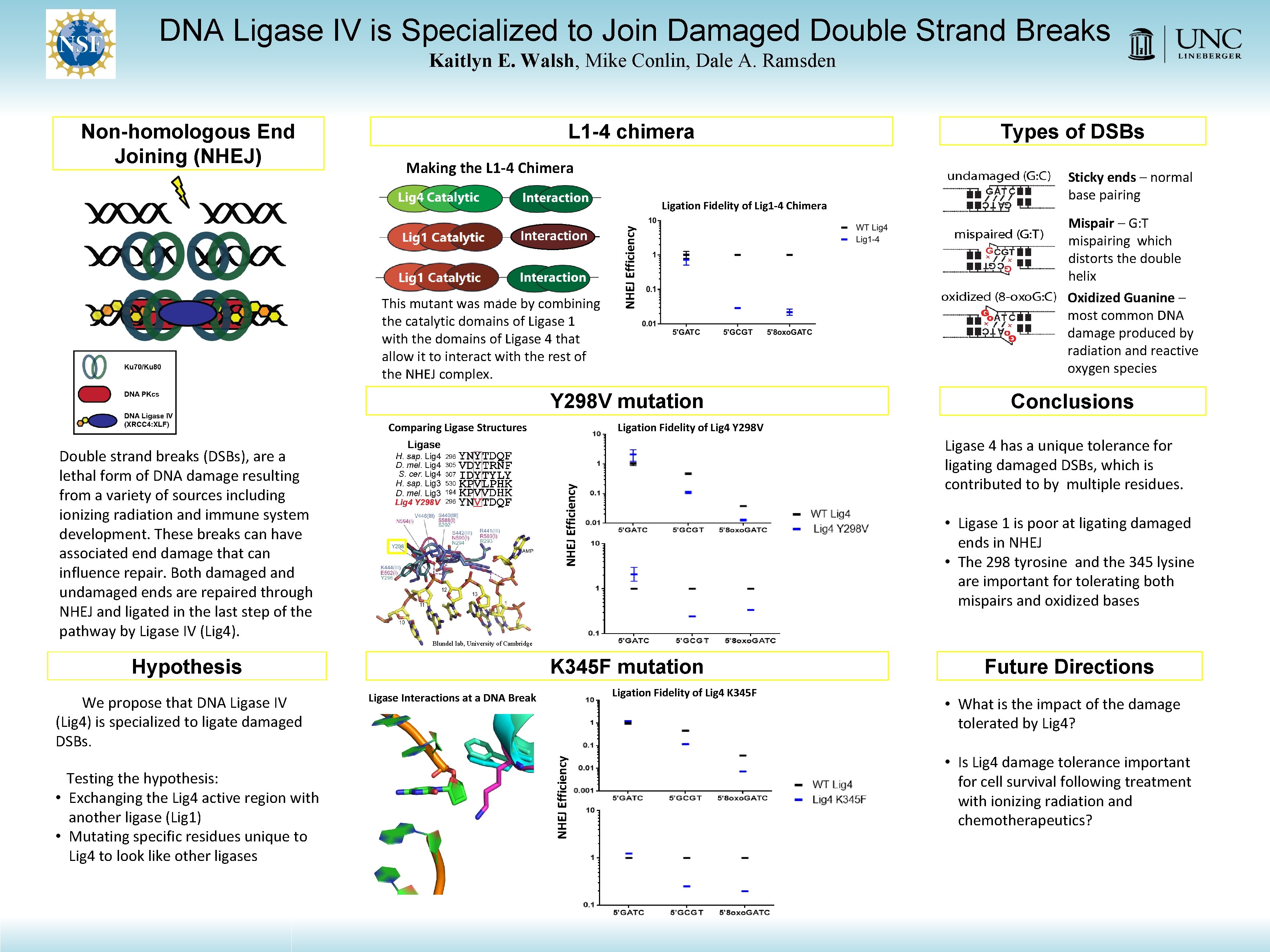
DNA Ligase IV is Specialized to Join Damaged Double Strand Breaks Kaitlyn E. Walsh, Mike Conlin, Dale A. Ramsden Non-homologous End Joining (NHEJ) L 1 -4 chimera Making the L 1 -4 Chimera Interaction This mutant was made by combining the catalytic domains of Ligase 1 with the domains of Ligase 4 that allow it to interact with the rest of the NHEJ complex. NHEJ Efficiency Ligation Fidelity of Lig 1 -4 Chimera Y 298 V mutation Comparing Ligase Structures Testing the hypothesis: • Exchanging the Lig 4 active region with another ligase (Lig 1) • Mutating specific residues unique to Lig 4 to look like other ligases Mispair – G: T mispairing which distorts the double helix Oxidized Guanine – most common DNA damage produced by radiation and reactive oxygen species Conclusions NHEJ Efficiency Ligase 4 has a unique tolerance for ligating damaged DSBs, which is contributed to by multiple residues. • Ligase 1 is poor at ligating damaged ends in NHEJ • The 298 tyrosine and the 345 lysine are important for tolerating both mispairs and oxidized bases Blundel lab, University of Cambridge Hypothesis We propose that DNA Ligase IV (Lig 4) is specialized to ligate damaged DSBs. Sticky ends – normal base pairing Ligation Fidelity of Lig 4 Y 298 V K 345 F mutation Ligation Fidelity of Lig 4 K 345 F Ligase Interactions at a DNA Break NHEJ Efficiency Double strand breaks (DSBs), are a lethal form of DNA damage resulting from a variety of sources including ionizing radiation and immune system development. These breaks can have associated end damage that can influence repair. Both damaged and undamaged ends are repaired through NHEJ and ligated in the last step of the pathway by Ligase IV (Lig 4). Types of DSBs Future Directions • What is the impact of the damage tolerated by Lig 4? • Is Lig 4 damage tolerance important for cell survival following treatment with ionizing radiation and chemotherapeutics? printed by www. postersession. com