
DNA In this presentation you will n identify
- Slides: 32
DNA In this presentation you will: n identify the structure of DNA n explore the process of protein synthesis n identify how to extract DNA from fruit
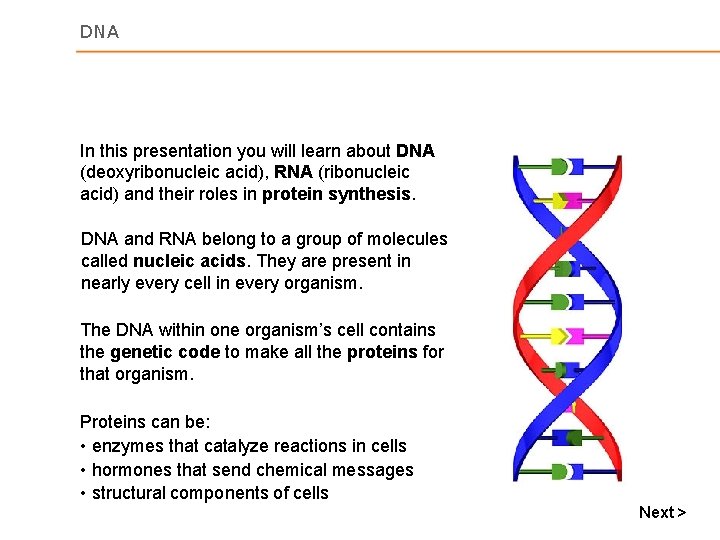
DNA In this presentation you will learn about DNA (deoxyribonucleic acid), RNA (ribonucleic acid) and their roles in protein synthesis. DNA and RNA belong to a group of molecules called nucleic acids. They are present in nearly every cell in every organism. The DNA within one organism’s cell contains the genetic code to make all the proteins for that organism. Proteins can be: • enzymes that catalyze reactions in cells • hormones that send chemical messages • structural components of cells Next >
DNA Question 1 Which of the following groups of molecules do DNA and RNA belong to? A) Proteins B) Nucleic acids C) Lipids D) Carbohydrates
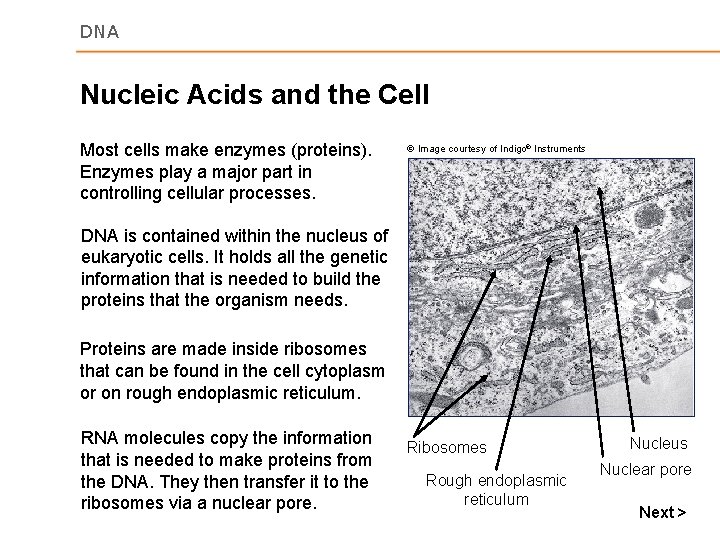
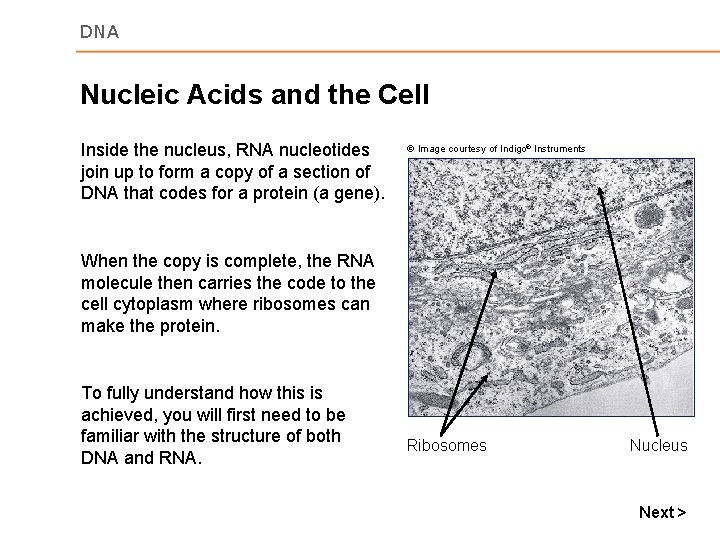
DNA Nucleic Acids and the Cell Most cells make enzymes (proteins). Enzymes play a major part in controlling cellular processes. © Image courtesy of Indigo® Instruments DNA is contained within the nucleus of eukaryotic cells. It holds all the genetic information that is needed to build the proteins that the organism needs. Proteins are made inside ribosomes that can be found in the cell cytoplasm or on rough endoplasmic reticulum. RNA molecules copy the information that is needed to make proteins from the DNA. They then transfer it to the ribosomes via a nuclear pore. Ribosomes Rough endoplasmic reticulum Nucleus Nuclear pore Next >
DNA Nucleic Acids and the Cell Inside the nucleus, RNA nucleotides join up to form a copy of a section of DNA that codes for a protein (a gene). © Image courtesy of Indigo® Instruments When the copy is complete, the RNA molecule then carries the code to the cell cytoplasm where ribosomes can make the protein. To fully understand how this is achieved, you will first need to be familiar with the structure of both DNA and RNA. Ribosomes Nucleus Next >
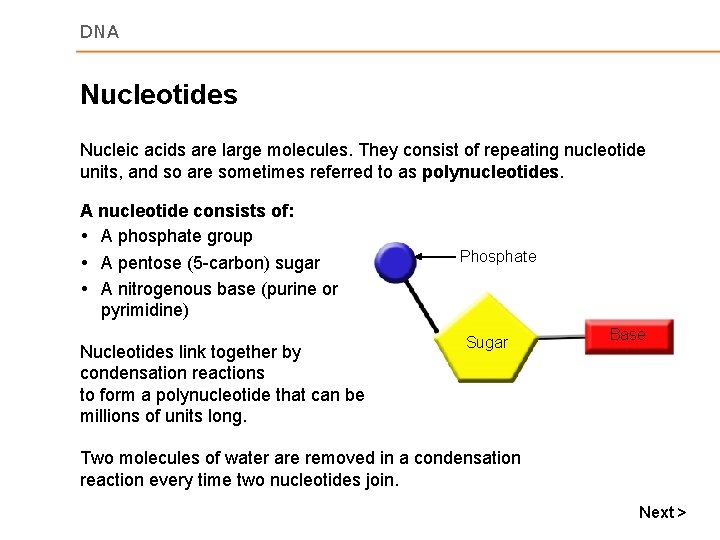
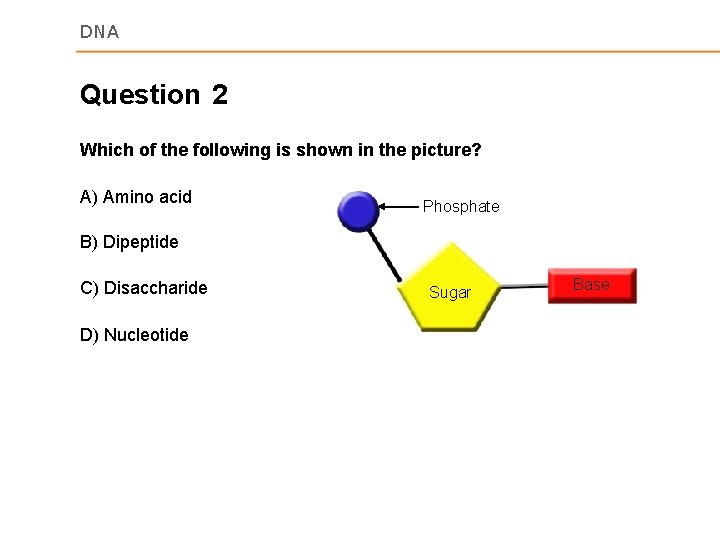
DNA Nucleotides Nucleic acids are large molecules. They consist of repeating nucleotide units, and so are sometimes referred to as polynucleotides. A nucleotide consists of: A phosphate group A pentose (5 -carbon) sugar A nitrogenous base (purine or pyrimidine) Nucleotides link together by condensation reactions to form a polynucleotide that can be millions of units long. Phosphate Sugar Base Two molecules of water are removed in a condensation reaction every time two nucleotides join. Next >
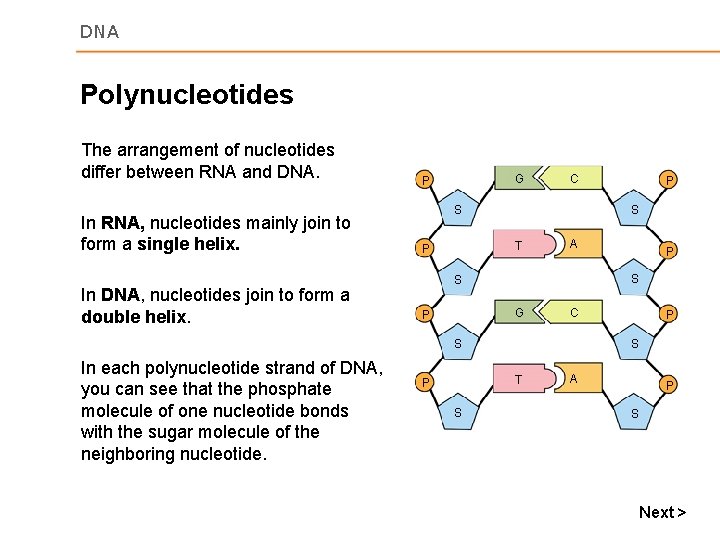
DNA Polynucleotides The arrangement of nucleotides differ between RNA and DNA. In RNA, nucleotides mainly join to form a single helix. In DNA, nucleotides join to form a double helix. Base P C Base P S Base P P Base. S P Phosphate S S Base. S In each polynucleotide strand of DNA, you can see that the phosphate molecule of one nucleotide bonds with the sugar molecule of the neighboring nucleotide. Sugar G Sugar T A P Phosphate S Sugar G C Sugar T Sugar A P Phosphate S Phosphate Next >
DNA Question 2 Which of the following is shown in the picture? A) Amino acid Phosphate B) Dipeptide C) Disaccharide D) Nucleotide Sugar Base
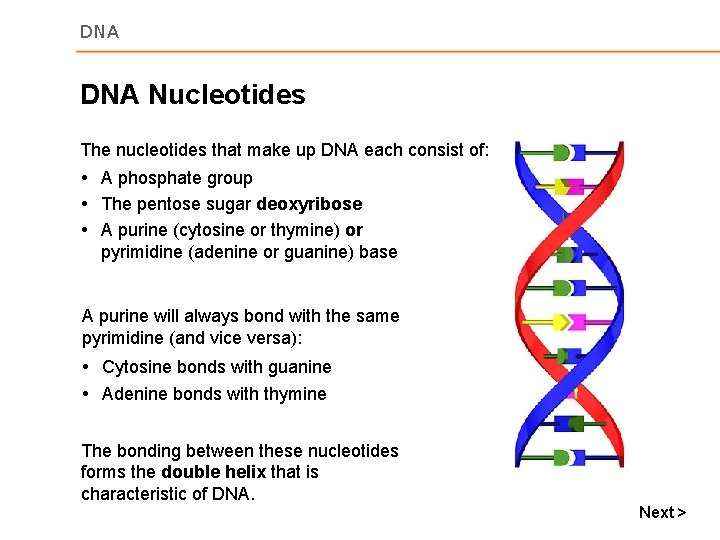
DNA Nucleotides The nucleotides that make up DNA each consist of: A phosphate group The pentose sugar deoxyribose A purine (cytosine or thymine) or pyrimidine (adenine or guanine) base G P C S S T P A Cytosine bonds with guanine Adenine bonds with thymine The bonding between these nucleotides forms the double helix that is characteristic of DNA. G P C S S P S T P P S S A purine will always bond with the same pyrimidine (and vice versa): P A P S Next >
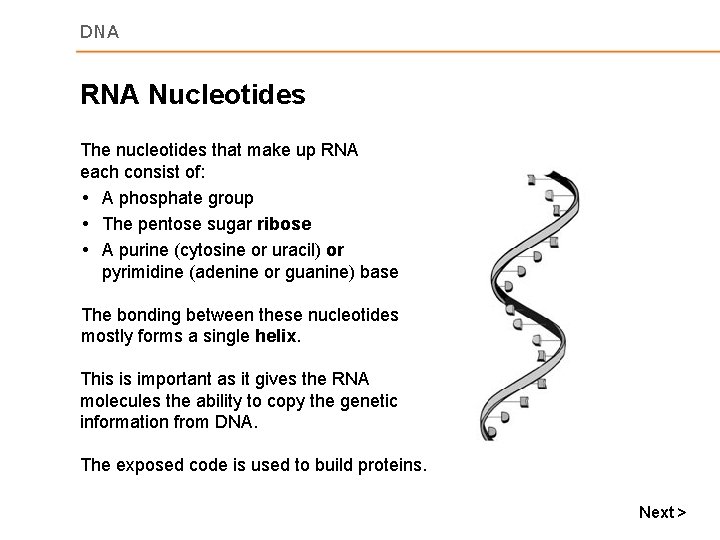
DNA RNA Nucleotides The nucleotides that make up RNA each consist of: A phosphate group The pentose sugar ribose A purine (cytosine or uracil) or pyrimidine (adenine or guanine) base A P s C P s U P The bonding between these nucleotides mostly forms a single helix. G s A P s This is important as it gives the RNA molecules the ability to copy the genetic information from DNA. The exposed code is used to build proteins. P s C G P s Next >
DNA Question 3 Which of the following bases is present in RNA molecules but not DNA? A) Adenine B) Cytosine C) Thymine D) Uracil
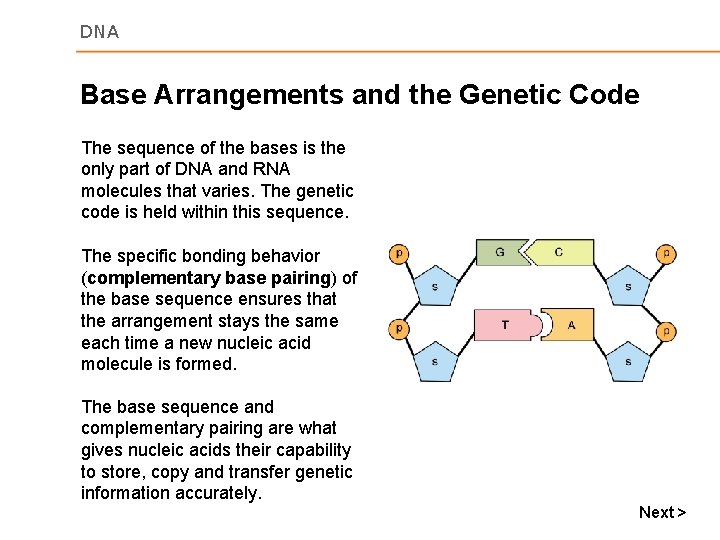
DNA Base Arrangements and the Genetic Code The sequence of the bases is the only part of DNA and RNA molecules that varies. The genetic code is held within this sequence. The specific bonding behavior (complementary base pairing) of the base sequence ensures that the arrangement stays the same each time a new nucleic acid molecule is formed. The base sequence and complementary pairing are what gives nucleic acids their capability to store, copy and transfer genetic information accurately. Next >
DNA Question 4 Which part of the nucleic acids carries the genetic code? A) Phosphate B) Bases C) Ribose D) Deoxyribose
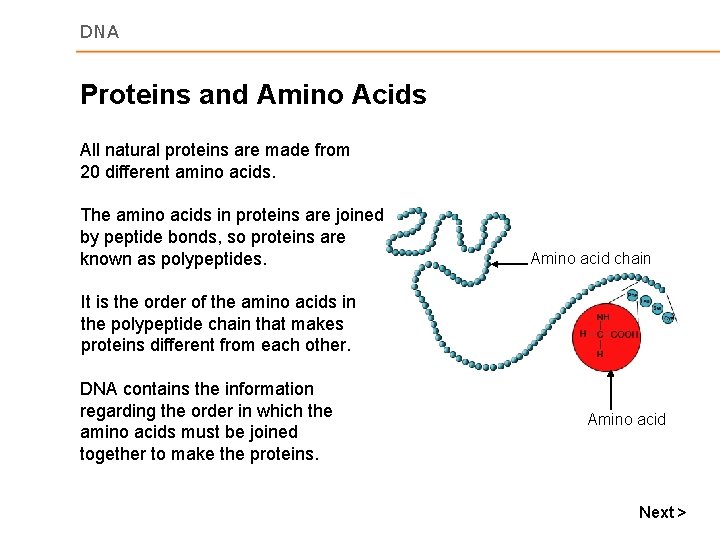
DNA Proteins and Amino Acids All natural proteins are made from 20 different amino acids. The amino acids in proteins are joined by peptide bonds, so proteins are known as polypeptides. Amino acid chain It is the order of the amino acids in the polypeptide chain that makes proteins different from each other. DNA contains the information regarding the order in which the amino acids must be joined together to make the proteins. Amino acid Next >
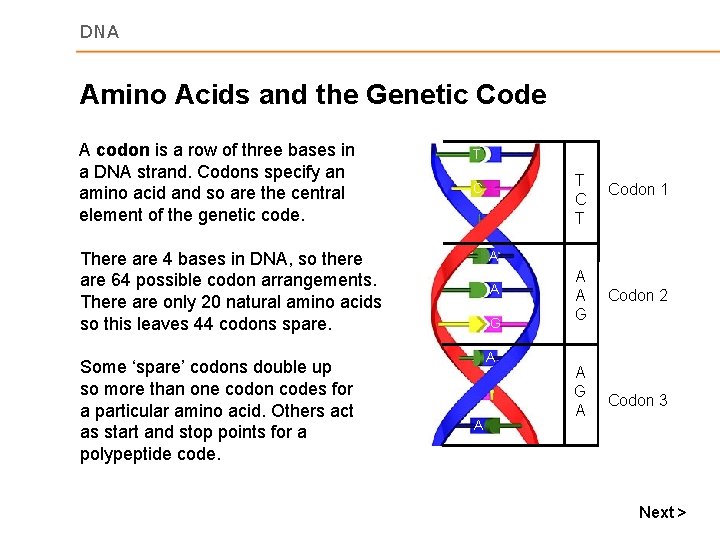
DNA Amino Acids and the Genetic Code A codon is a row of three bases in a DNA strand. Codons specify an amino acid and so are the central element of the genetic code. T Codon 1 A There are 4 bases in DNA, so there are 64 possible codon arrangements. There are only 20 natural amino acids so this leaves 44 codons spare. Some ‘spare’ codons double up so more than one codon codes for a particular amino acid. Others act as start and stop points for a polypeptide code. T C A G A Codon 2 Codon 3 Next >
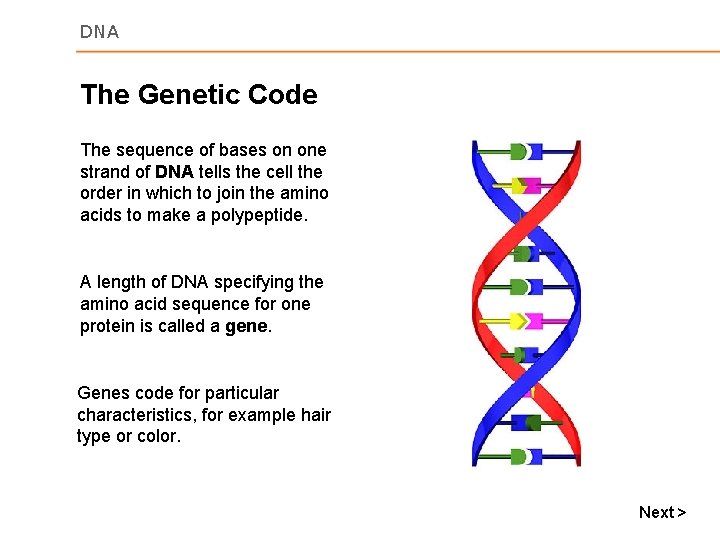
DNA The Genetic Code The sequence of bases on one strand of DNA tells the cell the order in which to join the amino acids to make a polypeptide. A length of DNA specifying the amino acid sequence for one protein is called a gene. Genes code for particular characteristics, for example hair type or color. Next >
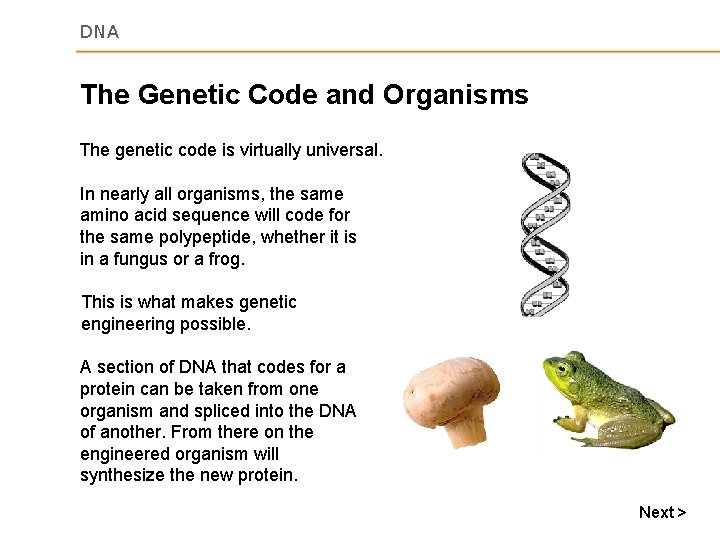
DNA The Genetic Code and Organisms The genetic code is virtually universal. In nearly all organisms, the same amino acid sequence will code for the same polypeptide, whether it is in a fungus or a frog. This is what makes genetic engineering possible. A section of DNA that codes for a protein can be taken from one organism and spliced into the DNA of another. From there on the engineered organism will synthesize the new protein. Next >
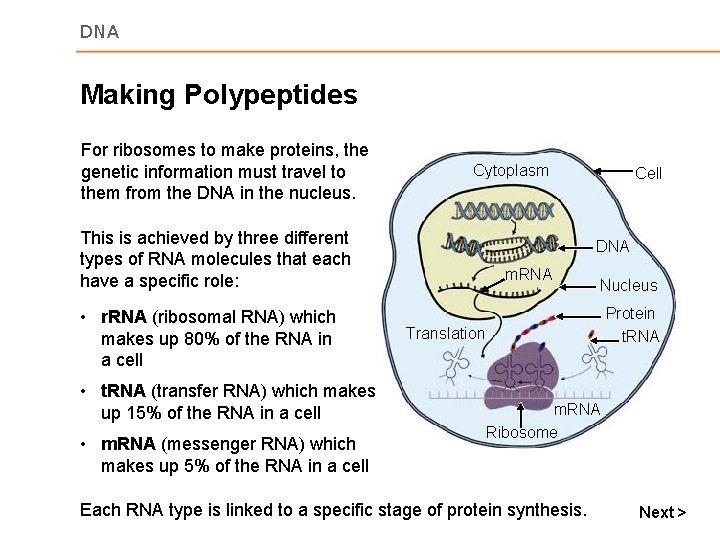
DNA Making Polypeptides For ribosomes to make proteins, the genetic information must travel to them from the DNA in the nucleus. Cytoplasm This is achieved by three different types of RNA molecules that each have a specific role: • r. RNA (ribosomal RNA) which makes up 80% of the RNA in a cell • t. RNA (transfer RNA) which makes up 15% of the RNA in a cell • m. RNA (messenger RNA) which makes up 5% of the RNA in a cell Cell DNA m. RNA Nucleus Protein t. RNA Translation m. RNA Ribosome Each RNA type is linked to a specific stage of protein synthesis. Next >
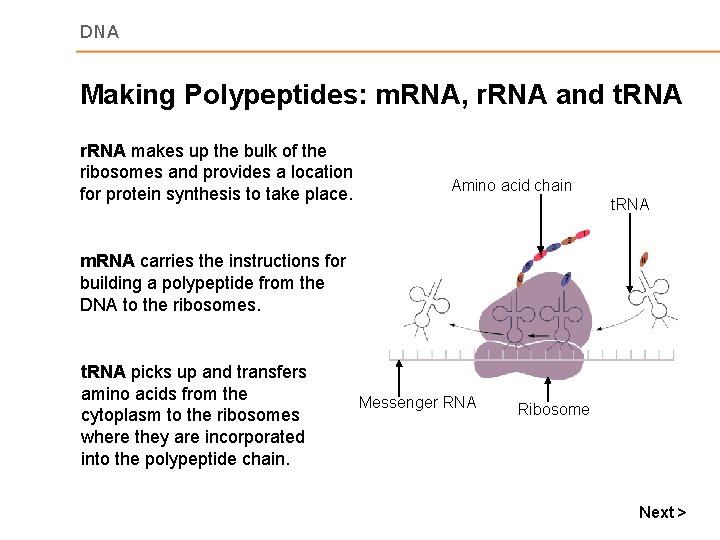
DNA Making Polypeptides: m. RNA, r. RNA and t. RNA r. RNA makes up the bulk of the ribosomes and provides a location for protein synthesis to take place. Amino acid chain t. RNA DNA m. RNA carries the instructions for building a polypeptide from the DNA to the ribosomes. t. RNA picks up and transfers amino acids from the cytoplasm to the ribosomes where they are incorporated into the polypeptide chain. Nucleus m. RNA (complementary base sequence to DNA) Messenger RNA Ribosome Next >
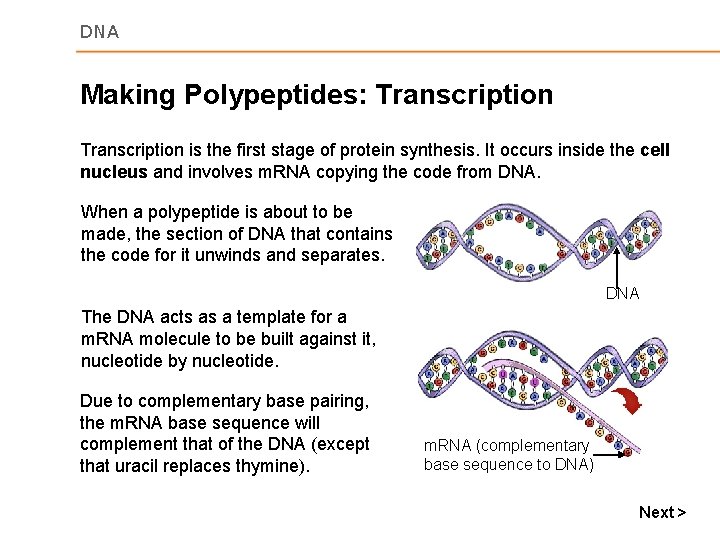
DNA Making Polypeptides: Transcription is the first stage of protein synthesis. It occurs inside the cell nucleus and involves m. RNA copying the code from DNA. When a polypeptide is about to be made, the section of DNA that contains the code for it unwinds and separates. DNA The DNA acts as a template for a m. RNA molecule to be built against it, nucleotide by nucleotide. Due to complementary base pairing, the m. RNA base sequence will complement that of the DNA (except that uracil replaces thymine). m. RNA (complementary base sequence to DNA) Next >
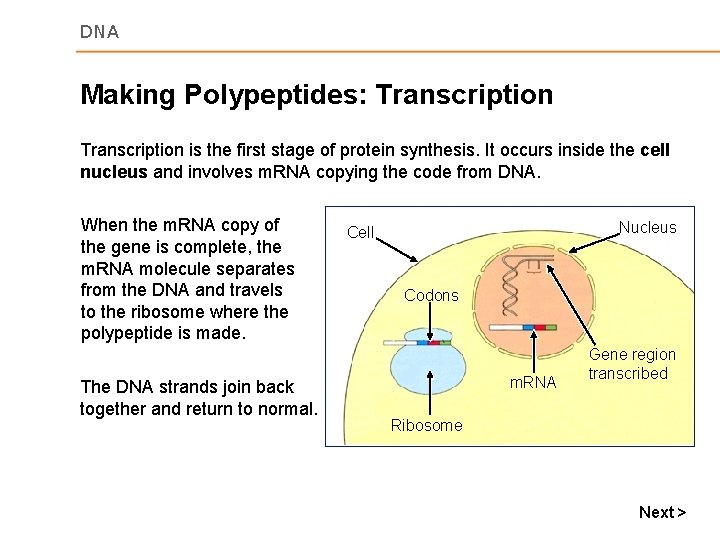
DNA Making Polypeptides: Transcription is the first stage of protein synthesis. It occurs inside the cell nucleus and involves m. RNA copying the code from DNA. When the m. RNA copy of the gene is complete, the m. RNA molecule separates from the DNA and travels to the ribosome where the polypeptide is made. The DNA strands join back together and return to normal. Nucleus Cell Codons m. RNA Gene region transcribed Ribosome Next >
DNA Question 5 Which of the following correctly describes the specific nature in which nucleotide bases pair up? A) A base will only join with an identical base. B) A base will only join with its complementary base. C) A purine will only join with a purine. D) A pyrimidine will only join with a pyrimidine.
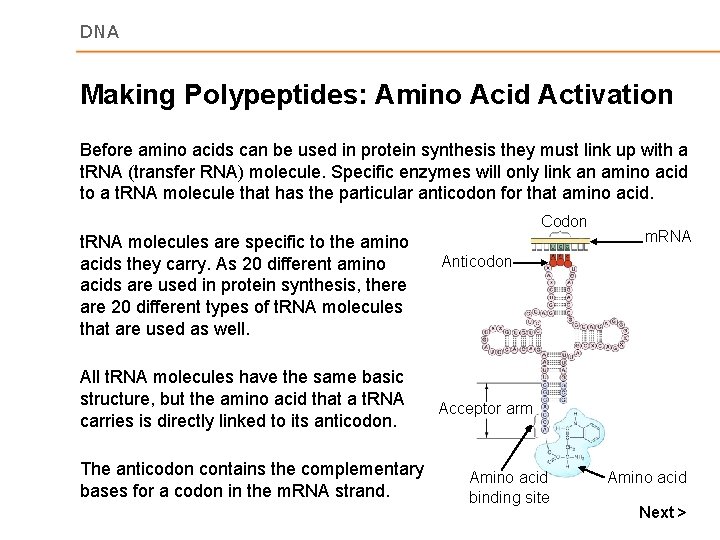
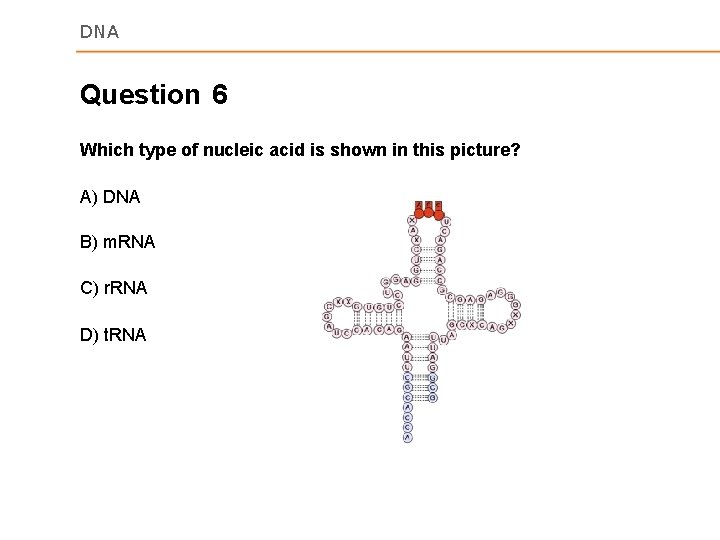
DNA Making Polypeptides: Amino Acid Activation Before amino acids can be used in protein synthesis they must link up with a t. RNA (transfer RNA) molecule. Specific enzymes will only link an amino acid to a t. RNA molecule that has the particular anticodon for that amino acid. Codon t. RNA molecules are specific to the amino acids they carry. As 20 different amino acids are used in protein synthesis, there are 20 different types of t. RNA molecules that are used as well. All t. RNA molecules have the same basic structure, but the amino acid that a t. RNA carries is directly linked to its anticodon. The anticodon contains the complementary bases for a codon in the m. RNA strand. m. RNA Anticodon Acceptor arm Amino acid binding site Amino acid Next >
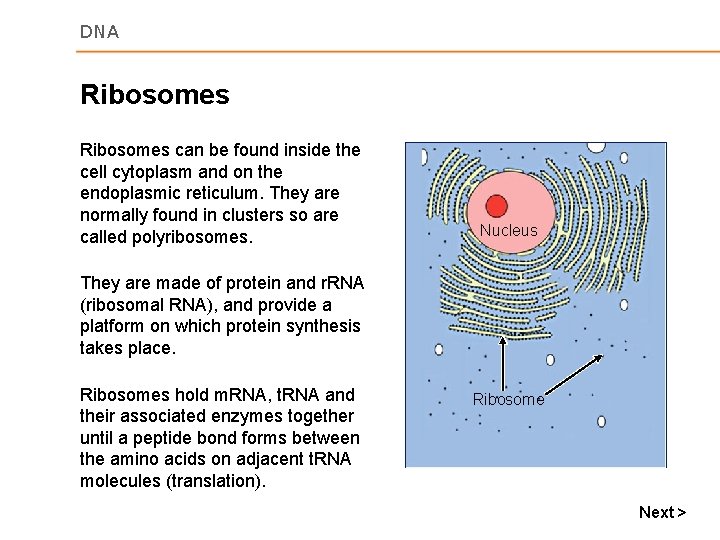
DNA Ribosomes can be found inside the cell cytoplasm and on the endoplasmic reticulum. They are normally found in clusters so are called polyribosomes. Nucleus They are made of protein and r. RNA (ribosomal RNA), and provide a platform on which protein synthesis takes place. Ribosomes hold m. RNA, t. RNA and their associated enzymes together until a peptide bond forms between the amino acids on adjacent t. RNA molecules (translation). Ribosome Next >
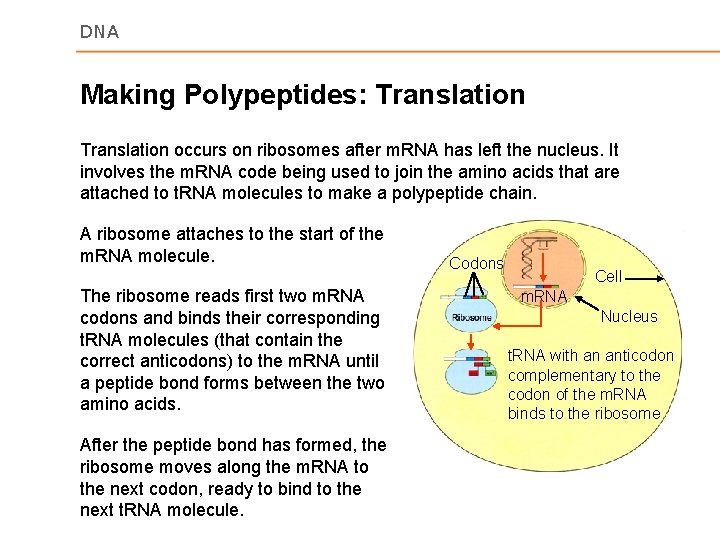
DNA Making Polypeptides: Translation occurs on ribosomes after m. RNA has left the nucleus. It involves the m. RNA code being used to join the amino acids that are attached to t. RNA molecules to make a polypeptide chain. A ribosome attaches to the start of the m. RNA molecule. The ribosome reads first two m. RNA codons and binds their corresponding t. RNA molecules (that contain the correct anticodons) to the m. RNA until a peptide bond forms between the two amino acids. After the peptide bond has formed, the ribosome moves along the m. RNA to the next codon, ready to bind to the next t. RNA molecule. Codons Cell m. RNA Nucleus t. RNA with an anticodon complementary to the codon of the m. RNA binds to the ribosome
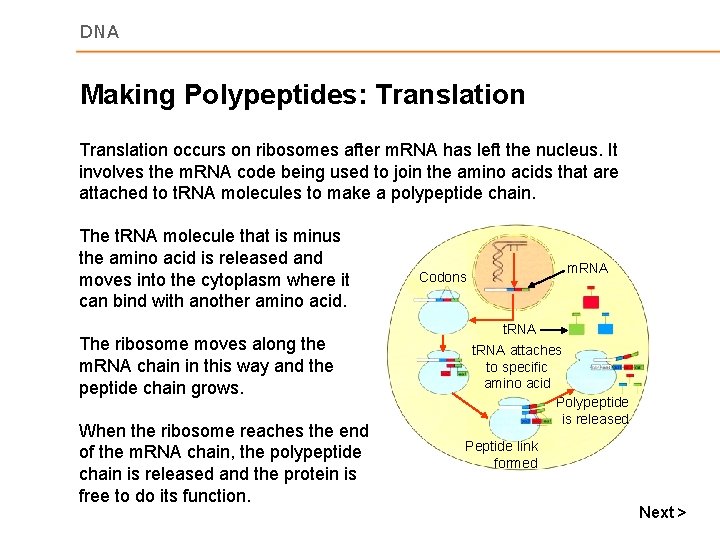
DNA Making Polypeptides: Translation occurs on ribosomes after m. RNA has left the nucleus. It involves the m. RNA code being used to join the amino acids that are attached to t. RNA molecules to make a polypeptide chain. The t. RNA molecule that is minus the amino acid is released and moves into the cytoplasm where it can bind with another amino acid. The ribosome moves along the m. RNA chain in this way and the peptide chain grows. When the ribosome reaches the end of the m. RNA chain, the polypeptide chain is released and the protein is free to do its function. m. RNA Codons t. RNA attaches to specific amino acid Polypeptide is released Peptide link formed Next >
DNA Question 6 Which type of nucleic acid is shown in this picture? A) DNA B) m. RNA C) r. RNA D) t. RNA
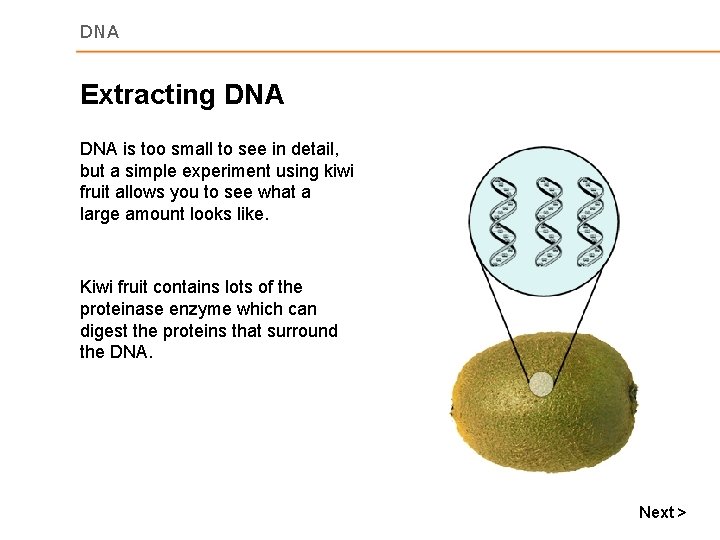
DNA Extracting DNA is too small to see in detail, but a simple experiment using kiwi fruit allows you to see what a large amount looks like. Kiwi fruit contains lots of the proteinase enzyme which can digest the proteins that surround the DNA. Next >
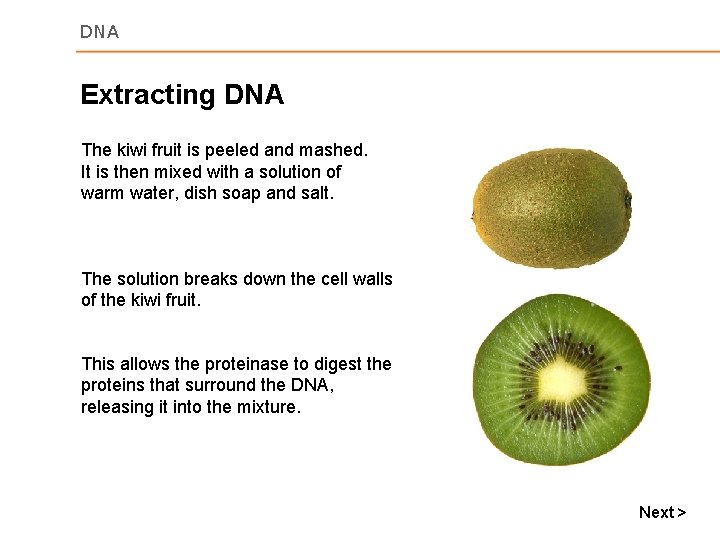
DNA Extracting DNA The kiwi fruit is peeled and mashed. It is then mixed with a solution of warm water, dish soap and salt. The solution breaks down the cell walls of the kiwi fruit. This allows the proteinase to digest the proteins that surround the DNA, releasing it into the mixture. Next >
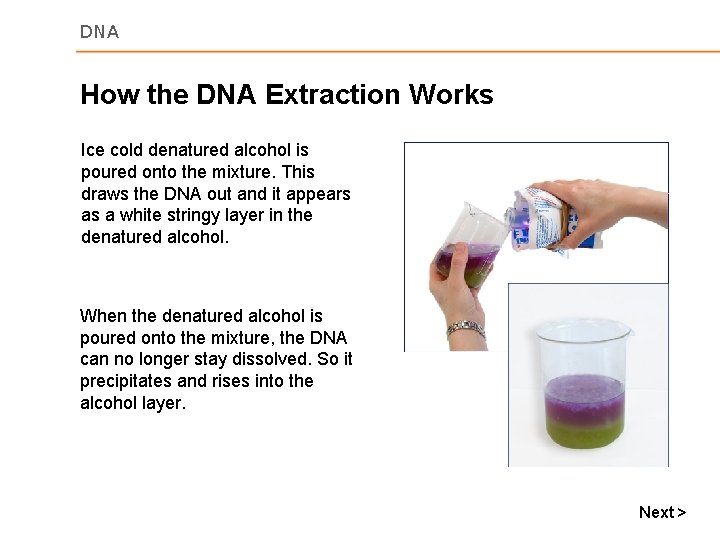
DNA How the DNA Extraction Works Ice cold denatured alcohol is poured onto the mixture. This draws the DNA out and it appears as a white stringy layer in the denatured alcohol. When the denatured alcohol is poured onto the mixture, the DNA can no longer stay dissolved. So it precipitates and rises into the alcohol layer. Next >
DNA Question 7 What is the function of using denatured alcohol during the DNA extraction? A) To mash up the kiwi fruit. B) To make the DNA precipitate from the mixture. C) To break the cell walls of the kiwi fruit. D) All of these.
DNA Summary After completing this presentation you should be able to: n identify the structure of DNA and RNA n show knowledge and understanding of the process of protein synthesis n show knowledge and understanding of how to extract DNA from fruit End >