
DNA history DNA History IIntroduction IIThe discovery DNA

- Slides: 9
DNA history
DNA History I-Introduction II-The discovery: DNA III-Time line of scientists IV-Bibliography
Introduction What is DNA? Deoxyribonucleic acid What does DNA do? the genetic instructions used in the development and functioning of all known living organisms. Of what is dna established? Double helix linked with hydrogen bonds; four bases: adenine, guanine, thymine and cytosine; These four bases are attached to the sugar/phosphate to form the complete nucleotide, as shown for adenosine monophosphate.
The discovery: DNA. The Swiss biochemist Friedrich Miescher (18441895) discovered the nucleic acids in 1868. His experiment: . He collected a lot of pus of bandages at the local hospital . He used a salt solution to wash the pus. Then he added a weak alkaline solution to the cells lysed and nuclei precipitated out of the solution . So he isolated a substance called nuclein, today called DNA
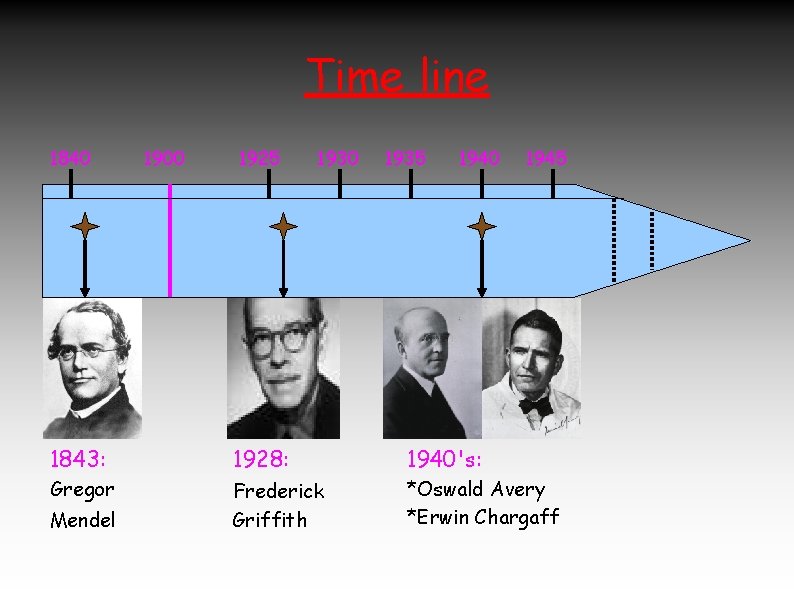
Time line 1840 1900 1925 1930 1935 1940 1945 1843: 1928: 1940's: Gregor Frederick Griffith *Oswald Avery *Erwin Chargaff Mendel
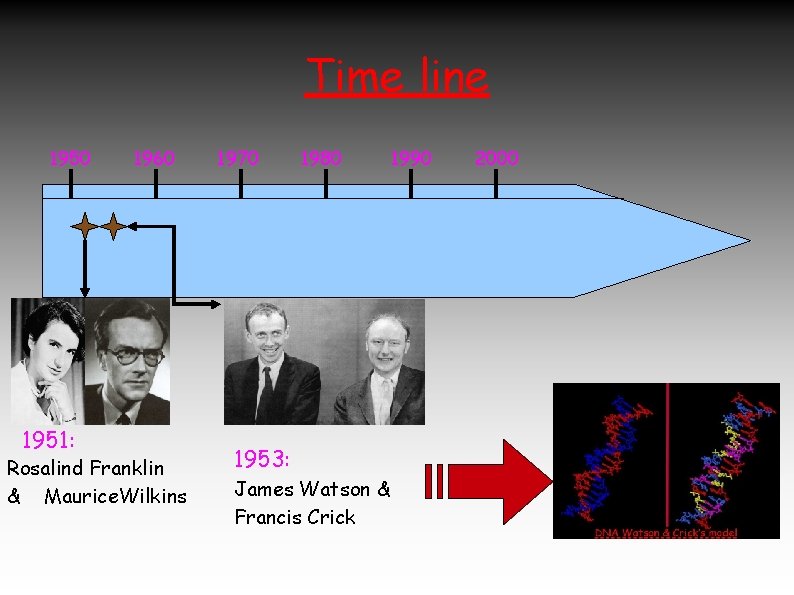
Time line 1950 1951: 1960 Rosalind Franklin & Maurice. Wilkins 1970 1980 1953: James Watson & Francis Crick 1990 2000
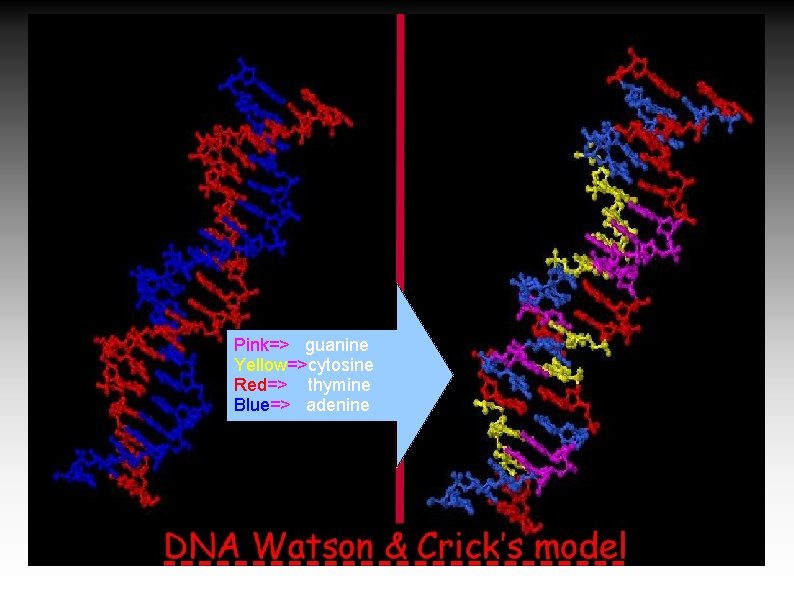
Pink=> guanine Yellow=>cytosine Red=> thymine Blue=> adenine
Bibliography *http: //en. wikipedia. org/wiki/ *http: //images. google. com/ *http: //library. thinkquest. org/
The end