
DNA Genetics Cell Division A basic unit of
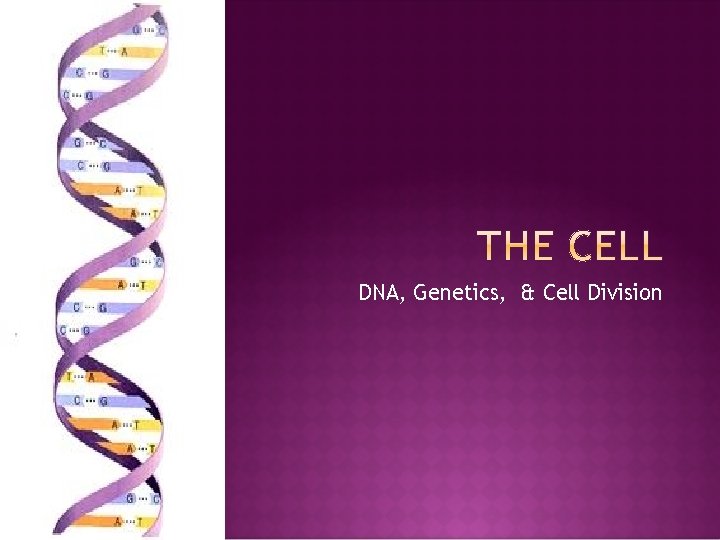
DNA, Genetics, & Cell Division
A basic unit of life for all living organisms There approx. 10 billion cells in the human body That’s 10 times more than the number of stars in the Milky Way galaxy
When the sperm fertilizes the egg, a new cell known as a zygote is created. This cell then divides several times At first all of the cells are identical During embryonic development, these cells differentiate and become specialized
The human body contains 200 different types of cells which have different shapes and functions Cells can become Skin cells Bone cells Muscle cells Nerve cells
Cell membrane Cytoplasm Nucleus
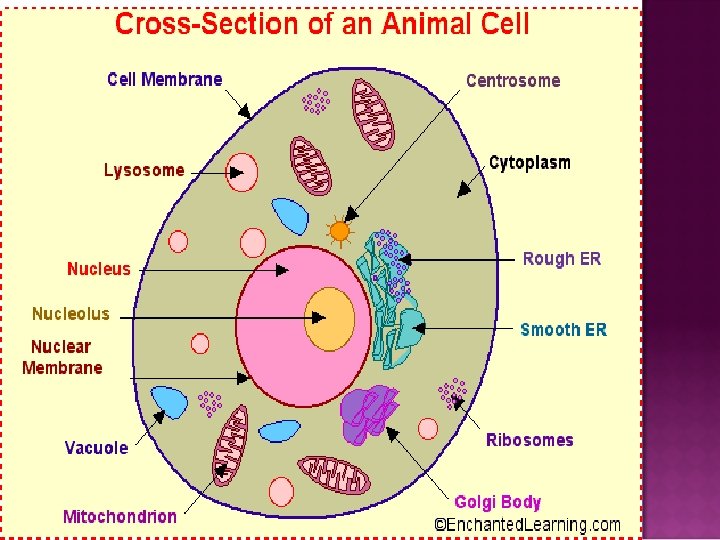
The nucleus controls the cell’s activities Growth Reproduction Manufacturing of substances Contains the cell’s genetic material DNA This genetic material is found in the form of chromosomes
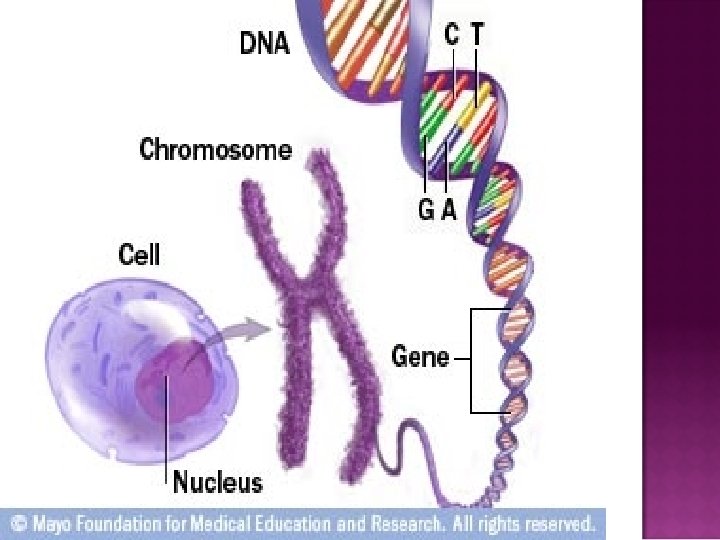
What does DNA stand for? Deoxyribonucleic acid DNA is made up nucleotides that are bonded together Nucleotides proteins are to DNA what amino acids are to
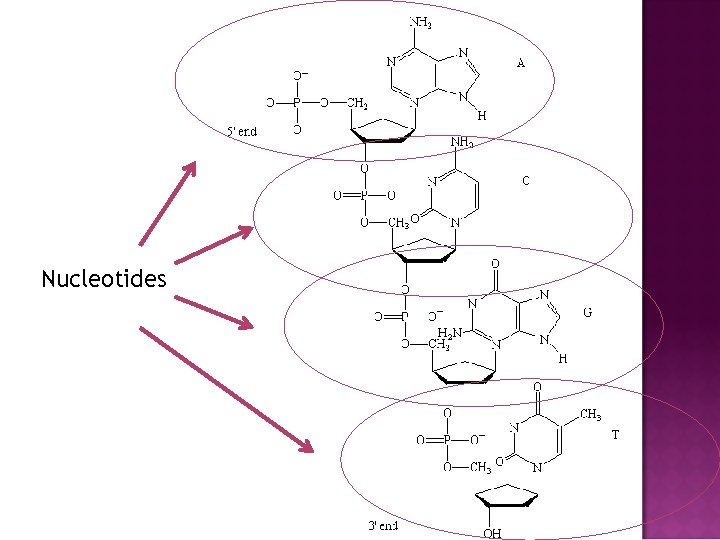
Nucleotides
Adenosine (A) Thymidine (T) Cytidine (C) Guanosine (G)
James Watson and Francis Crick in 1953 They discovered that our DNA is actually made up of two strands of nucleotides bonded together in a helical structure The nitrogenous bases are always bonded together in the same way: A with T G with C
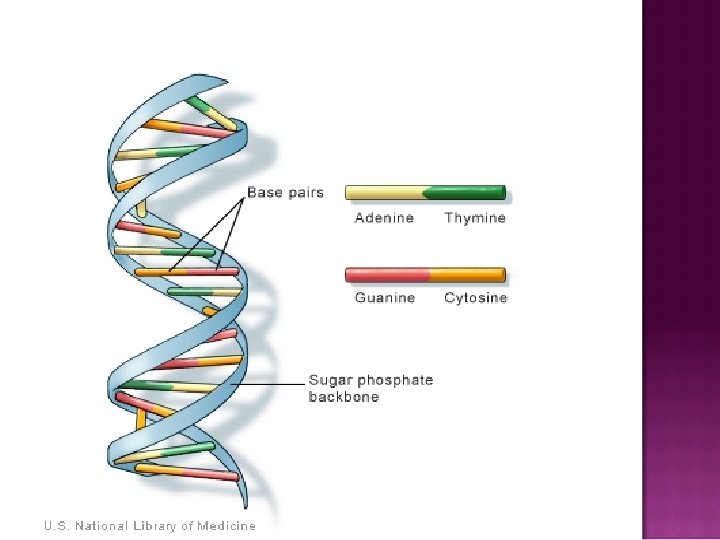
Your genetic code is determined by your unique order of nitrogenous bases One of your two strands might be ATCCCGA… Paired with (TAGGGCT) Your friend’s might be TTTCCGA… Paired with (AAAGGCT) **SHOW VIDEO “What is DNA? ”
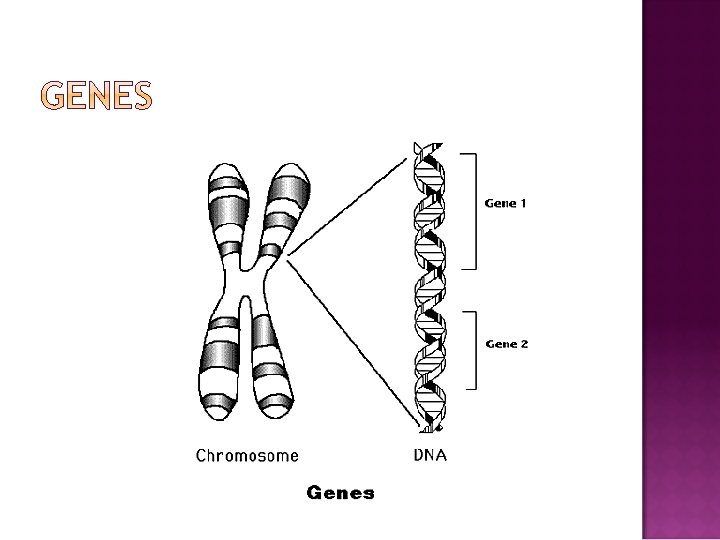
A gene is a segment of DNA that codes for the manufacturing of proteins -these substances help the cell and organism to function properly
Our entire set of genes is called the human genome (approx. 30 000 genes) All members of a species share essentially the same number of genes. However, small differences exist within genes in terms of the nitrogen bases (A, T, G, C). These differences are what makes the members of a species different from one another **watch the human genome project video
Each molecule of DNA in a cell is found in a structure called a chromosome. A human being has 23 pairs of homologous (similar) chromosomes (46 chromosomes in total) which together contain all of the DNA of that individual The reason they are in pairs is because one chromosome of each pair comes from the mom and the other comes from the dad Cells that contain 2 different types of each chromosome are known as diploid cells (the majority of human cells).
The chromosome pairs of humans are identified as follows: The first 22 pairs are called “autosomes” and are numbered from 1 -22. The last pair are known as the “sex chromosomes” Females have 2 X chromosomes (one from mom and one from dad) Males have an X and a Y (the X is from mom and the Y is from dad)
They are the homologous (similar) They are the same size and have the same appearance The only exception are the sex chromosomes The Y chromosome is smaller than the X chromosome
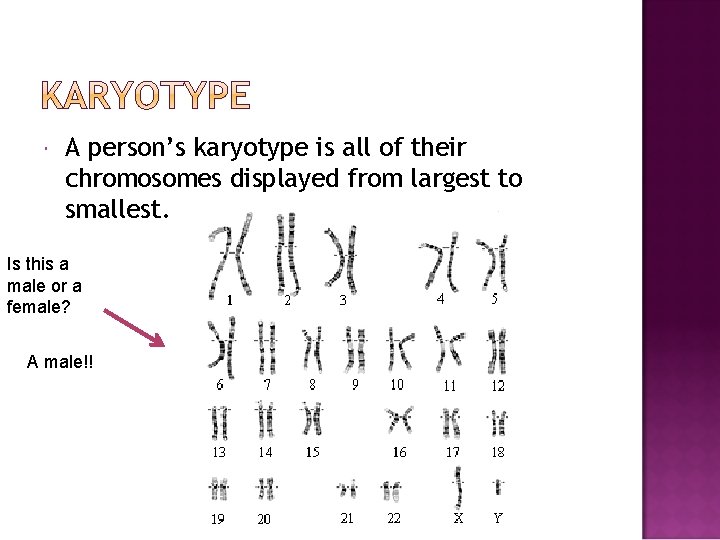
A person’s karyotype is all of their chromosomes displayed from largest to smallest. Is this a male or a female? A male!!
Cells reproduce by dividing themselves in two, also known as cell division. Cells divide to produce to new cells to ensure the growth of our tissues, in other words to replace dying cells The mother cell divides into what are called the daughter cells. In humans somatic cells divide by the process of mitosis and reproductive cells divide by the process of meiosis.
Through mitosis, 2 genetically identical somatic cells are obtained from the original mother cell. The resulting daughter cells contain the same 23 pairs of chromosomes as the mother cell from which they came.
1) The growth of the organism As a person grows from a baby they will need an increased number of cells When might mitotic activity be at its highest? Childhood and adolescence
2) Cellular regeneration In order to repair damaged tissues Some cells wear down more often than others and need to be replaced Ex. Skin cells are replaced every 2 weeks Ex. Red blood cells live for about 120 days **Some cells in the body are amitotic: they are unable to reproduce by mitosis Ex. neurons
A form of cell division that produces reproductive cells that are genetically different from the original somatic cell. Instead of having 2 pairs of each chromosome, the resulting daughter cells only have on of each chromosome. In humans, meiosis only happens in the ovaries and testicles. When a sperm cell, meets the ova and fertilization takes place, the resulting zygote has a copy of each chromosome.
The chromosome pairs we get at birth are distributed randomly during meiosis Ex. The daughter cells produced during meiosis can have various chromosomal combinations due to chance (ex. Chromosome 1, 2, and 3 from mom and chromosome, 4 and 5 from dad) The sperm and egg that meet during fertilization is random
Our various traits as humans (hair color, eye color, etc. ) are determined based on what genes we receive from mom and what we receive from dad. When we are talking about a particular trait, the genes we receive are known as alleles.
Trait: color of peas Alleles: C= green color, c= yellow color The combination of alleles (also known as genotype) that the plant has, determines the color of its peas (phenotype: how it looks).
A capital letter designates a dominant allele. As soon as one dominant allele is present in the genotype, the plant takes on the phenotype of the dominant allele. A lower-case letter designates a recessive allele. The phenotype of the recessive allele is only expressed when the plant has 2 recessive alleles.
Genotype: CC Phenotype: peas are green Genotype: Cc Phenotype: peas are green Genotype: cc Phenotype: peas are yellow
Your genotype is considered homozygous if your two alleles are the same ex. RR Your genotype is considered heterozygous if your two alleles are the different ex. Rr
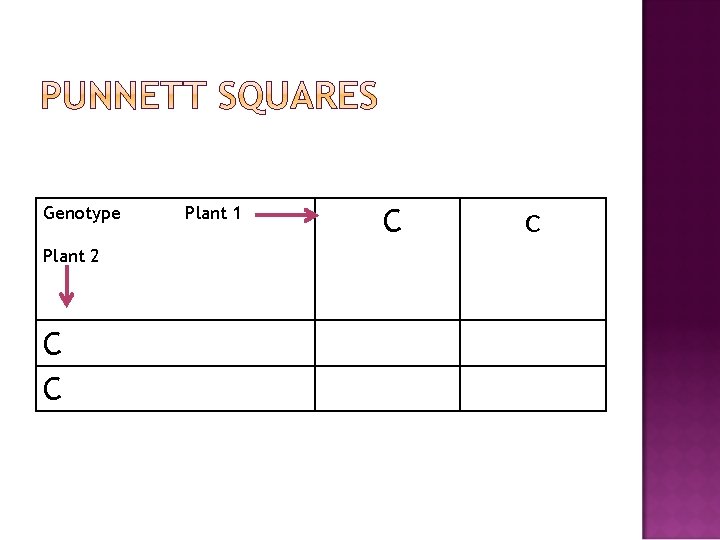
Genotype Plant 2 C C Plant 1 C c
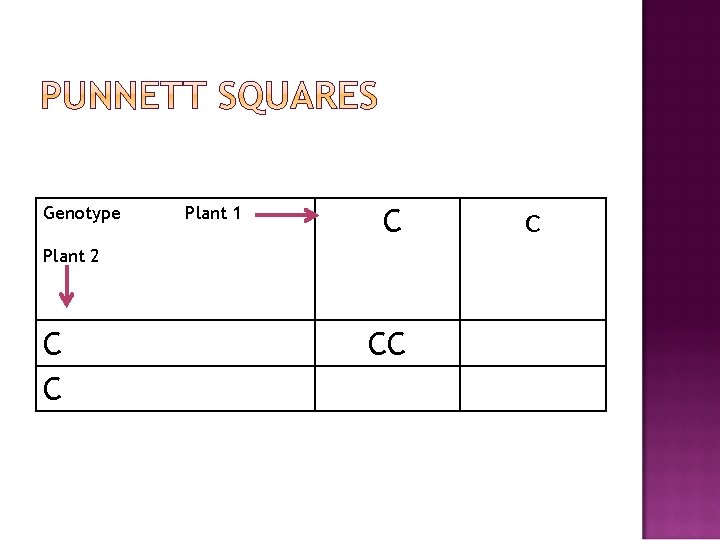
Genotype Plant 1 C Plant 2 C C CC c
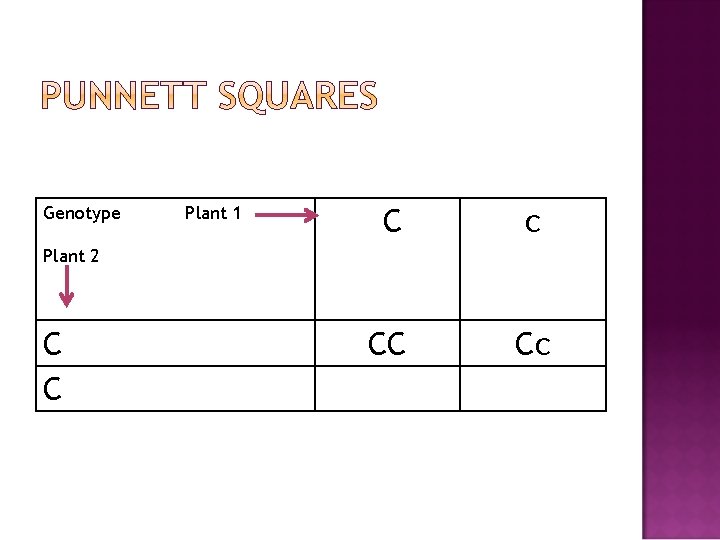
Genotype Plant 1 C c CC Cc Plant 2 C C
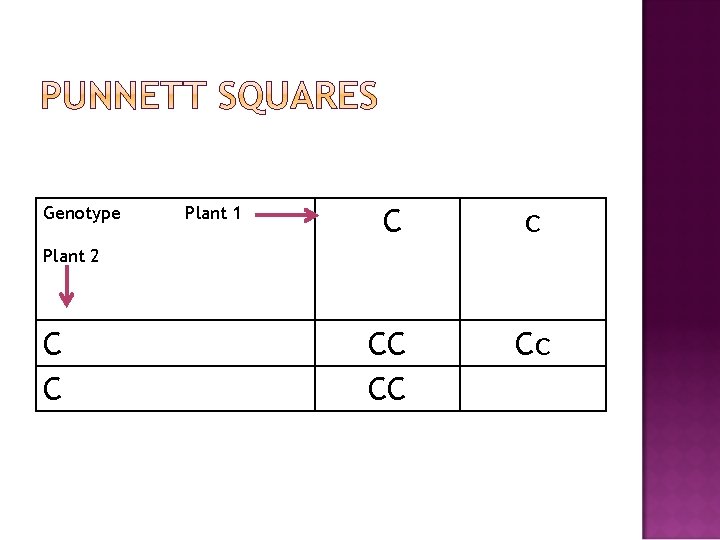
Genotype Plant 1 C c CC CC Cc Plant 2 C C
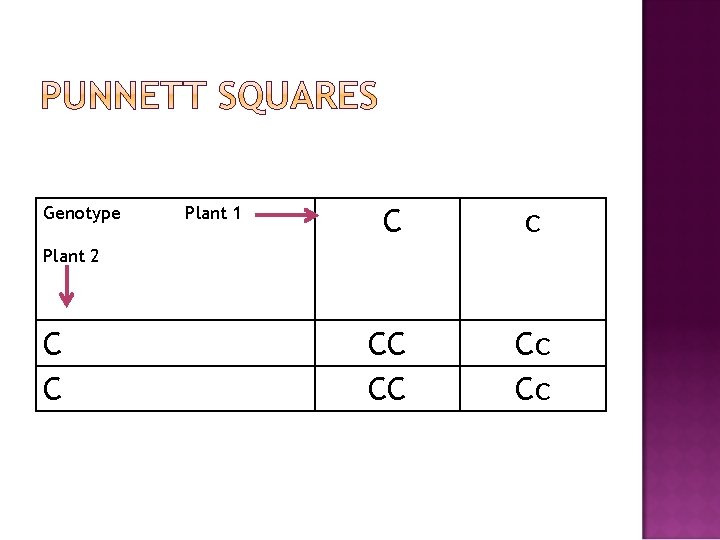
Genotype Plant 1 C c CC CC Cc Cc Plant 2 C C
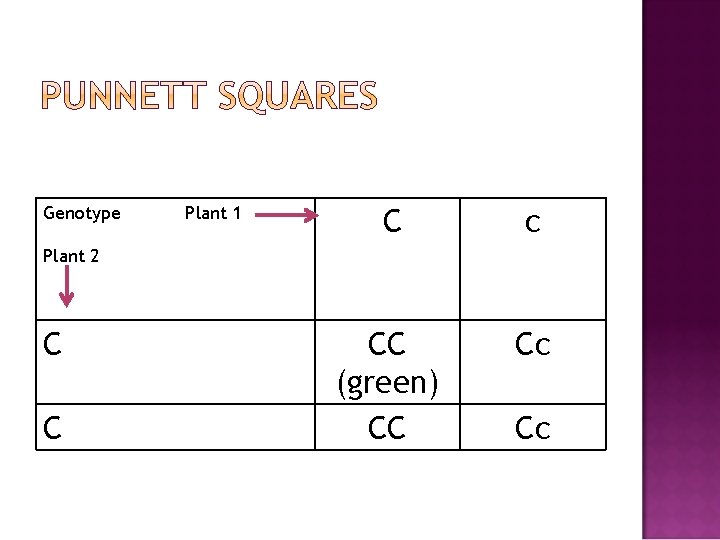
Genotype Plant 1 C c CC (green) CC Cc Plant 2 C C Cc
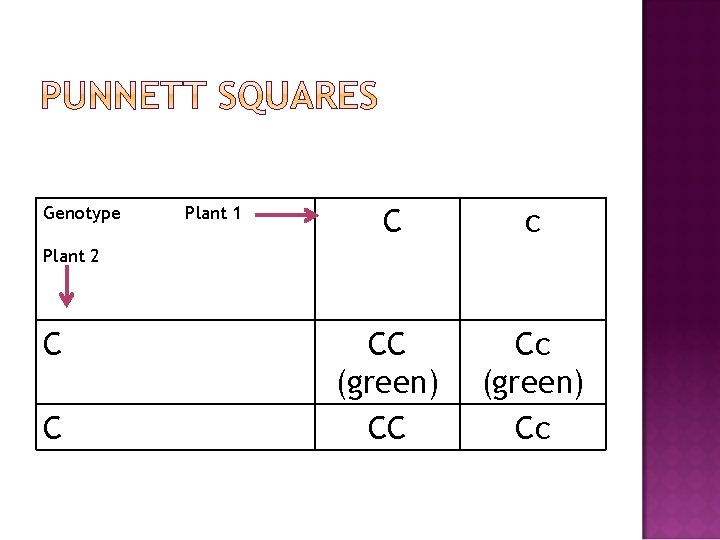
Genotype Plant 1 C c CC (green) CC Cc (green) Cc Plant 2 C C
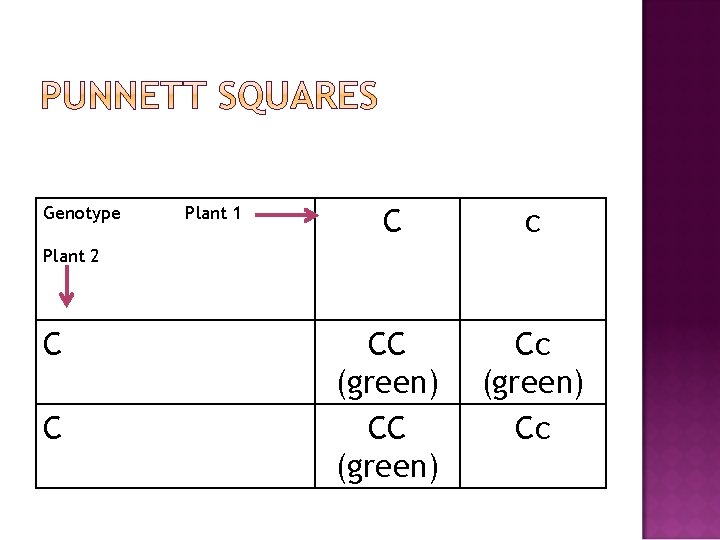
Genotype Plant 1 C c CC (green) Cc Plant 2 C C
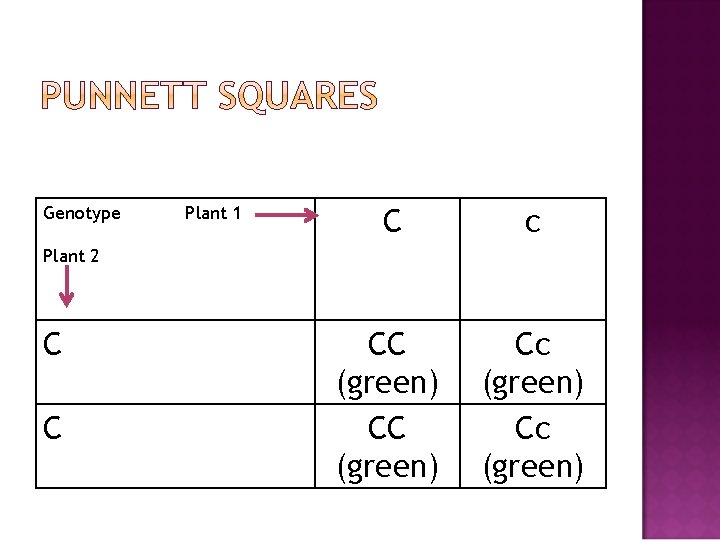
Genotype Plant 1 C c CC (green) Cc (green) Plant 2 C C
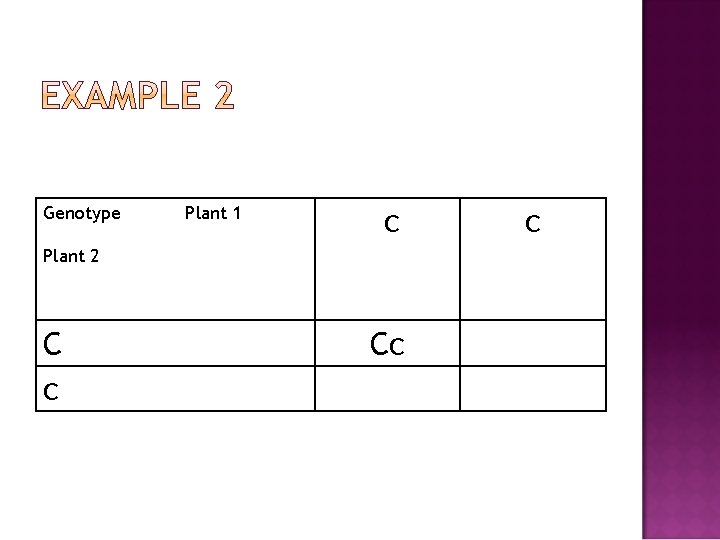
Genotype Plant 1 c Plant 2 C c Cc c
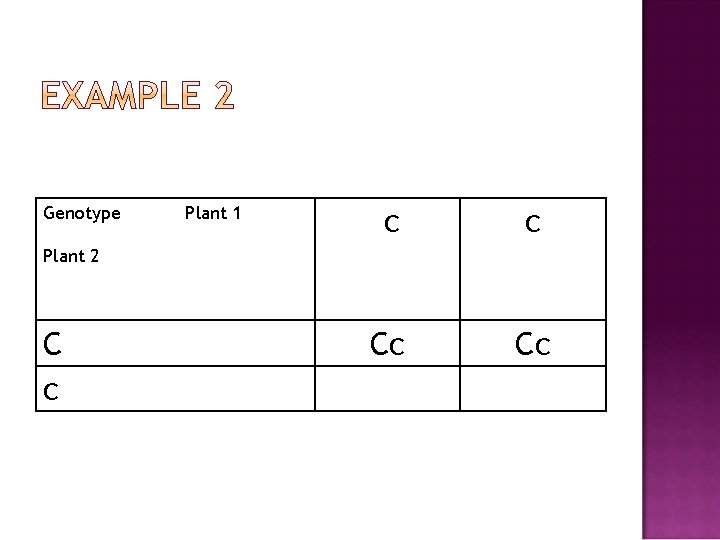
Genotype Plant 1 c c Cc Cc Plant 2 C c
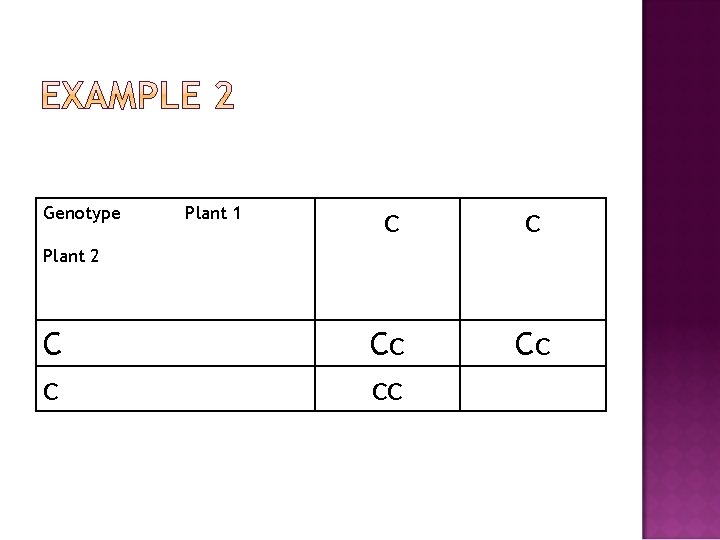
Genotype Plant 1 c c Cc cc Cc Plant 2 C c
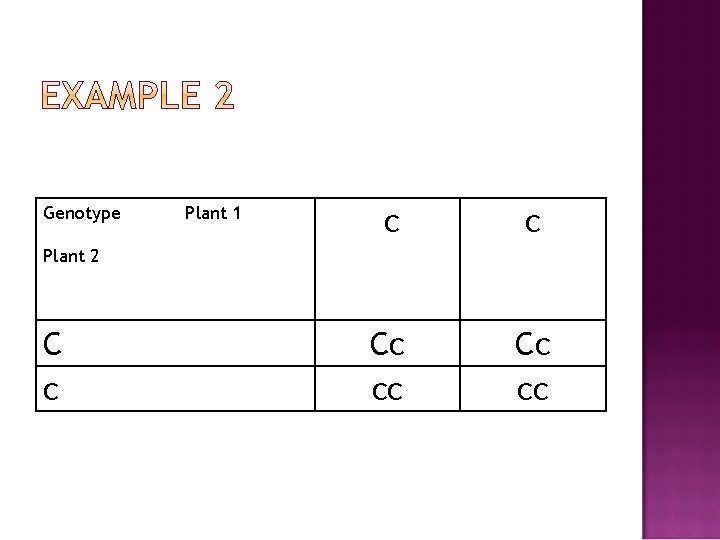
Genotype Plant 1 c c Cc cc Plant 2 C c
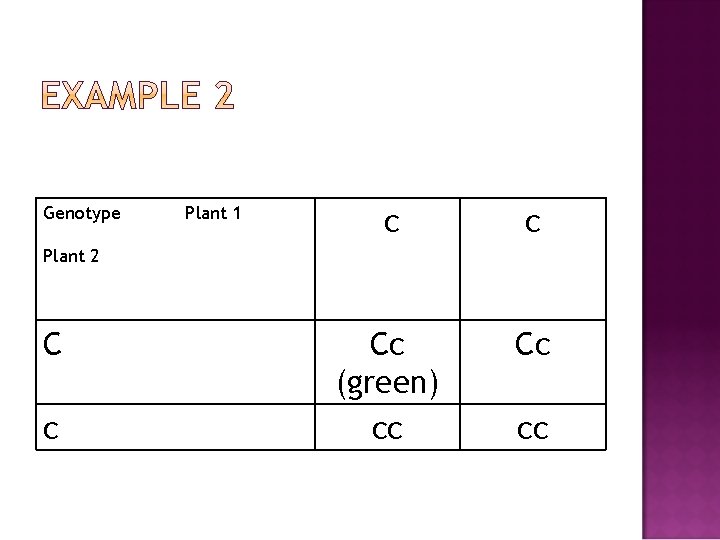
Genotype Plant 1 c c Cc (green) cc Cc Plant 2 C c cc
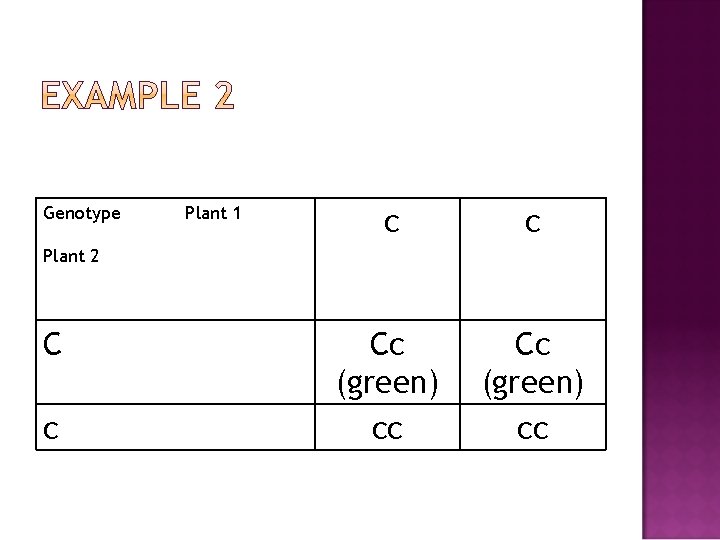
Genotype Plant 1 c c Cc (green) cc Plant 2 C c
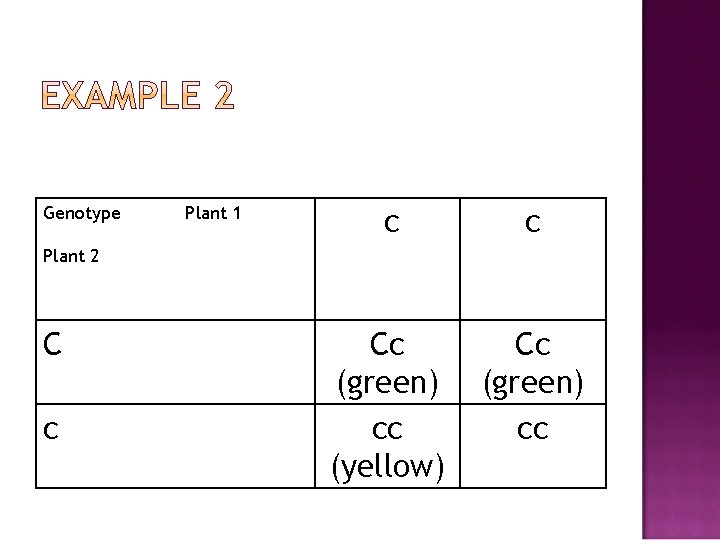
Genotype Plant 1 c c Cc (green) cc (yellow) Cc (green) cc Plant 2 C c
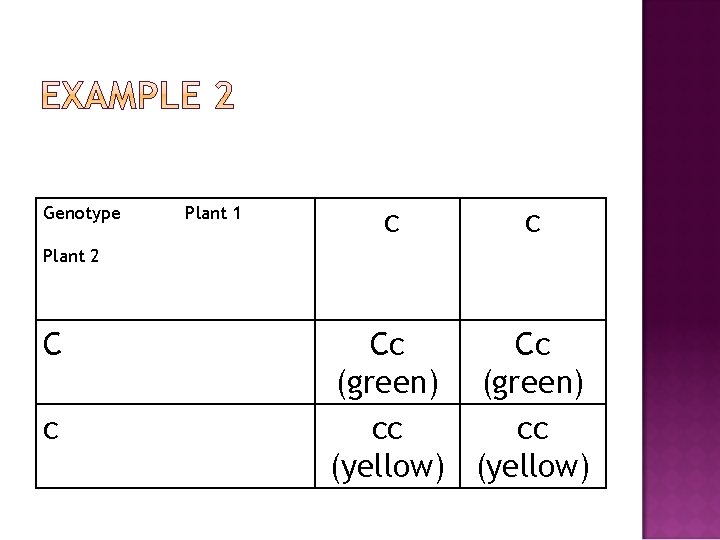
Genotype Plant 1 c c Plant 2 C c Cc Cc (green) cc cc (yellow)
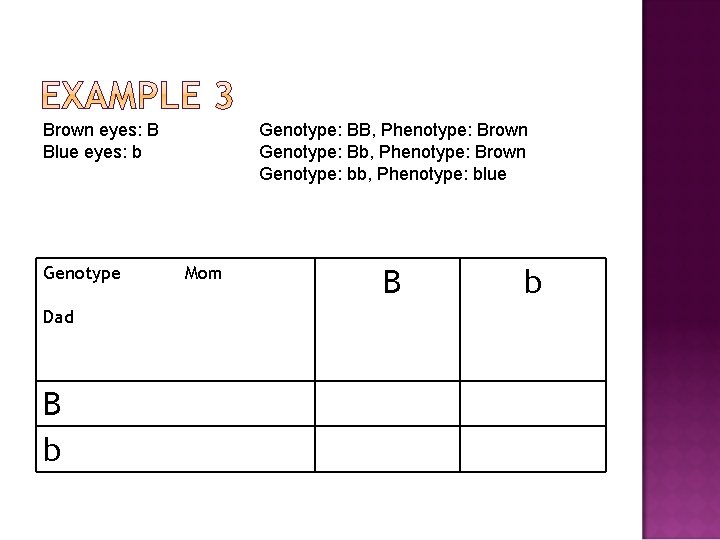
Brown eyes: B Blue eyes: b Genotype Dad B b Genotype: BB, Phenotype: Brown Genotype: Bb, Phenotype: Brown Genotype: bb, Phenotype: blue Mom B b
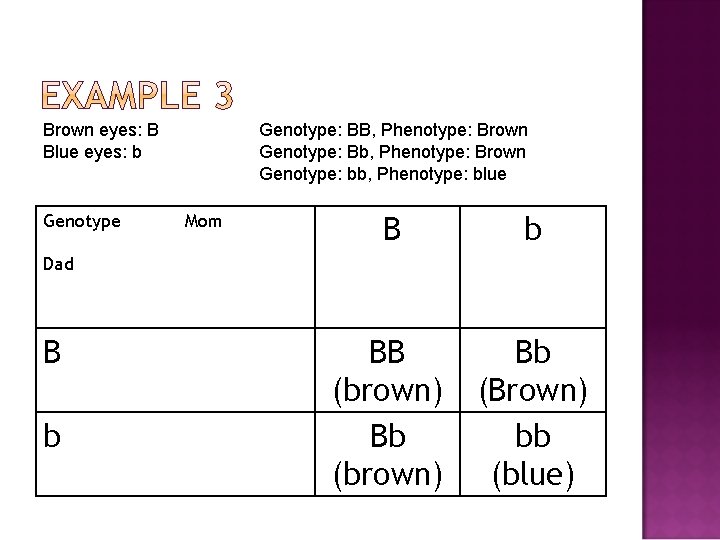
Brown eyes: B Blue eyes: b Genotype: BB, Phenotype: Brown Genotype: Bb, Phenotype: Brown Genotype: bb, Phenotype: blue Mom B b BB (brown) Bb (Brown) bb (blue) Dad B b
- Slides: 51