
DNA Filename DNA ppt Developed by D Thomas
DNA Filename DNA. ppt Developed by D. Thomas Updated Oct 1999 by H. B. Fackrell Material for Introductory Microbiology 55 -237 1 11/04/26
The quick Deoxybrown fox ribojumps over nucleic acid the lazy dog 2 11/04/26
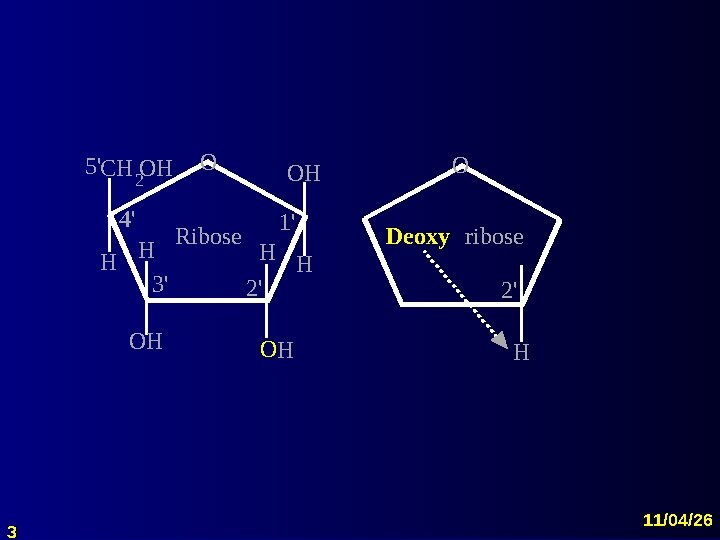
5'CH OH 2 4' H H 3' OH 3 O Ribose OH 1' H 2' OH O Deoxy ribose H 2' H 11/04/26
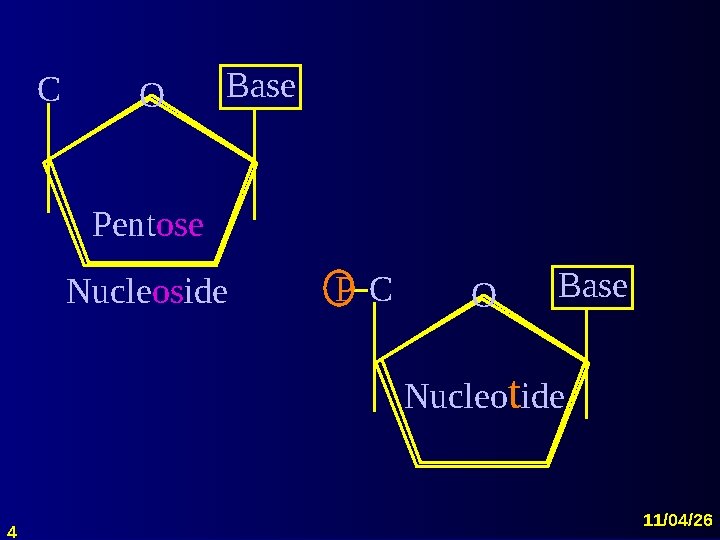
C O Base Pentose Nucleoside PC O Base Nucleotide 4 11/04/26
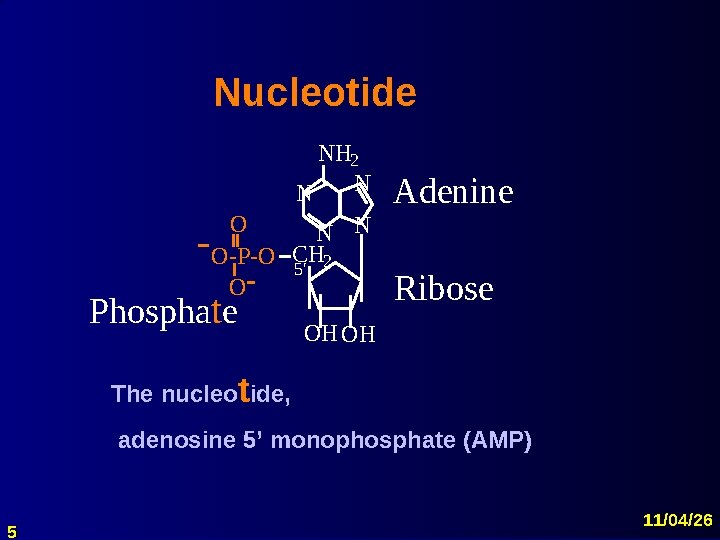
Nucleotide NH 2 N N O-P-O CH 5' 2 O Phosphate Adenine Ribose OH OH The nucleotide, adenosine 5’ monophosphate (AMP) 5 11/04/26
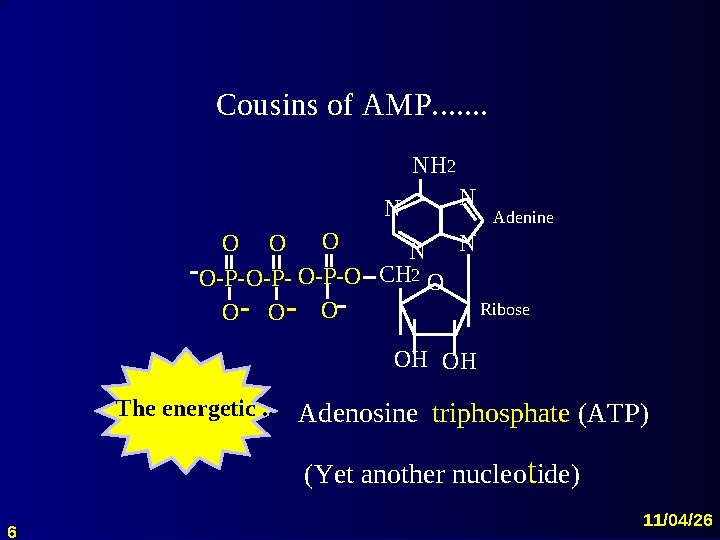
Cousins of AMP. . . . NH 2 N N Adenine O O O N N O-P-O CH 2 O Ribose O OH OH The energetic. . Adenosine triphosphate (ATP) (Yet another nucleotide) 6 11/04/26
The event of of 20 th Century biology 7 11/04/26
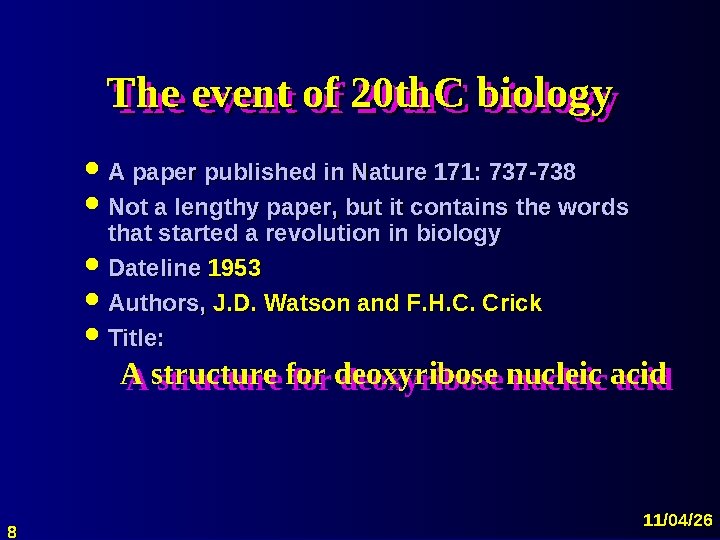
The event of of 20 th. C biology A paper published in Nature 171: 737 -738 Not a lengthy paper, but it contains the words that started a revolution in biology Dateline 1953 Authors, J. D. Watson and F. H. C. Crick Title: A A structure for deoxyribose nucleic acid 8 11/04/26
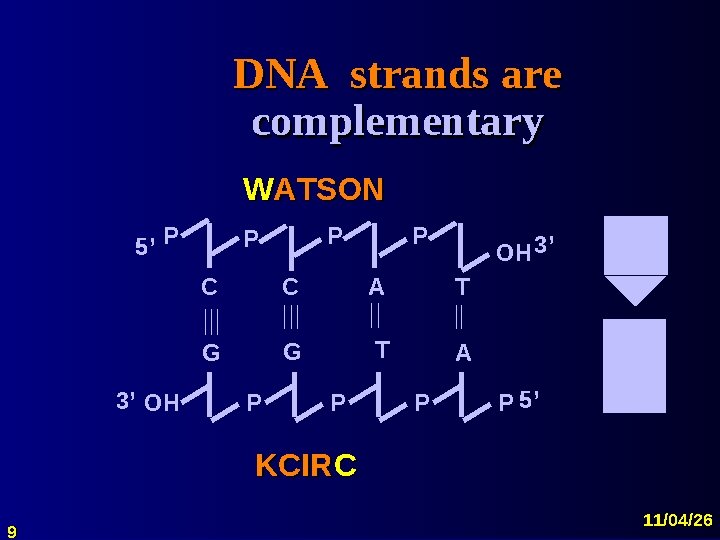
DNA strands are complementary WATSON 5’ P 3’ OH P P P OH 3’ C C A T G G T A P P 5’ KCIRC 9 11/04/26
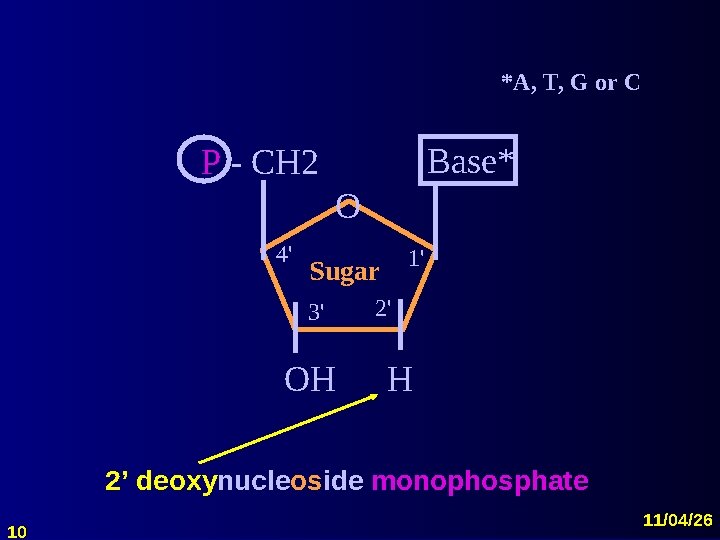
*A, T, G or C Base* P - CH 2 O 4' Sugar 1' 3' OH 2' H 2’ deoxynucleoside monophosphate 10 11/04/26
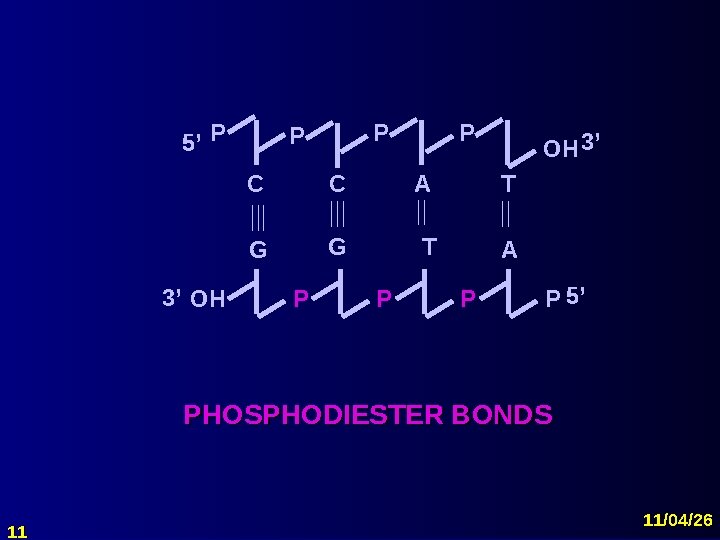
5’ P 3’ OH P P P OH 3’ C C A T G G T A P P 5’ PHOSPHODIESTER BONDS 11 11/04/26
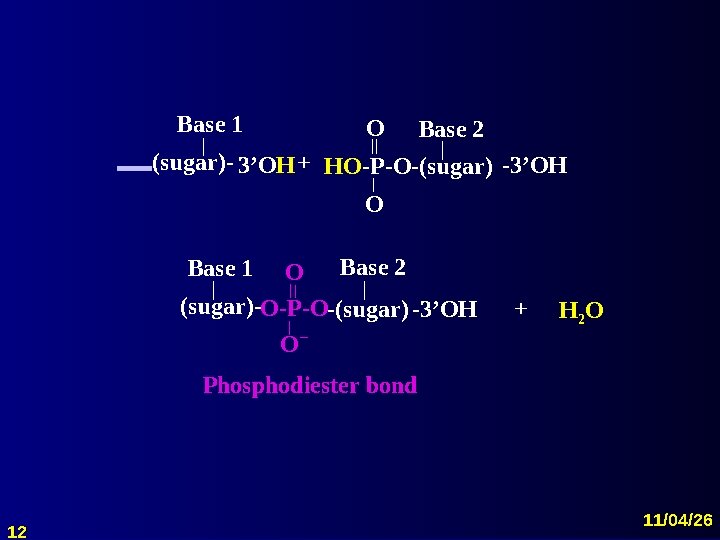
Base 1 O Base 2 (sugar)- 3’OH + HO-P-O-(sugar) -3’OH O Base 2 O (sugar)-O-P-O-(sugar) -3’OH O Base 1 + H 2 O Phosphodiester bond 12 11/04/26
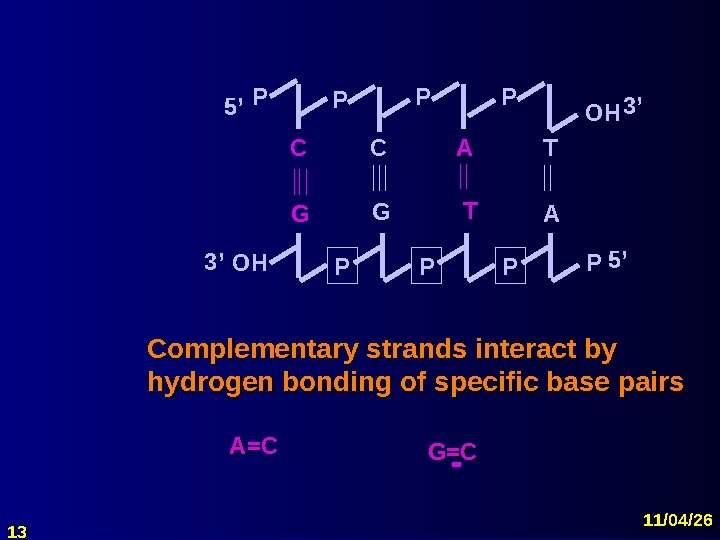
5’ P 3’ OH P P P OH 3’ C C A T G G T A P P 5’ Complementary strands interact by hydrogen bonding of specific base pairs A=C 13 G=C 11/04/26
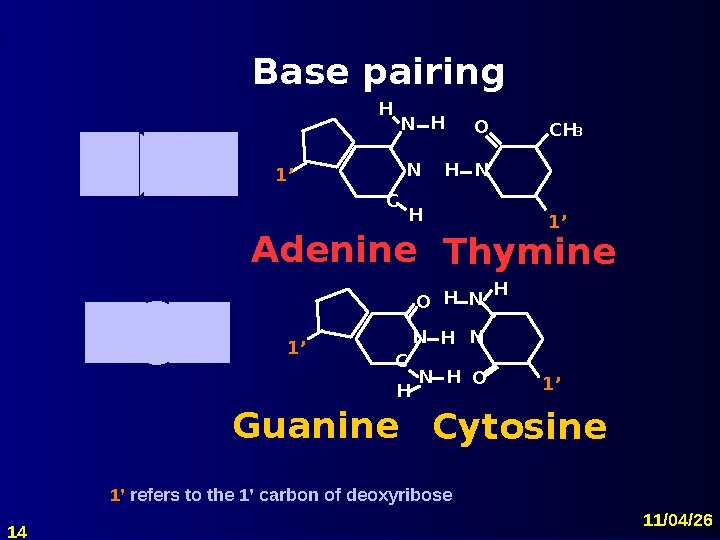
Base pairing H N 1’ C O CH 3 H N H 1’ Adenine Thymine O H N 1’ H N C H N H O 1’ Guanine Cytosine 1’ refers to the 1’ carbon of deoxyribose 14 11/04/26
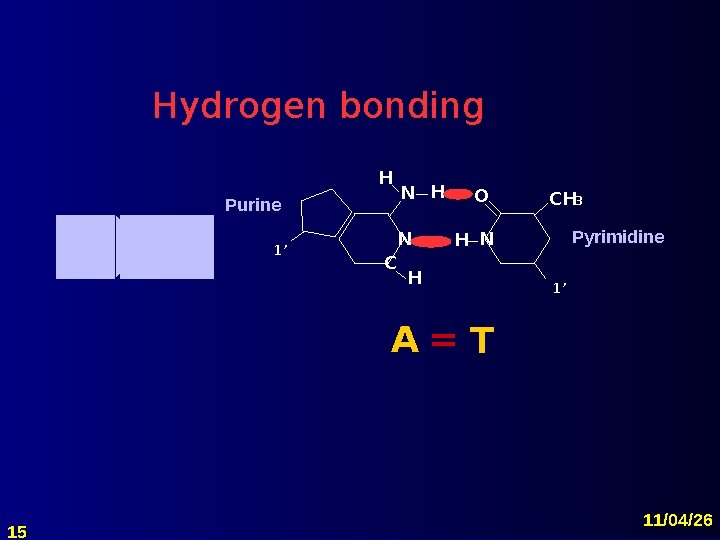
Hydrogen bonding H Purine 1’ N H N C H O CH 3 Pyrimidine H N 1’ A= T 15 11/04/26
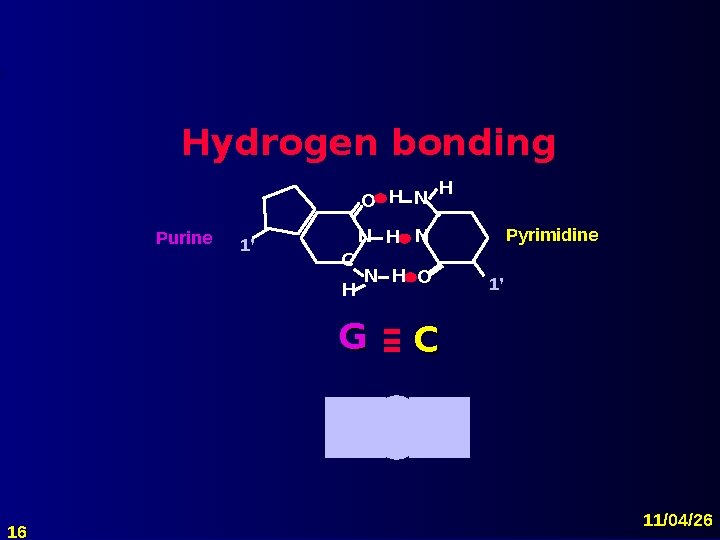
Hydrogen bonding H O H N Purine 1’ C H N H O G 16 Pyrimidine N H N 1’ C 11/04/26
In summary. . . 17 A T G C 11/04/26
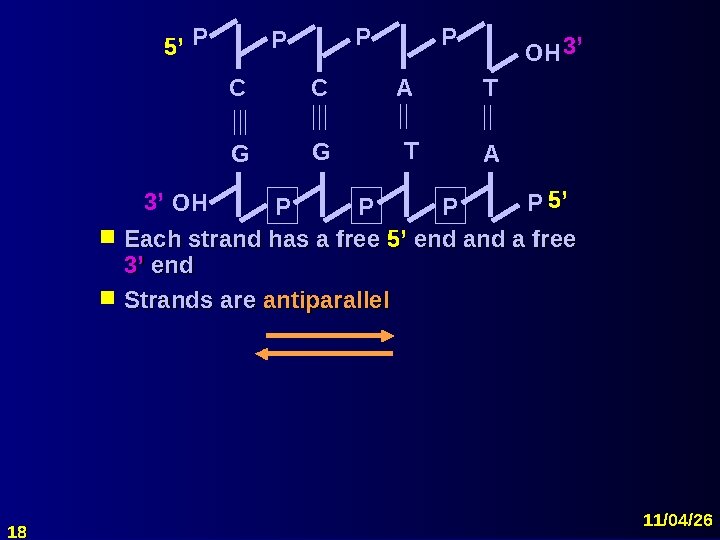
5’ P 18 P P P OH 3’ C C A T G G T A 3’ OH P 5’ P P P Each strand has a free 5’ end a free 3’ end Strands are antiparallel 11/04/26
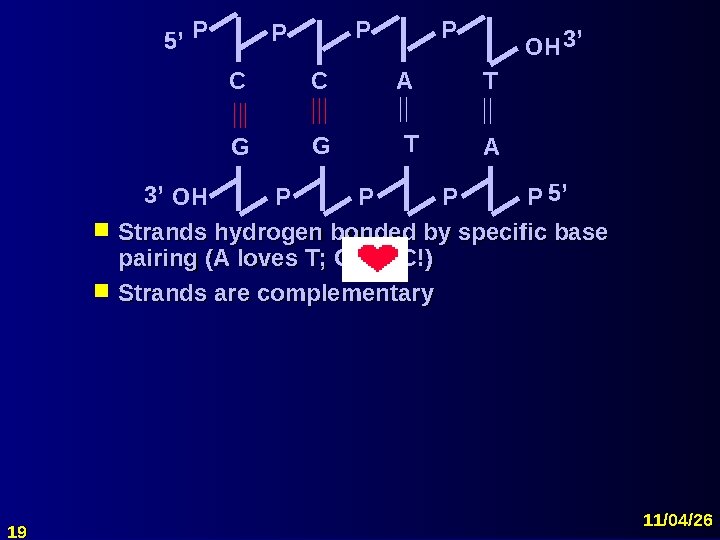
5’ P 19 P P P OH 3’ C C A T G G T A 3’ OH P P 5’ Strands hydrogen bonded by specific base pairing (A loves T; G C!) Strands are complementary 11/04/26
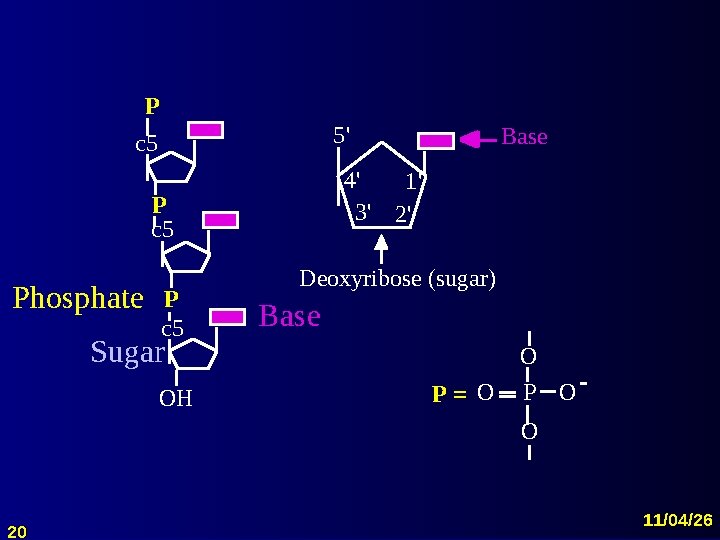
P 5' c 5 4' 1' 3' 2' P c 5 Phosphate P c 5 Base Deoxyribose (sugar) Base Sugar OH P= O O P O O 20 11/04/26
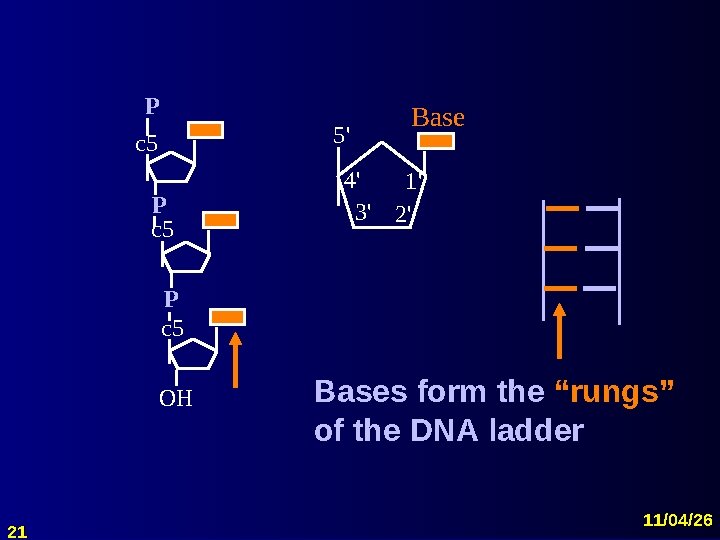
P 5' c 5 P c 5 Base 4' 1' 3' 2' P c 5 OH 21 Bases form the “rungs” of the DNA ladder 11/04/26
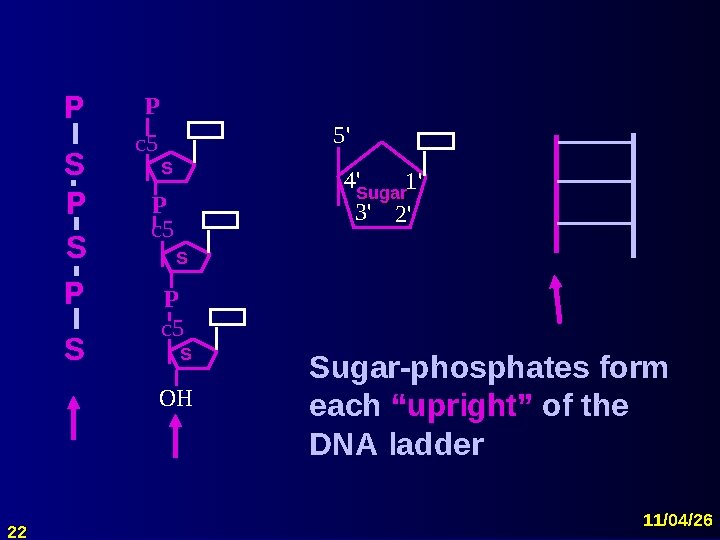
P S P S P 5' c 5 S 4'Sugar 1' 3' 2' P c 5 S OH 22 Sugar-phosphates form each “upright” of the DNA ladder 11/04/26
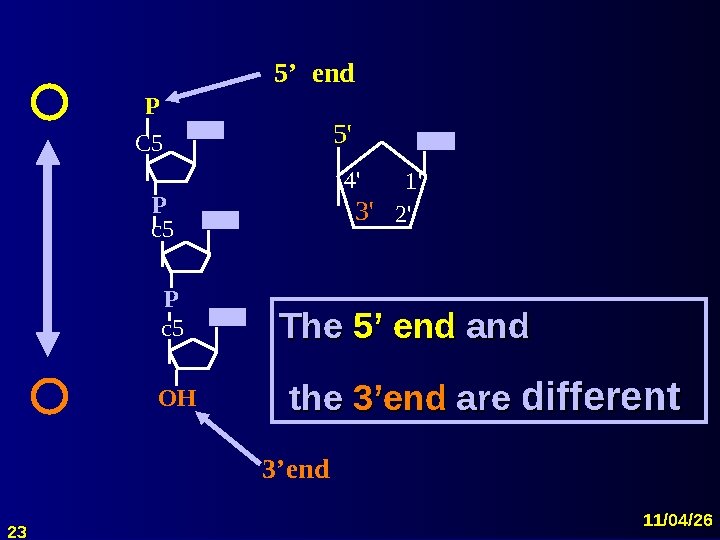
5’ end P 5' C 5 4' 1' 3' 2' P c 5 OH The 5’ end and the 3’end are different 3’end 23 11/04/26
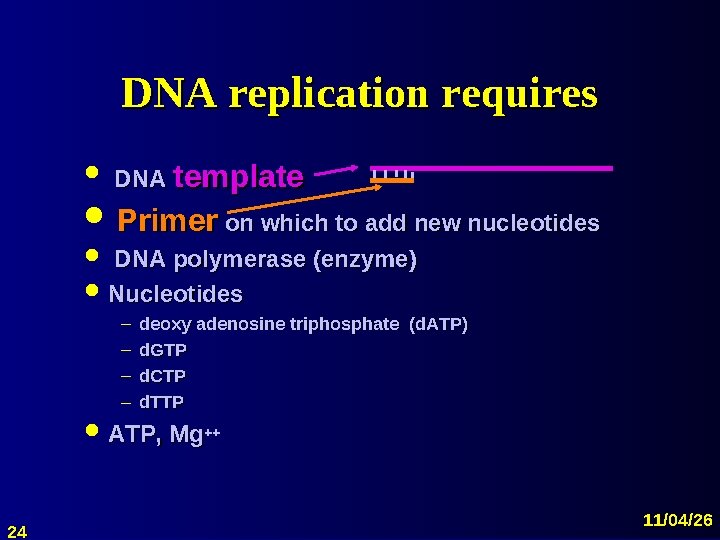
DNA replication requires DNA template Primer on which to add new nucleotides DNA polymerase (enzyme) Nucleotides – – 24 deoxy adenosine triphosphate (d. ATP) d. GTP d. CTP d. TTP ATP, Mg++ 11/04/26
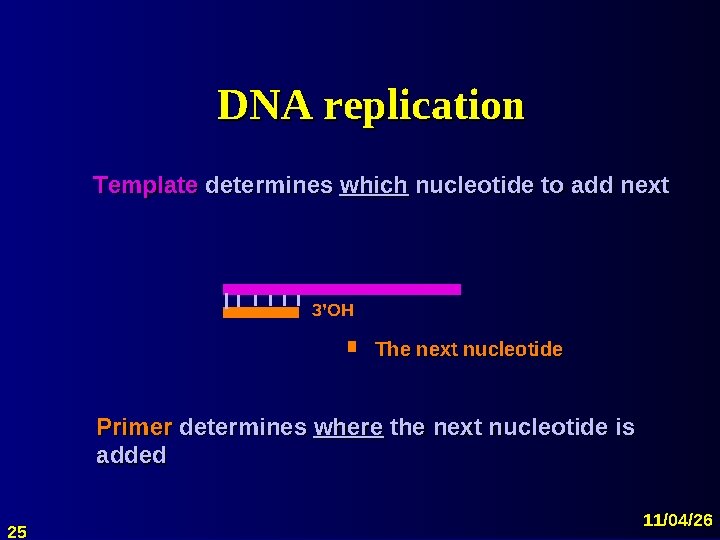
DNA replication Template determines which nucleotide to add next 3’OH The next nucleotide Primer determines where the next nucleotide is added 25 11/04/26
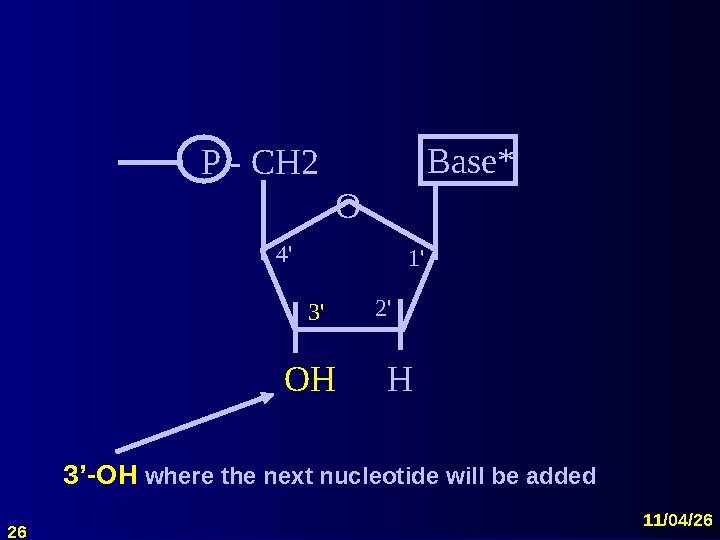
Base* P - CH 2 O 4' 1' 3' OH 2' H 3’-OH where the next nucleotide will be added 26 11/04/26
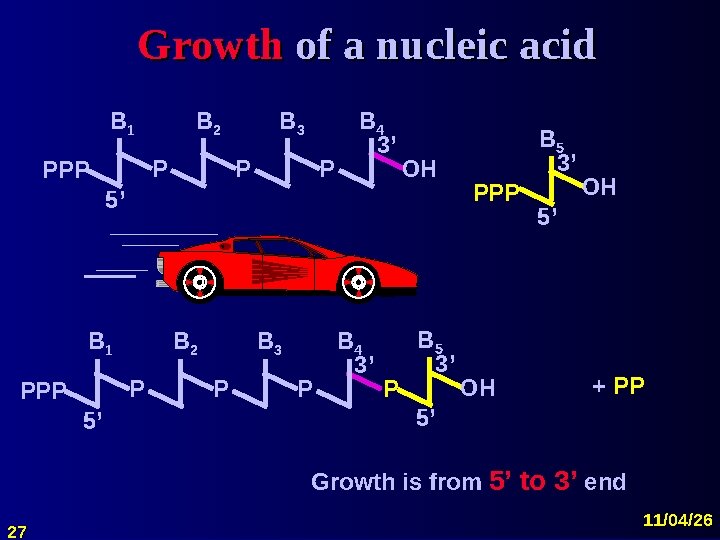
Growth of a nucleic acid B 1 B 2 P PPP B 3 P P B 4 3’ OH 5’ B 1 B 2 P PPP 5’ B 3 P P B 4 3’ P B 5 3’ PPP OH OH 5’ + PP 5’ Growth is from 5’ to 3’ end 27 11/04/26
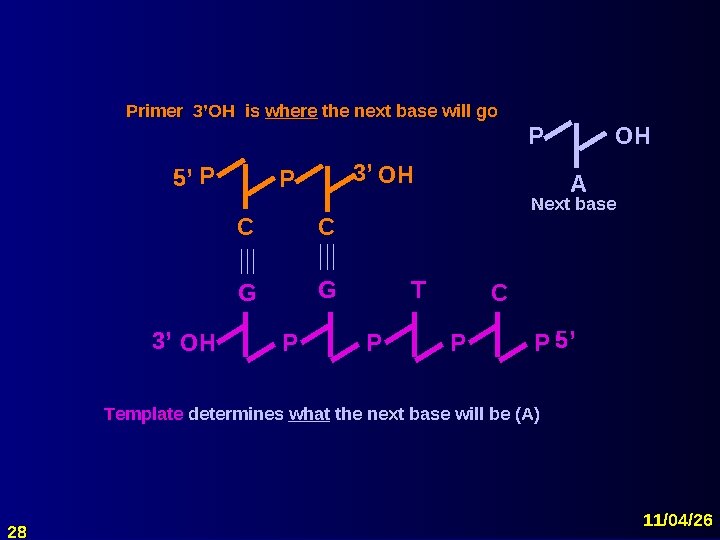
Primer 3’OH is where the next base will go P 5’ P 3’ OH P C C G G P OH A Next base T P C P P 5’ Template determines what the next base will be (A) 28 11/04/26
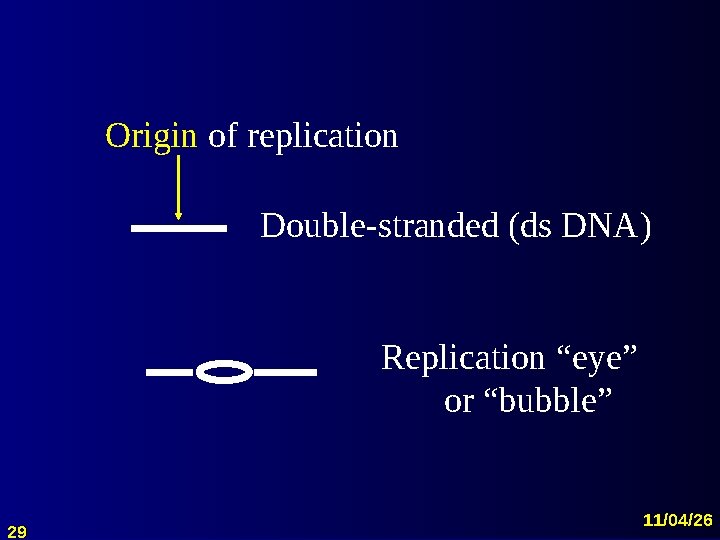
Origin of replication Double-stranded (ds DNA) Replication “eye” or “bubble” 29 11/04/26
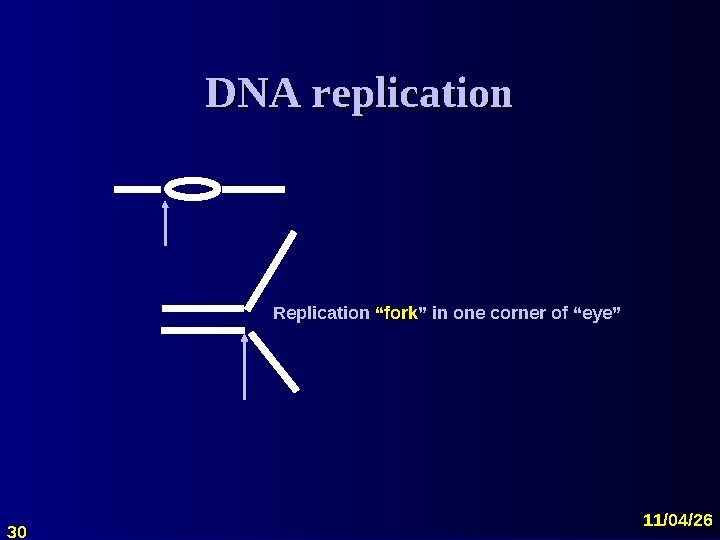
DNA replication Replication “fork” in one corner of “eye” 30 11/04/26
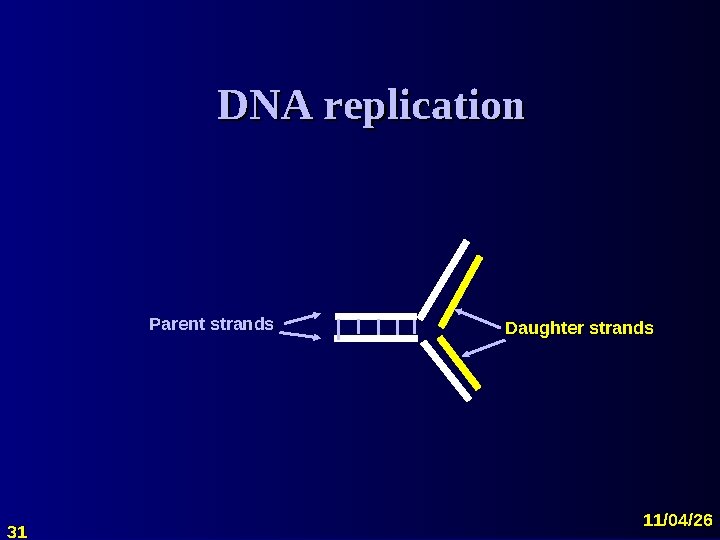
DNA replication Parent strands 31 Daughter strands 11/04/26
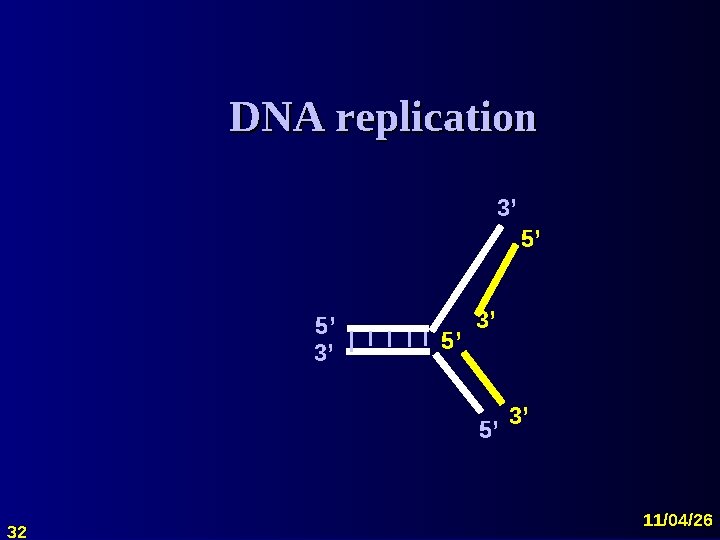
DNA replication 3’ 5’ 5’ 3’ 5’ 32 3’ 11/04/26
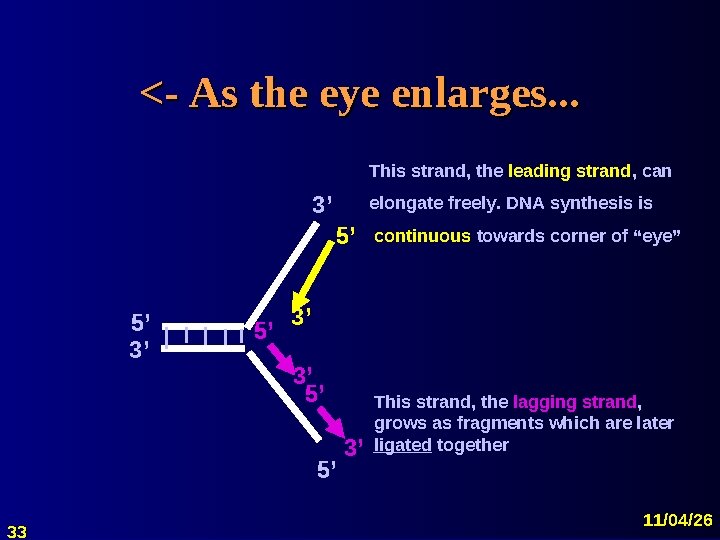
<- As the eye enlarges. . . This strand, the leading strand, can 3’ elongate freely. DNA synthesis is 5’ 5’ 3’ 3’ 5’ 5’ 33 continuous towards corner of “eye” 3’ This strand, the lagging strand, grows as fragments which are later ligated together 11/04/26
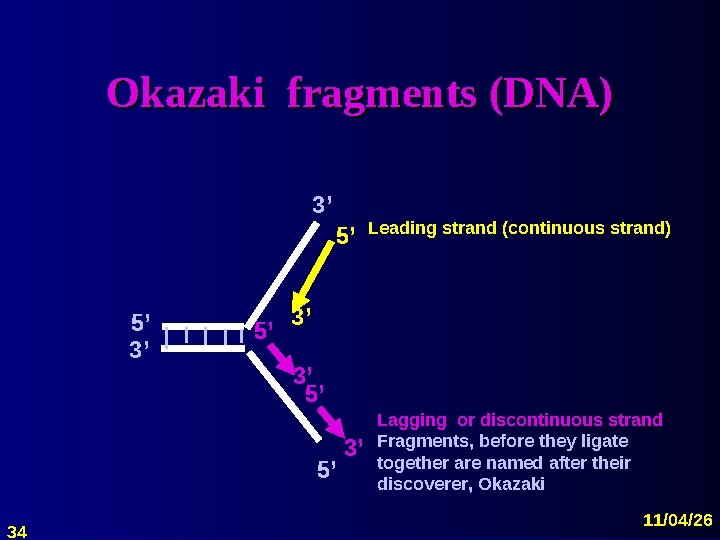
Okazaki fragments (DNA) 3’ 5’ 5’ 3’ 3’ 5’ 5’ 34 Leading strand (continuous strand) 3’ Lagging or discontinuous strand Fragments, before they ligate together are named after their discoverer, Okazaki 11/04/26
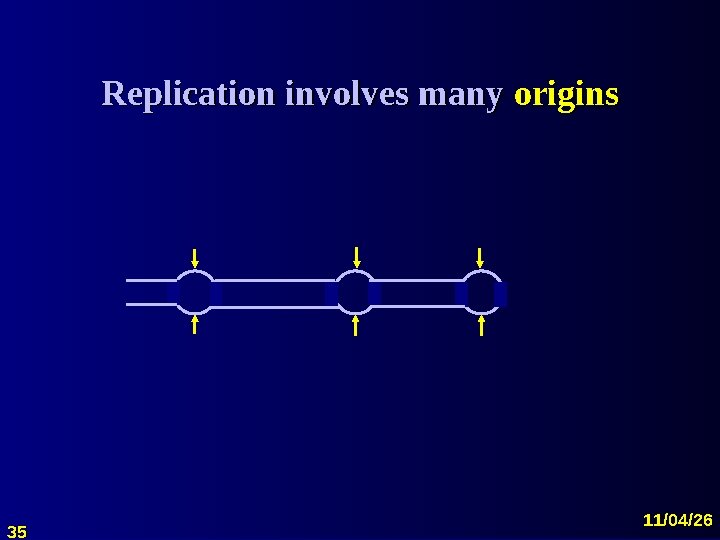
Replication involves many origins 35 11/04/26
Replication of DNA needs several enzymes 36 Helicase (to unwind the alpha helix) Primase (to build RNA primer segments) DNA polymerase (to extend primers, and more) DNA ligase (to link together the ends of adjacent DNA fragments 11/04/26
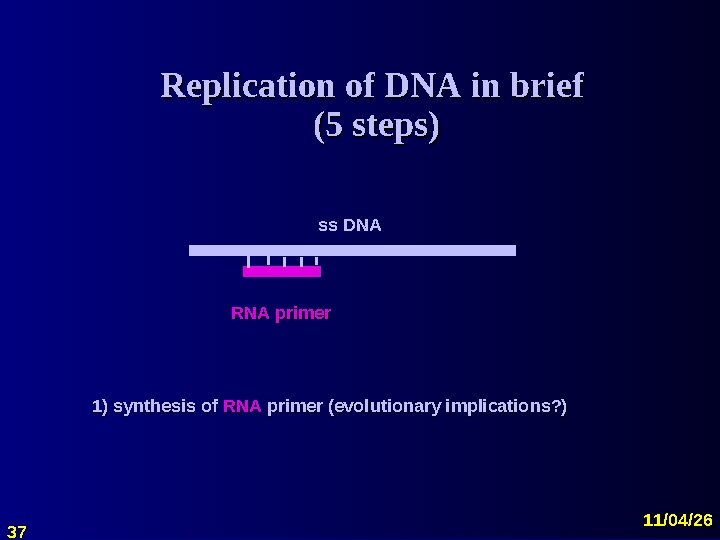
Replication of DNA in brief (5 steps) ss DNA RNA primer 1) synthesis of RNA primer (evolutionary implications? ) 37 11/04/26
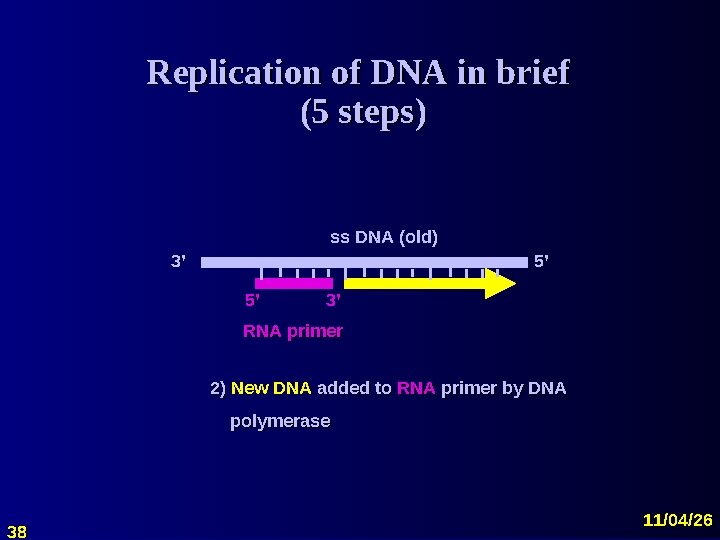
Replication of DNA in brief (5 steps) ss DNA (old) 3’ 5’ 5’ 3’ RNA primer 2) New DNA added to RNA primer by DNA polymerase 38 11/04/26
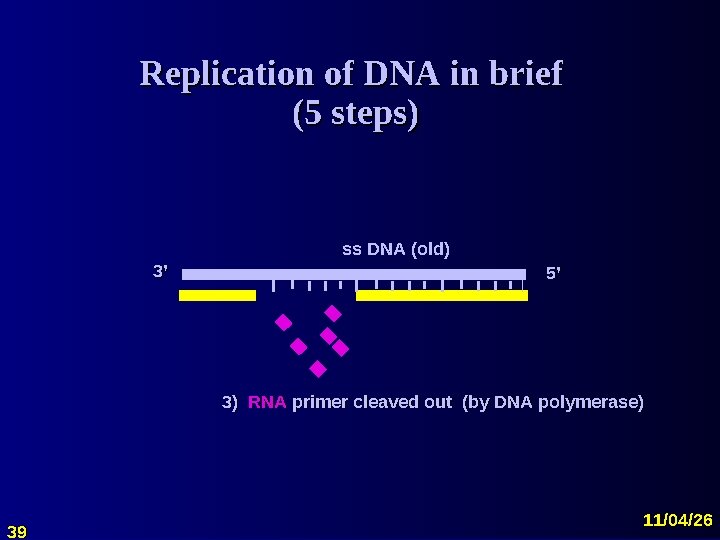
Replication of DNA in brief (5 steps) ss DNA (old) 3’ 5’ 3) RNA primer cleaved out (by DNA polymerase) 39 11/04/26
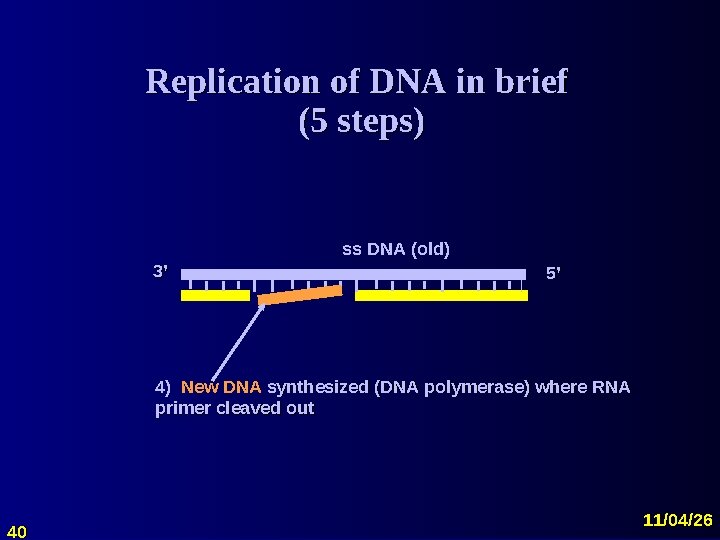
Replication of DNA in brief (5 steps) ss DNA (old) 3’ 5’ 4) New DNA synthesized (DNA polymerase) where RNA primer cleaved out 40 11/04/26
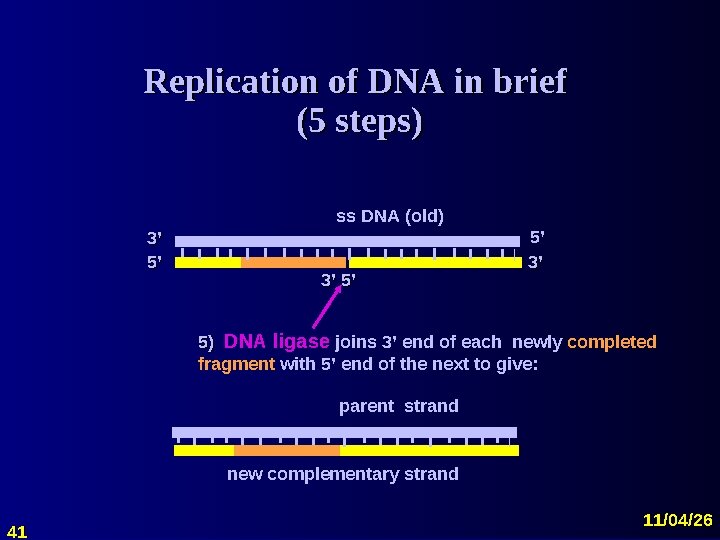
Replication of DNA in brief (5 steps) ss DNA (old) 3’ 5’ 5’ 3’ 5) DNA ligase joins 3’ end of each newly completed fragment with 5’ end of the next to give: parent strand new complementary strand 41 11/04/26
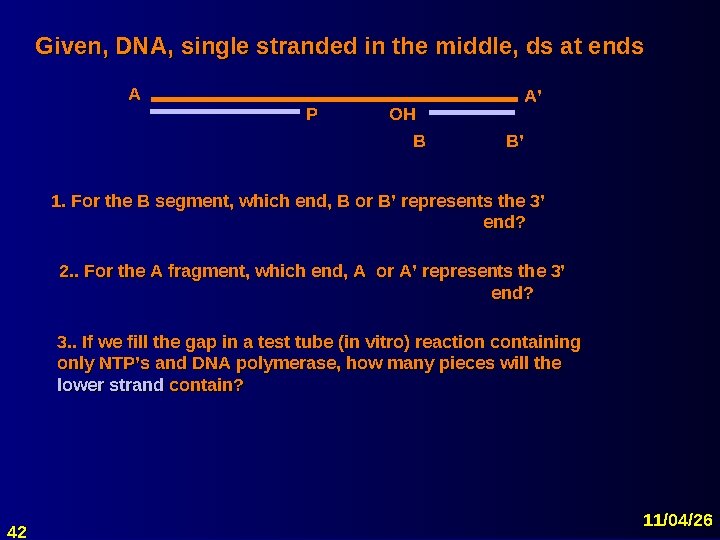
Given, DNA, single stranded in the middle, ds at ends A P OH B A’ B’ 1. For the B segment, which end, B or B’ represents the 3’ end? 2. . For the A fragment, which end, A or A’ represents the 3’ end? 3. . If we fill the gap in a test tube (in vitro) reaction containing only NTP’s and DNA polymerase, how many pieces will the lower strand contain? 42 11/04/26
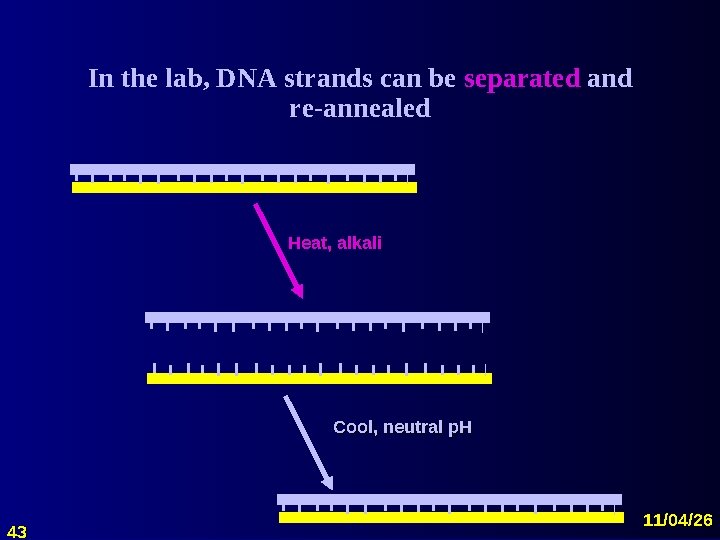
In the lab, DNA strands can be separated and re-annealed Heat, alkali Cool, neutral p. H 43 11/04/26
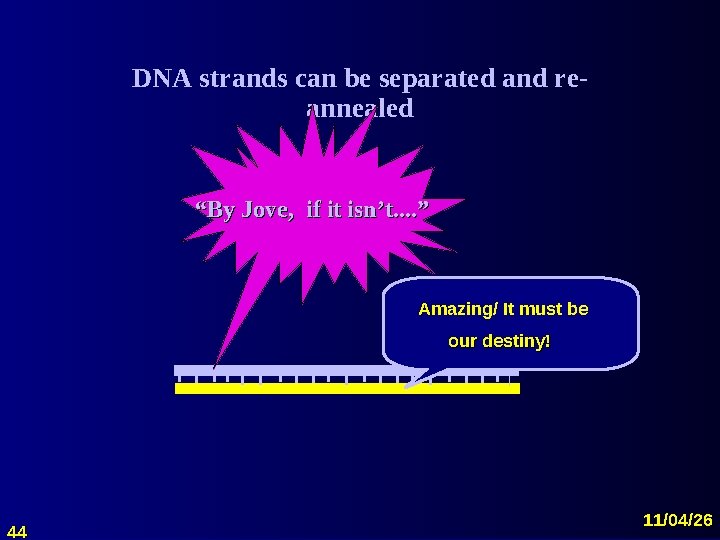
DNA strands can be separated and reannealed “By Jove, if it isn’t. . ” Amazing/ It must be our destiny! 44 11/04/26
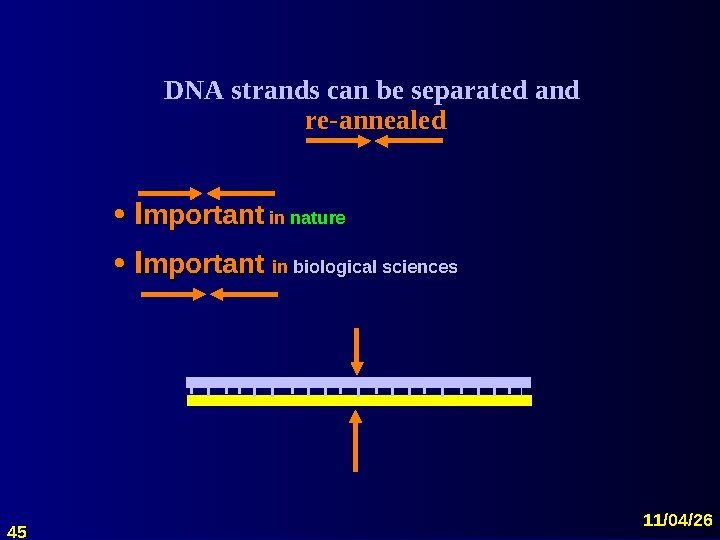
DNA strands can be separated and re-annealed • Important in nature • Important in biological sciences 45 11/04/26
The qui. Ck jumps over brown fox The l. Azy do. G 46 11/04/26
- Slides: 46