
DNA Drill What does DNA stand for and


- Slides: 32
DNA Drill What does DNA stand for and state its importance? Who discovered DNA & when? Who is the father of genetics? State his three laws.
Drill • Name sources of biological evidence. • Explain junk DNA. • How are VNTR’s differ from STR’s?
DNA Fingerprinting
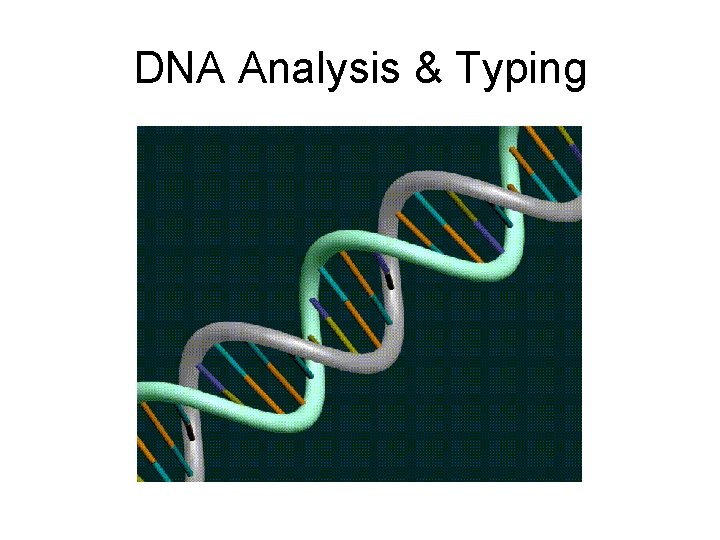
DNA Analysis & Typing
DNA Analysis All living things have genetic material that is. Found in the eukaryotic organisms. of
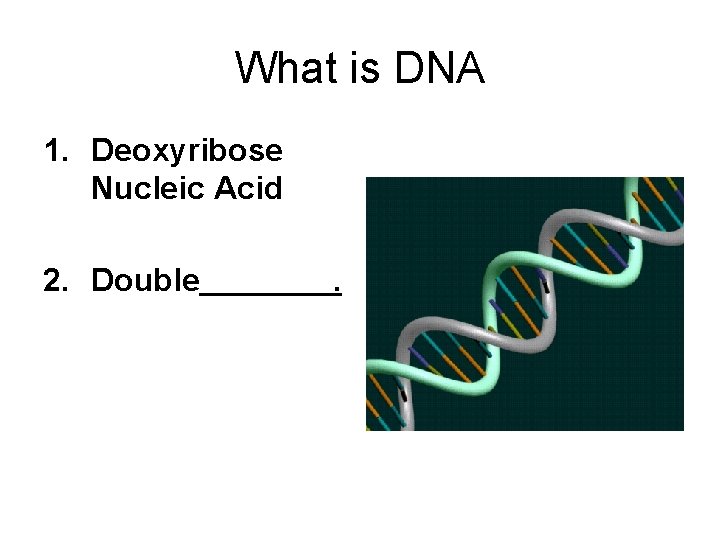
What is DNA 1. Deoxyribose Nucleic Acid 2. Double .
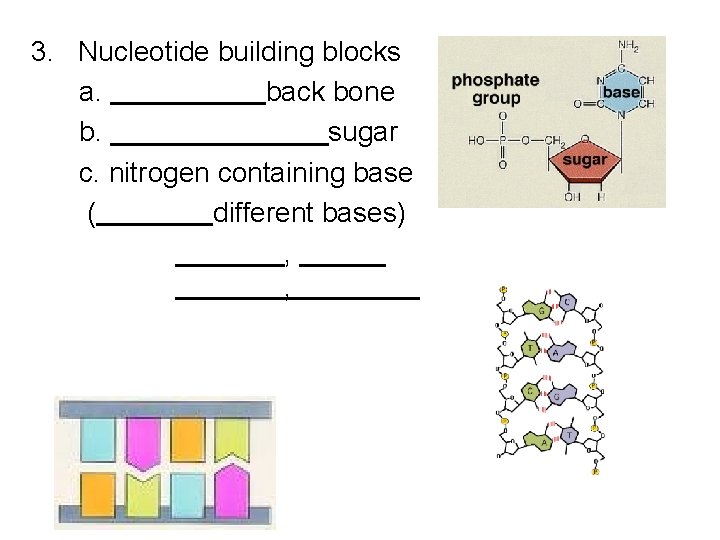
3. Nucleotide building blocks a. back bone b. sugar c. nitrogen containing base ( different bases) , , .
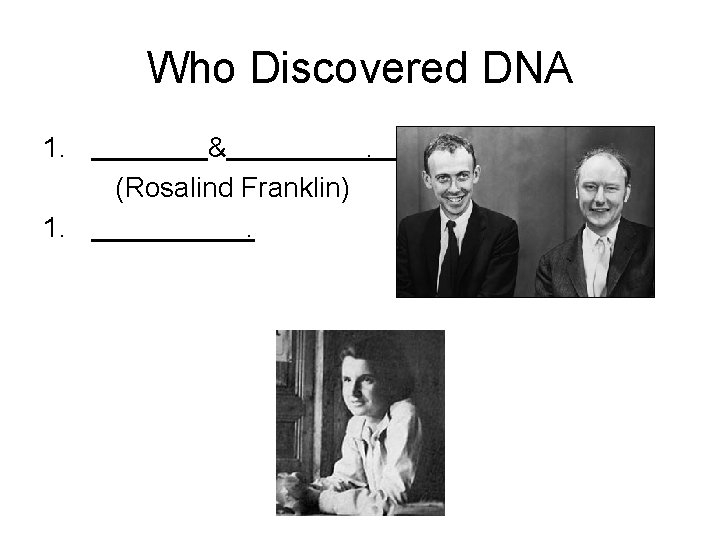
Who Discovered DNA 1. 1. &. (Rosalind Franklin).
Function of DNA 1. genetic information to the cells activity. on genetic information from one generation to the next.
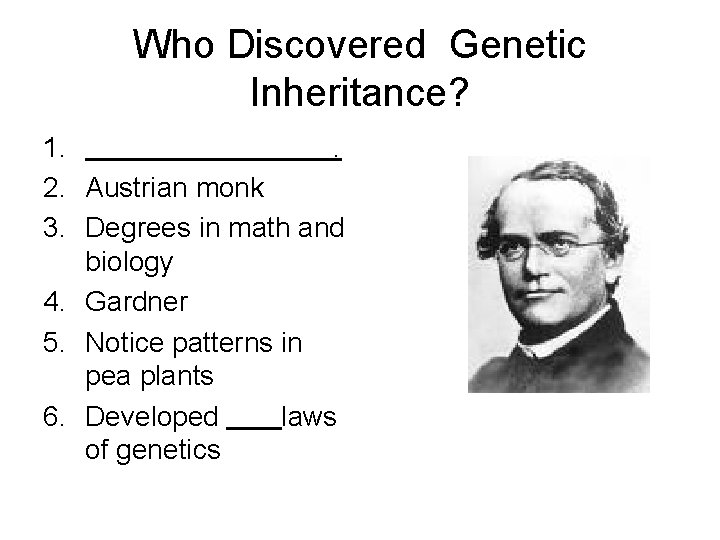
Who Discovered Genetic Inheritance? 1. . 2. Austrian monk 3. Degrees in math and biology 4. Gardner 5. Notice patterns in pea plants 6. Developed laws of genetics
Mendel 3 laws of Genetics 1. Law of . Dominant trait masks the weaker trait. 2. Law of Traits go into gametes independently from one another. 3. Law of Traits separate into gametes
Introduction and History of Biological Evidence in Forensics • DNA , also known as DNA is used in criminal or legal cases with a high degree of accuracy. , • Biological evidence such as , saliva, urine, semen, and are examined for the presence of inherited traits. • What examples can you give of how laboratory techniques used in forensics were originally developed for other purposes?
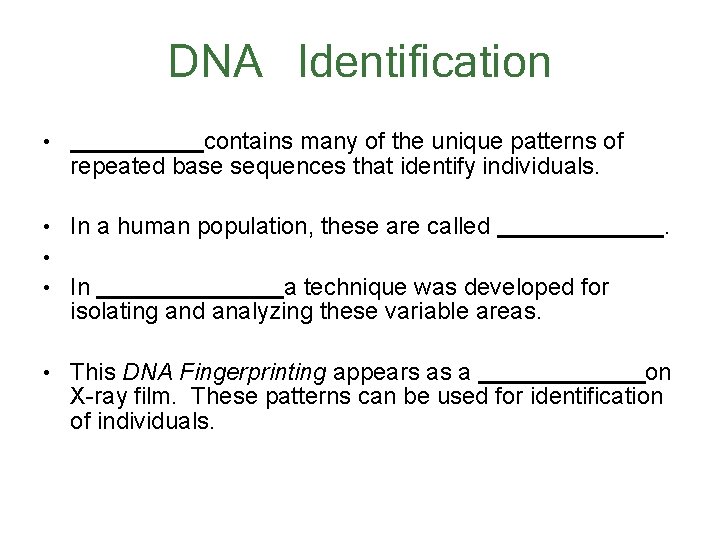
DNA Identification • contains many of the unique patterns of repeated base sequences that identify individuals. • In a human population, these are called • • In a technique was developed for . isolating and analyzing these variable areas. • This DNA Fingerprinting appears as a on X-ray film. These patterns can be used for identification of individuals.
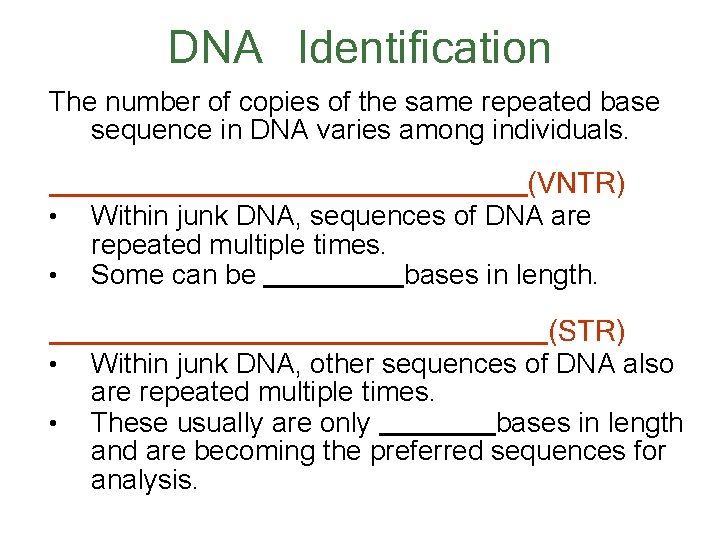
DNA Identification The number of copies of the same repeated base sequence in DNA varies among individuals. • • (VNTR) Within junk DNA, sequences of DNA are repeated multiple times. Some can be bases in length. (STR) Within junk DNA, other sequences of DNA also are repeated multiple times. These usually are only bases in length and are becoming the preferred sequences for analysis.
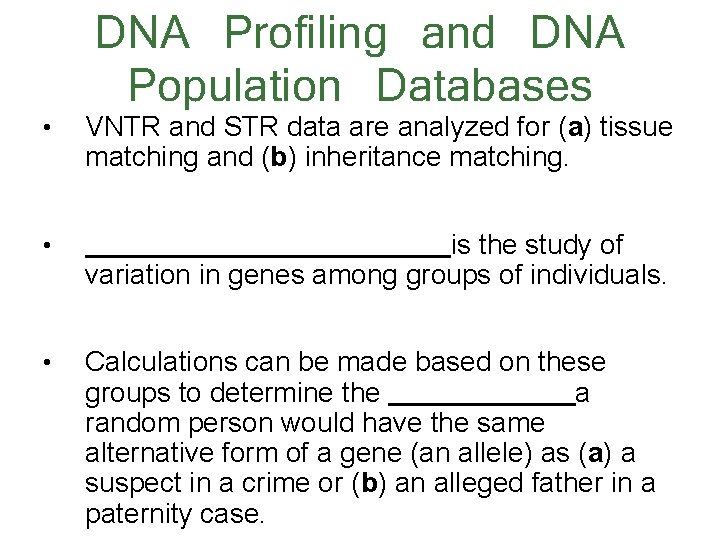
DNA Profiling and DNA Population Databases • VNTR and STR data are analyzed for (a) tissue matching and (b) inheritance matching. • is the study of variation in genes among groups of individuals. • Calculations can be made based on these groups to determine the a random person would have the same alternative form of a gene (an allele) as (a) a suspect in a crime or (b) an alleged father in a paternity case.
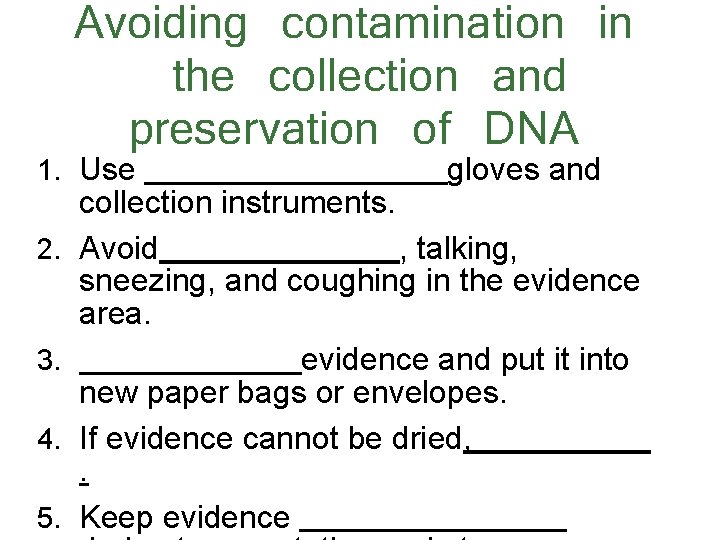
Avoiding contamination in the collection and preservation of DNA 1. Use 2. 3. 4. 5. gloves and collection instruments. Avoid , talking, sneezing, and coughing in the evidence area. evidence and put it into new paper bags or envelopes. If evidence cannot be dried, . Keep evidence
Preparing DNA Samples for Fingerprinting--Extraction 1. Cells are from biological evidence such as blood, saliva, urine, semen, and hair. 2. The cells then are to release the from proteins and other cell components. 3. Once released, the DNA can be from the cell .
Preparing DNA Samples for Fingerprinting . • With some VNTR analysis, polymerase chain reaction (PCR) can be used to the DNA that contains the VNTRs. • In STR profiles, are unnecessary; PCR allows the amplification of the strands with STR sequences. . • DNA samples are placed in through which electronic currents are passed. • DNA fragments line up in along the length of each gel
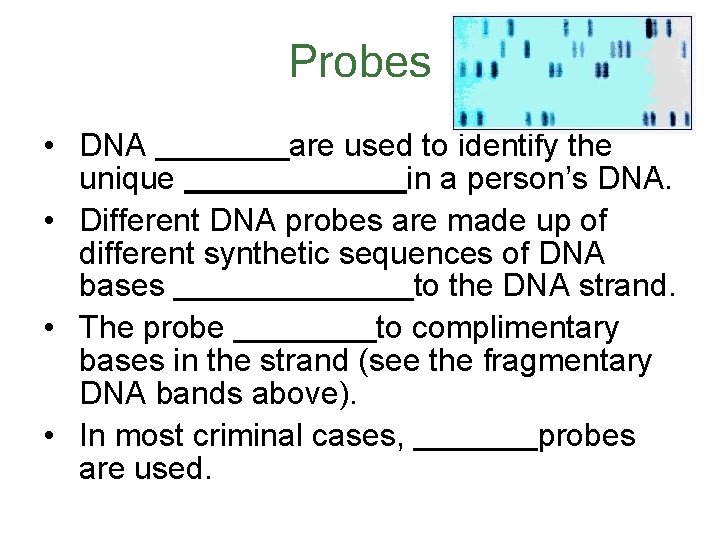
Probes • DNA are used to identify the unique in a person’s DNA. • Different DNA probes are made up of different synthetic sequences of DNA bases to the DNA strand. • The probe to complimentary bases in the strand (see the fragmentary DNA bands above). • In most criminal cases, probes are used.
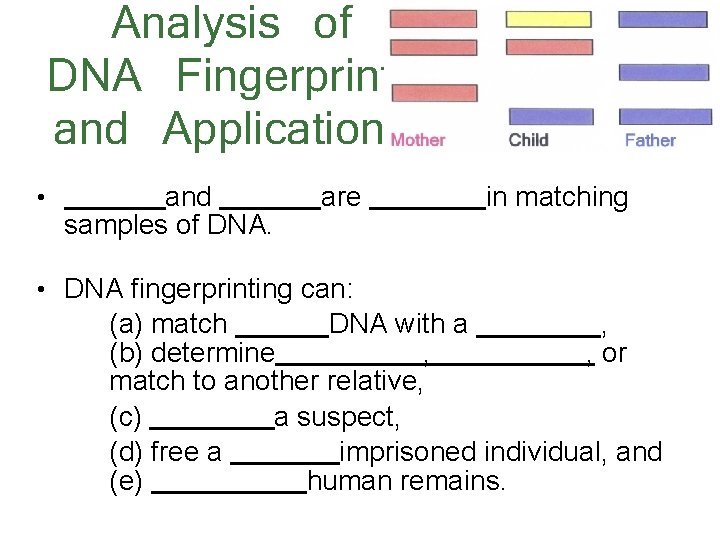
Analysis of DNA Fingerprints and Applications • and samples of DNA. are in matching • DNA fingerprinting can: (a) match DNA with a , (b) determine , , or match to another relative, (c) a suspect, (d) free a imprisoned individual, and (e) human remains.
Human DNA 1. Contain on 2. . species has their own chromosome. 3. Humans have. chromosomes.
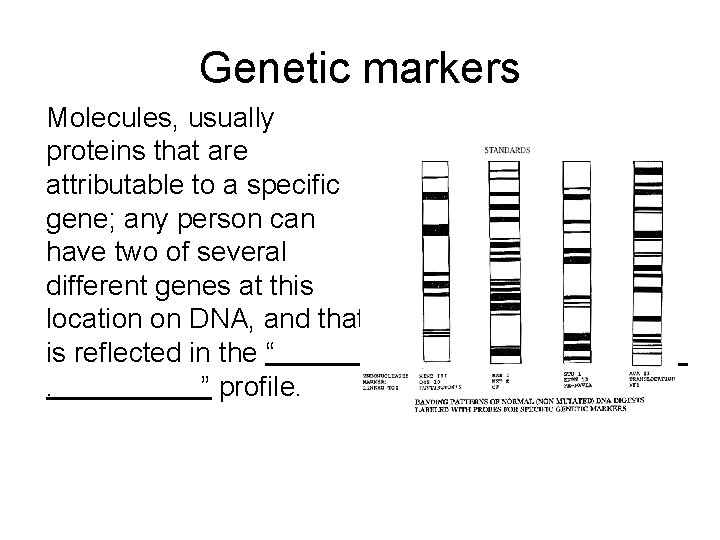
Genetic markers Molecules, usually proteins that are attributable to a specific gene; any person can have two of several different genes at this location on DNA, and that is reflected in the “. ” profile.
Collection & Preservation of Biological Evidence for DNA typing Same as before: Thoroughly packaging. before bags.
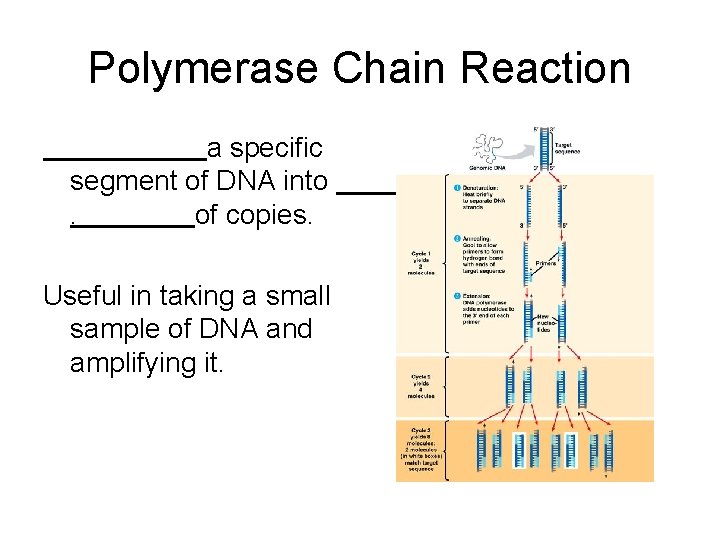
Polymerase Chain Reaction a specific segment of DNA into. of copies. Useful in taking a small sample of DNA and amplifying it.
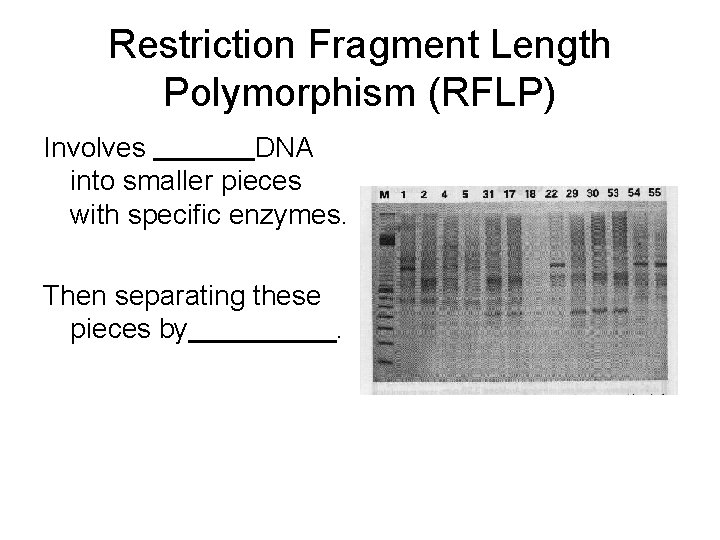
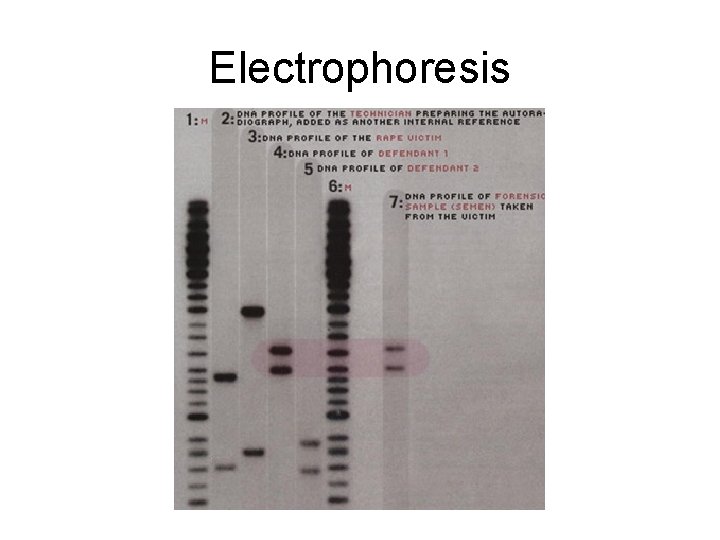
Restriction Fragment Length Polymorphism (RFLP) Involves DNA into smaller pieces with specific enzymes. Then separating these pieces by.
Narborough Rape Murders First case to use DNA typing – 1983. 15 year old girl was raped and murdered. No evidence. Three years latter another girl in Narborough was raped and murdered in a similar manner. 17 year old Rodney Buckland was arrested making a statement in the second murder but proclaiming his innocence in the earlier one. . Semen samples from both attacks and blood from the suspect. DNA analysis confirmed the same offender had committed both crimes but it also showed Buckland could not have been the perpetrator.
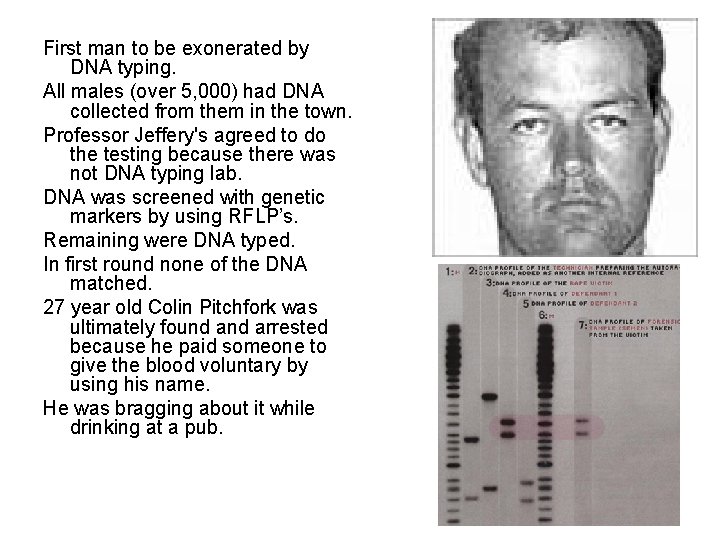
First man to be exonerated by DNA typing. All males (over 5, 000) had DNA collected from them in the town. Professor Jeffery's agreed to do the testing because there was not DNA typing lab. DNA was screened with genetic markers by using RFLP’s. Remaining were DNA typed. In first round none of the DNA matched. 27 year old Colin Pitchfork was ultimately found arrested because he paid someone to give the blood voluntary by using his name. He was bragging about it while drinking at a pub.
Electrophoresis
Tommy Lee Andrews – The first DNA Criminal Case in the USA 1986 a women in Florida was assaulted in her home by a stranger. Fingerprints outside her home lead to the arrest of Tommy Lee Andrews. At trial the jury was unable to reach a verdict and was declared a mistrial.
While preparing their retrial they heard about DNA typing – new form of biological evidence. Semen evidence and DNA from Andrews was sent to Lifecode Corporation in New York for testing. RFLP pattern from evidence matched that of Andrews. The second trial admitted the DNA evidence and the jury heard from Lifecode scientist that the odds of the DNA being from someone else were 1 out of 10 billion. The Florida court upheld the court’s decision in admitting the DNA and the conviction stood.
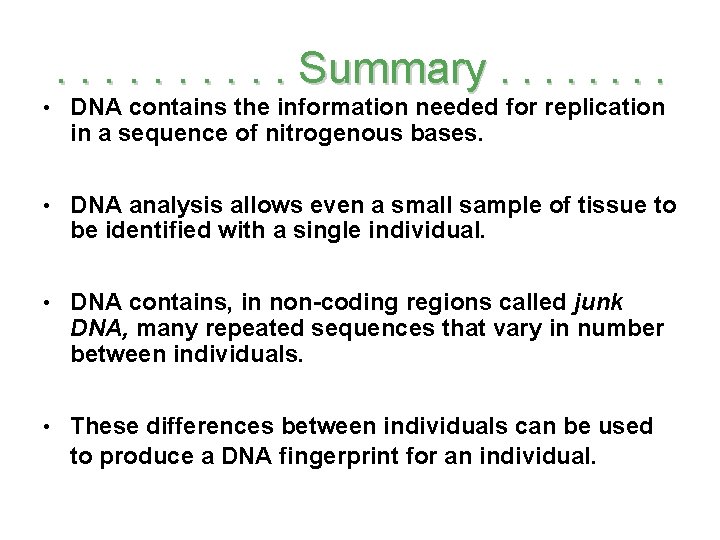
. . Summary. . . . • DNA contains the information needed for replication in a sequence of nitrogenous bases. • DNA analysis allows even a small sample of tissue to be identified with a single individual. • DNA contains, in non-coding regions called junk DNA, many repeated sequences that vary in number between individuals. • These differences between individuals can be used to produce a DNA fingerprint for an individual.
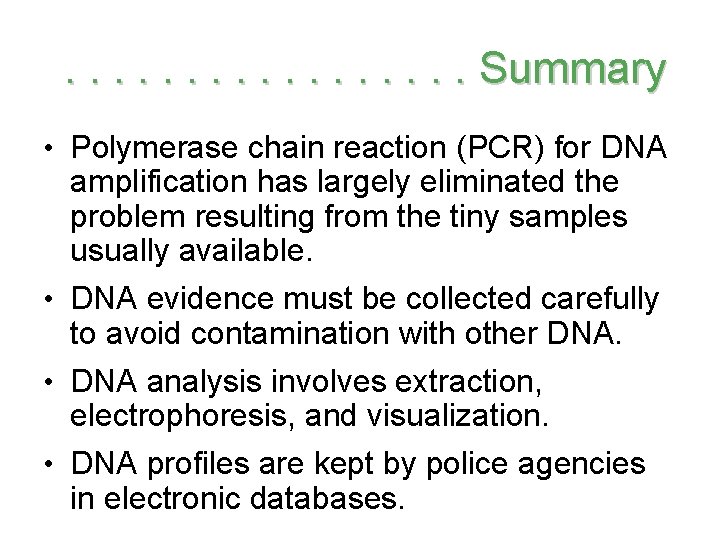
. . . . Summary • Polymerase chain reaction (PCR) for DNA amplification has largely eliminated the problem resulting from the tiny samples usually available. • DNA evidence must be collected carefully to avoid contamination with other DNA. • DNA analysis involves extraction, electrophoresis, and visualization. • DNA profiles are kept by police agencies in electronic databases.