
DNA Deoxyribonucleic Acid Structure and Function Remember from
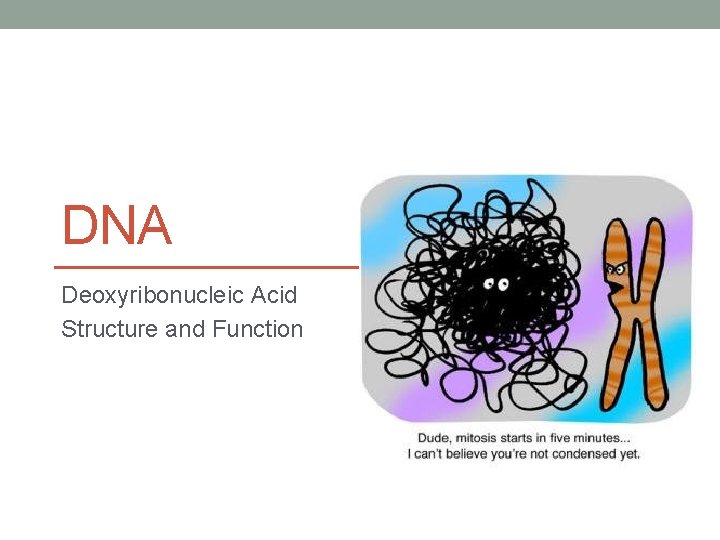
DNA Deoxyribonucleic Acid Structure and Function
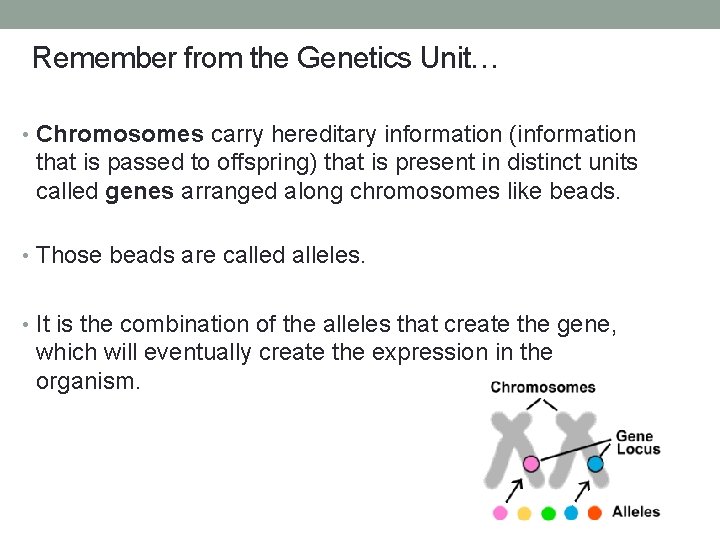
Remember from the Genetics Unit… • Chromosomes carry hereditary information (information that is passed to offspring) that is present in distinct units called genes arranged along chromosomes like beads. • Those beads are called alleles. • It is the combination of the alleles that create the gene, which will eventually create the expression in the organism.
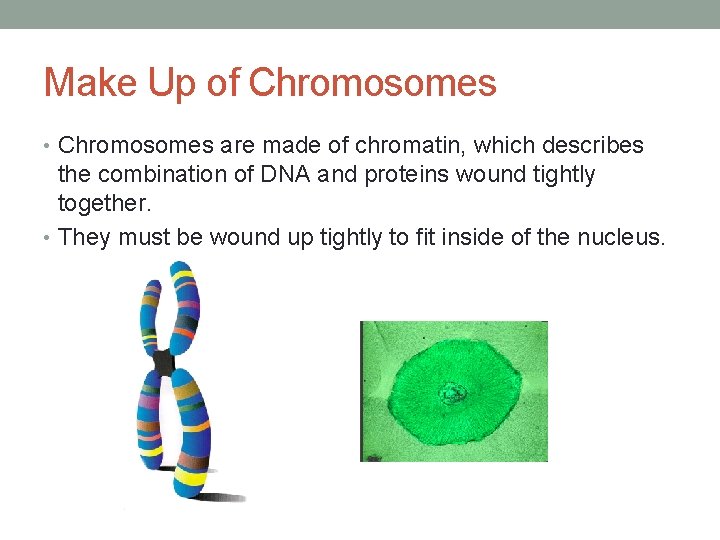
Make Up of Chromosomes • Chromosomes are made of chromatin, which describes the combination of DNA and proteins wound tightly together. • They must be wound up tightly to fit inside of the nucleus.
• http: //www. youtube. com/watch? v=e. Yr. Q 0 Eh. VCYA
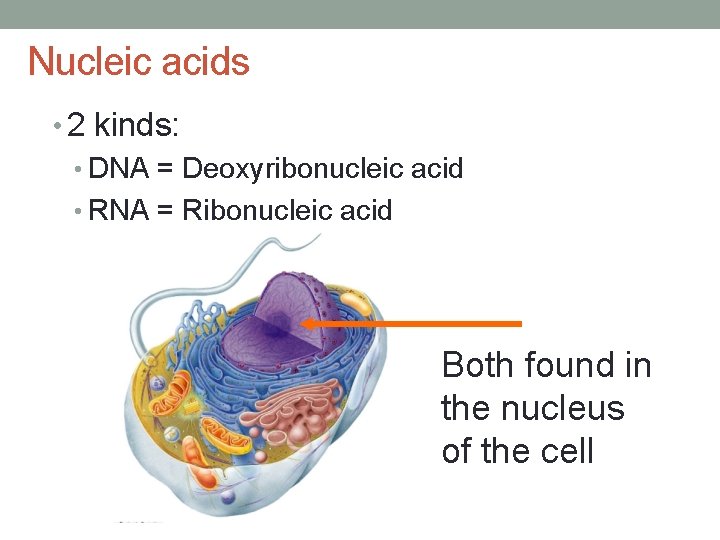
Nucleic acids • 2 kinds: • DNA = Deoxyribonucleic acid • RNA = Ribonucleic acid Both found in the nucleus of the cell
Let’s start with DNA… • DNA is the hereditary material that is passed on from one generation to the next through reproduction • No 2 people in the world have 100% the same DNA. • The Human Genome Project mapped the genes of a single person and found that the human genome contains more than 3. 4 billion base pairs and between 20 000 and 25 000 genes. • It took 13 years to map the human genome and was complete in 2003.
• http: //www. youtube. com/watch? v=t. Z_b 800 Kc. Po
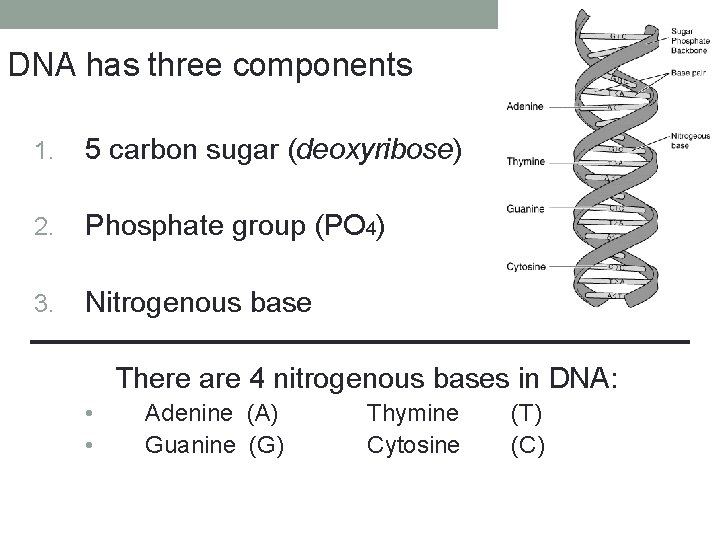
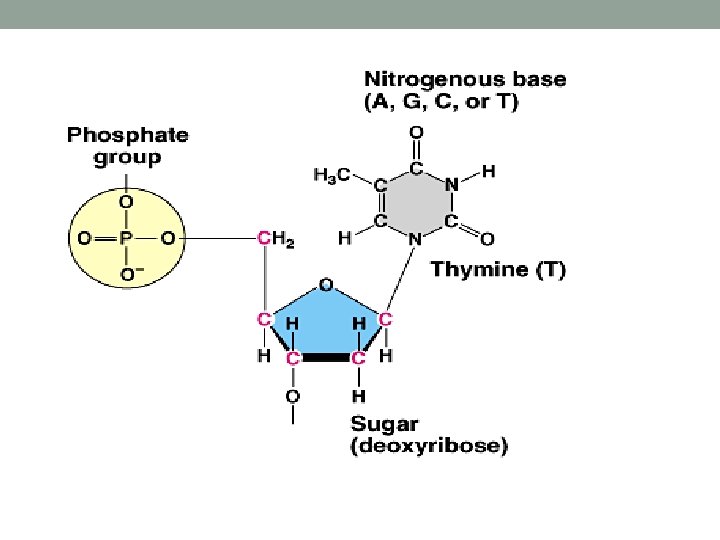
DNA has three components 1. 5 carbon sugar (deoxyribose) 2. Phosphate group (PO 4) 3. Nitrogenous base There are 4 nitrogenous bases in DNA: • • Adenine (A) Guanine (G) Thymine Cytosine (T) (C)
• When the 3 components are combined together, they create a nucleotide. • This unit repeats and composes the majority of the DNA structure. • DNA nucleotides are composed of: • 1 molecule deoxyribose sugar • 1 molecule phosphate group • & 1 of the 4 nitrogenous bases (A, T, C or G)
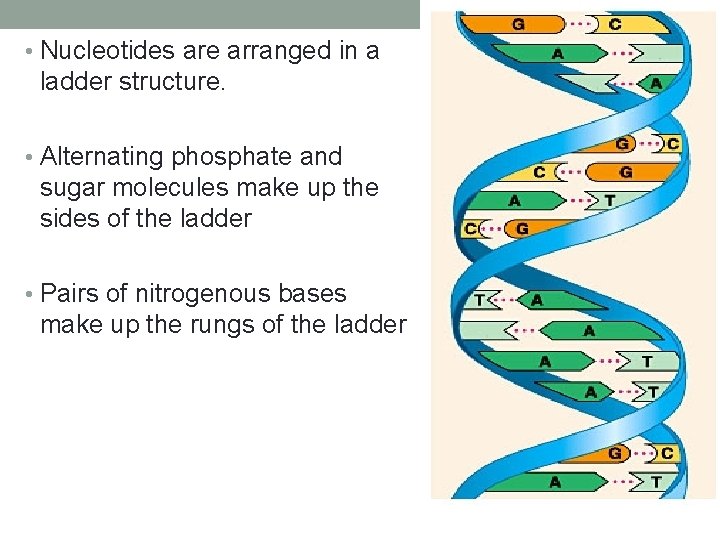
• Nucleotides are arranged in a ladder structure. • Alternating phosphate and sugar molecules make up the sides of the ladder • Pairs of nitrogenous bases make up the rungs of the ladder
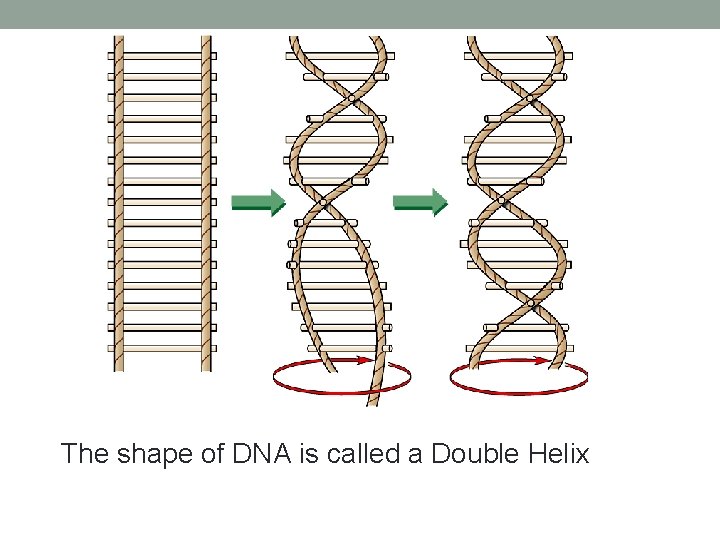
The shape of DNA is called a Double Helix
Complementary base pairing rule • In any pair of bases: • Adenine will bond only to Thymine • Guanine will bond only to Cytosine
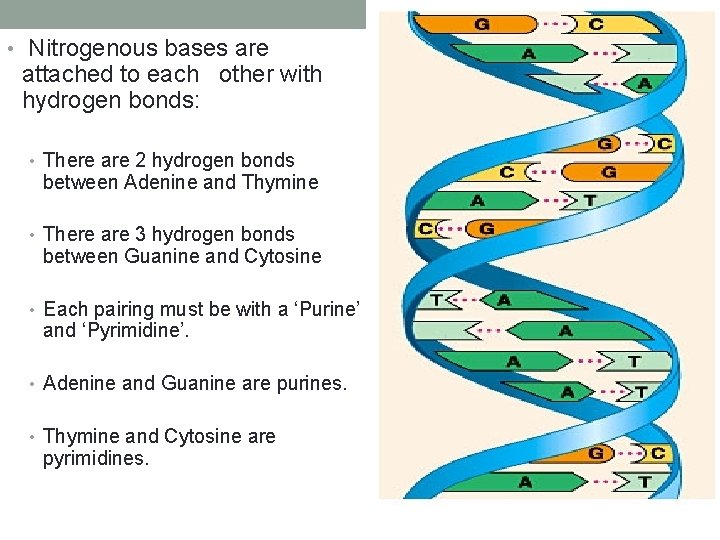
• Nitrogenous bases are attached to each other with hydrogen bonds: • There are 2 hydrogen bonds between Adenine and Thymine • There are 3 hydrogen bonds between Guanine and Cytosine • Each pairing must be with a ‘Purine’ and ‘Pyrimidine’. • Adenine and Guanine are purines. • Thymine and Cytosine are pyrimidines.
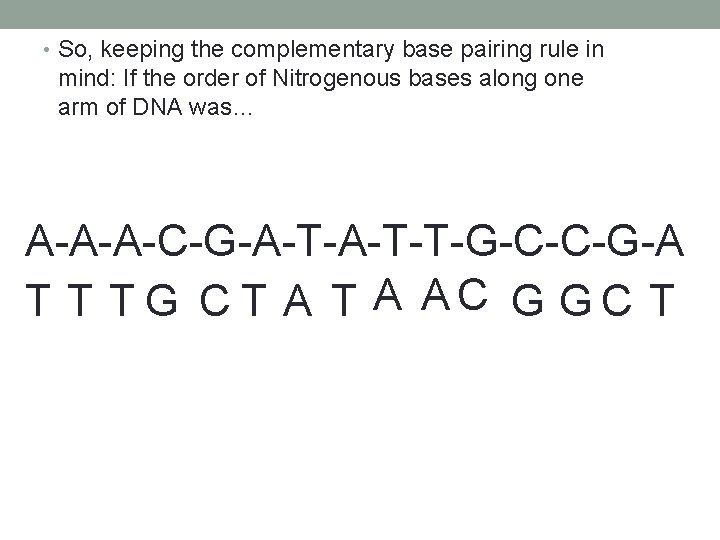
• So, keeping the complementary base pairing rule in mind: If the order of Nitrogenous bases along one arm of DNA was… A-A-A-C-G-A-T-T-G-C-C-G-A T T T G C T A AC G GC T
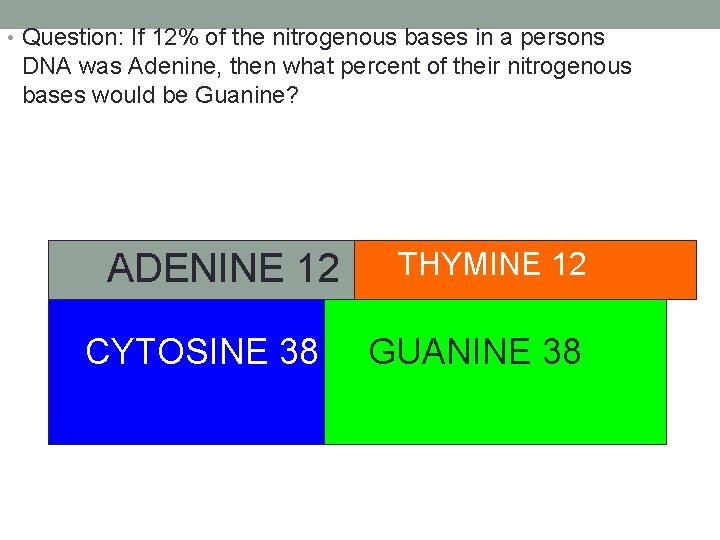
• Question: If 12% of the nitrogenous bases in a persons DNA was Adenine, then what percent of their nitrogenous bases would be Guanine? ADENINE 12 CYTOSINE 38 THYMINE 12 GUANINE 38
• The sequence of nitrogenous bases acts as a code. • The code determines what proteins will be made by the cell. • Proteins in turn determine the nature and activities of the cell. • This is why the amount of DNA is not important. • Sequence determines outcome.
Replication of DNA • Due to the fact that cells divide so rapidly, DNA must be replicated often and efficiently in order to keep up with demand. • DNA is replicated during interphase of either mitosis or meiosis depending on the cell. • Human cells take about 20 hours to replicate all 46 chromosomes. • However, some can take only minutes. E. Coli bacteria can replicate DNA and divide a cell in only 20 minutes.
Steps in Replication 1: The hydrogen bonds between the base pairs (nitrogenous bases) break and the two strands of the DNA molecule pull apart. • this exposes the base pairs along each strand • 2: Bases of free nucleotides (floating around in the nucleus) fasten on to complementary bases of the now exposed DNA chain.
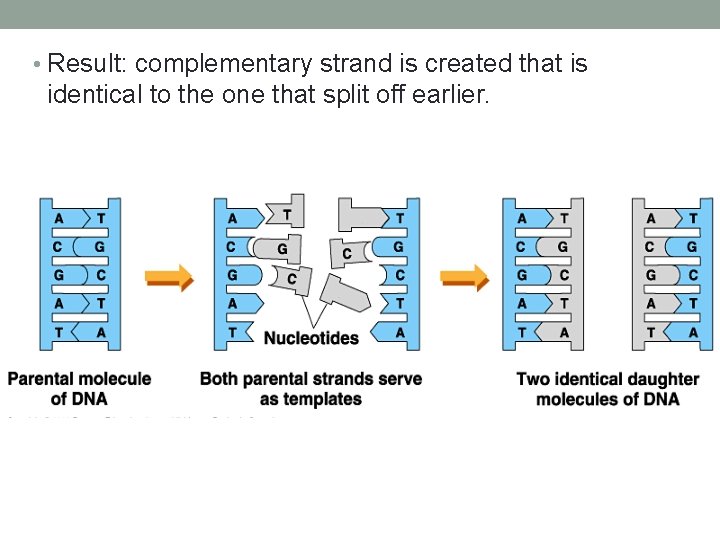
• Result: complementary strand is created that is identical to the one that split off earlier.
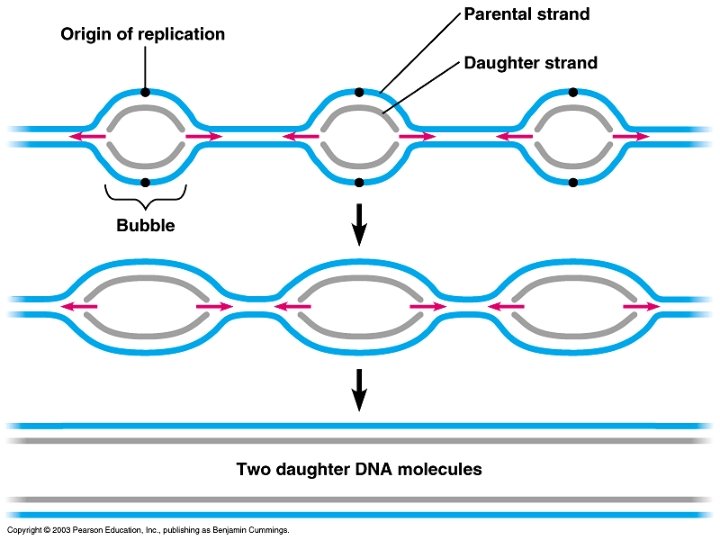
• Remember that this process is done for each of the two original DNA strands. • Think back to mitosis: when the chromosomes doubled • Replication does not actually begin at one end of the DNA strand end at the other. • To speed up the process, Replication begins at many points on the DNA strand that connect later. • These are called Replication bubbles.
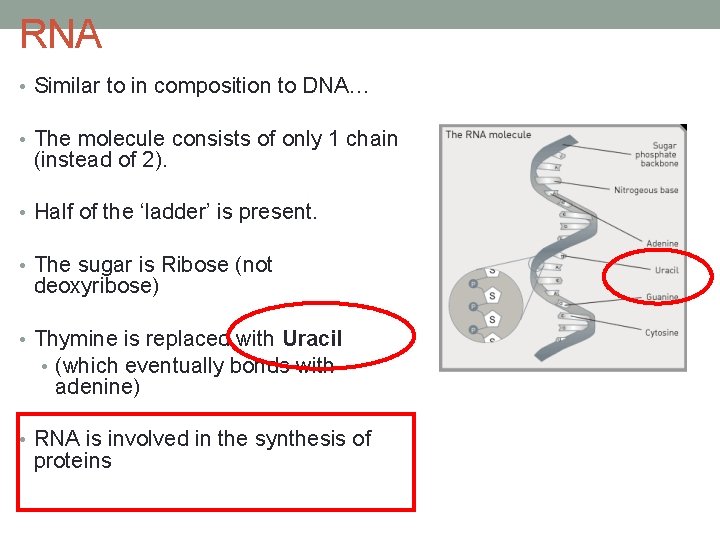
RNA • Similar to in composition to DNA… • The molecule consists of only 1 chain (instead of 2). • Half of the ‘ladder’ is present. • The sugar is Ribose (not deoxyribose) • Thymine is replaced with Uracil • (which eventually bonds with adenine) • RNA is involved in the synthesis of proteins
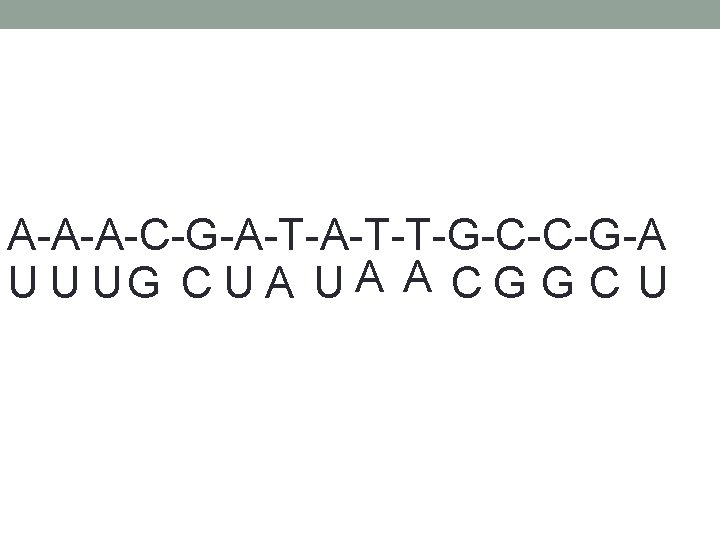
A-A-A-C-G-A-T-T-G-C-C-G-A U U UG C U A A C G G C U
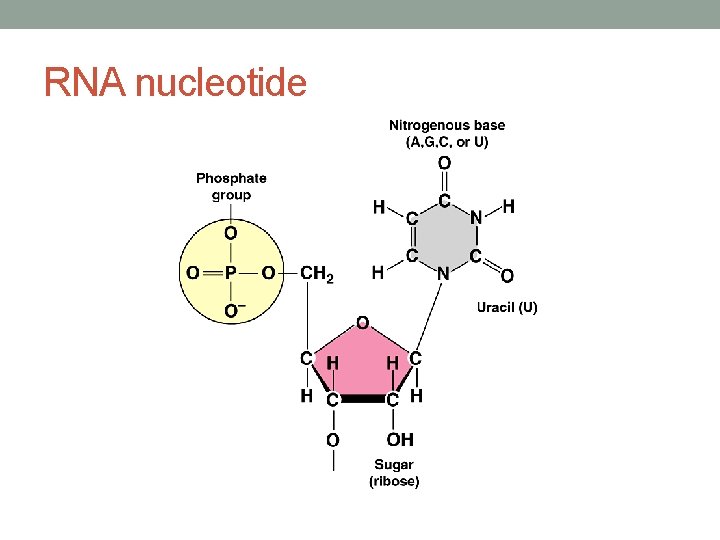
RNA nucleotide
• How many different DNA & RNA nucleotides are there total? 8
- Slides: 26