
DNA Component 3 Section A Knowledge Organiser Dennis

- Slides: 3
DNA Component 3 Section A Knowledge Organiser Dennis Kelly is a British playwright born in Barnet, 1970. He is known for writing plays that focus on social and political issues in modern society, posing questions rather than giving his own view on them. Playwright: Dennis Kelly puts his characters in high- pressure situations where they have to make difficult moral decisions and live with the consequences. The audience is encouraged to question these decisions Kelly Genre 1: ‘In-yer-face’ theatre (theatre that used shocking and violent methods to make the audience face up to the unpleasant truths of society) - Genre 2: Theatre in Education (TIE) – which had the principal aim of using theatre to teach an audience about a particular issue, idea or theme. It often involved the audience as participants in the drama. DNA is about a group of teenagers who think they’ve killed one of their schoolmates and try to cover up his ‘murder’. Many of the play’s themes focus on how the group behave and the consequences of their actions DNA Themes 1) Responsibility- The characters don’t take responsibility for their actions or for their treatment of others 2) Bullying- The play shows the destructive consequences of bullying and how it can be used to hurt and manipulate people 3) Power- Kelly suggests that power brings out the worst in people and cause them to act immorally 4) Identity- The characters face a struggle between trying to fit in with the group while acting in a way that is morally right. - DNA was written in 2007 originally to be performed by youth theatre groups as part of the 2007 National Theatre Connections after being asked to write a play for young people to perform. The first professional performance - was in 2008 at the Crossloe Theatre (part of the National Theatre) using a a non-naturalistic style. - DNA’s purpose was to raise questions about whether it was more beneficial to think about the group or the individual It also raised issues about social issues in 21 st century Britain. People believed that anti-social behaviour in young people was getting worse with media labelling it as ‘Broken Britain’- a British society where people acted for themselves rather than in a socially responsible DNA context way - An increase in terrorism caused anxiety and led to stricter surveillance laws. These laws were intended to protect the public but some people saw them as an invasion of privacy. - DNA is still relevant today as the same themes that affected it when it was written still apply today such as surveillance and terrorism anxiety, bullying and anti-social behaviour. The play purposely doesn’t use modern technology so that it can be produced anytime in the future and still be relevant. - The early 21 st century brought scientific advances in DNA research (human genome project). Scientists could compare human DNA to other animals to understand our ancestry. This relates when Leah compares humans to chimpanzees and bonobos (two animals who are almost 100% genetically identical yet in total opposite ways in their social circles). Knowledge about DNA and forensic science became widespread which helps the gang cover up the murder. Rehearsal technique 1: Transporting a character Definition and purpose: Technique to explore how a character or role might react or behave in a different situation, location or time. For example, an intimate bedroom scene between two lovers is 'transported' to a crowded supermarket. Done in order to build a stronger character profile and physicality (movement, voice, gestures), to explore character motivation and relationship with others Do: Use effective mime, facial expressions and body language to bring your new scene to life. Accept and build on each other’s ideas. Rehearsal technique Definition and purpose: Exercise that allows the inner thoughts of a character or role to be heard out loud. It is often used in conjunction with freeze-frame where a participant is asked say what they are thinking at that point in time. Done in order to develop a stronger character profile so we have a deeper understanding of them and their attitudes towards others 2: Thought tracking Rehearsal technique 3: Status games. Columbian Hypnosis Do: Speak in the 1 st person. Speak in character. Give an insight into the character’s feelings. If possible show conflict Definition and purpose: Exercise that involves students working in pairs, leading each other around the room with one of the pairs following the other pair’s hand with their face as close as possible at all times. Done in order to explore themes of power and leadership within character relationships. Do: Focus just on each other so that the movements are as fluid as possible. Explore height, width, eye contact, space, time, movement, proxemics (distance) Definition and purpose: a technique to gain a deeper understanding of a character or role and how characters feel towards other characters or particular situations. An individual sits in a chair designated as the
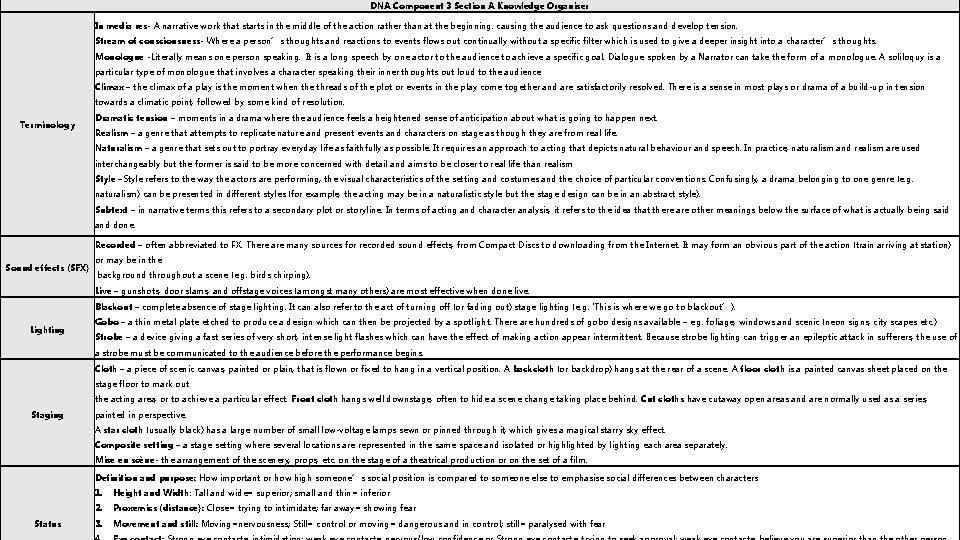
DNA Component 3 Section A Knowledge Organiser In media res- A narrative work that starts in the middle of the action rather than at the beginning. causing the audience to ask questions and develop tension. Stream of consciousness- Where a person’s thoughts and reactions to events flows out continually without a specific filter which is used to give a deeper insight into a character’s thoughts. Monologue -Literally means one person speaking. It is a long speech by one actor to the audience to achieve a specific goal. Dialogue spoken by a Narrator can take the form of a monologue. A soliloquy is a particular type of monologue that involves a character speaking their inner thoughts out loud to the audience Climax – the climax of a play is the moment when the threads of the plot or events in the play come together and are satisfactorily resolved. There is a sense in most plays or drama of a build-up in tension towards a climatic point, followed by some kind of resolution. Terminology Dramatic tension – moments in a drama where the audience feels a heightened sense of anticipation about what is going to happen next. Realism – a genre that attempts to replicate nature and present events and characters on stage as though they are from real life. Naturalism – a genre that sets out to portray everyday life as faithfully as possible. It requires an approach to acting that depicts natural behaviour and speech. In practice, naturalism and realism are used interchangeably but the former is said to be more concerned with detail and aims to be closer to real life than realism Style –Style refers to the way the actors are performing, the visual characteristics of the setting and costumes and the choice of particular conventions. Confusingly, a drama belonging to one genre (e. g. naturalism) can be presented in different styles (for example, the acting may be in a naturalistic style but the stage design can be in an abstract style). Subtext – in narrative terms this refers to a secondary plot or storyline. In terms of acting and character analysis, it refers to the idea that there are other meanings below the surface of what is actually being said and done. Recorded – often abbreviated to FX. There are many sources for recorded sound effects, from Compact Discs to downloading from the Internet. It may form an obvious part of the action (train arriving at station) Sound effects (SFX) or may be in the background throughout a scene (e. g. birds chirping). Live – gunshots, door slams, and offstage voices (amongst many others) are most effective when done live. Blackout – complete absence of stage lighting. It can also refer to the act of turning off (or fading out) stage lighting (e. g. 'This is where we go to blackout’). Lighting Gobo – a thin metal plate etched to produce a design which can then be projected by a spotlight. There are hundreds of gobo designs available – e. g. foliage, windows and scenic (neon signs, city scapes etc. ) Strobe – a device giving a fast series of very short, intense light flashes which can have the effect of making action appear intermittent. Because strobe lighting can trigger an epileptic attack in sufferers, the use of a strobe must be communicated to the audience before the performance begins. Cloth – a piece of scenic canvas, painted or plain, that is flown or fixed to hang in a vertical position. A backcloth (or backdrop) hangs at the rear of a scene. A floor cloth is a painted canvas sheet placed on the stage floor to mark out the acting area, or to achieve a particular effect. Front cloth hangs well downstage, often to hide a scene change taking place behind. Cut cloths have cutaway open areas and are normally used as a series, Staging painted in perspective. A star cloth (usually black) has a large number of small low-voltage lamps sewn or pinned through it, which gives a magical starry sky effect. Composite setting – a stage setting where several locations are represented in the same space and isolated or highlighted by lighting each area separately. Mise en scène- the arrangement of the scenery, props, etc. on the stage of a theatrical production or on the set of a film. Definition and purpose: How important or how high someone’s social position is compared to someone else to emphasise social differences between characters Status 1. Height and Width: Tall and wide= superior; small and thin= inferior 2. Proxemics (distance): Close= trying to intimidate; far away= showing fear 3. Movement and still: Moving=nervousness; Still= control or moving= dangerous and in control; still= paralysed with fear
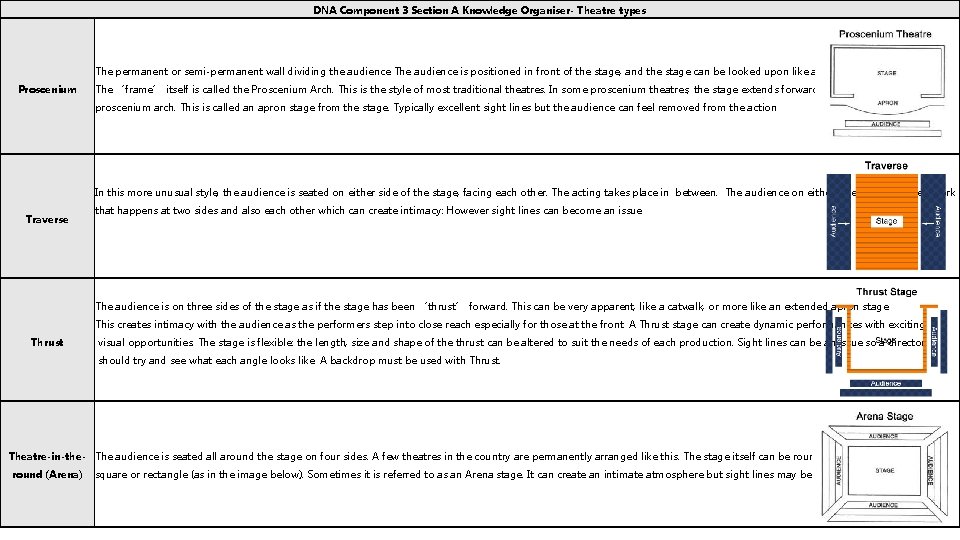
DNA Component 3 Section A Knowledge Organiser- Theatre types The permanent or semi-permanent wall dividing the audience The audience is positioned in front of the stage, and the stage can be looked upon like a picture frame. Proscenium The ‘frame’ itself is called the Proscenium Arch. This is the style of most traditional theatres. In some proscenium theatres, the stage extends forward in front of the proscenium arch. This is called an apron stage from the stage. Typically excellent sight lines but the audience can feel removed from the action In this more unusual style, the audience is seated on either side of the stage, facing each other. The acting takes place in between. The audience on either side can clearly see work Traverse that happens at two sides and also each other which can create intimacy: However sight lines can become an issue The audience is on three sides of the stage as if the stage has been ‘thrust’ forward. This can be very apparent, like a catwalk, or more like an extended apron stage. This creates intimacy with the audience as the performers step into close reach especially for those at the front. A Thrust stage can create dynamic performances with exciting Thrust visual opportunities. The stage is flexible: the length, size and shape of the thrust can be altered to suit the needs of each production. Sight lines can be an issue so a director should try and see what each angle looks like. A backdrop must be used with Thrust. Theatre-in-the- The audience is seated all around the stage on four sides. A few theatres in the country are permanently arranged like this. The stage itself can be round, round (Arena) square or rectangle (as in the image below). Sometimes it is referred to as an Arena stage. It can create an intimate atmosphere but sight lines may be an issue.