
DNA Chapter 10 Discovery of DNA Structure DNA
- Slides: 52
DNA Chapter 10
Discovery of DNA Structure DNA Protein of DNA Replication Synthesis Random 10 10 Final Jeopardy 20 20 20 30 30 30 40 40 40 50 50 50
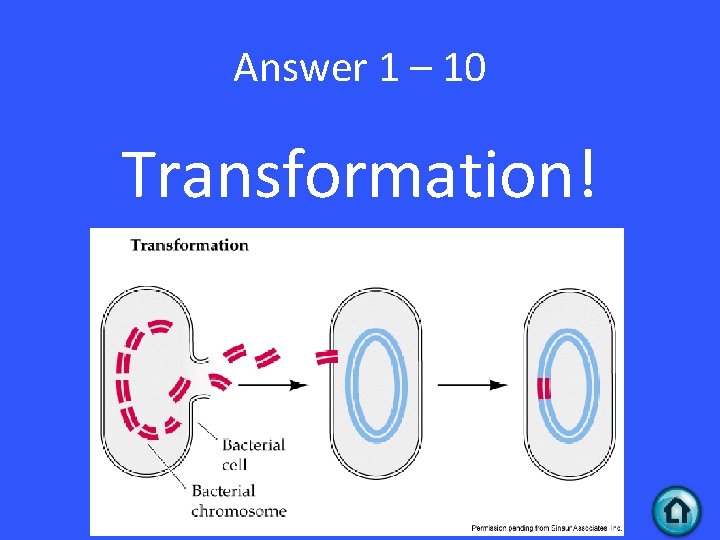
Question 1 - 10 • The process by which one strain of bacteria is apparently changed into another strain is called: a) b) c) d) Transcription Translation Transformation replication
Answer 1 – 10 Transformation!
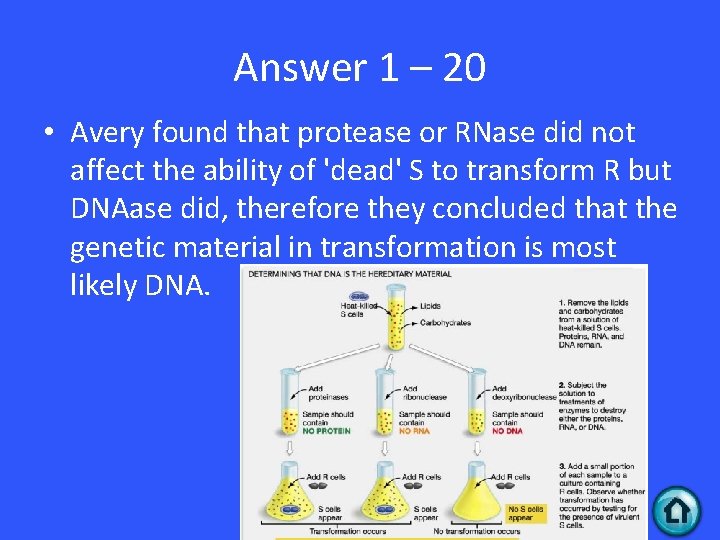
Question 1 - 20 • Describe Avery’s experiment and the conclusion he drew from this experiment.
Answer 1 – 20 • Avery found that protease or RNase did not affect the ability of 'dead' S to transform R but DNAase did, therefore they concluded that the genetic material in transformation is most likely DNA.
Question 1 - 30 • Describe the Hershey-Chase experiment and the conclusions that were drawn from this experiment.
Answer 1 – 30 1. Radioactive isotopes label protein and DNA, allowed viruses to infect E. coli bacteria -Radioactive sulfur (35 S) to label protein -Radioactive phosphorous (32 P) to label DNA • Found that all of the viral DNA and little of the protein had entered E. coli cells. They concluded that DNA is the hereditary molecule in viruses
Question 1 - 40 • How did Watson and Crick’s model explain why there are equal amounts of thymine and adenine in DNA? How did Watson and Crick know there were equal amounts of thymine and adenine in DNA?
Answer 1 – 40 • Hydrogen bonds can form only between certain base pairs- adenine with thymine and guanine with cytosine. • Chargaff’s rule- A to T and C to G are always found in 1: 1 ratio
Question 1 - 50 • Why did Hershey and Chase grow viruses in cultures that contained both radioactive phosphorous and radioactive sulfur? What might have happened if they had used only one radioactive substance?
Answer 1 – 50 • So that bothe viral DNA and viral proteins would have been able to trace the location of the unmarked molecule in the bacterial cell, or the results would not have been conclusive.
Question 2 - 10 • Describe Watson and Crick’s model of the DNA molecule.
Answer 2 – 10 • DNA is a double helix in which two strands are wound around each other
Question 2 - 20 • Explain the base pairing rules in DNA
Answer 2 – 20 • Adenine bonds with Thymine • Cytosine bonds with Guanine
Question 2 - 30 • There are two groups of nitrogenous bases. Name both groups and which nitrogenous bases are in each group
Answer 2 – 30 • Pyrimidines- Cytosine and Thymine • Purines- Adenine and Guanine
Question 2 - 40 • Name three components of a nucleotide in DNA
Answer 2 – 40 • Deoxyribose- 5 carbon sugar • Phosphate Group • Nitrogenous base
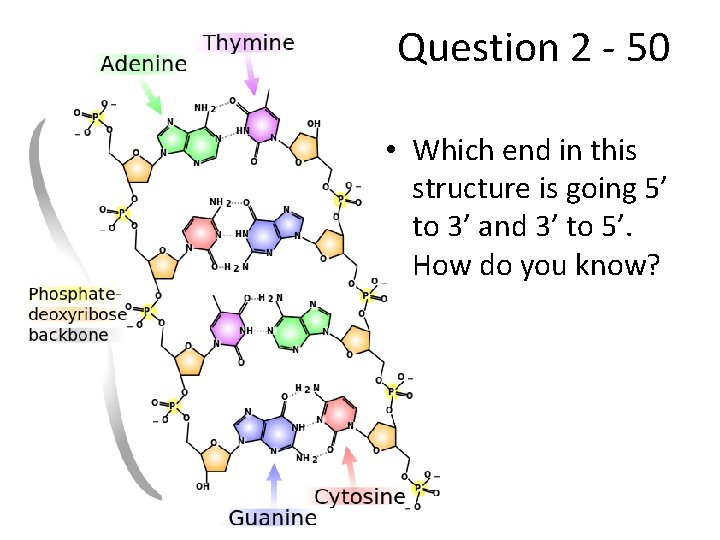
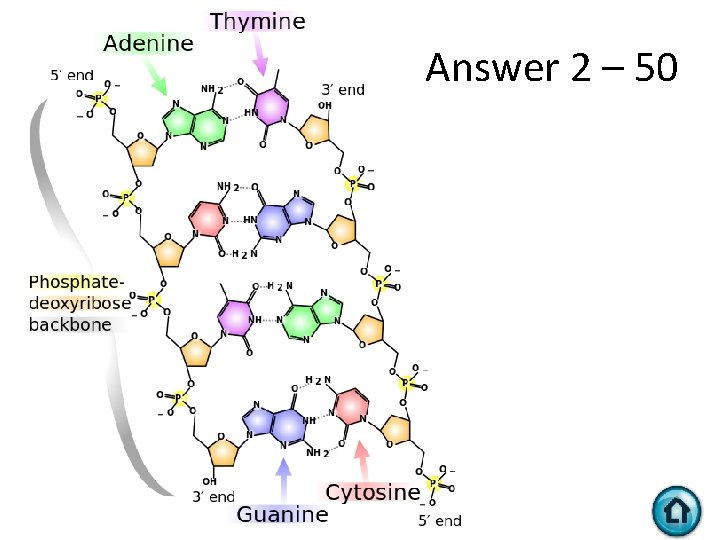
Question 2 - 50 • Which end in this structure is going 5’ to 3’ and 3’ to 5’. How do you know?
Answer 2 – 50
Question 3 - 10 • During DNA replication, which sequence of nucleotides would bond with the DNA sequence TATGA?
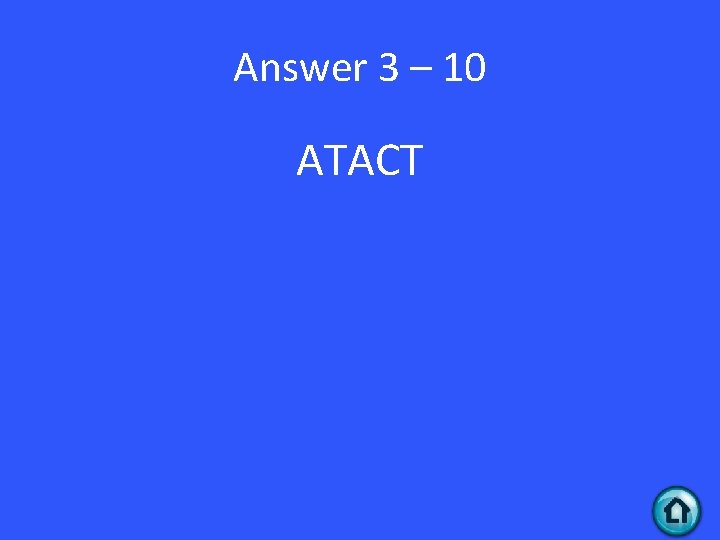
Answer 3 – 10 ATACT
Question 3 - 20 • What is the role of DNA polymerase in DNA replication?
Answer 3 – 20 • Principle enzyme in DNA replication. Adds individual nucleotides to produce DNA as well as “proof reads” DNA
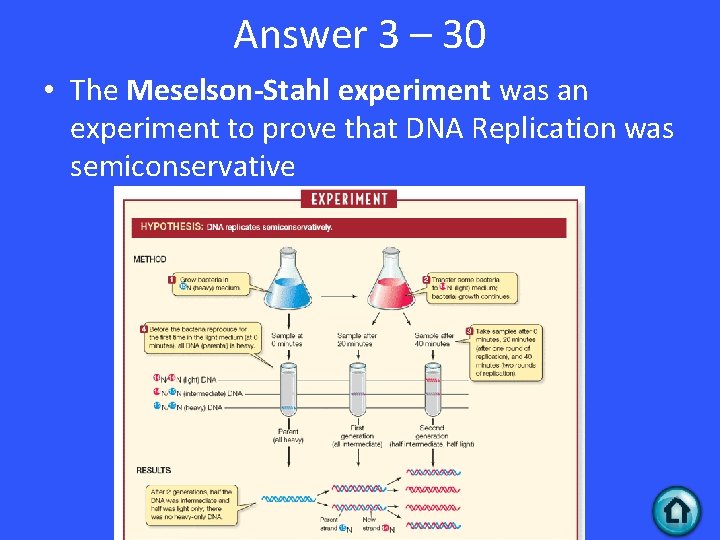
Question 3 - 30 • Describe the Meselson-Stahl experiment and the conclusions that were drawn from this experiment.
Answer 3 – 30 • The Meselson-Stahl experiment was an experiment to prove that DNA Replication was semiconservative
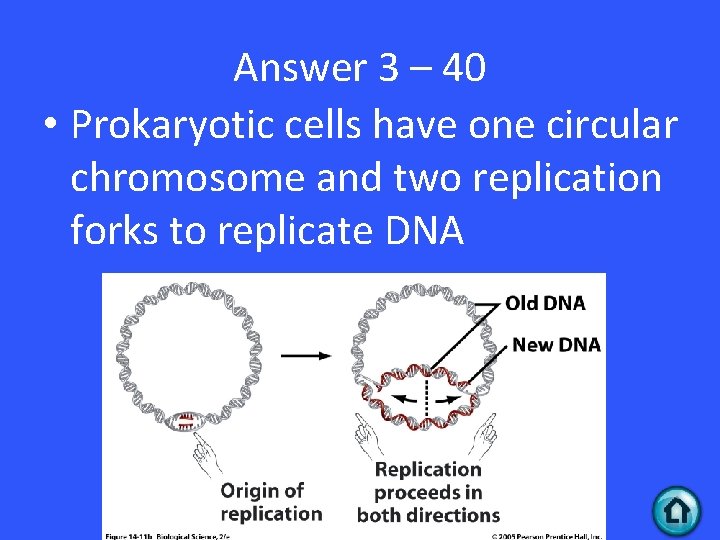
Question 3 - 40 • What is the difference between Prokaryotic and Eukaryotic Replication?
Answer 3 – 40 • Prokaryotic cells have one circular chromosome and two replication forks to replicate DNA
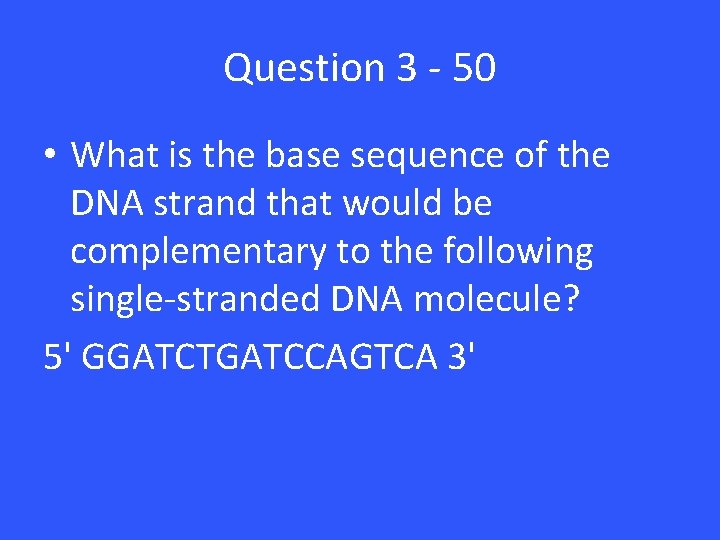
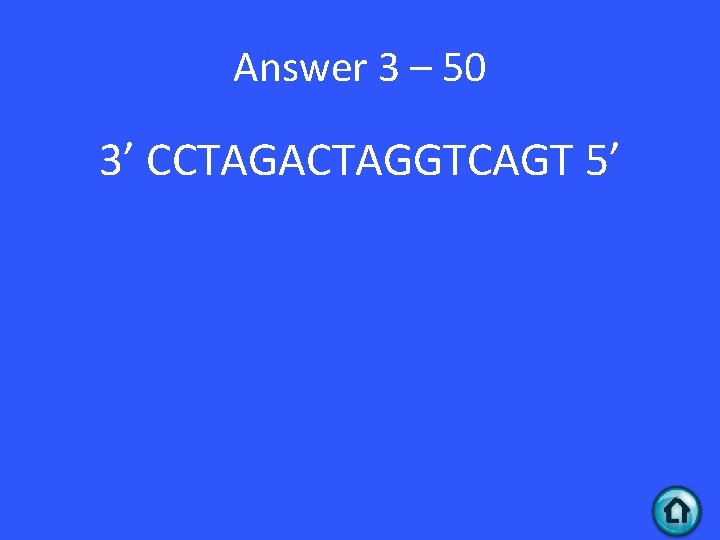
Question 3 - 50 • What is the base sequence of the DNA strand that would be complementary to the following single-stranded DNA molecule? 5' GGATCTGATCCAGTCA 3'
Answer 3 – 50 3’ CCTAGACTAGGTCAGT 5’
Question 4 - 10 • List the three main types of RNA
Answer 4 – 10 1. Messenger RNA 2. Transfer RNA 3. Ribosomal RNA
Question 4 - 20 • What happens during transcription?
Answer 4 – 20 • RNA polymerase binds to DNA, separates the strands, and then uses one strand as a template to assemble RNA
Question 4 - 30 • What happens during translation? Be specific!
Answer 4 – 30 • The cell uses information from messenger RNA to produce proteins • Initiation- Two ribosomal subunits, t. RNA, and an m. RNA join together. • Elongation- The t. RNA carrying the amino acid specified by the next codon binds to the codon. A peptide bond is formed between adjacent amino acids. • Termination- The process ends when a stop codon is reached. • Disassembly- The ribosome complex falls apart. Newly made polypeptide is released
Question 4 - 40 • Describe three main difference between DNA and RNA
Answer 4 – 40 • The sugar is ribose instead of deoxyribose, RNA is generally singlestranded, RNA contains uracil in place of thymine.
Question 4 - 50 • The three-nucleotide codon system can be arranged into ______ combinations. a) 16 b) 20 c) 64 d) 128
Answer 4 – 50 • With four possible bases, the three nucleotides can give 43 = 64 different possibilities, and these combinations are used to specify the 20 different amino acids used by living organisms.
Final Jeopardy • Explain the difference between introns and exons.
Final Jeopardy • Pre-RNA contains “introns, ” or intervening sequences, that must be removed before RNA becomes active. The remaining RNA, the “exons” or expressed sequences, are the actual genetic message that is used to assemble proteins.
Question 5 - 20 • What is a codon?
Answer 5 – 20 • A codon consists of three nucleotides that specify a single amino acid that is to be added to a polypeptide. The source of the codon’s message is DNA. Each codon strands for a specific amino acid
Question 5 - 30 • What is an anticodon? How does it function?
Answer 5 – 30 • An anticodon consists of the three bases on the t. RNA molecule that are complementary to a m. RNA codon. Anticodons determine which t. RNA binds to the codon on m. RNA, and thus which amino acid is attached to the polypeptide chain.
Question 5 - 40 • What are point mutations?
Answer 5 – 40 • Point mutations are mutations that affect one nucleotide, usually by substituting one nucleotide for another.
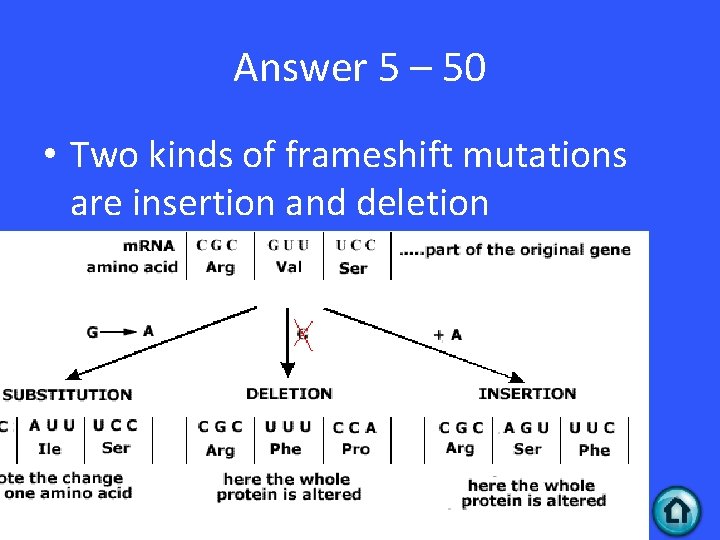
Question 5 - 50 • Give two examples of frameshift mutations.
Answer 5 – 50 • Two kinds of frameshift mutations are insertion and deletion