
DNA Biology By Presenter Media com DNA Deoxyribonucleic
DNA Biology By Presenter. Media. com
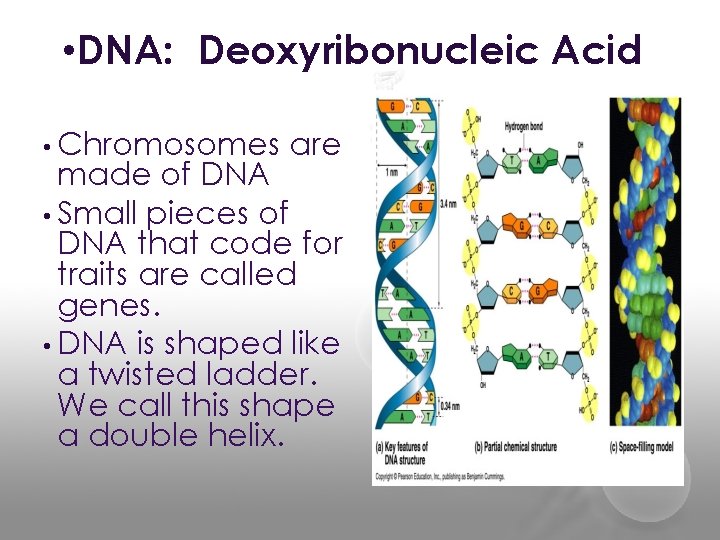
• DNA: Deoxyribonucleic Acid • Chromosomes are made of DNA • Small pieces of DNA that code for traits are called genes. • DNA is shaped like a twisted ladder. We call this shape a double helix.
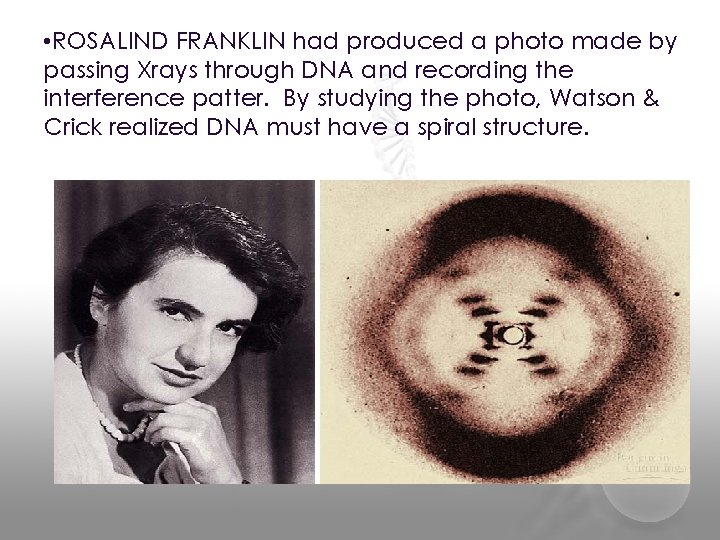
• ROSALIND FRANKLIN had produced a photo made by passing Xrays through DNA and recording the interference patter. By studying the photo, Watson & Crick realized DNA must have a spiral structure.
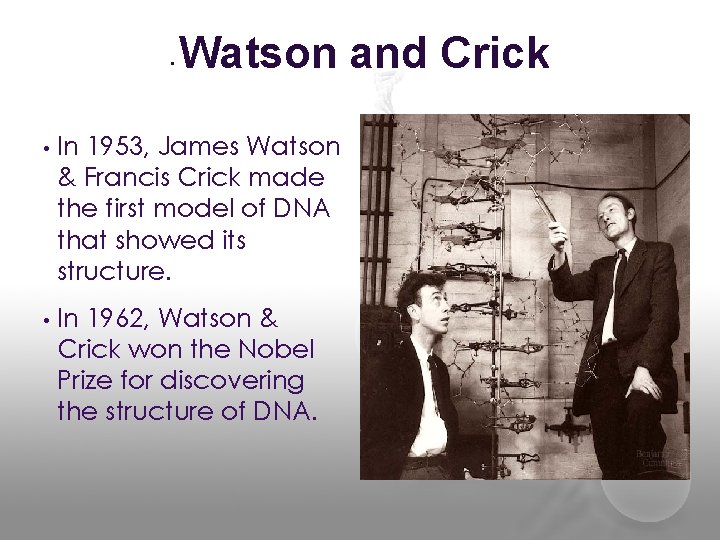
• Watson and Crick • In 1953, James Watson & Francis Crick made the first model of DNA that showed its structure. • In 1962, Watson & Crick won the Nobel Prize for discovering the structure of DNA.
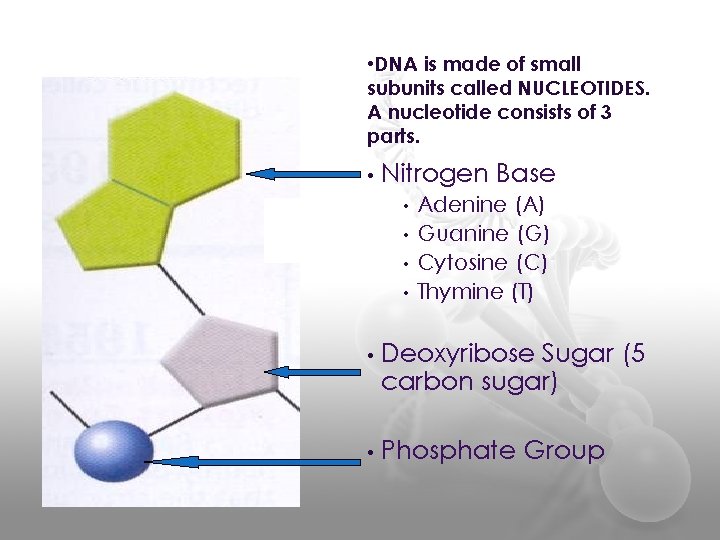
• DNA is made of small subunits called NUCLEOTIDES. A nucleotide consists of 3 parts. • Nitrogen Base • • Adenine (A) Guanine (G) Cytosine (C) Thymine (T) • Deoxyribose Sugar (5 carbon sugar) • Phosphate Group

• Nitrogen Bases Purines • “Double Rings” • Longer • Examples • • • Adenine Guanine Pyrimidines • “Single Rings” • Shorter • Examples • • • Cytosine Thymine
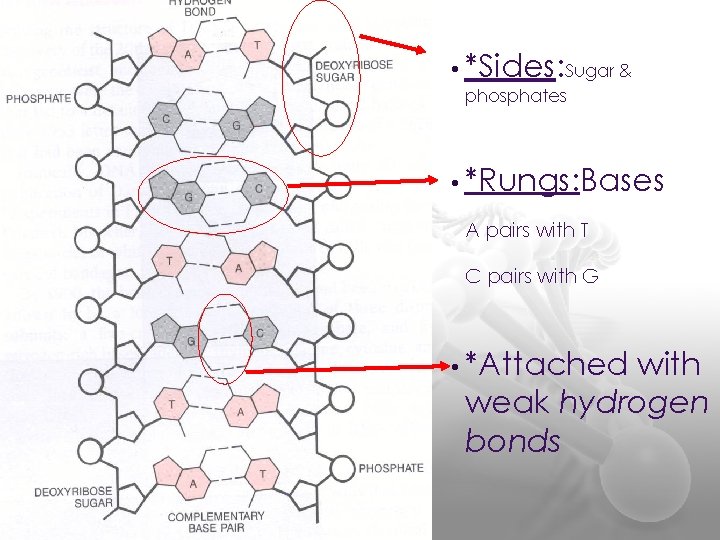
• *Sides: Sugar & phosphates • *Rungs: Bases A pairs with T C pairs with G • *Attached with weak hydrogen bonds
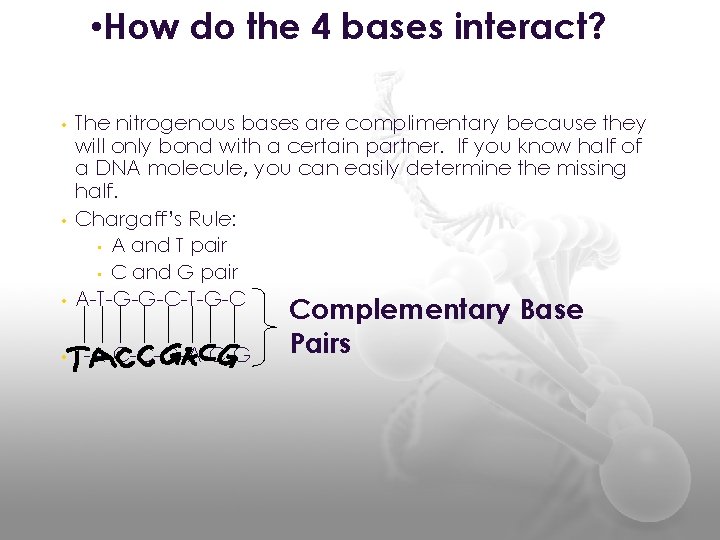
• How do the 4 bases interact? • The nitrogenous bases are complimentary because they will only bond with a certain partner. If you know half of a DNA molecule, you can easily determine the missing half. Chargaff’s Rule: • A and T pair • C and G pair A-T-G-G-C-T-G-C • T-A-C-C-G-A-C-G • • Complementary Base Pairs
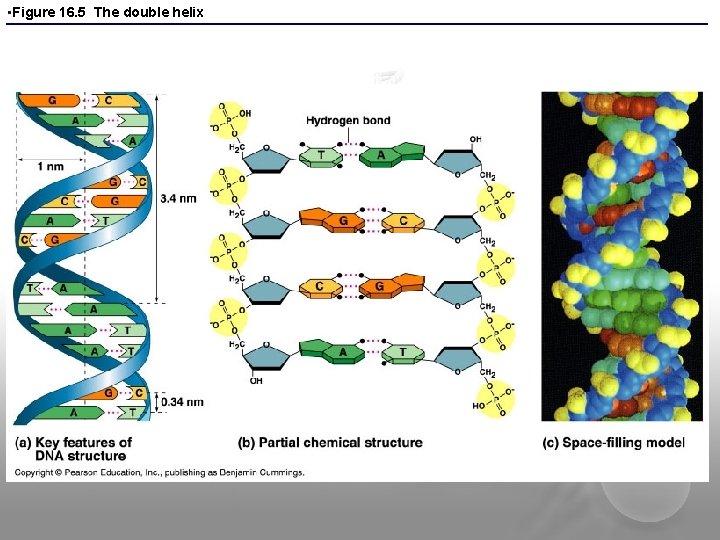
• Figure 16. 5 The double helix
• DNA REPLICATION • REPLICATION: Process in which DNA copies itself exactly. This occurs during interphase of the cell cycle.
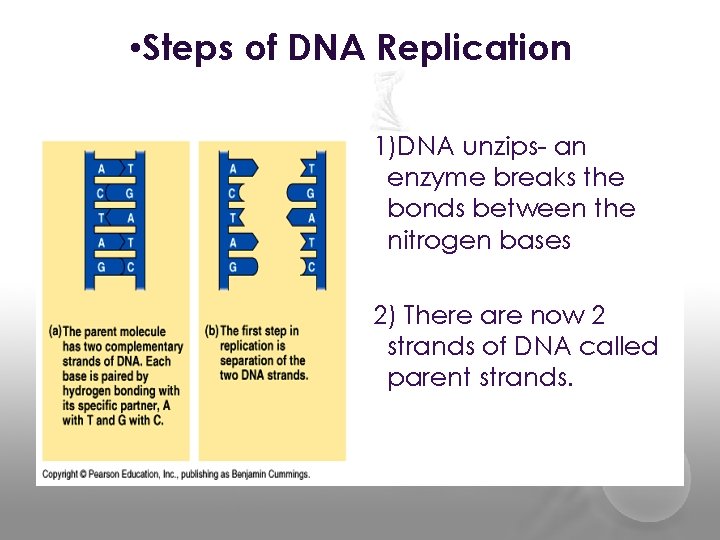
• Steps of DNA Replication 1)DNA unzips- an enzyme breaks the bonds between the nitrogen bases 2) There are now 2 strands of DNA called parent strands.
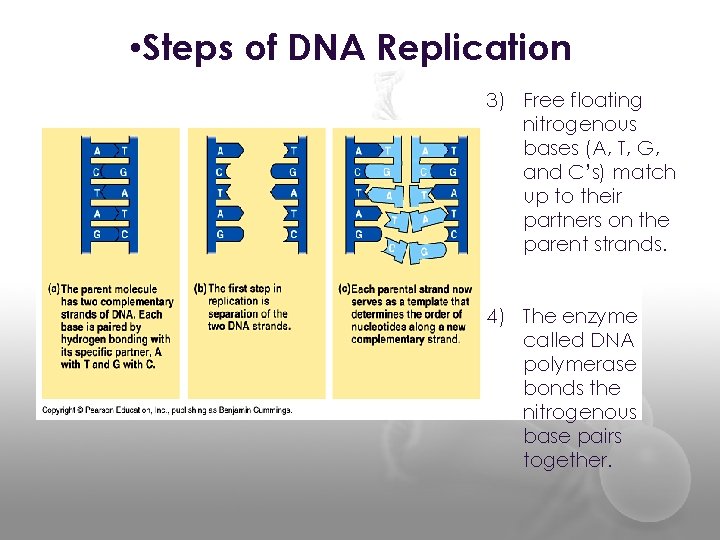
• Steps of DNA Replication 3) Free floating nitrogenous bases (A, T, G, and C’s) match up to their partners on the parent strands. 4) The enzyme called DNA polymerase bonds the nitrogenous base pairs together.
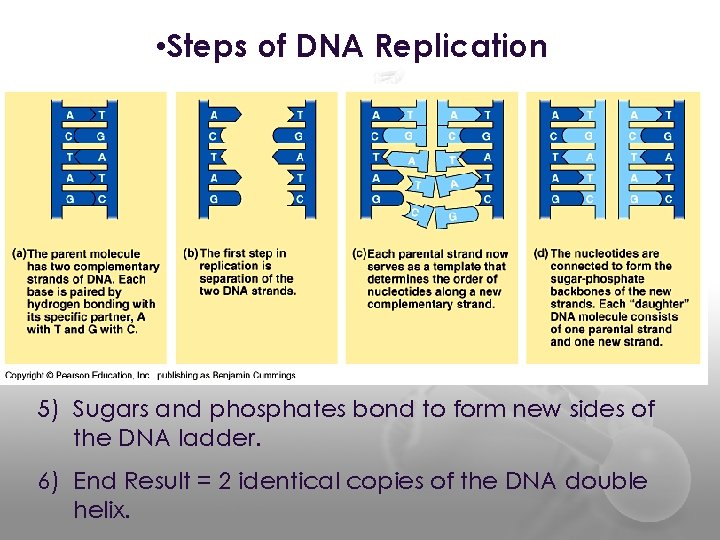
• Steps of DNA Replication 5) Sugars and phosphates bond to form new sides of the DNA ladder. 6) End Result = 2 identical copies of the DNA double helix.
- Slides: 13