
DNA Based Programmable Autonomous Molecular Robotic Devices John
DNA Based Programmable Autonomous Molecular Robotic Devices John Reif Dept CS Duke University
Organization of talk • DNA Autonomous Walkers • DNA Autonomous Devices: -DNA Autonomous Devices that Compute as they Walk - DNA Devices that Open Nano-Containers -
Goal of DNA-based autonomous devices • DNA-based autonomous biomolecular devices are molecular assemblies and molecular devices that are: (i) self-assembled: that is they assemble into DNA nanostructures in one stage without explicit external control, (ii) programmable: the tasks the molecular devices execute can be modified without an entire redesign and iii) autonomous: they operate without external mediation (e. g. thermal cycling).
Autonomous DNA Walkers: DNA Devices that Walk on DNA Nanostructures
![First DNA Walker Devices: Formulation & First Designs [Reif, 2002] (used no enzymes, random](http://slidetodoc.com/presentation_image_h2/06e8abeb028e32f1998e8fbc15eadfdf/image-5.jpg "First DNA Walker Devices: Formulation & First Designs [Reif, 2002] (used no enzymes, random")
First DNA Walker Devices: Formulation & First Designs [Reif, 2002] (used no enzymes, random moves) Designs for the first autonomous DNA nanomechanical devices that execute cycles of motion without external environmental changes. Walking DNA device Rolling DNA device Use ATP consumption Use hybridization energy These DNA devices translate across a circular strand of ss. DNA and rotate simultaneously. Generate random bidirectional movements that acquire after n steps an expected translational deviation of O(n 1/2).
Autonomous DNA Walkers using Enzymes:

Unidirectional Autonomous Walker Peng Yin, Hao Yan, Xiaoju G. Daniell, Andrew J. Turberfield, and John H. Reif Molecular-Scale device in which an autonomous walker moves unidirectionally along a DNA track, driven by the hydrolysis of ATP Yin, P. , Yan, H. , Daniell, X. G. , Turberfield, A. J. , & Reif, J. H. (2004). A Unidirectional DNA Walker That Moves Autonomously along a Track. Angewandte Chemie International Edition, 43(37), 4906– 4911. doi: 10. 1002/anie. 200460522
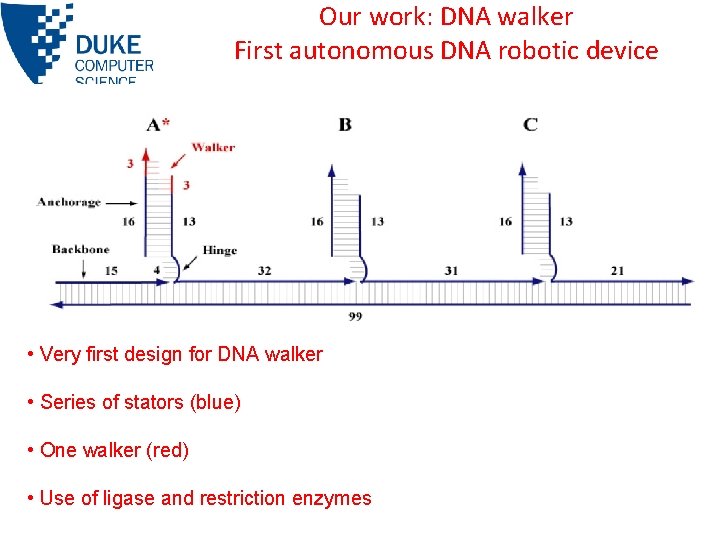
Our work: DNA walker First autonomous DNA robotic device • Very first design for DNA walker • Series of stators (blue) • One walker (red) • Use of ligase and restriction enzymes

Demonstrated First Autonomous DNA Walker: Peng Yin, Hao Yan, Xiaoju G. Daniel, Andrew J. Turberfield, John H. Reif, A Unidirectional DNA Walker Moving Autonomously Along a Linear Track, Angewandte Chemie Volume 43, Number 37, Sept. 20, 2004, pp 49064911. Restriction enzymes Ligase Pfl. M I Walker Anchorage A* B Track C Bst. AP I D A

Yin, P. , Yan, H. , Daniell, X. G. , Turberfield, A. J. , & Reif, J. H. (2004). A Unidirectional DNA Walker That Moves Autonomously along a Track. Angewandte Chemie International Edition, 43(37), 4906– 4911. doi: 10. 1002/anie. 200460522

DNA walker motion Peng Yin, Hao Yan, Xiaoju G. Daniel, Andrew J. Turberfield, John H. Reif, A Unidirectional DNA Walker Moving Autonomously Along a Linear Track, Angewandte Chemie [International Edition], Volume 43, Number 37, Sept. 20, 2004, pp. 4906 -4911
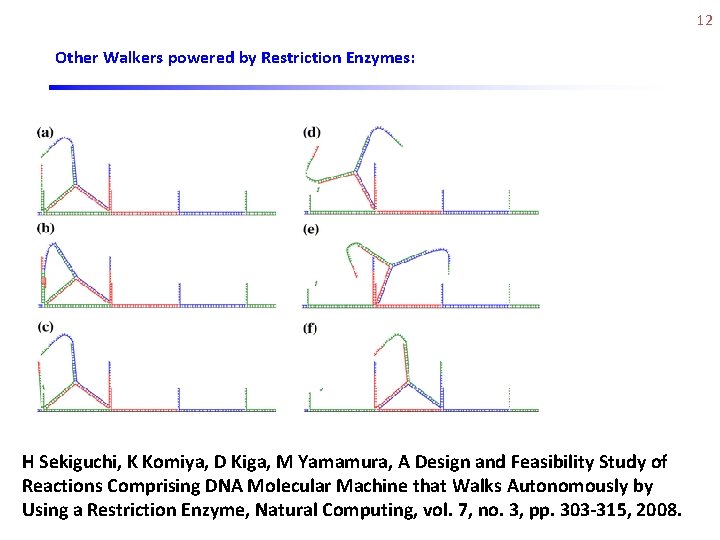
12 Other Walkers powered by Restriction Enzymes: H Sekiguchi, K Komiya, D Kiga, M Yamamura, A Design and Feasibility Study of Reactions Comprising DNA Molecular Machine that Walks Autonomously by Using a Restriction Enzyme, Natural Computing, vol. 7, no. 3, pp. 303 315, 2008.
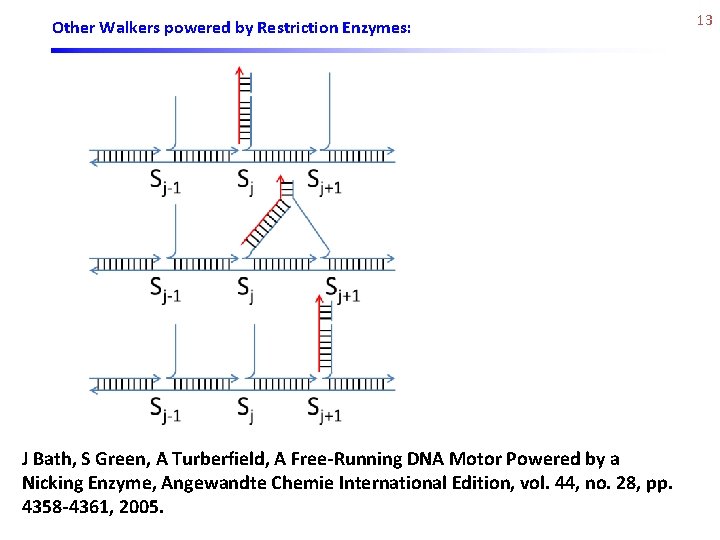
Other Walkers powered by Restriction Enzymes: J Bath, S Green, A Turberfield, A Free Running DNA Motor Powered by a Nicking Enzyme, Angewandte Chemie International Edition, vol. 44, no. 28, pp. 4358 4361, 2005. 13
![Other Walkers powered by DNAenzymes: [Tian & Mao 2005] Y Tian, Y He, Y](http://slidetodoc.com/presentation_image_h2/06e8abeb028e32f1998e8fbc15eadfdf/image-14.jpg "Other Walkers powered by DNAenzymes: [Tian & Mao 2005] Y Tian, Y He, Y")
Other Walkers powered by DNAenzymes: [Tian & Mao 2005] Y Tian, Y He, Y Chen, P Yin, C Mao, A DNAzyme That Walks Processively and Autono- mously along a One-Dimensional Track, Angewandte Chemie International Edition, vol. 44, no. 28, pp. 4355 -4358, 2005. Steps of a walker powered by DNAzymes. The DNAzyme region of the strand is shown in different shade. 14

Autonomous DNA Racetrack Runners using Polymerase: DNA Devices that Walk on Circular DNA Nanostructures

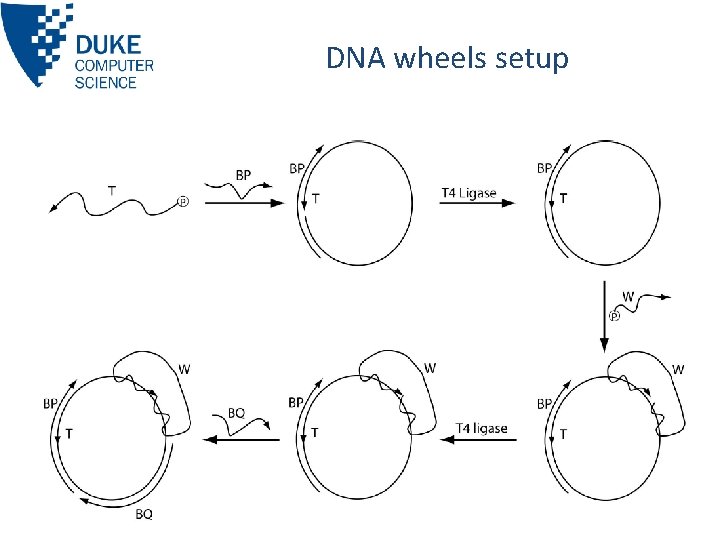
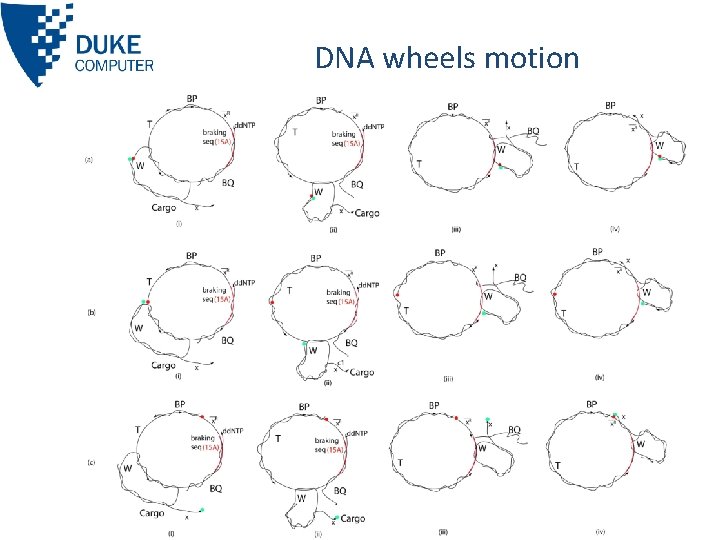
DNA Wheels Sudheer Sahu, Thomas H. La. Bean and John H. Reif, A DNA Nanotransport Device Powered by Polymerase ϕ 29, Nano Letters, 2008, 8 (11), pp 3870– 3878, (October, 2008) • phi-29 strand displacing polymerase • Pushes cargo strand around a circular track

Walker powered by Polyerase: 17 Nano transport device powered by phi 29. Polymerase extends the primer BP, and pushes the wheel W on the track T. Protector strand BQ prevents the wheel from moving on its own but is dislodged by polymerase extension of BP on left. S Sahu, T La. Bean, J Reif, A DNA Nanotransport Device Powered by Polymerase φ, Nano Letters, vol. 8, no. 11, pp. 3870 3878, 2008.
DNA wheels setup
DNA wheels motion
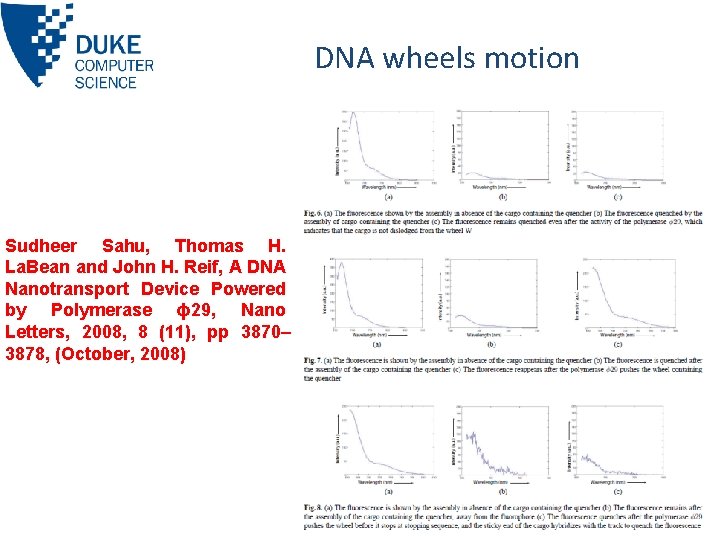
DNA wheels motion Sudheer Sahu, Thomas H. La. Bean and John H. Reif, A DNA Nanotransport Device Powered by Polymerase ϕ 29, Nano Letters, 2008, 8 (11), pp 3870– 3878, (October, 2008)
Autonomous DNA Devices (Using No Enzymes: Fueled by Strand Displacement)
![Autonomous DNA based Nanorobotic devices - no enzymes DNA walker [Tuberfield 2008] S. J.](http://slidetodoc.com/presentation_image_h2/06e8abeb028e32f1998e8fbc15eadfdf/image-22.jpg "Autonomous DNA based Nanorobotic devices - no enzymes DNA walker [Tuberfield 2008] S. J.")
Autonomous DNA based Nanorobotic devices - no enzymes DNA walker [Tuberfield 2008] S. J. Green, J. Bath, and A. J. Turberfield, Coordinated Chemomechanical Cycles: A Mechanism for Autonomous Molecular Motion, Physical Review Letters, 101, 238101 (2008). Two part fuel: complementary hairpins H 1 and H 2. Walker Operation: (i) Competition between feet for binding to the track can lift part of the left foot from the track, and (ii) The lifting of the left foot reveals a toehold domain. (iii) This can bind the complementary toehold domain of H 1, initiating a strand- displacement reaction that opens the neck of H 1 and displaces the left foot from the track (iv). (v) Part of the opened loop H 1 can act as a second toehold to initiate hybridization with H 2 to form a stable waste product (the H 1 H 2 duplex), (vi) displacing H 1 from all but the initial toehold domain of the lifted foot and allowing the foot to rebind the track to the left or right with equal probability
![Autonomous DNA Biped walker Turberfield 2008] - no enzymes S Green, J Bath, A](http://slidetodoc.com/presentation_image_h2/06e8abeb028e32f1998e8fbc15eadfdf/image-23.jpg "Autonomous DNA Biped walker Turberfield 2008] - no enzymes S Green, J Bath, A")
Autonomous DNA Biped walker Turberfield 2008] - no enzymes S Green, J Bath, A Turberfield, Coordinated Chemomechanical Cycles: A Mechanism for Autonomous Molecular Motion, Physical Review Letters, vol. 101, no. 23, 2008. Acts as a Brownian ratchet: Walker moves along a linear track with asymmetric bias towards one end of track, with aid of fuel supplied by DNA hairpins. The trailing foot is more likely to detach from track, and equally likely: • Swings forward ahead of leading foot or • Reattachs back at its original position. => Walker is biased towards stepping forward rather than back, and behaves like a Brownian ratchet. Trailing and leading feet are in competition for the same subsequence on the track. • If trailing foot loses, it exposes a toehold by which fuel strand H 1 invades and detaches it. => Gives asymmetry making detachment of the trailing foot much more likely. • Once detached, a further fuel strand H 2 takes away H 1 and allows the foot to attach back to the track, either at the same location or a forward step
![Autonomous DNA based Nanorobotic devices – no enzymes DNA Biped walker [Yin 2008] P](http://slidetodoc.com/presentation_image_h2/06e8abeb028e32f1998e8fbc15eadfdf/image-24.jpg "Autonomous DNA based Nanorobotic devices – no enzymes DNA Biped walker [Yin 2008] P")
Autonomous DNA based Nanorobotic devices – no enzymes DNA Biped walker [Yin 2008] P Yin, H Choi, C Calvert, N Pierce, Programming Biomolecular Self-assembly Pathways, Nature, vol. 451, no. 7176, pp. 318 -322, 2008. A biped walker walks hand over hand along stators attached to a double stranded linear track. Stators are in the form of hairpins The process is autonomous because the stators have identical sequence and the two legs of the walkers have the identical complementary sequences The walker is driven forward when its trailing leg is detached from the stator by the fuel strand B via a toehold-mediated strand displacement process and the leg swings over to the next stator in line. Detachment Possibilities: • 50% chance at each step that the leading foot is detached from the stator, in which case the walker halts. • slight probability that both the legs of the walker detach from the track.
![Autonomous DNA based Nanorobotic devices – no enzymes Autonomous DNA Biped walker [Seeman 2009]](http://slidetodoc.com/presentation_image_h2/06e8abeb028e32f1998e8fbc15eadfdf/image-25.jpg "Autonomous DNA based Nanorobotic devices – no enzymes Autonomous DNA Biped walker [Seeman 2009]")
Autonomous DNA based Nanorobotic devices – no enzymes Autonomous DNA Biped walker [Seeman 2009] Tosan Omabegho, Ruojie Sha, and Nadrian C. Seeman. A Bipedal DNA Brownian Motor with Coordinated Legs. Science, 2009; 324 (5923): 67 DOI: 10. 1126/science. 1170336
![Autonomous DNA Biped walker [Seeman 2009] Tosan Omabegho, Ruojie Sha, and Nadrian C. Seeman.](http://slidetodoc.com/presentation_image_h2/06e8abeb028e32f1998e8fbc15eadfdf/image-26.jpg "Autonomous DNA Biped walker [Seeman 2009] Tosan Omabegho, Ruojie Sha, and Nadrian C. Seeman.")
Autonomous DNA Biped walker [Seeman 2009] Tosan Omabegho, Ruojie Sha, and Nadrian C. Seeman. A Bipedal DNA Brownian Motor with Coordinated Legs. Science, 2009; 324 (5923): 67 DOI: 10. 1126/science. 1170336 Illustration of the DX track structure with the walker on it. • The walker is shown on stem loops T 1 and T 2. • The walker’s 5′, 5′ linkage is denoted by two black dots and its 3′ ends by half arrows. • T 16 denotes flexible polythymidine linkers on the walker and two fuel hairpins, F 1 and F 2. • Two T 5 regions provide flexibility at the base of the track stem loops.
![Autonomous DNA Biped walker [Seeman 2009] (C) The walker is programmed to take two](http://slidetodoc.com/presentation_image_h2/06e8abeb028e32f1998e8fbc15eadfdf/image-27.jpg "Autonomous DNA Biped walker [Seeman 2009] (C) The walker is programmed to take two")
Autonomous DNA Biped walker [Seeman 2009] (C) The walker is programmed to take two steps from RS-1 to RS-3 with the addition of F 1 and F 2 simultaneously (middle). A single step is made from RS-1 to RS-2 with the addition of F 1 alone (top). • With the addition of F 2 alone, the walker does not move • Only with the further addition of F 1 does the walker make the transition from RS-1 to RS-3 (bottom). (D) With the T 4 fuel-grabbing sequence c restored, the walker transitions to RS-4, incorporating another F 1 into the track, thereby kicking L-O off of T 3.
![Autonomous DNA Biped walker [Seeman 2009] Tosan Omabegho, Ruojie Sha, and Nadrian C. Seeman.](http://slidetodoc.com/presentation_image_h2/06e8abeb028e32f1998e8fbc15eadfdf/image-28.jpg "Autonomous DNA Biped walker [Seeman 2009] Tosan Omabegho, Ruojie Sha, and Nadrian C. Seeman.")
Autonomous DNA Biped walker [Seeman 2009] Tosan Omabegho, Ruojie Sha, and Nadrian C. Seeman. A Bipedal DNA Brownian Motor with Coordinated Legs. Science, 2009; 324 (5923): 67 DOI: 10. 1126/science. 1170336 Transition from RS 1 to RS 2: In eight sequential frames, this illustration depicts the biped taking one step. Illustrations 1 to 5 depict the activation of F 1 by T 2 and the release of L-O from T 1 by F 1. The freed leg L-O then begins the catalyzed release of L-E from T 2 (illustrations 6 to 8). Key to directionally biasing the biped, illustration 3 shows how the activated fuel strands are spatially restricted to act on the stem loop 7 nm away rather than the stem loop 21 nm away
![Autonomous DNA Biped walker [Seeman 2009] Tosan Omabegho, Ruojie Sha, and Nadrian C. Seeman.](http://slidetodoc.com/presentation_image_h2/06e8abeb028e32f1998e8fbc15eadfdf/image-29.jpg "Autonomous DNA Biped walker [Seeman 2009] Tosan Omabegho, Ruojie Sha, and Nadrian C. Seeman.")
Autonomous DNA Biped walker [Seeman 2009] Tosan Omabegho, Ruojie Sha, and Nadrian C. Seeman. A Bipedal DNA Brownian Motor with Coordinated Legs. Science, 2009; 324 (5923): 67 DOI: 10. 1126/science. 1170336 Psoralen cross linking and 32 P labeling. (A) A detailed picture of the UV-activated psoralen crosslinking reaction between the track stem loops and the walker. The psoralen on the stem loops covalently links to the thymidines on the walker’s legs just outside the duplex formed by the stem loops and the walker’s legs. (B) Visualizing the cross-link products with 32 P. The three cross-linked products w-t (walker linked to the stem -loop on its trailing leg), w-l (walker linked to the stem-loop on its leading leg), and w-t-l (walker linked on both its trailing and leading leg) are shown forming in each experiment (W*, T 1*, T 2*, T 3*, and T 4*) that they are visible for each resting state (RS-1, RS-2, RS-3, and RS-4) of the system. The radioactive strand is drawn in red and the nonradioactive strands that are part of the cross-linked complex are drawn in blue. The constituent components of the products formed are listed in each box. (C) Denatured topologies and size of the three walker–stem-loop cross-link products w-t, w-l, and w-t-l.
![DNA Motor Fueled by Hybridization [Venkatarama 2007] – no enzymes S Venkataraman, R Dirks,](http://slidetodoc.com/presentation_image_h2/06e8abeb028e32f1998e8fbc15eadfdf/image-30.jpg "DNA Motor Fueled by Hybridization [Venkatarama 2007] – no enzymes S Venkataraman, R Dirks,")
DNA Motor Fueled by Hybridization [Venkatarama 2007] – no enzymes S Venkataraman, R Dirks, P Rothemund, E Winfree, N Pierce, An Autonomous Polymerization Motor Powered by DNA Hybridization, Nature Nanotechnology, vol. 2, pp. 490 -494, 2007. A DNA motor inspired by bacterial pathogens like Rickettsia rickettsii. • The motor transports a single stranded cargo by (non enzymic) polymerization, with the cargo always located at the growing end of the polymer. • The system consists of two meta stable hairpins H 1 and H 2 and an initiator strand (A) which carries the cargo (R) • Initiator triggers a chain reaction building a linear double stranded polymer, with each hairpin unfolding to attach as a bridge between two hairpins of the other type. The byproduct of the polymerization is the transport of the cargo relative to the initiator strand.
Autonomous DNA Walkers that Navagate Networks (Using No Enzymes: Fueled by Strand Displacement)
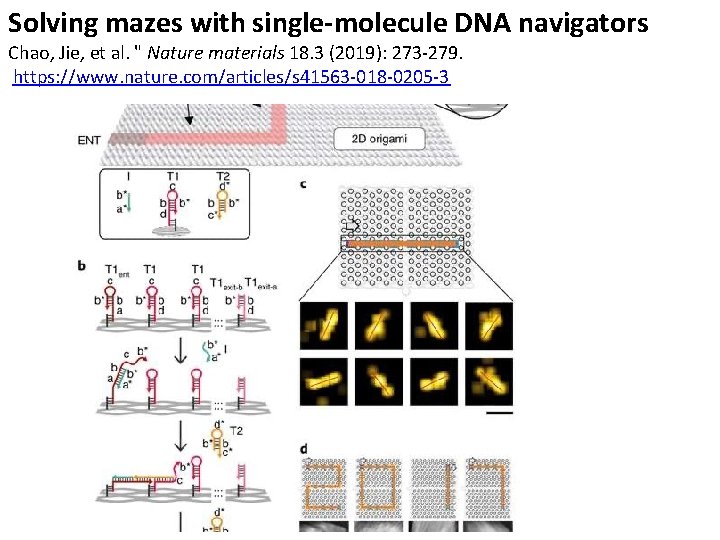
Solving mazes with single molecule DNA navigators Cargo-sorting DNA robots Chao, Jie, et al. " Nature materials 18. 3 (2019): 273 -279. https: //www. nature. com/articles/s 41563 -018 -0205 -3
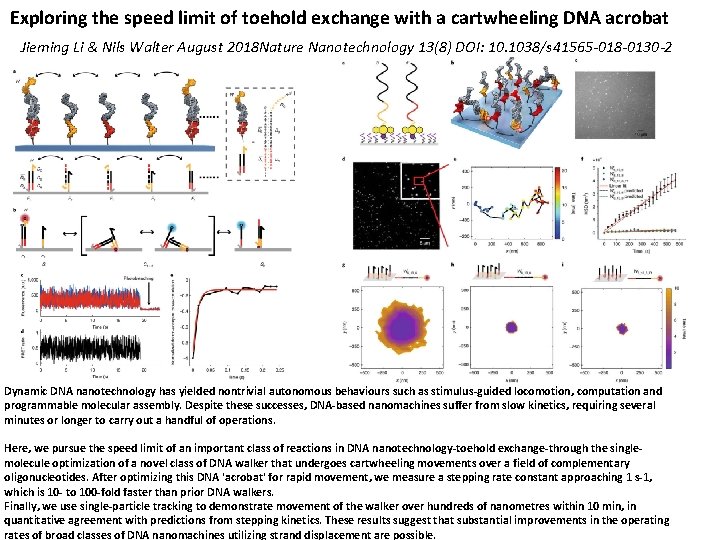
Exploring the speed limit of toehold exchange with a cartwheeling DNA acrobat Jieming Li & Nils Walter August 2018 Nature Nanotechnology 13(8) DOI: 10. 1038/s 41565 -018 -0130 -2 Dynamic DNA nanotechnology has yielded nontrivial autonomous behaviours such as stimulus guided locomotion, computation and programmable molecular assembly. Despite these successes, DNA based nanomachines suffer from slow kinetics, requiring several minutes or longer to carry out a handful of operations. Here, we pursue the speed limit of an important class of reactions in DNA nanotechnology toehold exchange through the single molecule optimization of a novel class of DNA walker that undergoes cartwheeling movements over a field of complementary oligonucleotides. After optimizing this DNA 'acrobat' for rapid movement, we measure a stepping rate constant approaching 1 s 1, which is 10 to 100 fold faster than prior DNA walkers. Finally, we use single particle tracking to demonstrate movement of the walker over hundreds of nanometres within 10 min, in quantitative agreement with predictions from stepping kinetics. These results suggest that substantial improvements in the operating rates of broad classes of DNA nanomachines utilizing strand displacement are possible.
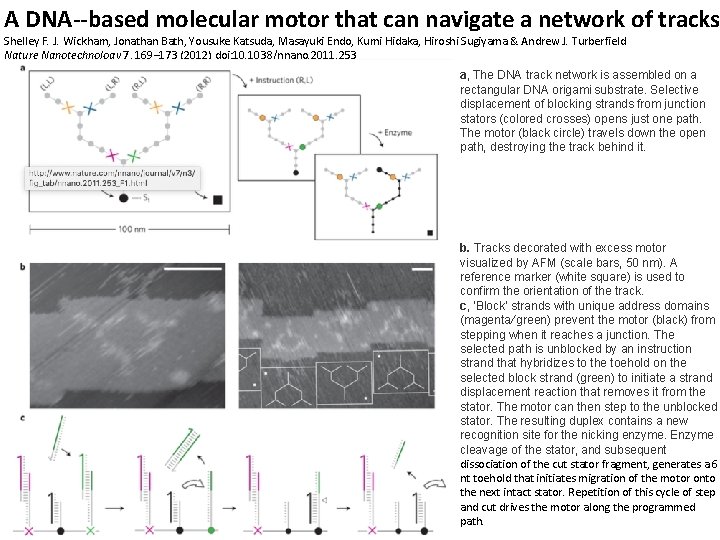
A DNA based molecular motor that can navigate a network of tracks Cargo-sorting DNA robots Shelley F. J. Wickham, Jonathan Bath, Yousuke Katsuda, Masayuki Endo, Kumi Hidaka, Hiroshi Sugiyama & Andrew J. Turberfield Nature Nanotechnology 7, 169– 173 (2012) doi: 10. 1038/nnano. 2011. 253 a, The DNA track network is assembled on a rectangular DNA origami substrate. Selective displacement of blocking strands from junction stators (colored crosses) opens just one path. The motor (black circle) travels down the open path, destroying the track behind it. b. Tracks decorated with excess motor visualized by AFM (scale bars, 50 nm). A reference marker (white square) is used to confirm the orientation of the track. c, ‘Block’ strands with unique address domains (magenta/green) prevent the motor (black) from stepping when it reaches a junction. The selected path is unblocked by an instruction strand that hybridizes to the toehold on the selected block strand (green) to initiate a strand displacement reaction that removes it from the stator. The motor can then step to the unblocked stator. The resulting duplex contains a new recognition site for the nicking enzyme. Enzyme cleavage of the stator, and subsequent dissociation of the cut stator fragment, generates a 6 nt toehold that initiates migration of the motor onto the next intact stator. Repetition of this cycle of step and cut drives the motor along the programmed path.
Autonomous DNA Devices that Deliver Cargo as They Walk (Using No Enzymes: Fueled by Strand Displacement)
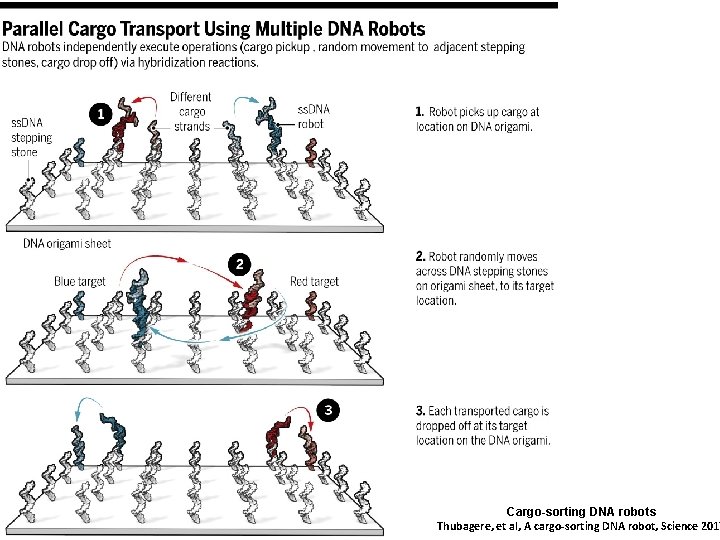
Cargo-sorting DNA robots Thubagere, et al, A cargo sorting DNA robot, Science 2017 § § § They demonstrate three modular building blocks for a DNA robot that performs cargo sorting at the molecular level. A simple algorithm encoding recognition between cargos and their destinations allows for a simple robot design, a single-stranded DNA with one leg and two foot domains for walking, and one arm and one hand domain for picking up and dropping off cargos. The robot explores a two-dimensional testing ground on the surface of DNA origami, picks up multiple cargos of two types that are initially at unordered locations and delivers them to specified destinations, until all molecules are sorted into two distinct piles. The robot is designed to perform a random walk without any energy supply. Exploiting this feature, a single robot can repeatedly sort multiple cargos. Localization on DNA origami allows for distinct cargo-sorting tasks to take place simultaneously in one test tube, or for multiple robots to collectively perform the same task
Cargo-sorting DNA robots Thubagere, et al, A cargo sorting DNA robot, Science 2017
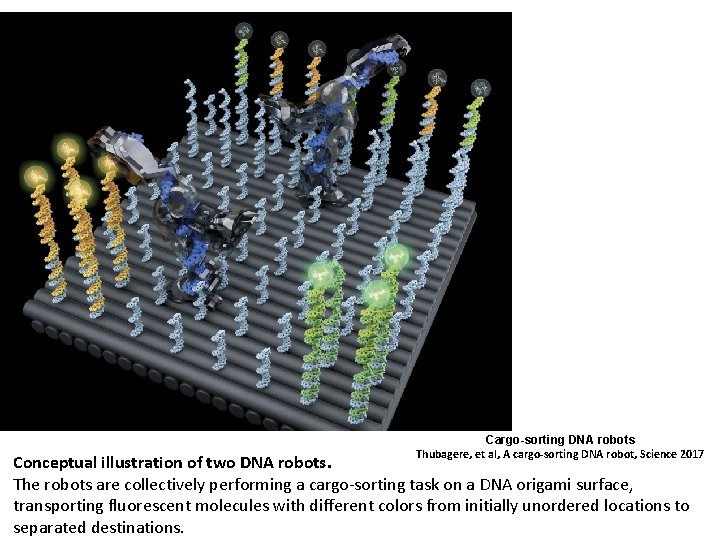
Cargo-sorting DNA robots Thubagere, et al, A cargo sorting DNA robot, Science 2017 Conceptual illustration of two DNA robots. The robots are collectively performing a cargo-sorting task on a DNA origami surface, transporting fluorescent molecules with different colors from initially unordered locations to separated destinations.
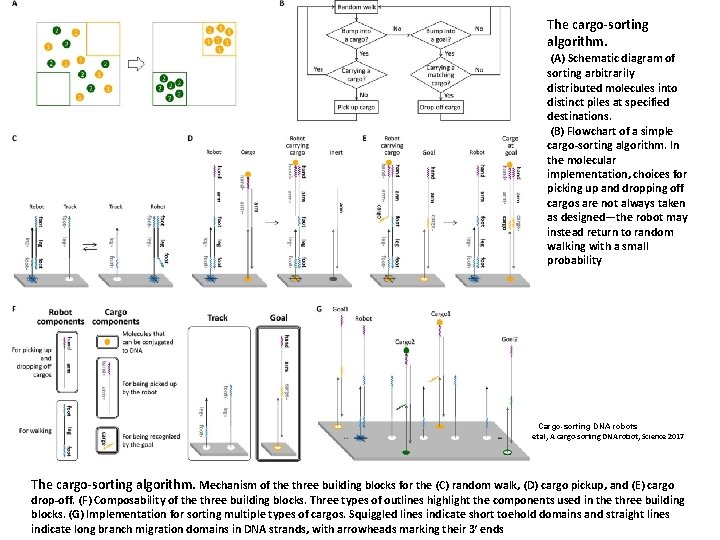
The cargo sorting algorithm. (A) Schematic diagram of sorting arbitrarily distributed molecules into distinct piles at specified destinations. (B) Flowchart of a simple cargo sorting algorithm. In the molecular implementation, choices for picking up and dropping off cargos are not always taken as designed—the robot may instead return to random walking with a small probability Cargo-sorting DNA robots Thubagere, et al, A cargo sorting DNA robot, Science 2017 The cargo sorting algorithm. Mechanism of the three building blocks for the (C) random walk, (D) cargo pickup, and (E) cargo drop off. (F) Composability of the three building blocks. Three types of outlines highlight the components used in the three building blocks. (G) Implementation for sorting multiple types of cargos. Squiggled lines indicate short toehold domains and straight lines indicate long branch migration domains in DNA strands, with arrowheads marking their 3′ ends
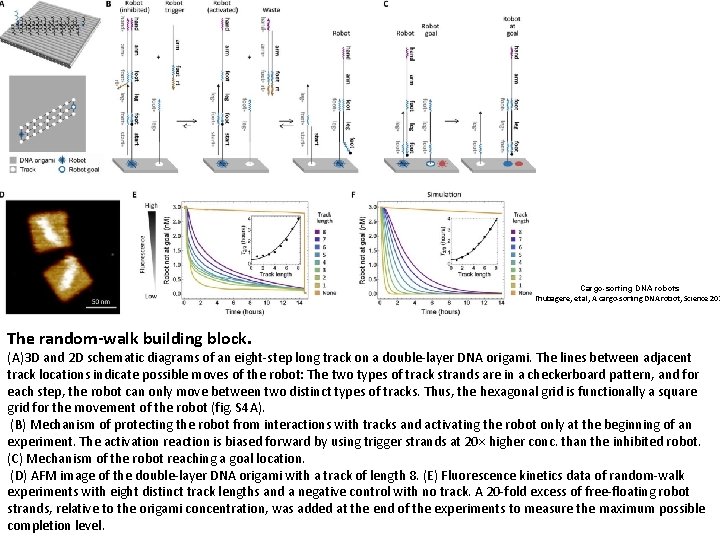
Cargo-sorting DNA robots Thubagere, et al, A cargo sorting DNA robot, Science 201 The random walk building block. (A)3 D and 2 D schematic diagrams of an eight-step long track on a double-layer DNA origami. The lines between adjacent track locations indicate possible moves of the robot: The two types of track strands are in a checkerboard pattern, and for each step, the robot can only move between two distinct types of tracks. Thus, the hexagonal grid is functionally a square grid for the movement of the robot (fig. S 4 A). (B) Mechanism of protecting the robot from interactions with tracks and activating the robot only at the beginning of an experiment. The activation reaction is biased forward by using trigger strands at 20× higher conc. than the inhibited robot. (C) Mechanism of the robot reaching a goal location. (D) AFM image of the double-layer DNA origami with a track of length 8. (E) Fluorescence kinetics data of random-walk experiments with eight distinct track lengths and a negative control with no track. A 20 -fold excess of free-floating robot strands, relative to the origami concentration, was added at the end of the experiments to measure the maximum possible completion level.
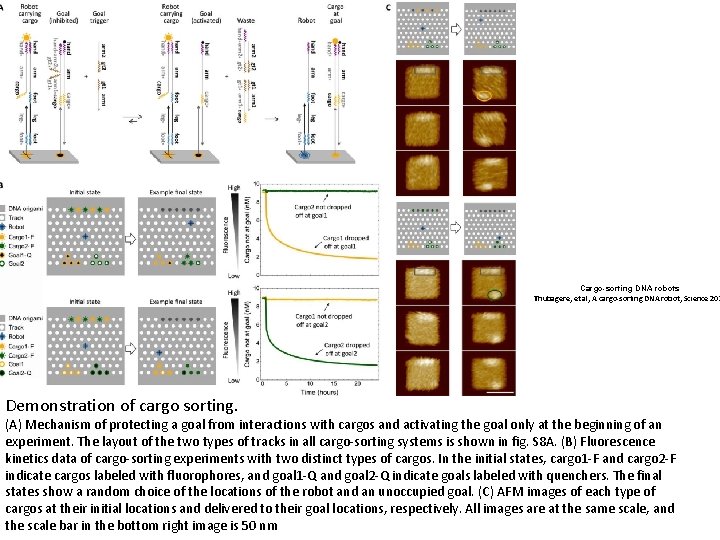
Cargo-sorting DNA robots Thubagere, et al, A cargo sorting DNA robot, Science 201 Demonstration of cargo sorting. (A) Mechanism of protecting a goal from interactions with cargos and activating the goal only at the beginning of an experiment. The layout of the two types of tracks in all cargo-sorting systems is shown in fig. S 8 A. (B) Fluorescence kinetics data of cargo-sorting experiments with two distinct types of cargos. In the initial states, cargo 1 -F and cargo 2 -F indicate cargos labeled with fluorophores, and goal 1 -Q and goal 2 -Q indicate goals labeled with quenchers. The final states show a random choice of the locations of the robot and an unoccupied goal. (C) AFM images of each type of cargos at their initial locations and delivered to their goal locations, respectively. All images are at the same scale, and the scale bar in the bottom right image is 50 nm
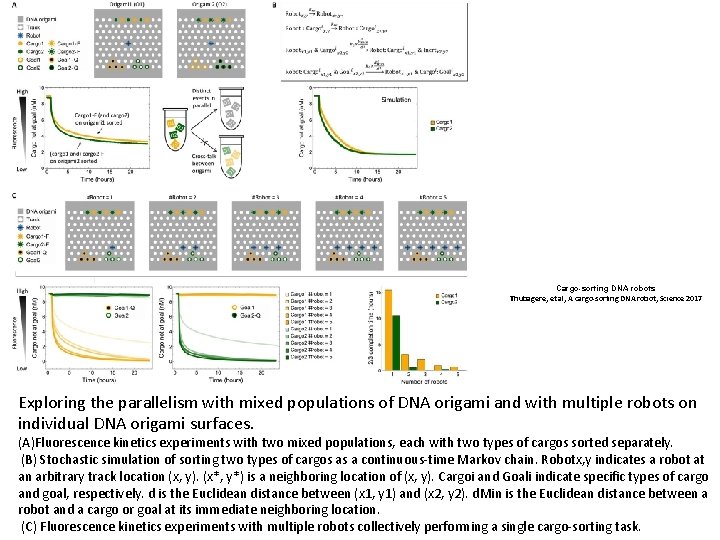
Cargo-sorting DNA robots Thubagere, et al, A cargo sorting DNA robot, Science 2017 Exploring the parallelism with mixed populations of DNA origami and with multiple robots on individual DNA origami surfaces. (A)Fluorescence kinetics experiments with two mixed populations, each with two types of cargos sorted separately. (B) Stochastic simulation of sorting two types of cargos as a continuous-time Markov chain. Robotx, y indicates a robot at an arbitrary track location (x, y). (x*, y*) is a neighboring location of (x, y). Cargoi and Goali indicate specific types of cargo and goal, respectively. d is the Euclidean distance between (x 1, y 1) and (x 2, y 2). d. Min is the Euclidean distance between a robot and a cargo or goal at its immediate neighboring location. (C) Fluorescence kinetics experiments with multiple robots collectively performing a single cargo-sorting task.
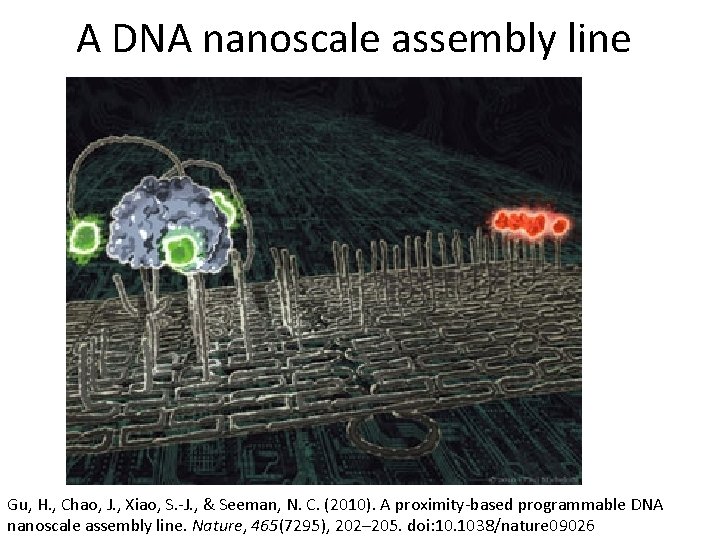
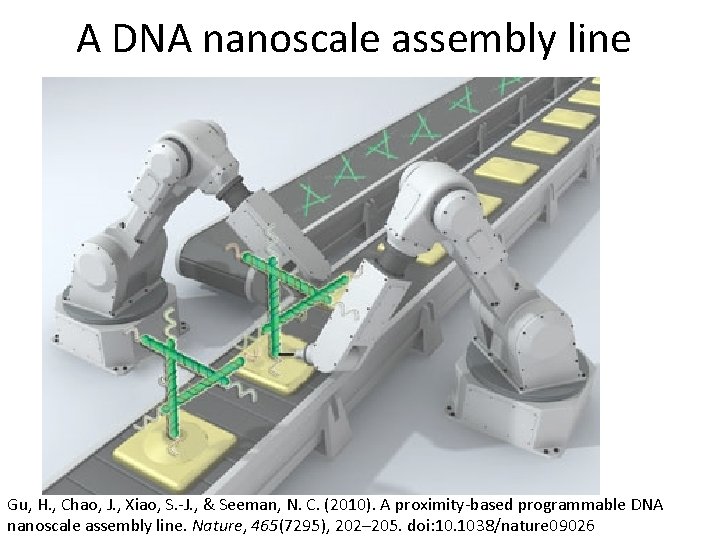
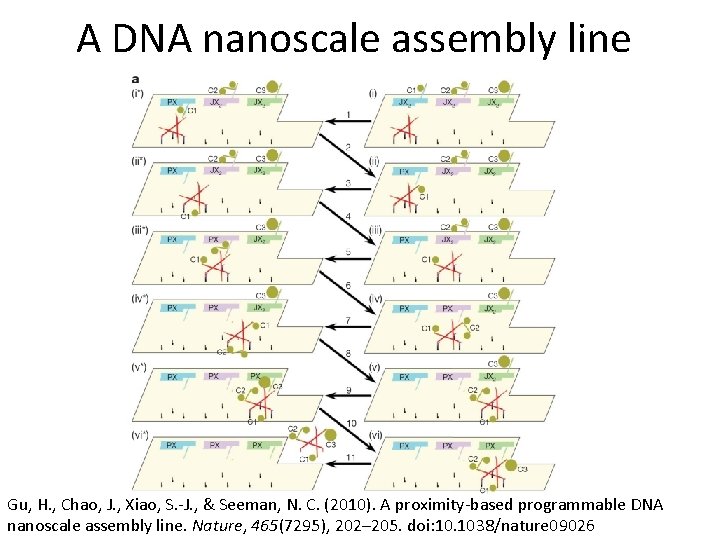
Autonomous DNA Devices that Deliver Cargo as They Walk (Using No Enzymes: Fueled by Strand Displacement) A DNA nanoscale assembly line Hongzhou Gu, Jie Chao, Shou-Jun Xiao & Nadrian C. Seeman A walker that moves along an origami tile, with programmable cassettes that transfer cargo (gold nanoparticles) to the walker’s ‘hands’
A DNA nanoscale assembly line Gu, H. , Chao, J. , Xiao, S. -J. , & Seeman, N. C. (2010). A proximity-based programmable DNA nanoscale assembly line. Nature, 465(7295), 202– 205. doi: 10. 1038/nature 09026
A DNA nanoscale assembly line Gu, H. , Chao, J. , Xiao, S. -J. , & Seeman, N. C. (2010). A proximity-based programmable DNA nanoscale assembly line. Nature, 465(7295), 202– 205. doi: 10. 1038/nature 09026
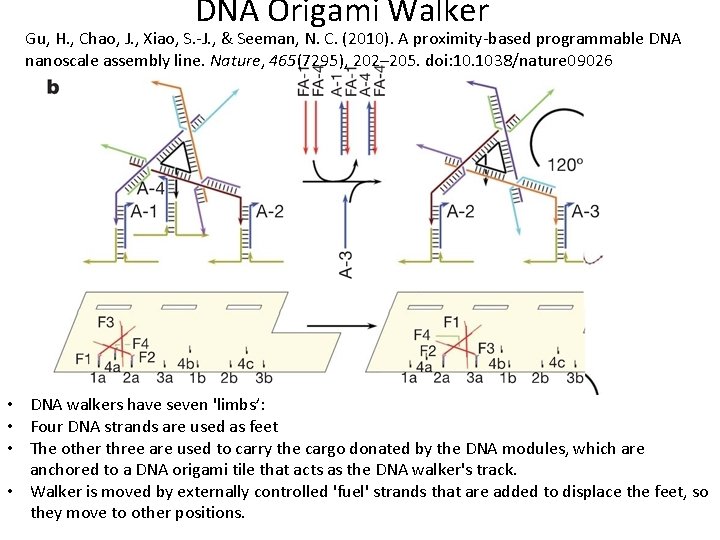
DNA Origami Walker Gu, H. , Chao, J. , Xiao, S. -J. , & Seeman, N. C. (2010). A proximity-based programmable DNA nanoscale assembly line. Nature, 465(7295), 202– 205. doi: 10. 1038/nature 09026 • DNA walkers have seven 'limbs’: • Four DNA strands are used as feet • The other three are used to carry the cargo donated by the DNA modules, which are anchored to a DNA origami tile that acts as the DNA walker's track. • Walker is moved by externally controlled 'fuel' strands that are added to displace the feet, so they move to other positions.
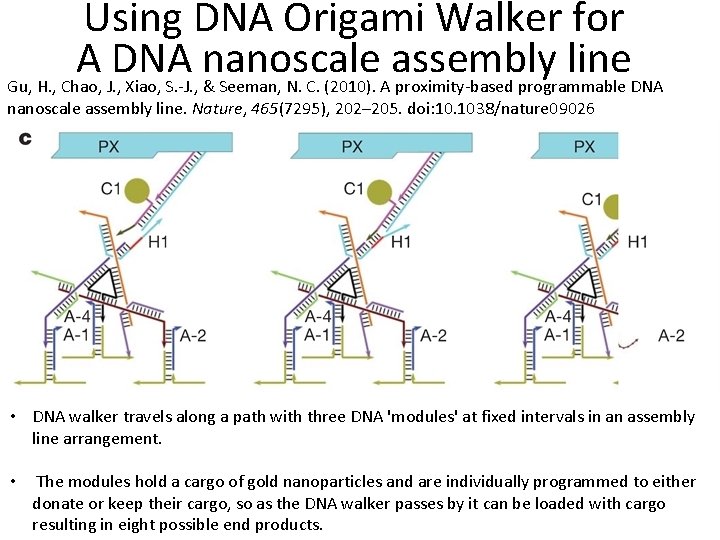
Using DNA Origami Walker for A DNA nanoscale assembly line Gu, H. , Chao, J. , Xiao, S. -J. , & Seeman, N. C. (2010). A proximity-based programmable DNA nanoscale assembly line. Nature, 465(7295), 202– 205. doi: 10. 1038/nature 09026 • DNA walker travels along a path with three DNA 'modules' at fixed intervals in an assembly line arrangement. • The modules hold a cargo of gold nanoparticles and are individually programmed to either donate or keep their cargo, so as the DNA walker passes by it can be loaded with cargo resulting in eight possible end products.
A DNA nanoscale assembly line Gu, H. , Chao, J. , Xiao, S. -J. , & Seeman, N. C. (2010). A proximity-based programmable DNA nanoscale assembly line. Nature, 465(7295), 202– 205. doi: 10. 1038/nature 09026
- Slides: 48