
DNA Barcoding and The Australian Barcode Network www
DNA Barcoding and The Australian Barcode Network www. chromosome. com/dnapic 2. html

ALPHA TAXONOMY Barcoding provides a rapid assessment without the need for detailed morphological expertise in the first instance. More detailed morphological analyses can be undertaken if one is interested in functional morphology, evolutionary adaptations etc. Rapid confirmation of cryptic species.
MORPHO-SPECIES • Morpho-taxa are designated on easily recognizable characteristics but not comprehensively compared with other species or formally described. • How do we determine whether similar looking morphospecies from different locations are the same or different? • DNA barcoding can provide a test of conspecificity. • Morpho-species approach with DNA barcoding can be used to undertake rapid assessment of new biodiversity.
LINKING ADULT and JUVENILE/LARVAL FORMS Linking adult and juvenile stages is often difficult in groups such as marine and freshwater invertebrates, fishes, amphibians and terrestrial invertebrates. Important implication for management of fisheries, marine bio-regionalisation, identifying larvae of pest species and monitoring freshwater quality. Better understanding of dispersal patterns of adults and juveniles. Documenting taxonomic diversity need not rely on adult specimens.
TRACKING LIFE CYCLES OF SPECIES In species with complex life-cycles, especially parasites with multiple hosts, barcoding can be an invaluable tool.
LINKING MALE AND FEMALE MORPHOLOGIES In many Dipteran and Hymenopteran insects, species identity is based on male genital morphology. Female morphology is more conserved and useful at generic alignment but not species identity. Documenting taxonomic diversity need not rely on male specimens only. Better understanding of dispersal of males and females within a species and relative abundances of the sexes.
INVASIVE vs. COSMPOLITAN SPECIES A global approach is needed to identify whether a species is widespread in its distribution, or has dispersed through recent human-mediated events. Regional barcoding programs are a key component. Taxonomic approaches rely on knowledge of taxonomic variation, whereas regional ones are not biased by taxonomic perceptions. BOLD database provides the vehicle for researchers to differentiate between cryptic species, cosmopolitan species and invasive species.
BENEFITS OF DNA BARCODING • DNA barcoding can speed up identification of new species. • DNA barcodes can be linked to readily observable morphological characters. • DNA barcoding can provide an avenue to encourage new participants into taxonomy. • Applied taxonomic research areas will benefit from barcoding.

Barcode of Life - International Consortium Initiative Vision: Plan to launch a large-scale, collaborative program to build comprehensive barcode registry for eukaryotic life Initiator - Paul Hebert, University of Guelph, Ontario Targets: Acquisition of DNA barcode records for 5 M specimens representing 500 K species Timeframe 5 Years Raise $150 M Invitation Australia has been invited to join ICI
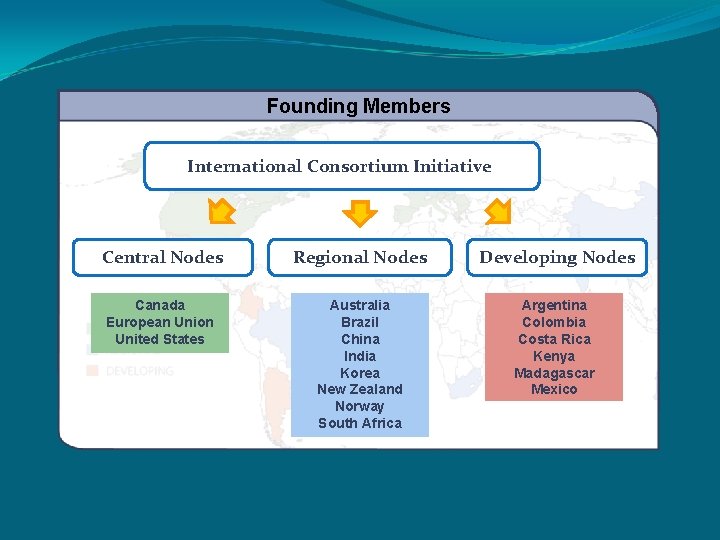
Founding Members International Consortium Initiative Central Nodes Regional Nodes Developing Nodes Canada European Union United States Australia Brazil China India Korea New Zealand Norway South Africa Argentina Colombia Costa Rica Kenya Madagascar Mexico
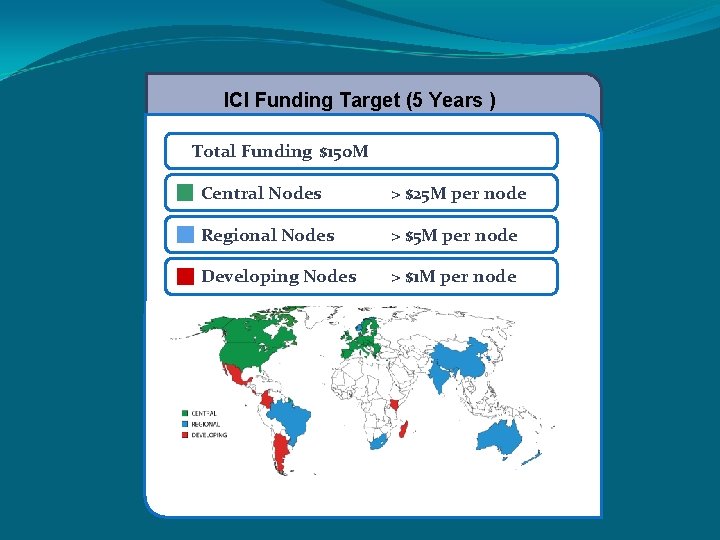
ICI Funding Target (5 Years ) Total Funding $150 M Central Nodes > $25 M per node Regional Nodes > $5 M per node Developing Nodes > $1 M per node
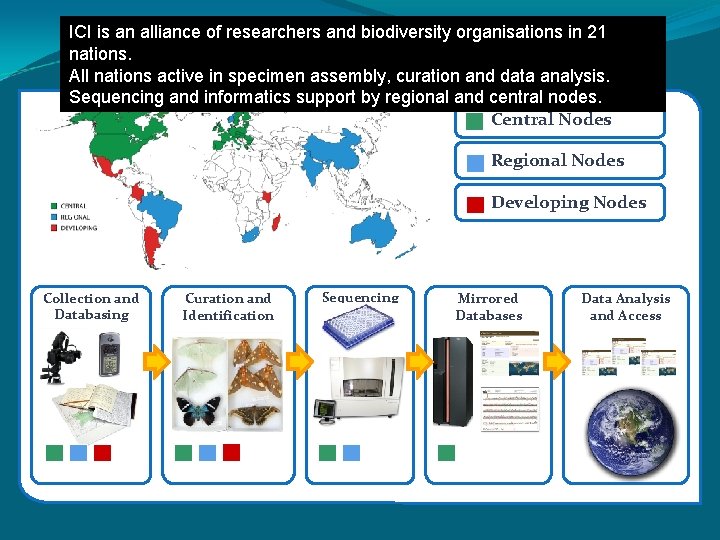
ICI is an alliance of researchers and biodiversity organisations in 21 nations. All nations active in specimen assembly, curation and data analysis. Sequencing and informatics support by regional and central nodes. Central Nodes Regional Nodes Developing Nodes Collection and Databasing Curation and Identification Sequencing Mirrored Databases Data Analysis and Access
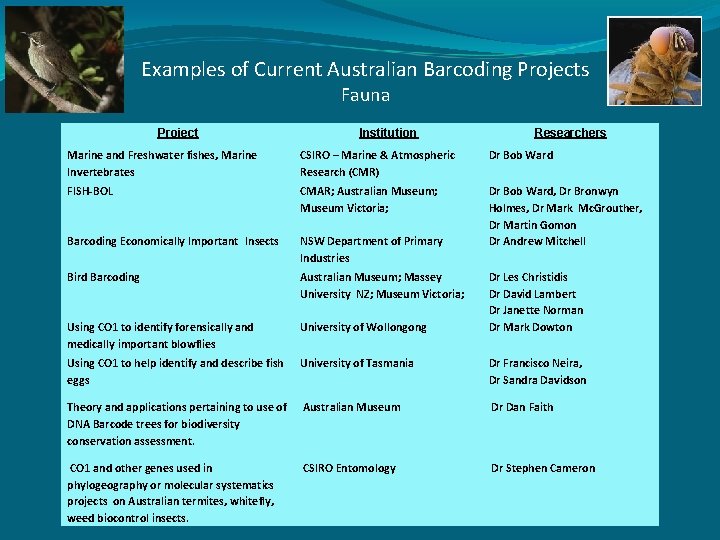
Examples of Current Australian Barcoding Projects Fauna Project Institution Researchers Marine and Freshwater fishes, Marine Invertebrates CSIRO – Marine & Atmospheric Research (CMR) Dr Bob Ward FISH-BOL CMAR; Australian Museum; Museum Victoria; Barcoding Economically Important Insects NSW Department of Primary Industries Dr Bob Ward, Dr Bronwyn Holmes, Dr Mark Mc. Grouther, Dr Martin Gomon Dr Andrew Mitchell Bird Barcoding Australian Museum; Massey University NZ; Museum Victoria; Using CO 1 to identify forensically and medically important blowflies University of Wollongong Using CO 1 to help identify and describe fish eggs University of Tasmania Dr Les Christidis Dr David Lambert Dr Janette Norman Dr Mark Dowton Dr Francisco Neira, Dr Sandra Davidson Theory and applications pertaining to use of Australian Museum DNA Barcode trees for biodiversity conservation assessment. Dr Dan Faith CO 1 and other genes used in phylogeography or molecular systematics projects on Australian termites, whitefly, weed biocontrol insects. Dr Stephen Cameron CSIRO Entomology
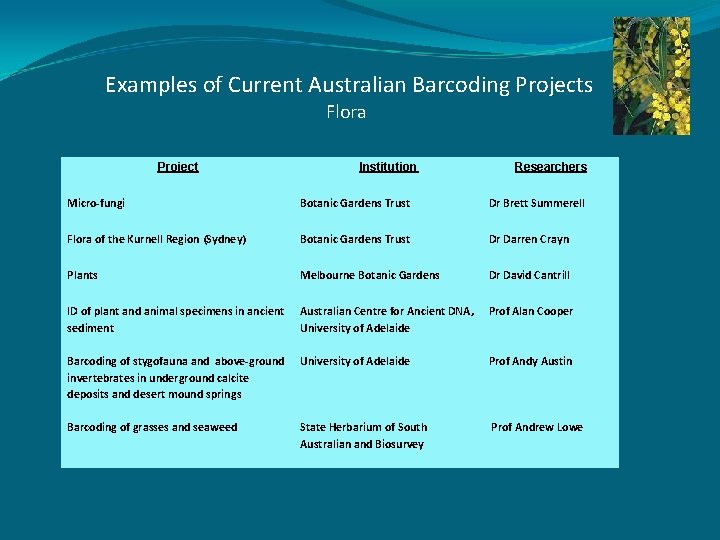
Examples of Current Australian Barcoding Projects Flora Project Institution Researchers Micro-fungi Botanic Gardens Trust Dr Brett Summerell Flora of the Kurnell Region (Sydney) Botanic Gardens Trust Dr Darren Crayn Plants Melbourne Botanic Gardens Dr David Cantrill ID of plant and animal specimens in ancient sediment Australian Centre for Ancient DNA, University of Adelaide Prof Alan Cooper Barcoding of stygofauna and above-ground invertebrates in underground calcite deposits and desert mound springs University of Adelaide Prof Andy Austin Barcoding of grasses and seaweed State Herbarium of South Australian and Biosurvey Prof Andrew Lowe
Australian Barcoding Regional Node to be called The Australian Barcode Network; a decentralised model with a large network of barcode supporters, users and participants; a Steering Committee will facilitate and support the barcoding network; Website to be established as a key means of communication.
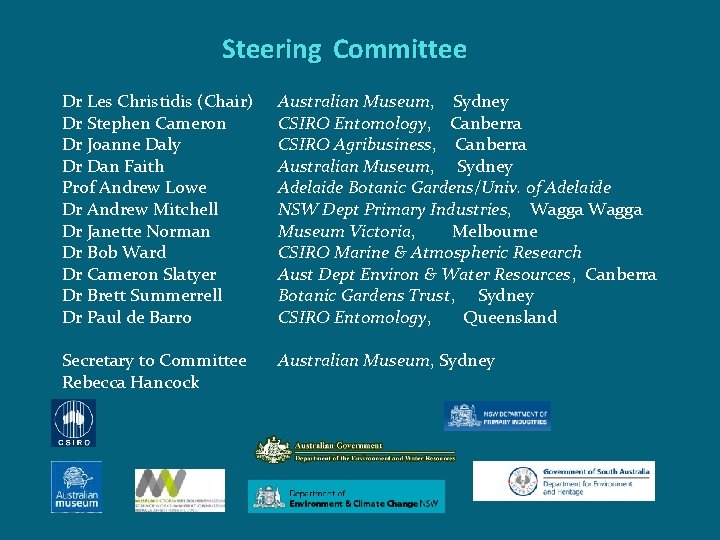
Steering Committee Dr Les Christidis (Chair) Dr Stephen Cameron Dr Joanne Daly Dr Dan Faith Prof Andrew Lowe Dr Andrew Mitchell Dr Janette Norman Dr Bob Ward Dr Cameron Slatyer Dr Brett Summerrell Dr Paul de Barro Australian Museum, Sydney CSIRO Entomology, Canberra CSIRO Agribusiness, Canberra Australian Museum, Sydney Adelaide Botanic Gardens/Univ. of Adelaide NSW Dept Primary Industries, Wagga Museum Victoria, Melbourne CSIRO Marine & Atmospheric Research Aust Dept Environ & Water Resources, Canberra Botanic Gardens Trust, Sydney CSIRO Entomology, Queensland Secretary to Committee Rebecca Hancock Australian Museum, Sydney
Links to International Initiatives CBOL Scientific Advisory Committee Paul de Barro, CSIRO Entomology - Australian representative CBOL fish barcoding Dr Bob Ward, CMAR - co-chair of with Paul Hebert Australian FISH-BOL Dr Bob Ward, CMAR & Martin Gomon, Museum Victoria - co-chair CBOL “All Birds Barcoding Initiative” Dr Les Christidis, Australian Museum, Dr Janette Norman, Museum Victoria, Dr David Lambert, Massey University, NZ - co-regional coordinators CBOL “Leading Lab” network Australian Museum CBOL members - Plant Biodiversity Centre, Adelaide Botanical Gardens; - CSIRO, Hobart; - Australian Plant DNA Bank, Lismore; - National Herbarium of Victoria at Royal Botanic Gardens, Melbourne - Australian Museum, Sydney - Macquarie University, Sydney
Roles of the Steering Committee promoting barcoding for the benefit of Australia; contribute to international initiatives where appropriate; establishing Australian Barcode Network website; informing the Network about barcoding initiatives, support, conferences etc; providing advice on CBOL standards; Workshops /training; negotiating on behalf of barcoders; providing a link for barcoders to government departments – to “wave the flag”; pursue funding opportunities.
- Slides: 18