
DNA Analysis Forensics Chapter 11 DNA DNA fingerprinting

- Slides: 15
DNA Analysis Forensics Chapter 11
DNA � DNA “fingerprinting” is a common way to identify people by their unique genetic code � It is currently being used to identify the perpetrator in a crime, to identify fathers in paternity cases, and to identify unknown remains in mass disasters and other situations � DNA is in every nucleated cell of the human body and can be extracted from blood, semen, urine, bone, hair follicles, and saliva.
Biological Aspects of DNA A basic functional and structural element of all living things is the cell � Cell functions on its own, as in a red blood cell, or in groups, as in tissues or organs � Chromosomes that are inherited from both parents, are long-chain DNA molecules that are tightly bound in a specific structure � Human body has approx. 35, 000 genes, which are simply portions of the DNA the code the information required to make specific proteins � › These proteins determine human traits and functions › Genes have a specific code for a specific body function, are the fundamental unit of heredity, and determine traits of organisms
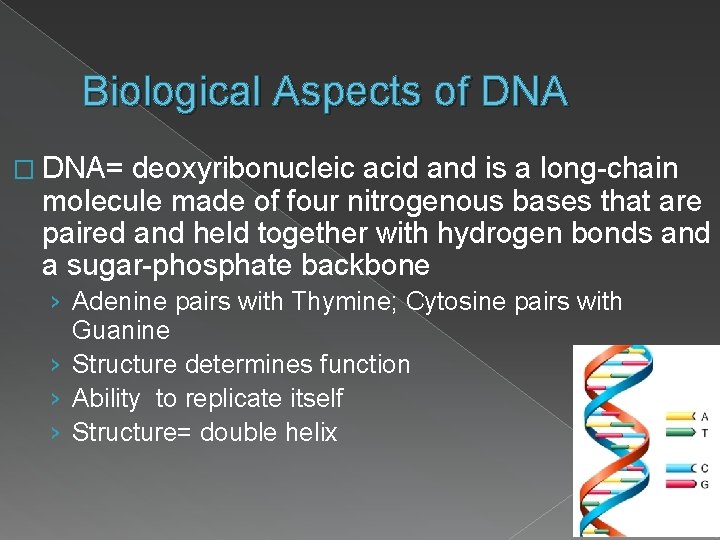
Biological Aspects of DNA � DNA= deoxyribonucleic acid and is a long-chain molecule made of four nitrogenous bases that are paired and held together with hydrogen bonds and a sugar-phosphate backbone › Adenine pairs with Thymine; Cytosine pairs with Guanine › Structure determines function › Ability to replicate itself › Structure= double helix
Biological Aspects of DNA Average DNA molecule contains approx. 100 million nucleotide groups � In humans, the order of these nucleotide bases is 99. 9% the same � The unique sequence of the other 0. 1% makes each human one of a kind (except in identical twins, who have the same DNA) � The sequence of these bases is a code for specific amino acids to combine to make specific proteins � › The sequence of the nucleotide bases is what determines the proteins that will lead to specific growth, functions, and reproduction
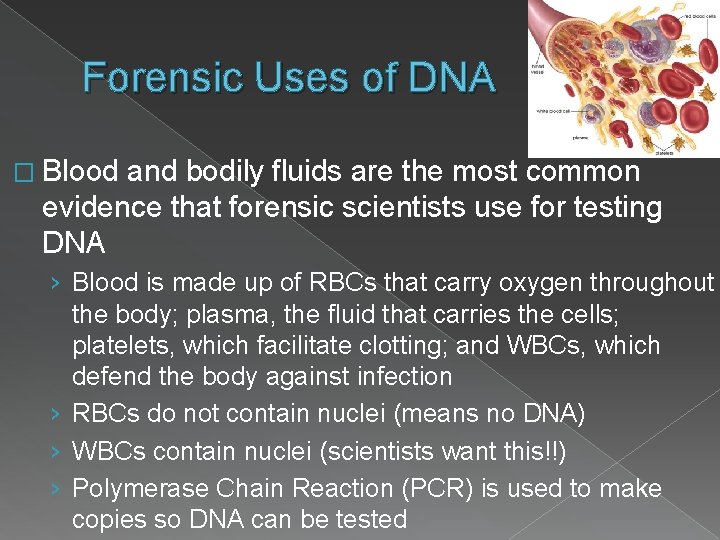
Forensic Uses of DNA � Blood and bodily fluids are the most common evidence that forensic scientists use for testing DNA › Blood is made up of RBCs that carry oxygen throughout the body; plasma, the fluid that carries the cells; platelets, which facilitate clotting; and WBCs, which defend the body against infection › RBCs do not contain nuclei (means no DNA) › WBCs contain nuclei (scientists want this!!) › Polymerase Chain Reaction (PCR) is used to make copies so DNA can be tested
Forensic Uses of DNA � DNA fingerprinting can be useful for many purposes: › To identify potential suspects whose DNA may match evidence left at crime scenes › To clear persons wrongly accused of crimes › To identify crime and catastrophe victims › To establish paternity and other family relationship › To match organ donors with recipients in transplant programs
Forensic Uses of DNA � Samples collected from a crime scene are examined to determine whether the sample is appropriate for DNA analysis…therefore, it must be properly prepared › 1. removed from object › 2. extracted from the cell (DNA must be isolated- no fats, proteins, or carbohydrates) › 3. enzymes used to release DNA from chromosomal packaging. . then it’s ready!
RFLP Analysis for DNA Fingerprinting RFLP- restriction, fragments, lengths, polymorphism � DNA is cut into smaller pieces using restriction enzymes then the sample is run through electrophoresis, which separates the fragments according to size. � Four main procedures in DNA fingerprinting � › Isolation of the DNA to separate the DNA from the cell › Cutting with a restriction enzyme to make shorter base strands › Sorting the segments by size, using an electrophoresis procedure › Analyzing the resulting print by identifying specific alleles
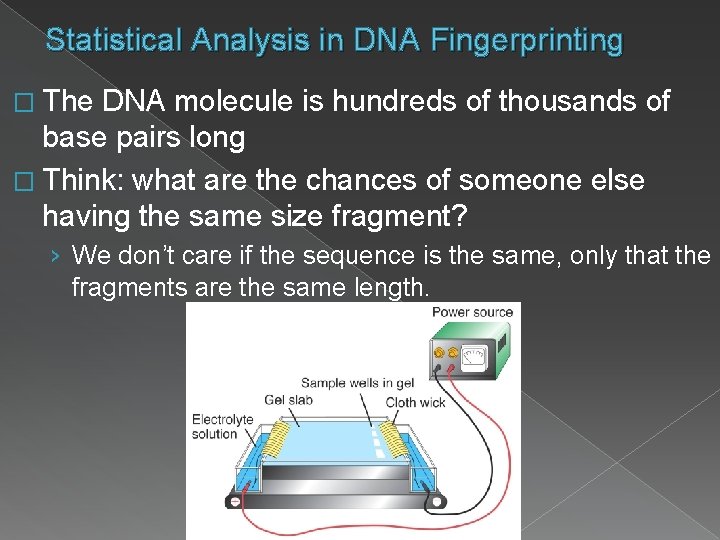
Statistical Analysis in DNA Fingerprinting � The DNA molecule is hundreds of thousands of base pairs long � Think: what are the chances of someone else having the same size fragment? › We don’t care if the sequence is the same, only that the fragments are the same length.
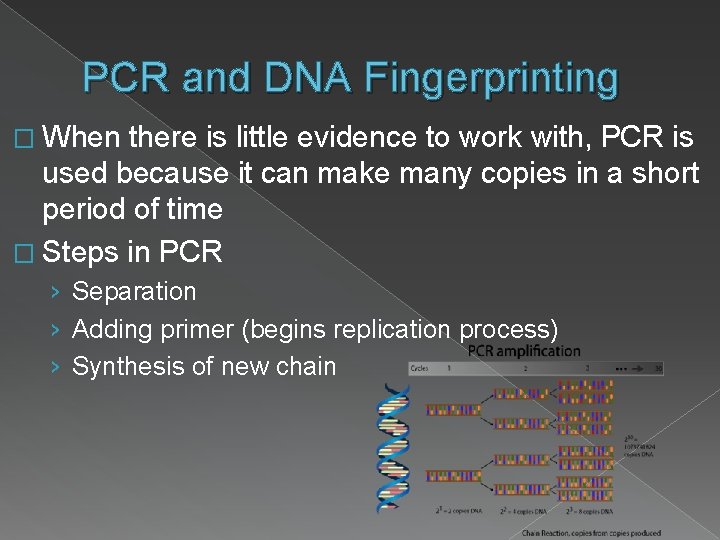
PCR and DNA Fingerprinting � When there is little evidence to work with, PCR is used because it can make many copies in a short period of time � Steps in PCR › Separation › Adding primer (begins replication process) › Synthesis of new chain
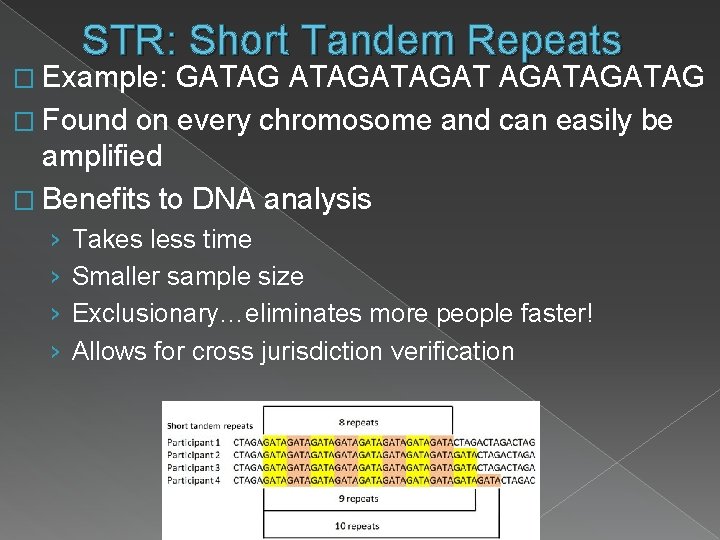
STR: Short Tandem Repeats � Example: GATAGAT AGATAG � Found on every chromosome and can easily be amplified � Benefits to DNA analysis › › Takes less time Smaller sample size Exclusionary…eliminates more people faster! Allows for cross jurisdiction verification
Mitochondrial DNA Another structure in the cell that contains DNA is the mitochondria � Mitochondria are the powerhouses of the cell � Each cell contains thousands of mitochondria, each containing several loops of DNA � m. DNA is inherited from only the mother � › This makes any individual with the same maternal lineage indistinguishable if m. DNA is used for analysis � Techniques scientists use to characterize mitochondrial DNA are significantly more sensitive than the techniques for profiling nuclear DNA…but it’s more expensive › FBI has only a few labs that will do m. DNA testing and there are VERY strict limitations to the cases they will accept.