
DNA 17 Tutorial Theory of Algorithmic Self Assembly
DNA 17 Tutorial: Theory of Algorithmic Self. Assembly with DNA Tiles Dave Doty California Institute of Technology
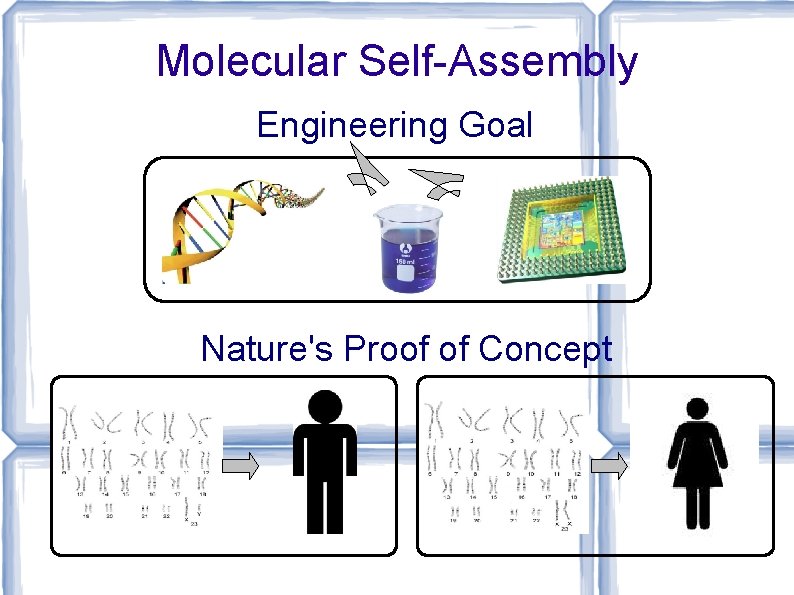
Molecular Self-Assembly Engineering Goal Nature's Proof of Concept
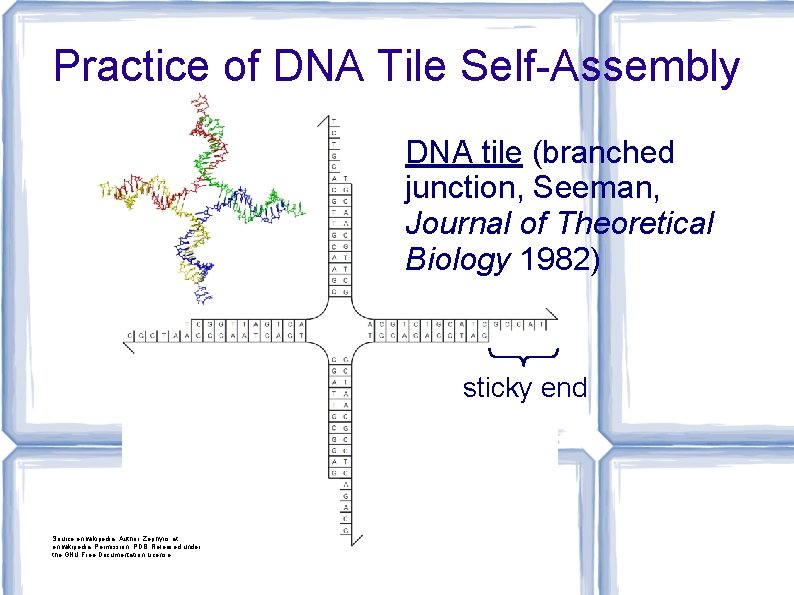
Practice of DNA Tile Self-Assembly DNA tile (branched junction, Seeman, Journal of Theoretical Biology 1982) sticky end Source: en. wikipedia; Author: Zephyris at en. wikipedia; Permission: PDB; Released under the GNU Free Documentation License.
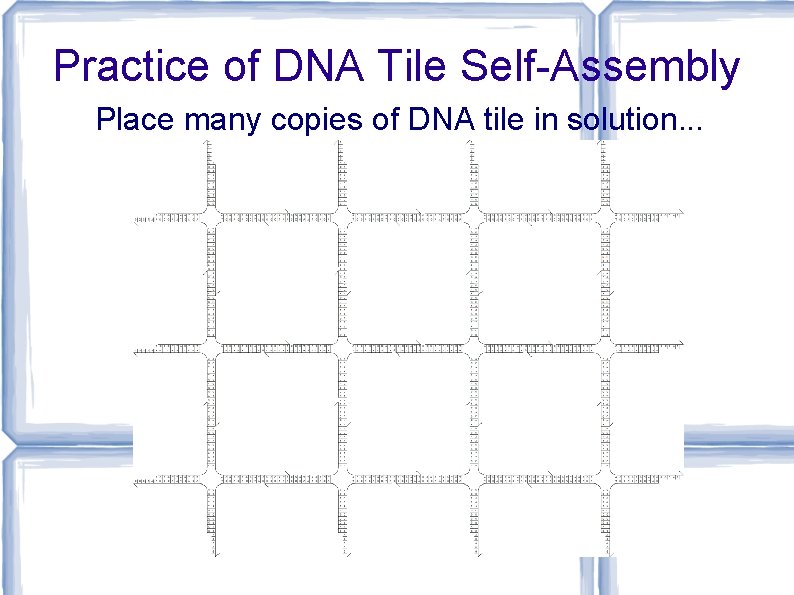
Practice of DNA Tile Self-Assembly Place many copies of DNA tile in solution. . .
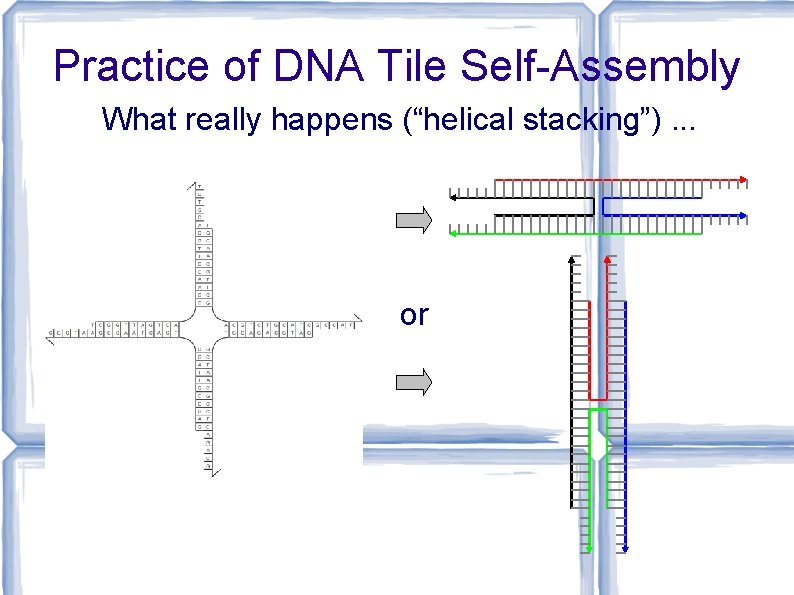
Practice of DNA Tile Self-Assembly What really happens (“helical stacking”). . . or
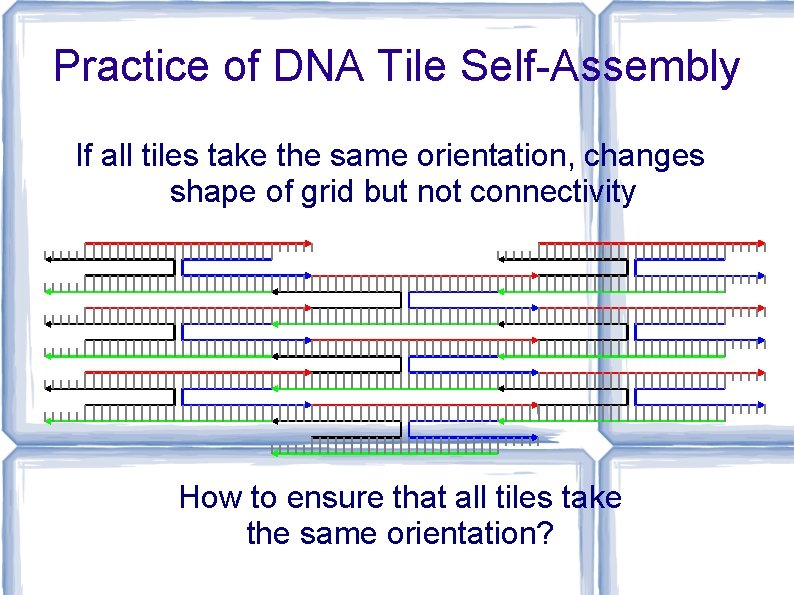
Practice of DNA Tile Self-Assembly If all tiles take the same orientation, changes shape of grid but not connectivity How to ensure that all tiles take the same orientation?
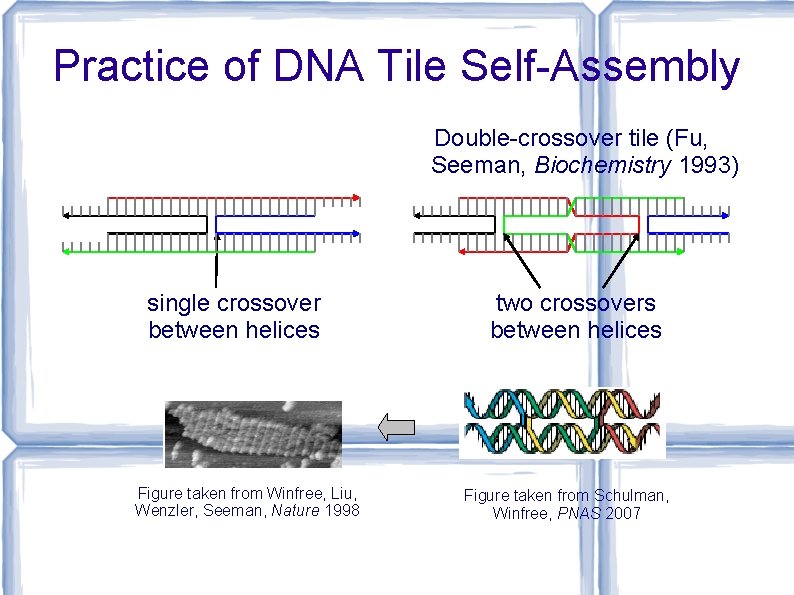
Practice of DNA Tile Self-Assembly Double-crossover tile (Fu, Seeman, Biochemistry 1993) single crossover between helices Figure taken from Winfree, Liu, Wenzler, Seeman, Nature 1998 two crossovers between helices Figure taken from Schulman, Winfree, PNAS 2007

Practice of DNA Tile Self-Assembly Some other tile motifs 4 x 4 tile (Yan, Park, Finkelstein, Reif, La. Bean, Science 2003) triple-crossover tile (La. Bean, Yan, Kopatsch, Liu, Winfree, Reif, Seeman, JACS 2000) single-stranded tile (Yin, Hariadi, Sahu, Choi, Park, La. Bean, Reif, Science 2008) DNA origami tile (Liu, Zhong, Wang, Seeman, Angewandte Chemie 2011)
Theory of Algorithmic Self-Assembly Erik Winfree asked, “What if. . . ” … there is more than one type of tile, with different sticky ends? … some sticky ends are “weak”? (cooperative binding: two sticky ends required to attach tile) Cooperation enables algorithmic behavior.
![Abstract Tile Assembly Model [Winfree, Ph. D. Thesis 1998] tile type = unit square](http://slidetodoc.com/presentation_image_h/73bd1d940c4bfe985904ccebf9b7daf4/image-10.jpg "Abstract Tile Assembly Model [Winfree, Ph. D. Thesis 1998] tile type = unit square")
Abstract Tile Assembly Model [Winfree, Ph. D. Thesis 1998] tile type = unit square each side has a glue, with a label and a strength (0, 1, 2) if tiles with matching glues touch, they are attracted with the glue's strength tiles cannot be rotated strength 0 strength 1 strength 2 finitely many tile types infinitely many tiles: copies of each tile type assembly starts as a single copy of a special seed tile type a tile can attach to the assembly if it binds with total strength at least 2 (the “temperature”)
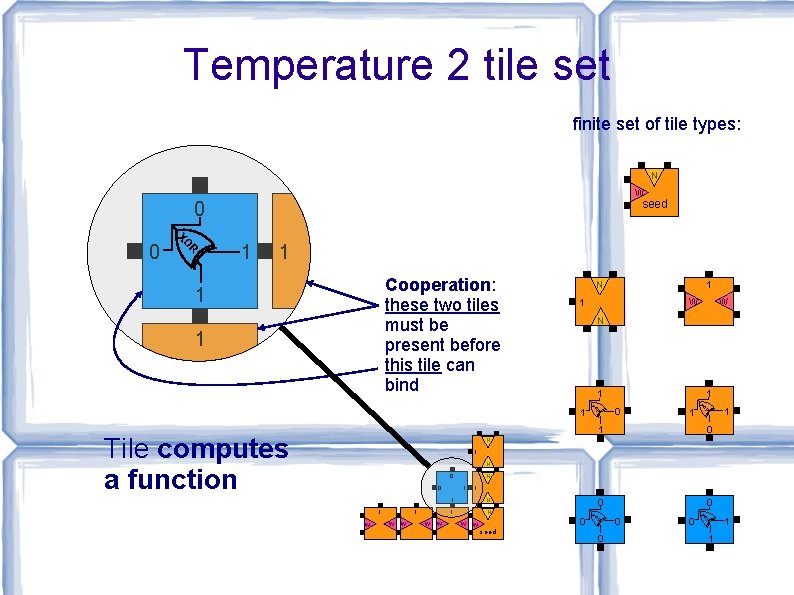
Temperature 2 tile set finite set of tile types: N W seed 0 R XO 0 1 1 Cooperation: these two tiles must be present before this tile can bind 1 1 N W W 1 N 1 1 1 R 0 XO R XO 1 Tile computes a function 1 1 0 0 0 1 N 0 1 0 W W N 1 N W 0 W seed 0 0 0 R XO W 1 1 1 R XO 1 N 1 1
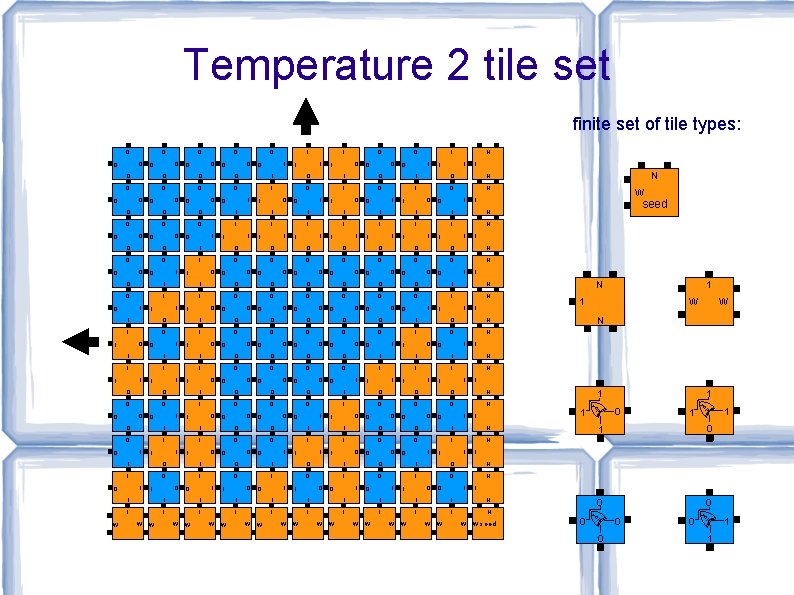
Temperature 2 tile set finite set of tile types: 0 0 0 0 0 1 1 1 0 0 0 N 1 1 0 1 1 1 0 0 0 0 1 0 1 0 1 0 N 0 0 1 0 0 0 0 N 0 0 1 0 0 0 1 0 1 1 0 0 0 1 N 1 0 1 0 0 0 0 0 1 0 1 0 0 0 1 0 N 1 0 0 0 1 0 N 0 1 1 0 0 0 0 0 1 1 0 0 0 0 1 1 1 N 1 1 1 0 1 0 0 0 1 0 1 1 1 0 0 0 N 0 0 1 0 0 0 0 1 0 1 1 0 0 1 N 1 0 1 0 0 1 0 1 0 1 0 N 1 0 1 1 0 0 1 1 1 1 1 N W W W W 0 0 0 W seed 0 0 R XO 1 W 1 1 1 1 W 0 1 1 0 1 R 0 1 1 1 R 1 N XO 1 0 W W 1 XO 0 0 1 1 0 0 N 1 1 1 seed N 1 1 W N 1 1 1 0 1 1 1 1 1 1 0 0 0 0 0 W 0 0 0 1 1
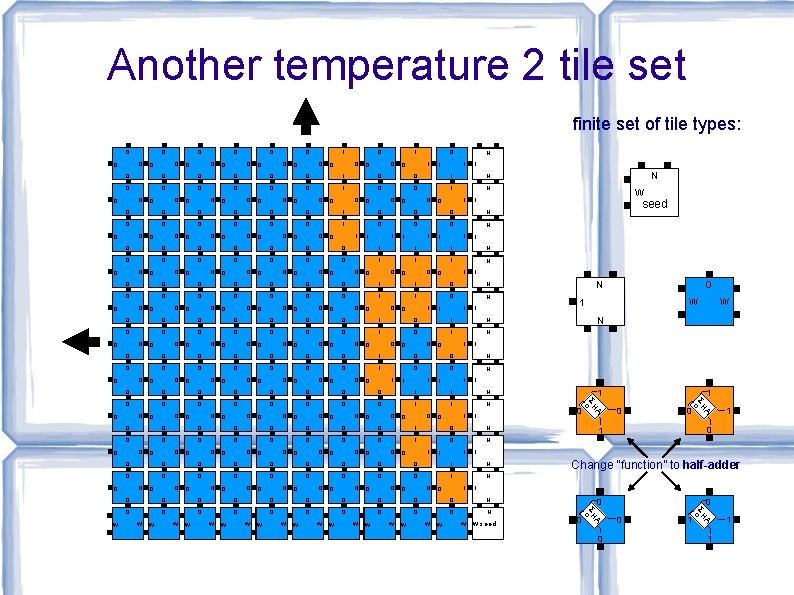
Another temperature 2 tile set finite set of tile types: 0 0 0 0 0 1 1 0 0 0 1 0 0 N 1 0 1 1 1 00 00 01 00 11 00 01 10 N 0 0 1 0 0 1 N 0 0 1 00 00 10 10 10 N 0 0 1 0 1 N 0 0 1 0 0 0 0 1 00 01 01 00 00 10 10 01 N 0 1 0 0 0 1 0 1 1 0 N 1 0 0 0 0 0 0 1 0 1 1 1 01 00 00 10 01 10 N 1 0 0 0 0 1 1 0 0 1 N 0 1 0 0 0 0 0 1 0 01 01 00 00 11 01 01 N 1 0 1 0 0 0 1 1 0 N 1 0 1 0 0 0 0 0 1 1 1 1 00 00 00 01 00 10 10 N 0 0 1 0 0 0 1 N 0 0 1 0 0 0 0 0 1 00 01 01 00 10 01 N 0 1 0 1 0 0 0 1 1 0 N 1 0 0 1 0 0 0 1 0 1 1 00 01 10 N 0 1 0 0 1 N 0 1 0 1 0 0 1 1 0 0 0 1 0 1 0 01 01 1 0 N 1 0 1 0 1 0 N W W W W seed 0 0 1 A W 0 A W Change “function” to half-adder ΣH c 01 W 1 0 1 ΣH c 01 W 0 1 01 0 0 1 A 1 0 N ΣH c 01 0 W W 1 ΣH c 00 0 0 1 00 0 N 1 01 1 0 seed N 1 1 W N 1 0 1 1 N 1 01 1 0 1 1 1 0 01 1 0 01 1 1 0 1 0 1 0 01 1 0 1 0 0 01 1 0 0 0 1 0 0 00 0 00 W 0 0 0 1 1
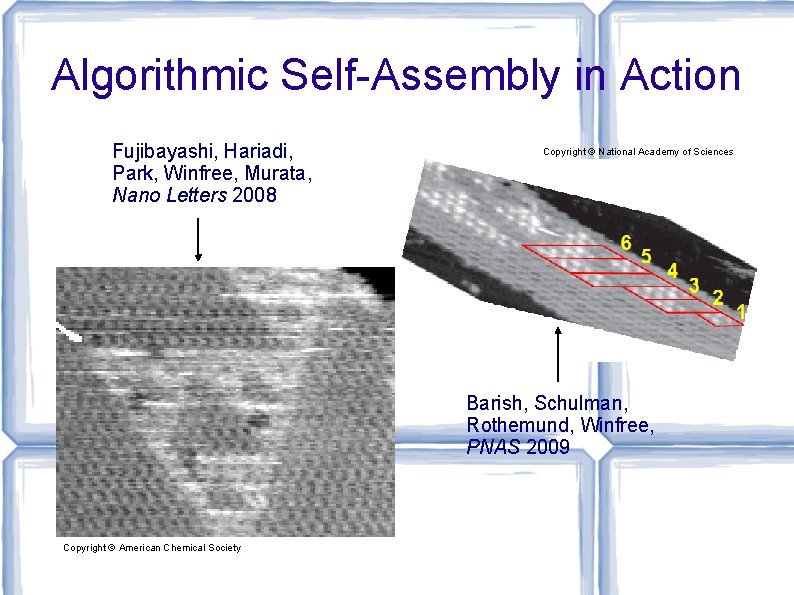
Algorithmic Self-Assembly in Action Fujibayashi, Hariadi, Park, Winfree, Murata, Nano Letters 2008 Copyright © National Academy of Sciences Barish, Schulman, Rothemund, Winfree, PNAS 2009 Copyright © American Chemical Society
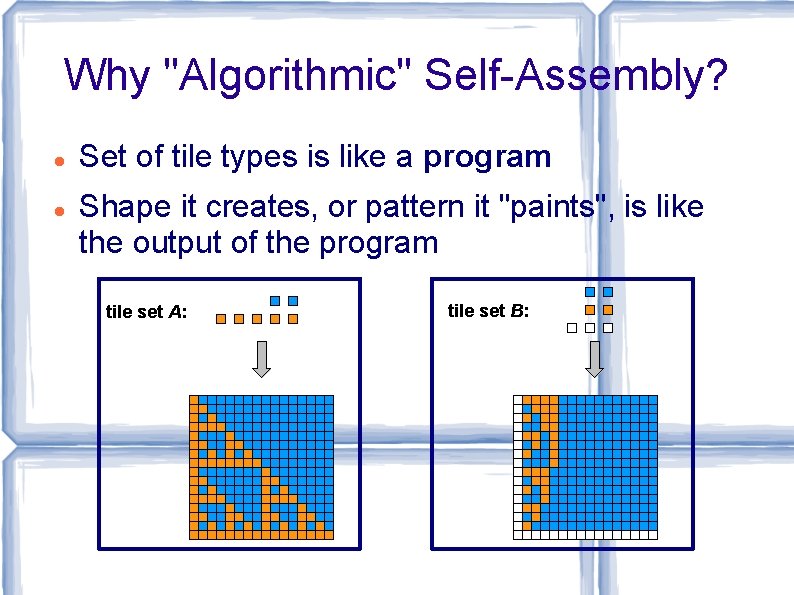
Why "Algorithmic" Self-Assembly? Set of tile types is like a program Shape it creates, or pattern it "paints", is like the output of the program tile set A: tile set B:
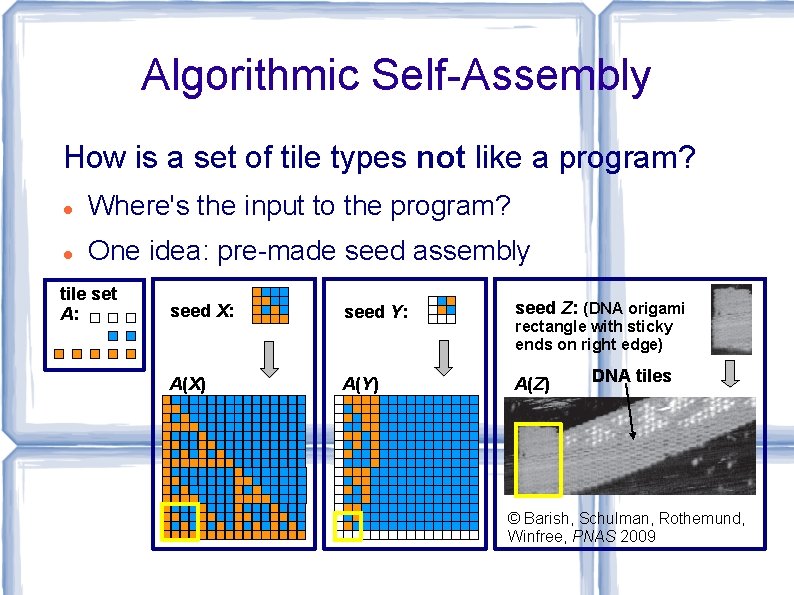
Algorithmic Self-Assembly How is a set of tile types not like a program? Where's the input to the program? One idea: pre-made seed assembly tile set A: seed X: seed Y: seed Z: (DNA origami A(X) A(Y) A(Z) rectangle with sticky ends on right edge) DNA tiles © Barish, Schulman, Rothemund, Winfree, PNAS 2009
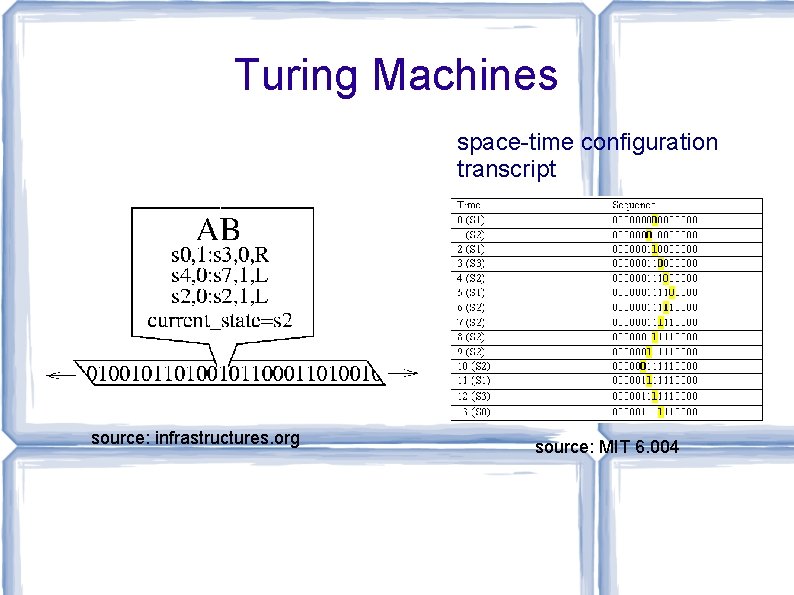
Turing Machines space-time configuration transcript source: infrastructures. org source: MIT 6. 004
(Some) Fundamental Theoretical Results in the a. TAM (in my humble opinion)
![The a. TAM is Turing Universal [Winfree, Ph. D. Thesis, 1998] Informally: tiles can](http://slidetodoc.com/presentation_image_h/73bd1d940c4bfe985904ccebf9b7daf4/image-19.jpg "The a. TAM is Turing Universal [Winfree, Ph. D. Thesis, 1998] Informally: tiles can")
The a. TAM is Turing Universal [Winfree, Ph. D. Thesis, 1998] Informally: tiles can “simulate” any algorithm Theorem: For every Turing machine M, there is a tile set T so that, for every input string x, there is a seed assembly σ of T so that. . . T with seed σ assembles a space-time configuration transcript of M on input x. i. e. , T ≈ program M, σ ≈ data x
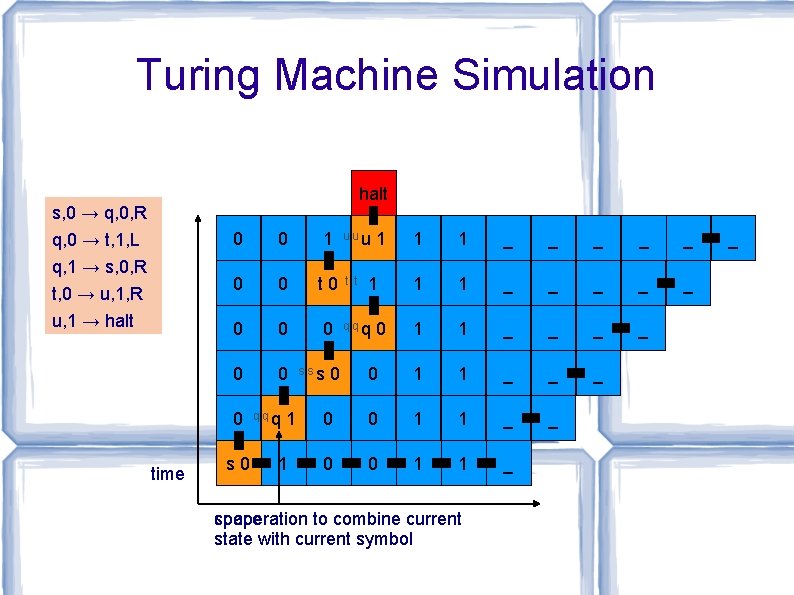
Turing Machine Simulation halt s, 0 → q, 0, R q, 0 → t, 1, L q, 1 → s, 0, R t, 0 → u, 1, R 0 0 1 0 0 t 0 u, 1 → halt 0 0 0 time s 0 qqq 1 1 _ _ _ _ _ 1 1 _ _ 0 1 1 _ _ _ 0 0 1 1 _ sss 0 uuu t t 1 1 qqq 0 space cooperation to combine current state with current symbol _
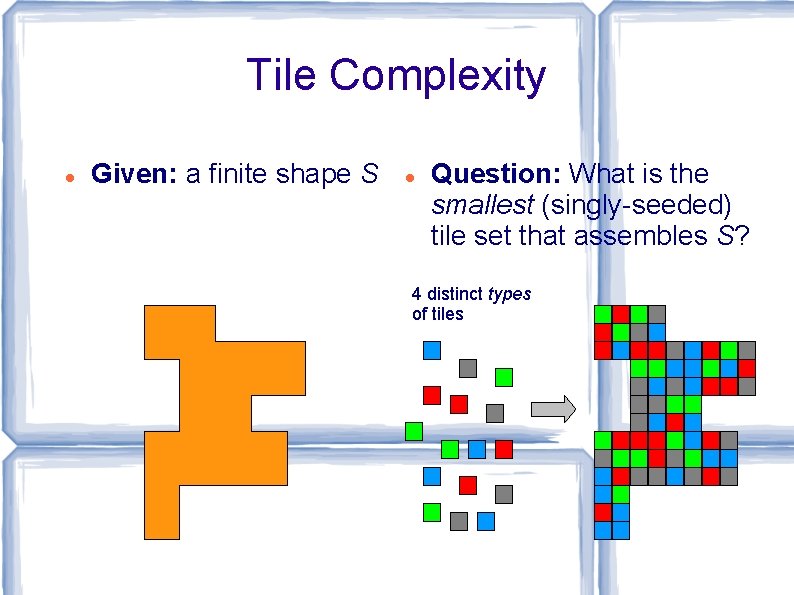
Tile Complexity Given: a finite shape S Question: What is the smallest (singly-seeded) tile set that assembles S? 4 distinct types of tiles
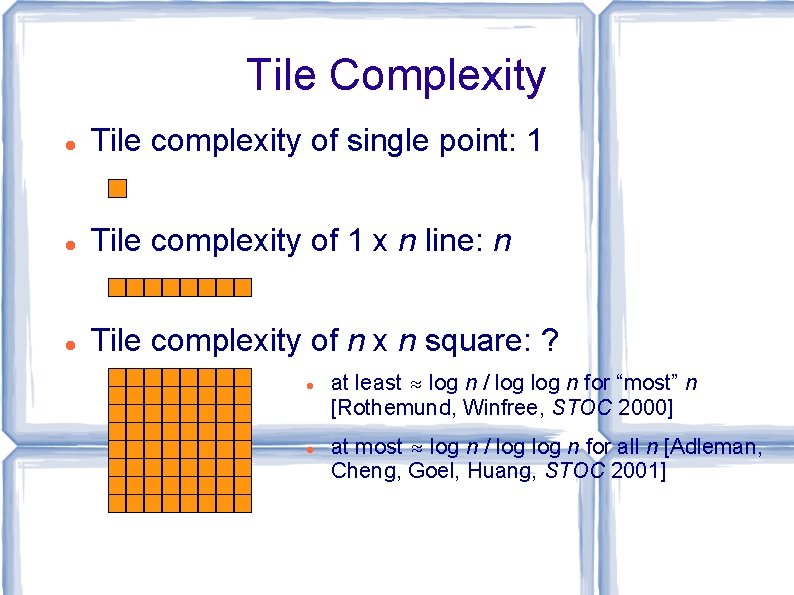
Tile Complexity Tile complexity of single point: 1 Tile complexity of 1 x n line: n Tile complexity of n x n square: ? at least ≈ log n / log n for “most” n [Rothemund, Winfree, STOC 2000] at most ≈ log n / log n for all n [Adleman, Cheng, Goel, Huang, STOC 2001]
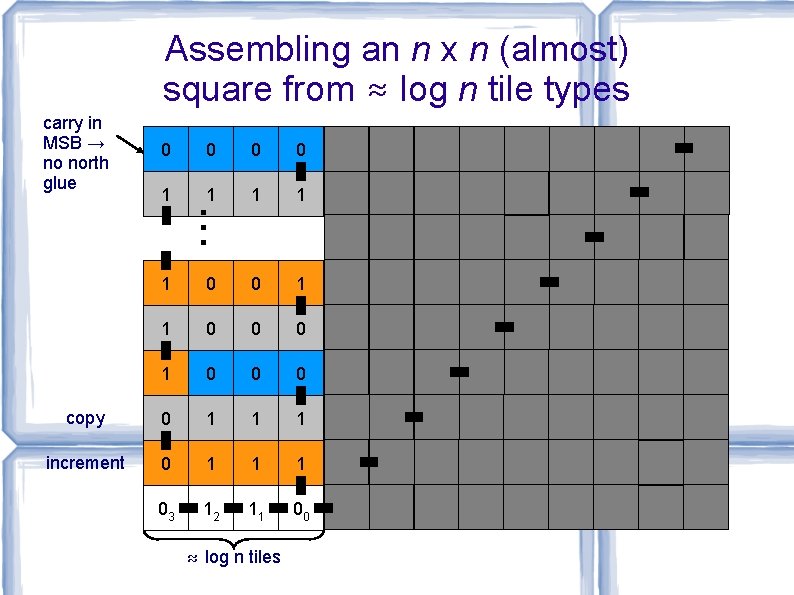
Assembling an n x n (almost) square from ≈ log n tile types carry in MSB → no north glue 0 0 1 1 . . . 1 0 0 1 1 0 0 0 copy 0 1 1 1 increment 0 1 1 1 03 12 11 00 ≈ log n tiles
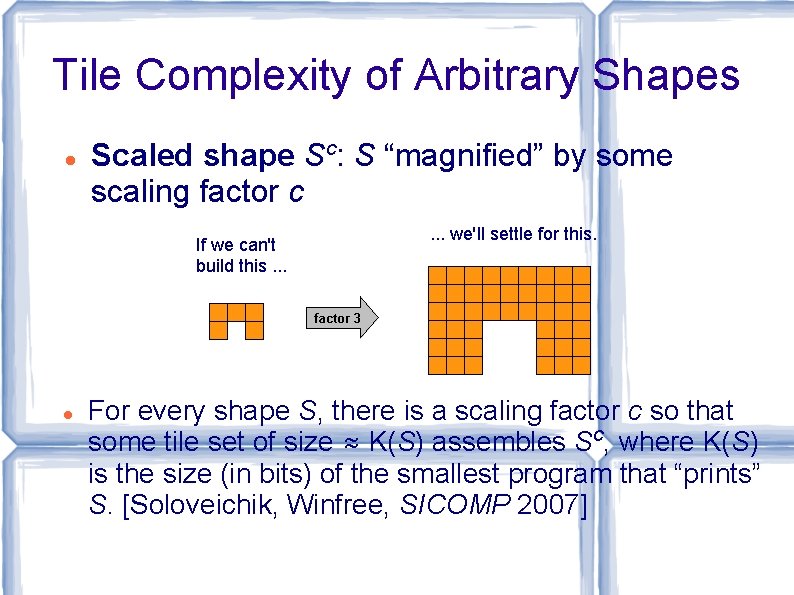
Tile Complexity of Arbitrary Shapes Scaled shape Sc: S “magnified” by some scaling factor c. . . we'll settle for this. If we can't build this. . . factor 3 For every shape S, there is a scaling factor c so that some tile set of size ≈ K(S) assembles Sc, where K(S) is the size (in bits) of the smallest program that “prints” S. [Soloveichik, Winfree, SICOMP 2007]
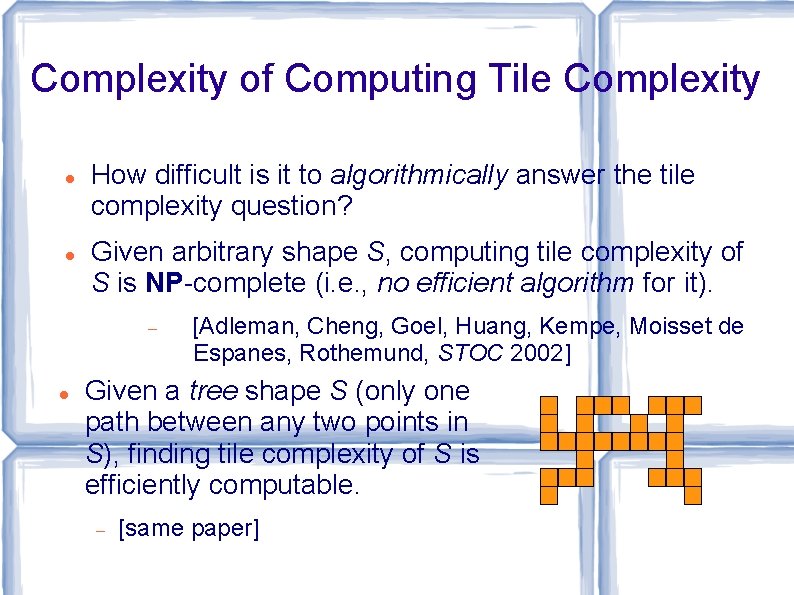
Complexity of Computing Tile Complexity How difficult is it to algorithmically answer the tile complexity question? Given arbitrary shape S, computing tile complexity of S is NP-complete (i. e. , no efficient algorithm for it). [Adleman, Cheng, Goel, Huang, Kempe, Moisset de Espanes, Rothemund, STOC 2002] Given a tree shape S (only one path between any two points in S), finding tile complexity of S is efficiently computable. [same paper]
![Complexity of Computing Tile Complexity at DNA 17 [Lempiäinen, Czeizler, Orponen, DNA 17]](http://slidetodoc.com/presentation_image_h/73bd1d940c4bfe985904ccebf9b7daf4/image-26.jpg "Complexity of Computing Tile Complexity at DNA 17 [Lempiäinen, Czeizler, Orponen, DNA 17]")
Complexity of Computing Tile Complexity at DNA 17 [Lempiäinen, Czeizler, Orponen, DNA 17]
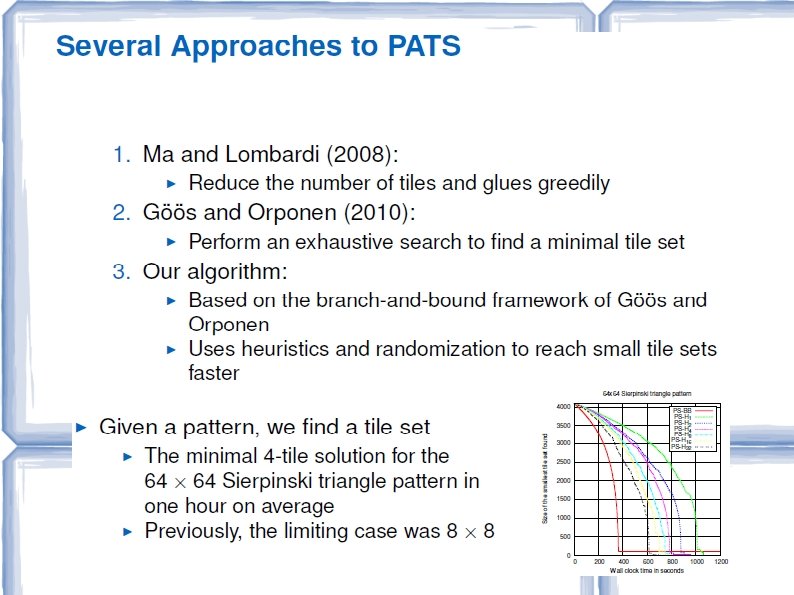
Assembly Time Basic Time Model: expected time for tile t to attach to an empty location is proportional to 1/[t] : concentration of t concentration of each tile type held constant (valid if seed is much lower concentration) concentrations of all tile types must sum to ≤ 1 Parallelism allowed: if many empty binding locations, could all bind in short time
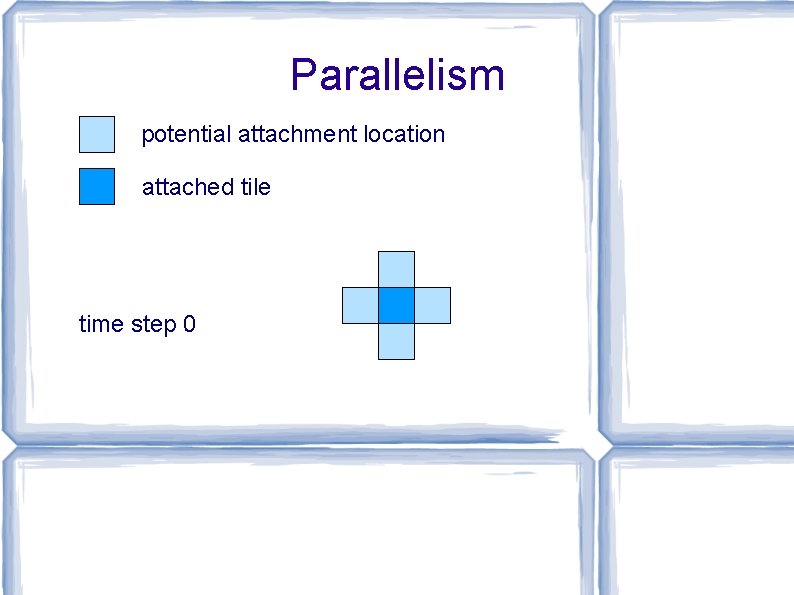
Parallelism potential attachment location attached tile time step 0
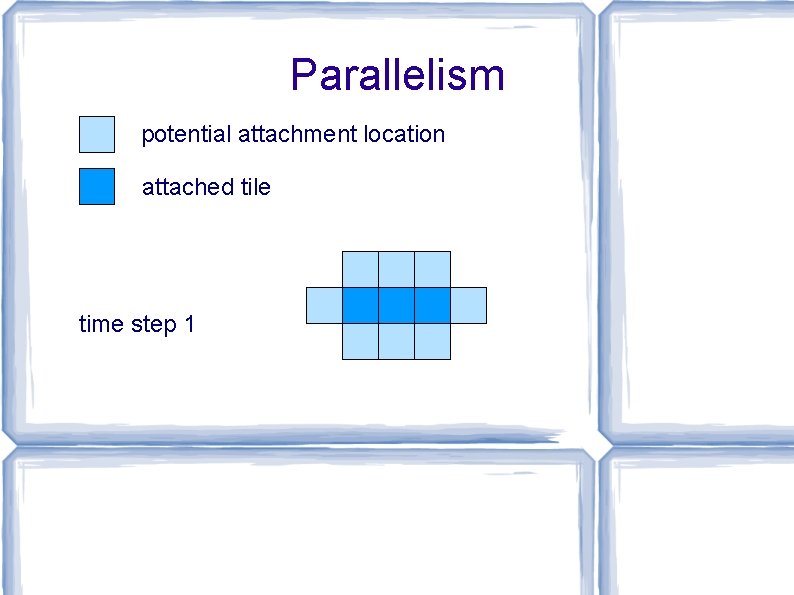
Parallelism potential attachment location attached tile time step 1
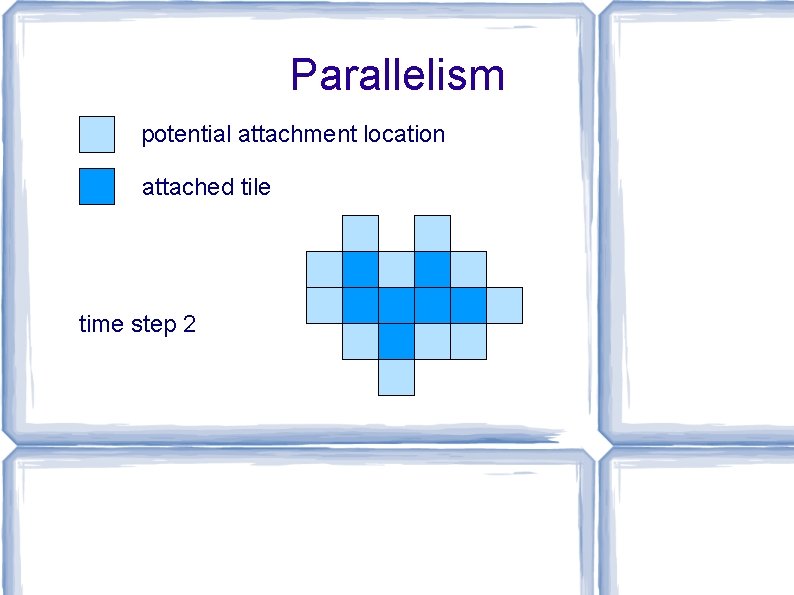
Parallelism potential attachment location attached tile time step 2

Parallelism potential attachment location attached tile time step 3

Parallelism potential attachment location attached tile time step 4 time t: perimeter ≤ t (with high probability) → max attachments per time step ≤ t → max total attachments after t steps ≤ t 2 → min time to assemble any shape of size N ≥ √N
Assembly Time Expected time to assemble any shape of diameter d is at least d. (diameter = largest distance between any two points) [Adleman, Cheng, Goel, Huang, STOC 2001] Any n x n square can be assembled in expected time ≈ n. [Adleman, Cheng, Goel, Huang, STOC 2001]
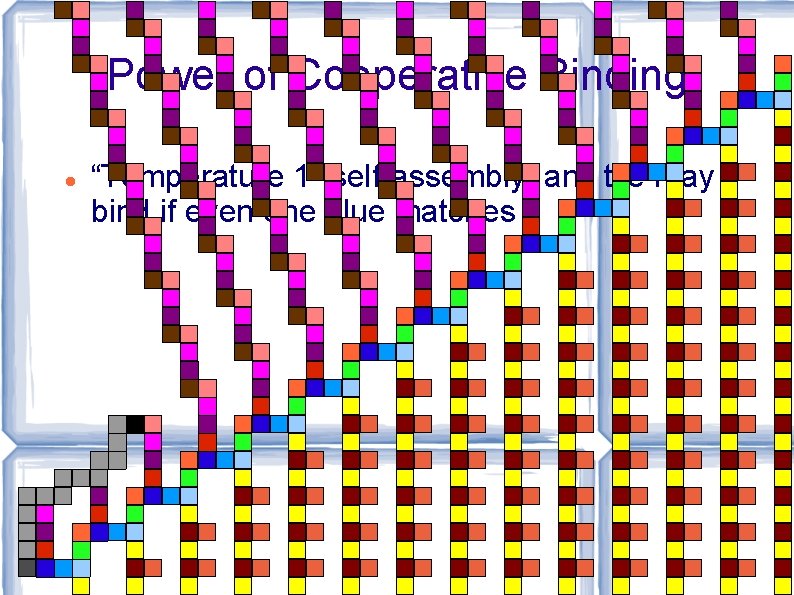
Power of Cooperative Binding “Temperature 1” self-assembly: any tile may bind if even one glue matches
Power of Cooperative Binding Turing machine simulation at temperature 1 in a certain nondeterministic sense [Adleman, Kari, Reishus, Sosik, FOCS 2002, SICOMP 2009] Turing machine simulation at temperature 1 deterministically in 3 D [Cook, Fu, Schweller, SODA 2011]
Power of Cooperative Binding Computational power of deterministic 2 D temperature 1 self-assembly is unknown. Certain class of temperature 1 deterministic tile sets cannot do universal computation [D, Patitz, Summers, DNA 2009, TCS 2011] Rothemund and Winfree [STOC 2000] conjectured temperature 1 tile complexity of assembling an n x n square is 2 n-1 True if no glue mismatches [Manuch, Stacho, Stoll, i. CBBE 2009]
Modeling Errors in Tile Assembly
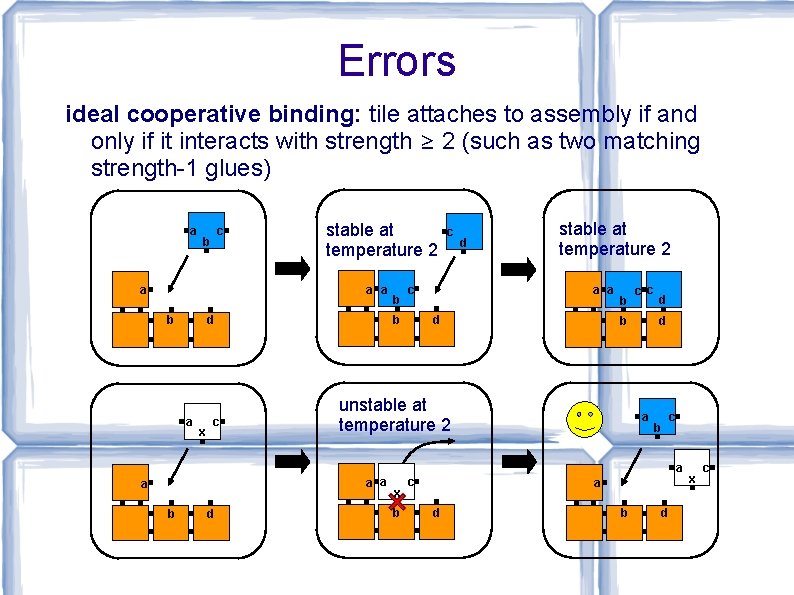
Errors ideal cooperative binding: tile attaches to assembly if and only if it interacts with strength ≥ 2 (such as two matching strength-1 glues) a c b stable at temperature 2 a a a b x c c b d a b c d stable at temperature 2 a a d b c c b unstable at temperature 2 d d a b c a a b d x b c a d b d x c
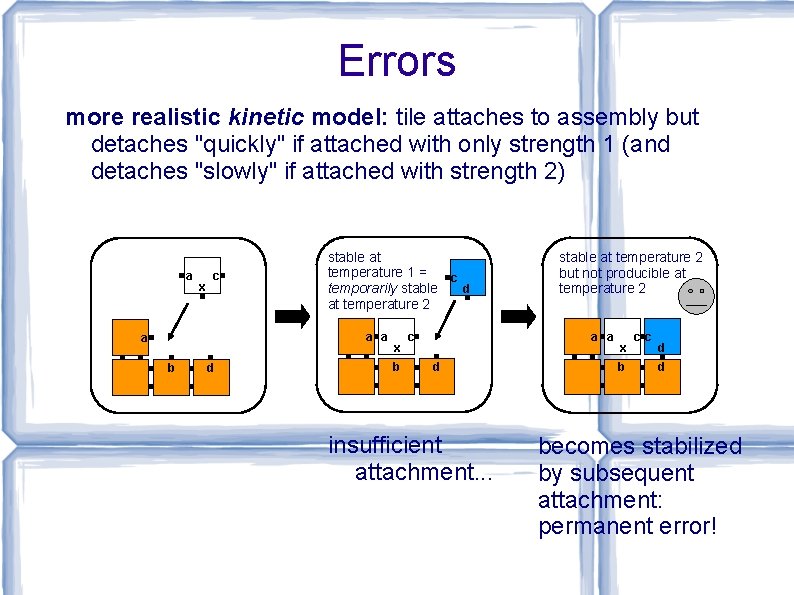
Errors more realistic kinetic model: tile attaches to assembly but detaches "quickly" if attached with only strength 1 (and detaches "slowly" if attached with strength 2) a x c stable at temperature 1 = c temporarily stable d at temperature 2 a a a b d x b c stable at temperature 2 but not producible at temperature 2 a a d insufficient attachment. . . x b c c d d becomes stabilized by subsequent attachment: permanent error!
Errors a. TAM makes (≥) two simplifying assumptions observed not to hold in practice: tiles never detach tiles only attach if held with strength 2 Using stochastic chemical kinetics to determine rates of attachment and detachment, gives the kinetic Tile Assembly Model (k. TAM)
![k. TAM [Winfree, Ph. D. thesis 1998] attachment rate of tile type t to](http://slidetodoc.com/presentation_image_h/73bd1d940c4bfe985904ccebf9b7daf4/image-42.jpg "k. TAM [Winfree, Ph. D. thesis 1998] attachment rate of tile type t to")
k. TAM [Winfree, Ph. D. thesis 1998] attachment rate of tile type t to empty position = rf ≈ [t] ≈ e–Gmc, Gmc = entropy loss of binding detachment rate = rr, b ≈ e–b∙Gse, b = total binding strength Gse = energy of single strength bond
![k. TAM can approximate a. TAM [Winfree, Ph. D. thesis 1998] By setting Gmc](http://slidetodoc.com/presentation_image_h/73bd1d940c4bfe985904ccebf9b7daf4/image-43.jpg "k. TAM can approximate a. TAM [Winfree, Ph. D. thesis 1998] By setting Gmc")
k. TAM can approximate a. TAM [Winfree, Ph. D. thesis 1998] By setting Gmc ≈ 2 Gse, forward rate is just barely larger than reverse rate of strength 2 attachments Assembly proceeds very slowly (more slowly the closer Gmc is to 2 Gse), but high likelihood of only “correct” attachments in the end (more likely the closer Gmc is to 2 Gse)
![k. TAM analysis at DNA 17 [Lempiäinen, Czeizler, Orponen, DNA 17]](http://slidetodoc.com/presentation_image_h/73bd1d940c4bfe985904ccebf9b7daf4/image-44.jpg "k. TAM analysis at DNA 17 [Lempiäinen, Czeizler, Orponen, DNA 17]")
k. TAM analysis at DNA 17 [Lempiäinen, Czeizler, Orponen, DNA 17]
![k. TAM analysis at DNA 17 [Lempiäinen, Czeizler, Orponen, DNA 17] Big picture: smaller](http://slidetodoc.com/presentation_image_h/73bd1d940c4bfe985904ccebf9b7daf4/image-45.jpg "k. TAM analysis at DNA 17 [Lempiäinen, Czeizler, Orponen, DNA 17] Big picture: smaller")
k. TAM analysis at DNA 17 [Lempiäinen, Czeizler, Orponen, DNA 17] Big picture: smaller tile set to assemble a pattern → more reliable tile set, and even same-size tile sets are more reliable when output by their program
![Proofreading [Winfree, Bekbolatov, DNA 9]: force errors to come in groups; i. e. cannot](http://slidetodoc.com/presentation_image_h/73bd1d940c4bfe985904ccebf9b7daf4/image-46.jpg "Proofreading [Winfree, Bekbolatov, DNA 9]: force errors to come in groups; i. e. cannot")
Proofreading [Winfree, Bekbolatov, DNA 9]: force errors to come in groups; i. e. cannot have one insufficient attachment without forcing more to happen block replacement scheme n 1 w 2 n w T e s n 2 Tb Tb e 2 Ta Tc w 1 Td s 1 Td e 1 s 2
![Proofreading Compact proofreading [Reif, Sahu, Yin, DNA 10]: no block replacement: each tile in](http://slidetodoc.com/presentation_image_h/73bd1d940c4bfe985904ccebf9b7daf4/image-47.jpg "Proofreading Compact proofreading [Reif, Sahu, Yin, DNA 10]: no block replacement: each tile in")
Proofreading Compact proofreading [Reif, Sahu, Yin, DNA 10]: no block replacement: each tile in original tile set represented by single tile in proofreading tile set exponential blowup in tile complexity except for a restricted class of tile sets (Soloveichik, Winfree, DNA 11) Both standard and compact correct growth errors but not facet errors y 1 Z x 1 W x 2 x 3 x 4
![Proofreading Snaked proofreading [Chen, Goel, DNA 10]: block replacement scheme that corrects both growth](http://slidetodoc.com/presentation_image_h/73bd1d940c4bfe985904ccebf9b7daf4/image-48.jpg "Proofreading Snaked proofreading [Chen, Goel, DNA 10]: block replacement scheme that corrects both growth")
Proofreading Snaked proofreading [Chen, Goel, DNA 10]: block replacement scheme that corrects both growth errors and facet errors [Chen, Schulman, Goel, Winfree, Nano Letters 2007] standard proofreading snaked proofreading
![Self-Healing [Winfree 2006]: transform a tile set to one that can re-grow correctly after](http://slidetodoc.com/presentation_image_h/73bd1d940c4bfe985904ccebf9b7daf4/image-49.jpg "Self-Healing [Winfree 2006]: transform a tile set to one that can re-grow correctly after")
Self-Healing [Winfree 2006]: transform a tile set to one that can re-grow correctly after large holes are cut of the assembly Extreme Self-Healing [Chen, Goel, Luhrs, Winfree, DNA 13]: there is a tile set of cardinality log n that assembles an n x n square from any subassembly of size ≥ 2 log n a salamander that can regrow his severed tail a salamander that can regrow the rest of his body from his severed tail (or his foot, or his ear) Self-healing + Proofreading [Soloveichik, Cook, Winfree, Natural Computing 2008]
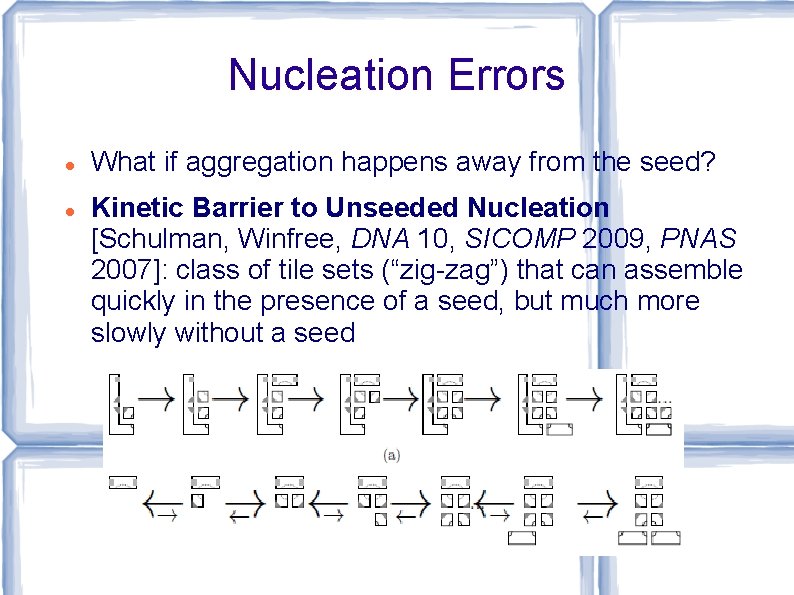
Nucleation Errors What if aggregation happens away from the seed? Kinetic Barrier to Unseeded Nucleation [Schulman, Winfree, DNA 10, SICOMP 2009, PNAS 2007]: class of tile sets (“zig-zag”) that can assemble quickly in the presence of a seed, but much more slowly without a seed
Fault-Tolerant Self-Assembly Conclusion: under certain assumptions, the a. TAM is an implementable “programming language” for tile self-assembly All these results are algorithmic error correction: correction occurs via “software” within the k. TAM Other proposals include physical mechanisms that go around the k. TAM to prevent spurious binding

Interesting Results in Variants of the a. TAM
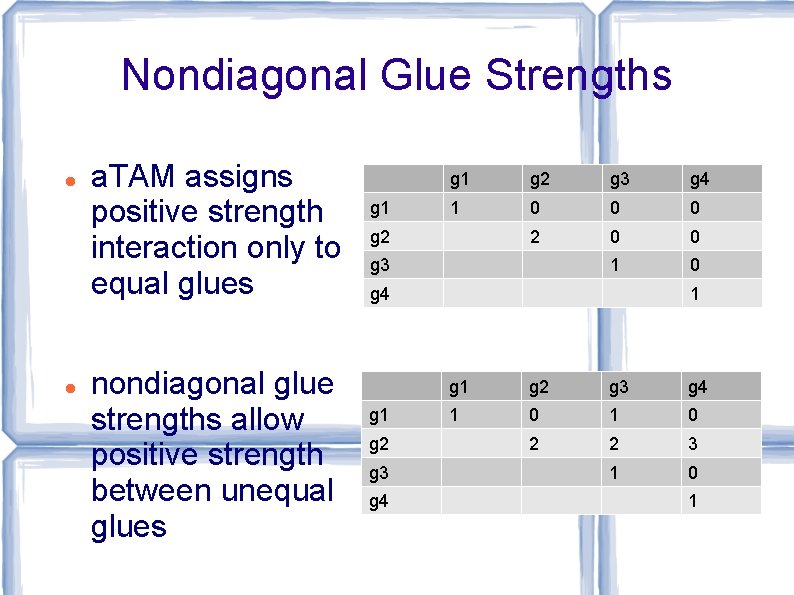
Nondiagonal Glue Strengths a. TAM assigns positive strength interaction only to equal glues nondiagonal glue strengths allow positive strength between unequal glues g 1 g 2 g 3 g 4 1 0 0 0 2 0 0 1 0 g 2 g 3 g 4 g 1 g 2 g 3 g 4 1 0 1 0 2 2 3 1 0 1
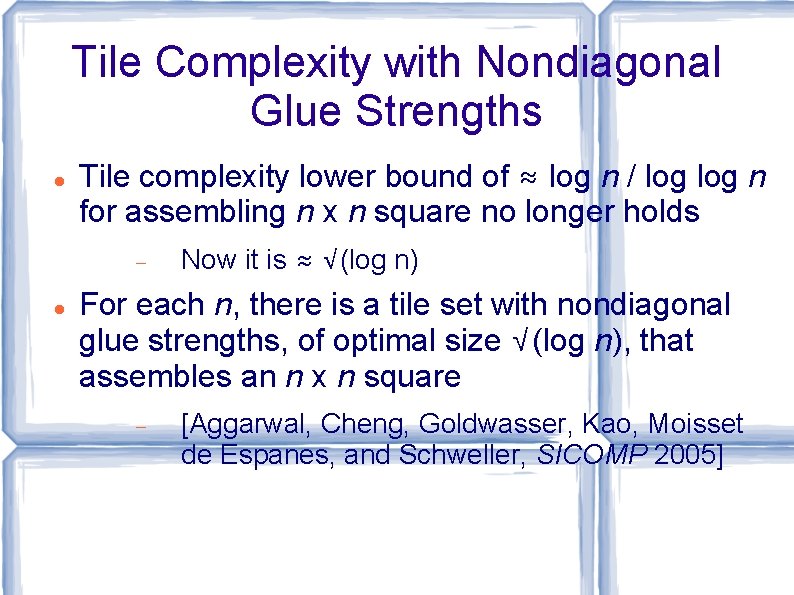
Tile Complexity with Nondiagonal Glue Strengths Tile complexity lower bound of ≈ log n / log n for assembling n x n square no longer holds Now it is ≈ √(log n) For each n, there is a tile set with nondiagonal glue strengths, of optimal size √(log n), that assembles an n x n square [Aggarwal, Cheng, Goldwasser, Kao, Moisset de Espanes, and Schweller, SICOMP 2005]
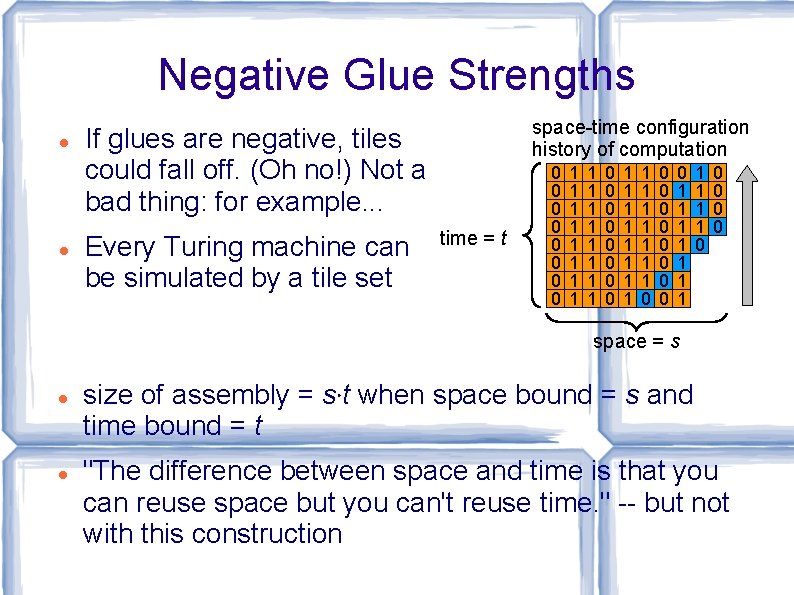
Negative Glue Strengths space-time configuration history of computation If glues are negative, tiles could fall off. (Oh no!) Not a bad thing: for example. . . Every Turing machine can be simulated by a tile set time = t 0 0 0 0 1 1 1 1 1 1 1 1 0 0 0 0 0 1 1 1 0 0 0 space = s size of assembly = s·t when space bound = s and time bound = t "The difference between space and time is that you can reuse space but you can't reuse time. " -- but not with this construction
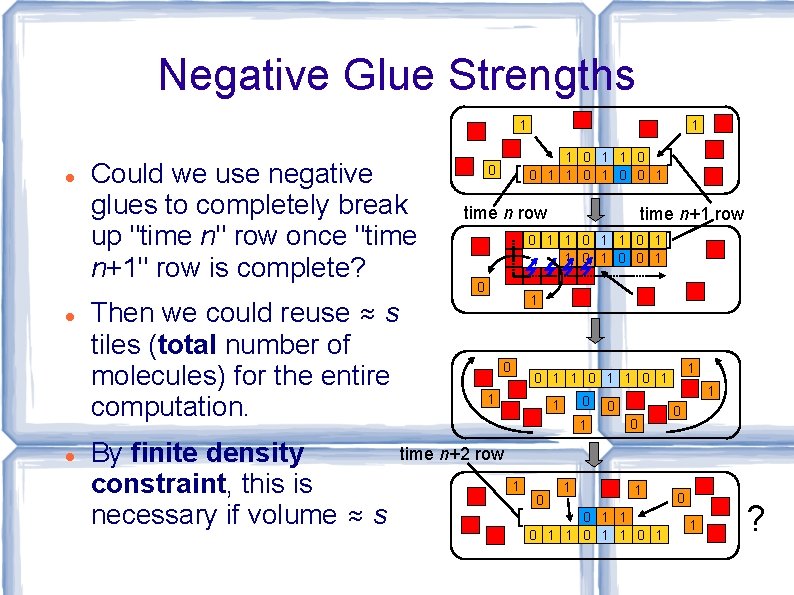
Negative Glue Strengths 1 Could we use negative glues to completely break up "time n" row once "time n+1" row is complete? Then we could reuse ≈ s tiles (total number of molecules) for the entire computation. By finite density constraint, this is necessary if volume ≈ s 1 1 0 0 1 0 time n row time n+1 row 0 1 1 0 0 1 0 1 1 0 1 1 0 0 1 0 time n+2 row 1 0 1 1 0 1 ?
![Negative Glue Strengths [Reif, Sahu, Yin; DNA 2005]: [D, Kari, Masson, DNA 2010]: If](http://slidetodoc.com/presentation_image_h/73bd1d940c4bfe985904ccebf9b7daf4/image-57.jpg "Negative Glue Strengths [Reif, Sahu, Yin; DNA 2005]: [D, Kari, Masson, DNA 2010]: If")
Negative Glue Strengths [Reif, Sahu, Yin; DNA 2005]: [D, Kari, Masson, DNA 2010]: If attachment/detachment reactions are thermodynamically reversible, a set of ≈ s tiles can simulate an sspaced-bounded Turing machine for arbitrarily many steps. Assembly proceeds in an unbiased random walk, taking expected n 2 time to compute n steps. 0 1 1 0 1 1 0 1 1 0 0 10 01 1 0 0 1 1 0 0 0 1 1 1 0 Theorem 1: If reactions are irreversible, then after t steps of assembly, ≈ t tiles are permanently bound. Theorem 2: With irreversible reactions, an s-space-bounded Turing machine can be simulated by a set of tile types, while ensuring no intermediate assembly grows larger than ≈ s If t >> s, then size-s assembly of current configuration, but. . . 0 1 1 0 0 1 1 by Theorem 1, there are 0 1 t >> s unusable "junk" 1 0 assemblies in solution 01
![Negative Glue Strengths at DNA 17 [Patitz, Schweller, Summers, DNA 17]: Temperature 1 universal](http://slidetodoc.com/presentation_image_h/73bd1d940c4bfe985904ccebf9b7daf4/image-58.jpg "Negative Glue Strengths at DNA 17 [Patitz, Schweller, Summers, DNA 17]: Temperature 1 universal")
Negative Glue Strengths at DNA 17 [Patitz, Schweller, Summers, DNA 17]: Temperature 1 universal computation is possible with negative glue strengths Nothing falls off; negative glues simply prevent incorrect tiles from binding.
![Temperature Programming [Aggarwal, Cheng, Goldwasser, Kao, Moisset de Espanes, and Schweller, SICOMP 2005]: Vary](http://slidetodoc.com/presentation_image_h/73bd1d940c4bfe985904ccebf9b7daf4/image-59.jpg "Temperature Programming [Aggarwal, Cheng, Goldwasser, Kao, Moisset de Espanes, and Schweller, SICOMP 2005]: Vary")
Temperature Programming [Aggarwal, Cheng, Goldwasser, Kao, Moisset de Espanes, and Schweller, SICOMP 2005]: Vary temperature (binding strength threshold) throughout assembly to control what assembles. temperature time singlyseeded set of tile types:
![Temperature Programming [Kao, Schweller, SODA 2006]: There is a constant set of tile types](http://slidetodoc.com/presentation_image_h/73bd1d940c4bfe985904ccebf9b7daf4/image-60.jpg "Temperature Programming [Kao, Schweller, SODA 2006]: There is a constant set of tile types")
Temperature Programming [Kao, Schweller, SODA 2006]: There is a constant set of tile types T such that, for every n, there is a sequence of temperature changes so that T assembles an n x n square. Need ≈ log n temperature changes temps = 3, 2, 5, 3 temps = 3, 2, 4, 5, 3, 2, 4
![Complexity of Temperature Programming [Summers, Algorithmica to appear]: A fixed set of tile types](http://slidetodoc.com/presentation_image_h/73bd1d940c4bfe985904ccebf9b7daf4/image-61.jpg "Complexity of Temperature Programming [Summers, Algorithmica to appear]: A fixed set of tile types")
Complexity of Temperature Programming [Summers, Algorithmica to appear]: A fixed set of tile types can assemble any finite scaled shape through temperature programming. Number of tile types (a self-assembly "resource") is constant, no matter the shape. Other resource bounds: What resolution loss is required? What number of temperature changes are required?
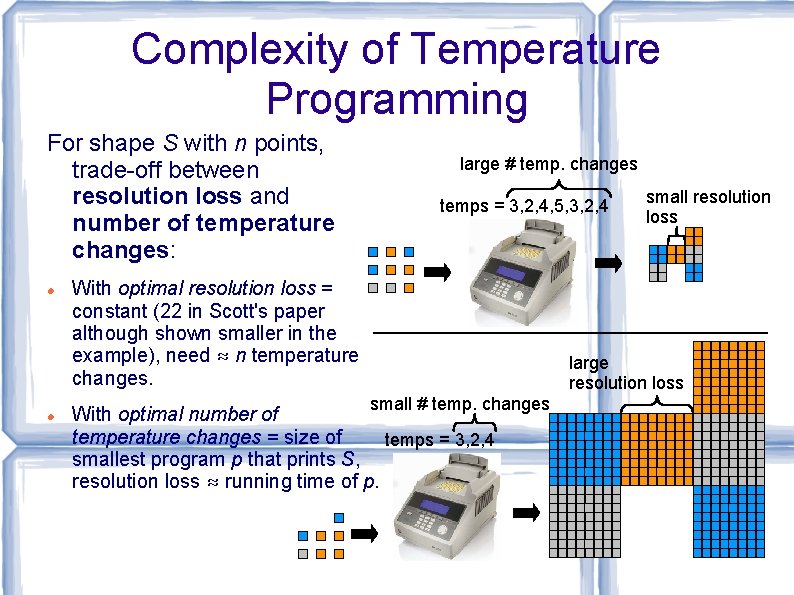
Complexity of Temperature Programming For shape S with n points, trade-off between resolution loss and number of temperature changes: large # temp. changes temps = 3, 2, 4, 5, 3, 2, 4 With optimal resolution loss = constant (22 in Scott's paper although shown smaller in the example), need ≈ n temperature changes. small resolution loss large resolution loss small # temp. changes With optimal number of temperature changes = size of temps = 3, 2, 4 smallest program p that prints S, resolution loss ≈ running time of p.
![Concentration Programming [Becker, Rapaport, Rémila, FSTTCS 2006]: Set relative concentrations of tile types to](http://slidetodoc.com/presentation_image_h/73bd1d940c4bfe985904ccebf9b7daf4/image-63.jpg "Concentration Programming [Becker, Rapaport, Rémila, FSTTCS 2006]: Set relative concentrations of tile types to")
Concentration Programming [Becker, Rapaport, Rémila, FSTTCS 2006]: Set relative concentrations of tile types to control what is likely to assemble. singly-seeded set of tile types; blue and orange share glues so they compete [ ] = 0. 8 [ ] = 0. 2 likely assemblies: unlikely assemblies: [ ] = 0. 5 likely assemblies: unlikely assemblies:
![Concentration Programming for Approximate Shapes [Kao, Schweller, ICALP 2008]: A fixed set of tile](http://slidetodoc.com/presentation_image_h/73bd1d940c4bfe985904ccebf9b7daf4/image-64.jpg "Concentration Programming for Approximate Shapes [Kao, Schweller, ICALP 2008]: A fixed set of tile")
Concentration Programming for Approximate Shapes [Kao, Schweller, ICALP 2008]: A fixed set of tile types can assemble, for any n, a square of width within 1% of n x n with probability at least 99%.
![Concentration Programming for Exact Shapes [D, SICOMP 2010]: A fixed set of tile types](http://slidetodoc.com/presentation_image_h/73bd1d940c4bfe985904ccebf9b7daf4/image-65.jpg "Concentration Programming for Exact Shapes [D, SICOMP 2010]: A fixed set of tile types")
Concentration Programming for Exact Shapes [D, SICOMP 2010]: A fixed set of tile types can assemble any n x n square with high probability by setting tile concentrations depending on n. And, a fixed set of tile types can assemble any finite scaled shape with high probability through tile concentration programming; resolution loss depends on size of shape.
![Randomized Self-Assembly with Equal Concentrations [Chandran, Gopalkrishnan, Reif, ICALP 2009]: The tile complexity of](http://slidetodoc.com/presentation_image_h/73bd1d940c4bfe985904ccebf9b7daf4/image-66.jpg "Randomized Self-Assembly with Equal Concentrations [Chandran, Gopalkrishnan, Reif, ICALP 2009]: The tile complexity of")
Randomized Self-Assembly with Equal Concentrations [Chandran, Gopalkrishnan, Reif, ICALP 2009]: The tile complexity of assembling a line within 1% of length n is ≈ log n, if concentrations of all tile types are required to be equal.
![Step Assembly [Reif, DNA 3]: Step-assembly model: Assembly proceeds in stages. Only some tile](http://slidetodoc.com/presentation_image_h/73bd1d940c4bfe985904ccebf9b7daf4/image-67.jpg "Step Assembly [Reif, DNA 3]: Step-assembly model: Assembly proceeds in stages. Only some tile")
Step Assembly [Reif, DNA 3]: Step-assembly model: Assembly proceeds in stages. Only some tile types are present in stage n. They are all washed away before introducing a different subset of tile types in stage n+1. Many problems can be solved with optimal assembly size and parallel time prefix sum (basis for parallel solutions to addition, multiplication by constant, finite automata simulation, etc. ) shuffle-exchange networks (discrete Fourier transform, bitonic merge, etc. )
![Step Assembly [Manuch, Stacho, Stoll, Natural Computing to appear]: For a large class of](http://slidetodoc.com/presentation_image_h/73bd1d940c4bfe985904ccebf9b7daf4/image-68.jpg "Step Assembly [Manuch, Stacho, Stoll, Natural Computing to appear]: For a large class of")
Step Assembly [Manuch, Stacho, Stoll, Natural Computing to appear]: For a large class of shapes, including arbitrary shapes scaled by factor 2 or any other shape with a Hamiltonian path, a constant set of tile types can assemble the shape in the step assembly model.
![Staged Self-Assembly [Demaine, Fekete, Ishaque, Rafalin, Schweller, Souvaine, DNA 13]: Separate test tubes reach](http://slidetodoc.com/presentation_image_h/73bd1d940c4bfe985904ccebf9b7daf4/image-69.jpg "Staged Self-Assembly [Demaine, Fekete, Ishaque, Rafalin, Schweller, Souvaine, DNA 13]: Separate test tubes reach")
Staged Self-Assembly [Demaine, Fekete, Ishaque, Rafalin, Schweller, Souvaine, DNA 13]: Separate test tubes reach a terminal state before washing away tile types and being mixed. Constant number of tile types can be used to assemble any shape ≈ log n (parallel) stages required for n x n square, 1 x n line, monotone shapes
![Staged Self-Assembly at DNA 17 [Demaine, Eisenstat, Ishaque, Winslow, DNA 17] One-dimensional staged self-assembly](http://slidetodoc.com/presentation_image_h/73bd1d940c4bfe985904ccebf9b7daf4/image-70.jpg "Staged Self-Assembly at DNA 17 [Demaine, Eisenstat, Ishaque, Winslow, DNA 17] One-dimensional staged self-assembly")
Staged Self-Assembly at DNA 17 [Demaine, Eisenstat, Ishaque, Winslow, DNA 17] One-dimensional staged self-assembly of strings: Problem: design fixed tile set (each labeled with a symbol) so that, given any string of symbols x, tiles can be mixed to uniquely assemble a linear assembly “spelling” x. Question: How many mixing stages are required? Answer: If each tube must have unique terminal assembly, equal to size of smallest context-free grammar producing x. Otherwise, can sometimes use fewer mixing stages.
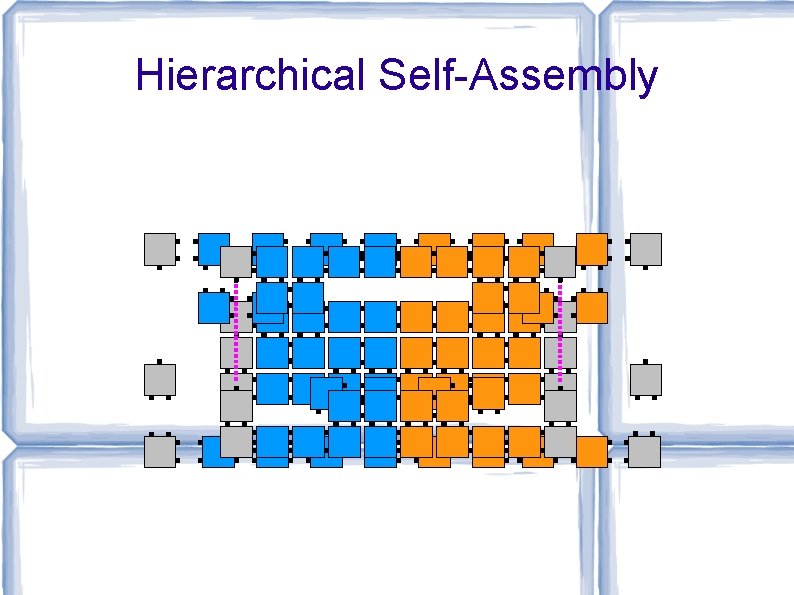
Hierarchical Self-Assembly
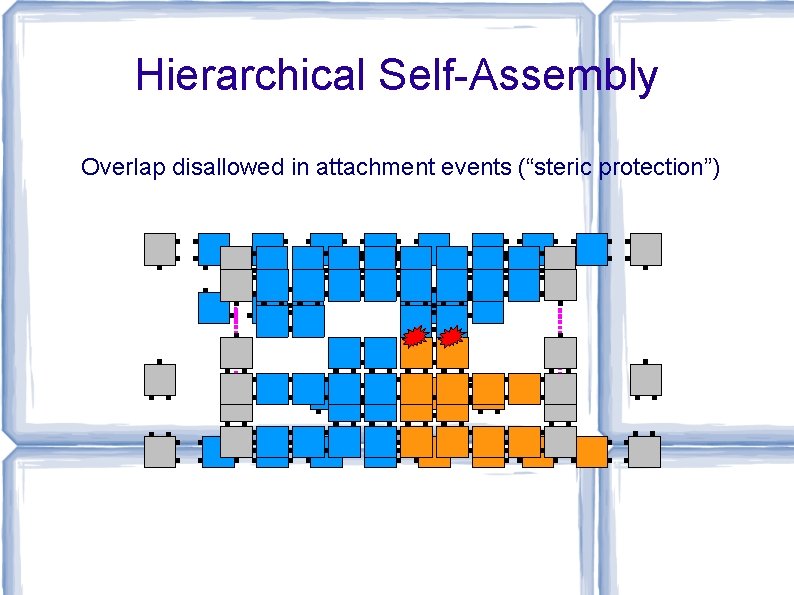
Hierarchical Self-Assembly Overlap disallowed in attachment events (“steric protection”)
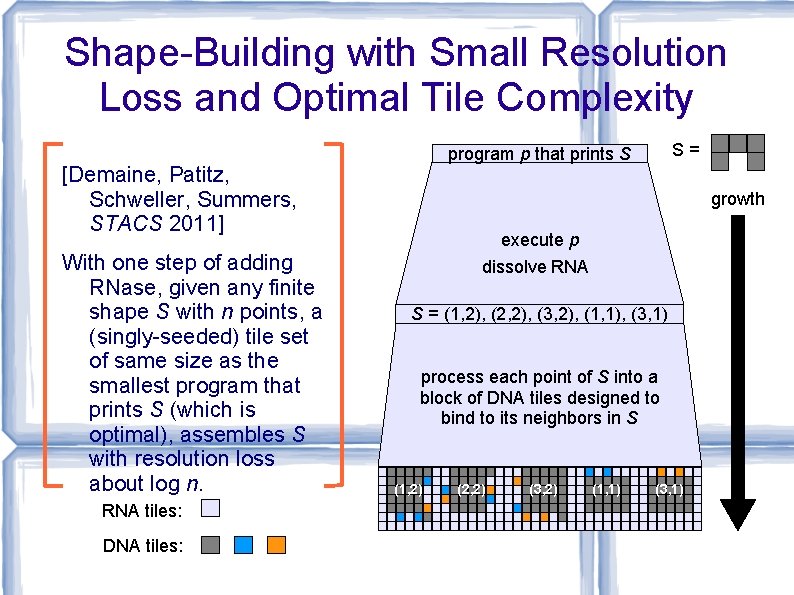
Shape-Building with Small Resolution Loss and Optimal Tile Complexity [Demaine, Patitz, Schweller, Summers, STACS 2011] With one step of adding RNase, given any finite shape S with n points, a (singly-seeded) tile set of same size as the smallest program that prints S (which is optimal), assembles S with resolution loss about log n. RNA tiles: DNA tiles: S= program p that prints S growth execute p dissolve RNA S = (1, 2), (2, 2), (3, 2), (1, 1), (3, 1) process each point of S into a block of DNA tiles designed to bind to its neighbors in S (1, 2) (2, 2) (3, 2) (1, 1) (3, 1)
![Hierarchical Self-Assembly at DNA 17 [Patitz, Schweller, Summers, DNA 17] Tile complexity of n](http://slidetodoc.com/presentation_image_h/73bd1d940c4bfe985904ccebf9b7daf4/image-74.jpg "Hierarchical Self-Assembly at DNA 17 [Patitz, Schweller, Summers, DNA 17] Tile complexity of n")
Hierarchical Self-Assembly at DNA 17 [Patitz, Schweller, Summers, DNA 17] Tile complexity of n x n squares 3 D hierarchical temperature 1 is ≤ log n. Recall in single-tile-aggregation 2 D model: temperature 2: log n / log n temperature 1: conjectured 2 n-1 temperature 1, no glue mismatches: proven 2 n-1 [Manuch, Stacho, Stoll 2009]
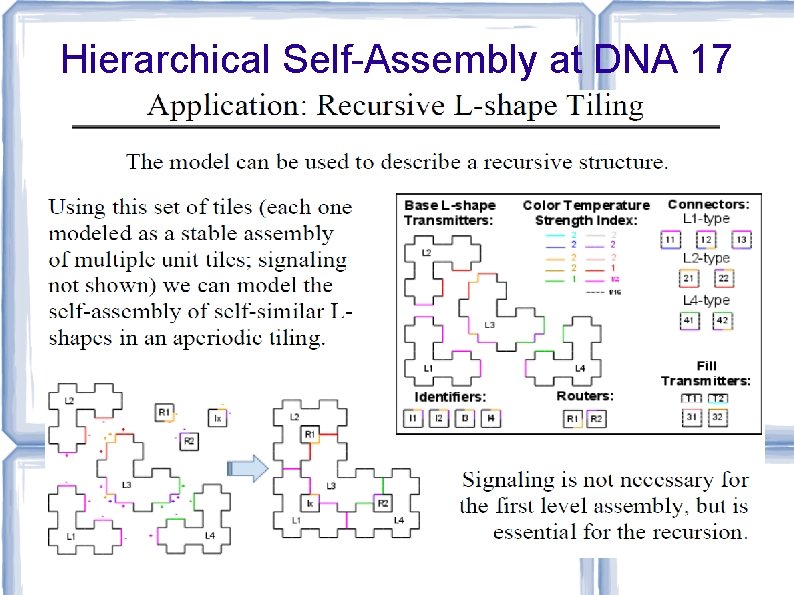
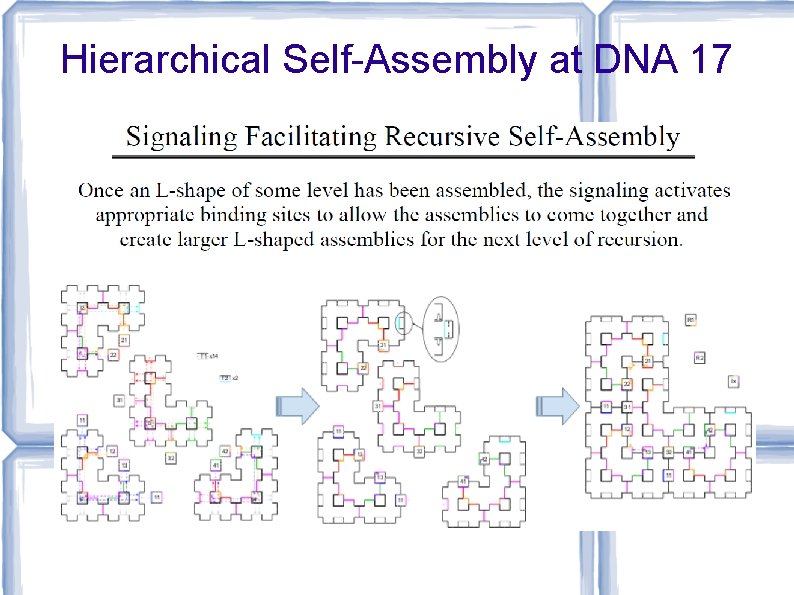
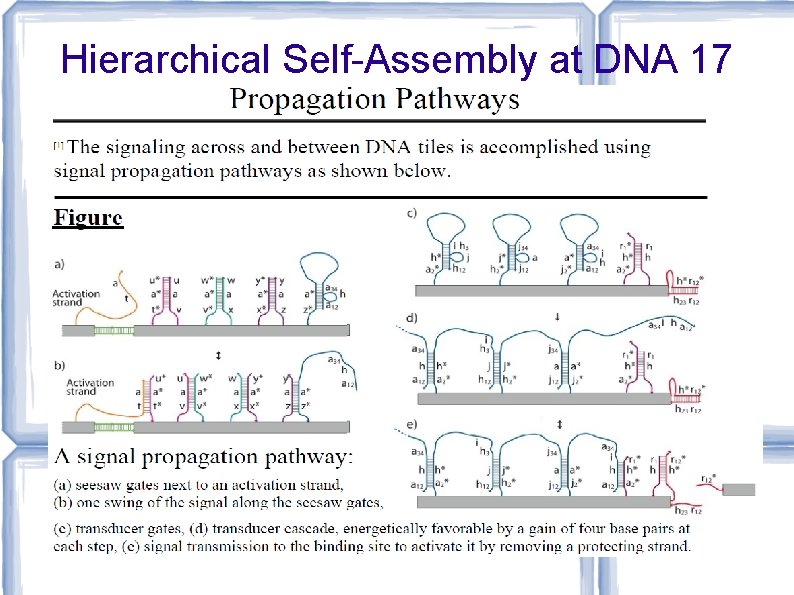
![Hierarchical Self-Assembly at DNA 17 [Karpenko, Jonoska, Padilla, Liu, Seeman, DNA 17]](http://slidetodoc.com/presentation_image_h/73bd1d940c4bfe985904ccebf9b7daf4/image-75.jpg "Hierarchical Self-Assembly at DNA 17 [Karpenko, Jonoska, Padilla, Liu, Seeman, DNA 17]")
Hierarchical Self-Assembly at DNA 17 [Karpenko, Jonoska, Padilla, Liu, Seeman, DNA 17]
Hierarchical Self-Assembly at DNA 17
Hierarchical Self-Assembly at DNA 17
Hierarchical Self-Assembly at DNA 17

Thank you!
- Slides: 79