
DMR 21 a Find the probability that a
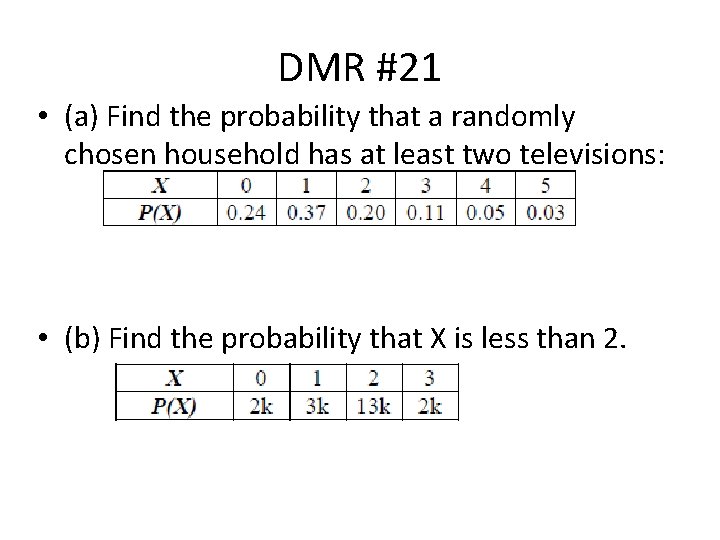
DMR #21 • (a) Find the probability that a randomly chosen household has at least two televisions: • (b) Find the probability that X is less than 2.
DMR #22 • A business evaluates a proposed venture as follows. It stands to make a profit of $10, 000 with probability 3/20, to make a profit of $5000 with probability 9/20, to break even with probability 5/20, and to lose $5000 with probability 3/20. The expected profit in dollars is:
DMR #23 • Let the random variable X represent the profit made on a randomly selected day by a certain store. Assume that X is Normal with mean $360 and standard deviation $50. What is P(X > $400)?
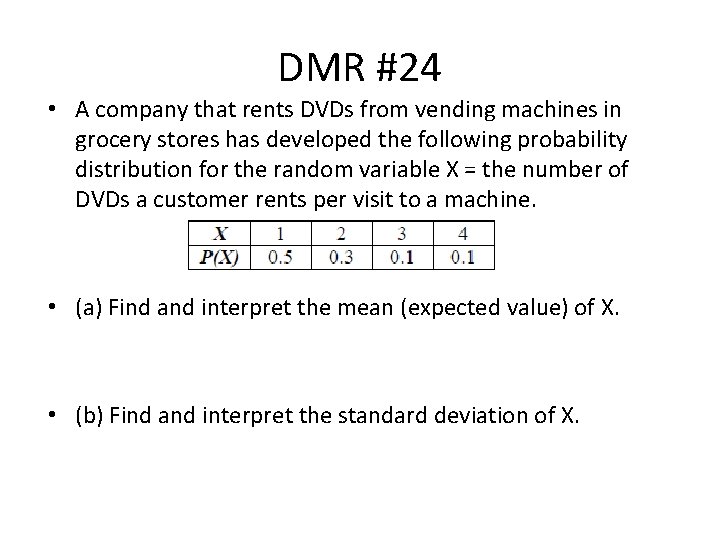
DMR #24 • A company that rents DVDs from vending machines in grocery stores has developed the following probability distribution for the random variable X = the number of DVDs a customer rents per visit to a machine. • (a) Find and interpret the mean (expected value) of X. • (b) Find and interpret the standard deviation of X.
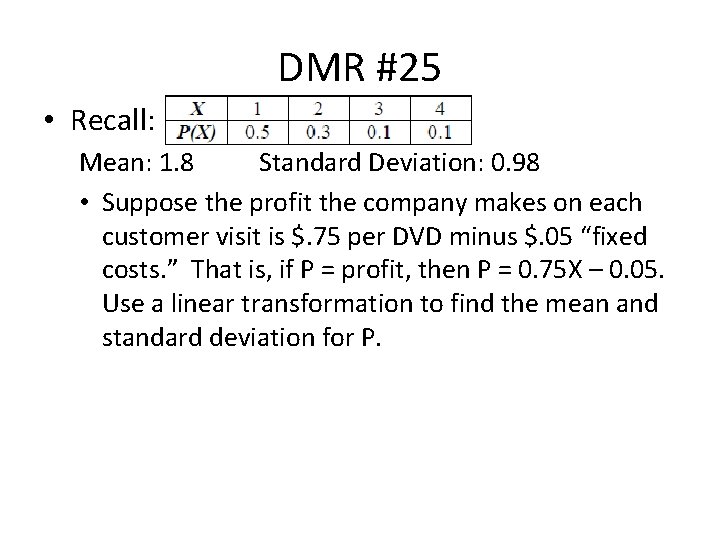
DMR #25 • Recall: Mean: 1. 8 Standard Deviation: 0. 98 • Suppose the profit the company makes on each customer visit is $. 75 per DVD minus $. 05 “fixed costs. ” That is, if P = profit, then P = 0. 75 X – 0. 05. Use a linear transformation to find the mean and standard deviation for P.
DMR #26 • ACT scores for the members of the 2004 high school graduating class who took the test closely follow the Normal distribution with mean 20. 9 and standard deviation 4. 8. Choose two students independently and at random: • (a) What is the expected difference in their scores? • (b) What is the standard deviation of the difference in their scores? • (c) Find the probability that the difference in the two students’ scores is greater than 6.
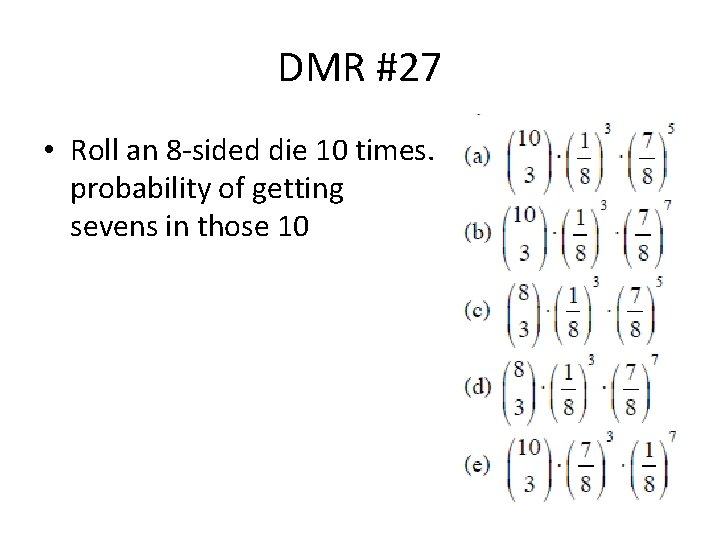
DMR #27 • Roll an 8 -sided die 10 times. probability of getting sevens in those 10 The exactly 3 rolls is:
DMR #28 • In a large population of college students, 20% of the students have experienced feelings of math anxiety. If you take a random sample of 10 students from this population, the mean and standard deviation of the number of students in the sample who have experienced math anxiety is:
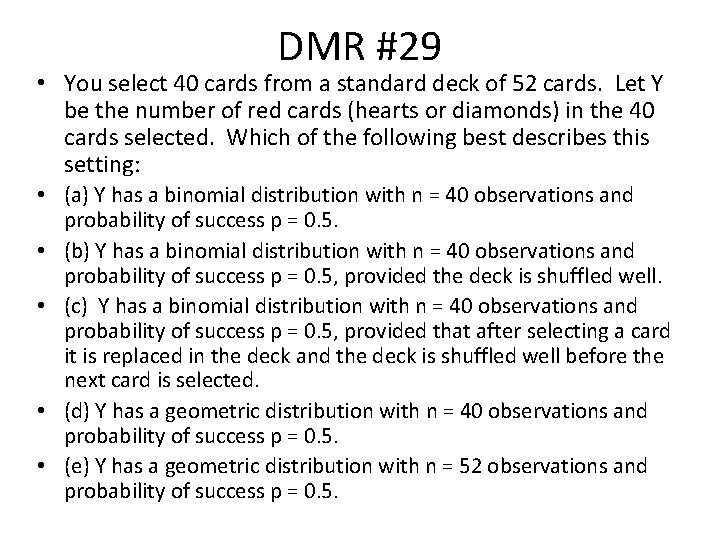
DMR #29 • You select 40 cards from a standard deck of 52 cards. Let Y be the number of red cards (hearts or diamonds) in the 40 cards selected. Which of the following best describes this setting: • (a) Y has a binomial distribution with n = 40 observations and probability of success p = 0. 5. • (b) Y has a binomial distribution with n = 40 observations and probability of success p = 0. 5, provided the deck is shuffled well. • (c) Y has a binomial distribution with n = 40 observations and probability of success p = 0. 5, provided that after selecting a card it is replaced in the deck and the deck is shuffled well before the next card is selected. • (d) Y has a geometric distribution with n = 40 observations and probability of success p = 0. 5. • (e) Y has a geometric distribution with n = 52 observations and probability of success p = 0. 5.
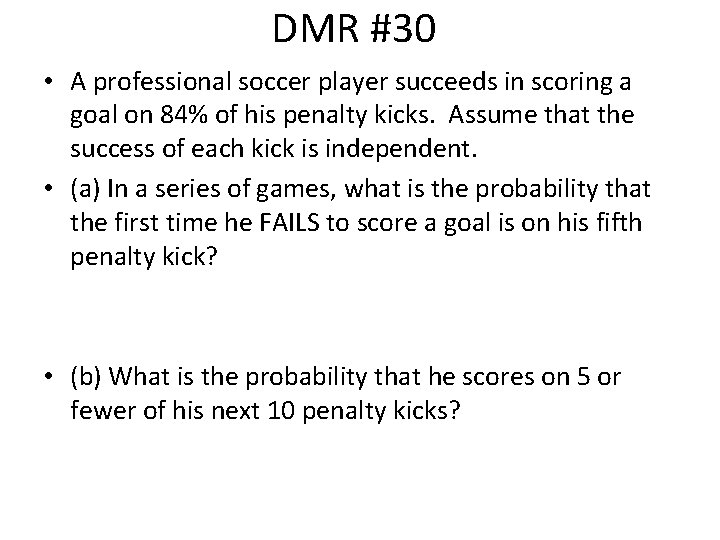
DMR #30 • A professional soccer player succeeds in scoring a goal on 84% of his penalty kicks. Assume that the success of each kick is independent. • (a) In a series of games, what is the probability that the first time he FAILS to score a goal is on his fifth penalty kick? • (b) What is the probability that he scores on 5 or fewer of his next 10 penalty kicks?
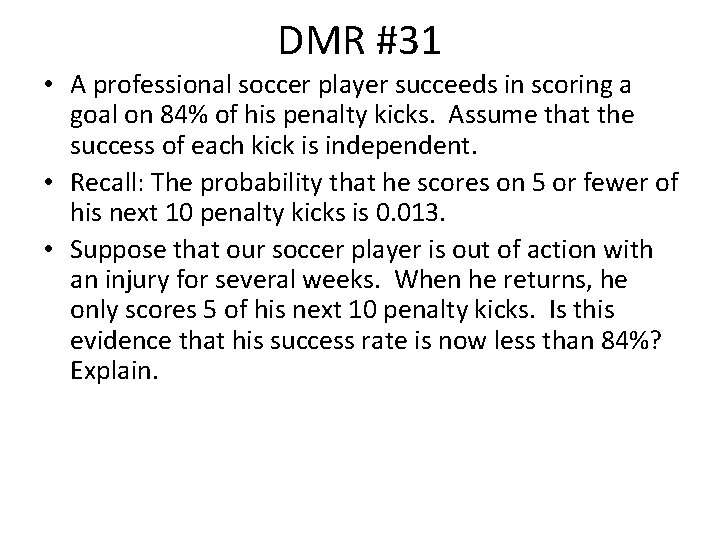
DMR #31 • A professional soccer player succeeds in scoring a goal on 84% of his penalty kicks. Assume that the success of each kick is independent. • Recall: The probability that he scores on 5 or fewer of his next 10 penalty kicks is 0. 013. • Suppose that our soccer player is out of action with an injury for several weeks. When he returns, he only scores 5 of his next 10 penalty kicks. Is this evidence that his success rate is now less than 84%? Explain.
- Slides: 11