
DMP why what and how DMP Presentation Event
- Slides: 22
DMP: why, what and how DMP Presentation Event, London, 2008/01/25 Leonardo Chiariglione 2008/01/25 Getting video to users via the network
There is something wrong with digital media… o Great innovation n o More and richer content Easier and more effective distribution/access Vastly impro user experience Stil everybody is unhappy n n n 08/01/25 Rights holders complain that their assets are looted Consumers complain that their user experience is being spoilt The European Commission is holding a consultation on what is happening with digital media… DMP: why, what and how 2
No need to be unhappy – here comes the DMP o Launched as Digital Media Manifesto in July 2003 n n o The Digital Media Project established as a not-for-profit organisation in December 2003 n o Manifesto published in September 2003 (http: //www. chiariglione. org/manifesto/dmm. htm) The “digital media stalemate” identified http: //www. digital-media-project. org/ DMP’s mission: to promote continuing successful development, deployment and use of digital media that respect n n n Rights of creators and rights holders to exploit their works Wish of end users to fully enjoy the benefits of digital media Interests of various value-chain players to provide products and services 08/01/25 DMP: why, what and how 3
Achieving the mission o o DMP operates on the basis of open international collaboration of all interested parties DMP seeks the involvement of creators and end users of Digital Media through appropriate mechanisms The goals of DMP are realised through Technical Specifications, Recommended Practices and Recommended Actions DMP contributes the results of its activities to appropriate formal standards bodies and other appropriate entities 08/01/25 DMP: why, what and how 4
A direction for a solution o o Digital Rights Management (DRM) systems are widely used A definition according to NIST n n o o Are IT components and services which strive to distribute and control Content and its rights. Operate in environments driven by law, policies and business models DRM is tailored to the needs of rights holders Independently designed, deployed and operated DRM systems are a source of frustration and opposition by consumers 08/01/25 DMP: why, what and how 5
Taming DRM o o DMP agrees that DRM systems can be a solution to the “digital media stalemate” but only if interoperability is ensured What is interoperability? n o From the consumer viewpoint: the ability to play the same type of content from different sources with the same device Interoperability is also important to value chain users when they do business between them 08/01/25 DMP: why, what and how 6
How to achieve interoperability o All devices support all DRM systems n n o A service makes conversions n n o Many DRM systems New DRM systems continue to be invented Any new DRM system implies some more IPR whose cost is to be added to the device cost A technology is not necessarily available for licensing A content/service provider may not be interested in letting its content to be converted Who pays for the service? There is a DRM standard 08/01/25 DMP: why, what and how 7
Which DRM standard? o A DRM standard must n n o It is impossible to provide a DRM standard for all types of value chains n o o o Satisfy the manifold needs of media value chain players Allow continuous injection of innovation They are just too many and more are coming It is doable to provide standards for low-level functions (Primitive Functions) Value chains can then be assembled from primitive functions The DMP standard is n n The Interoperable DRM Platform (now at version 3. 1) Its OSS Reference Implementatiov Chillout® 08/01/25 DMP: why, what and how 8
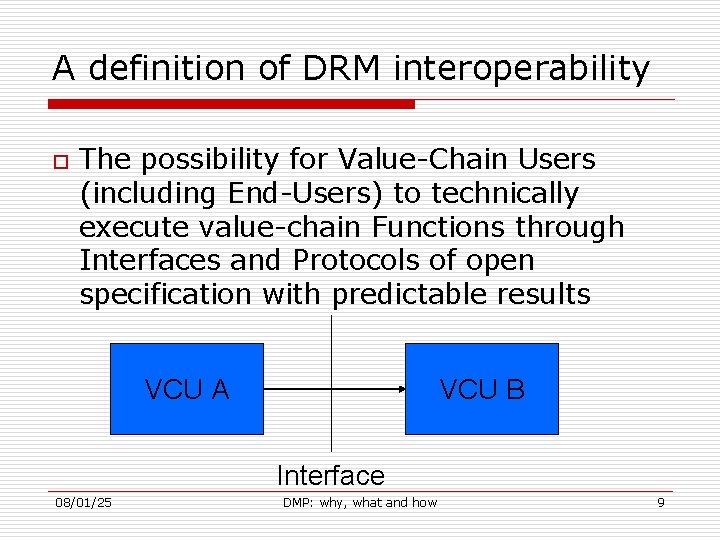
A definition of DRM interoperability o The possibility for Value-Chain Users (including End-Users) to technically execute value-chain Functions through Interfaces and Protocols of open specification with predictable results VCU A VCU B Interface 08/01/25 DMP: why, what and how 9
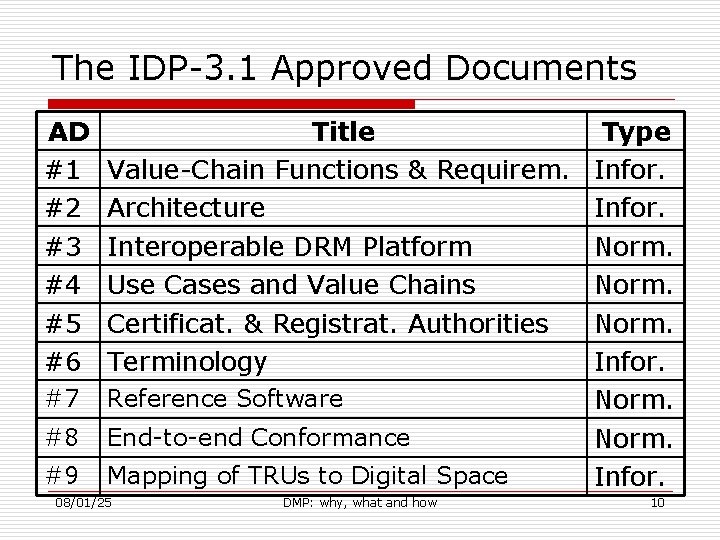
The IDP-3. 1 Approved Documents AD #1 #2 #3 #4 #5 #6 Title Value-Chain Functions & Requirem. Architecture Interoperable DRM Platform Use Cases and Value Chains Certificat. & Registrat. Authorities Terminology #7 Reference Software #8 End-to-end Conformance #9 Mapping of TRUs to Digital Space 08/01/25 DMP: why, what and how Type Infor. Norm. Infor. 10
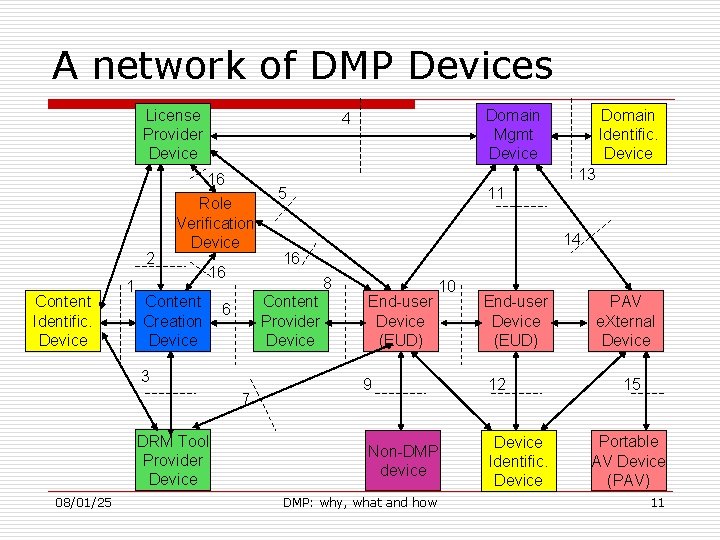
A network of DMP Devices License Provider Device Content Identific. Device 1 Role Verification Device 16 Content Creation Device 11 14 16 Content Provider Device 6 7 08/01/25 5 8 3 DRM Tool Provider Device Domain Identific. Device 13 16 2 Domain Mgmt Device 4 End-user Device (EUD) 10 9 Non-DMP device DMP: why, what and how End-user Device (EUD) 12 Device Identific. Device PAV e. Xternal Device 15 Portable AV Device (PAV) 11
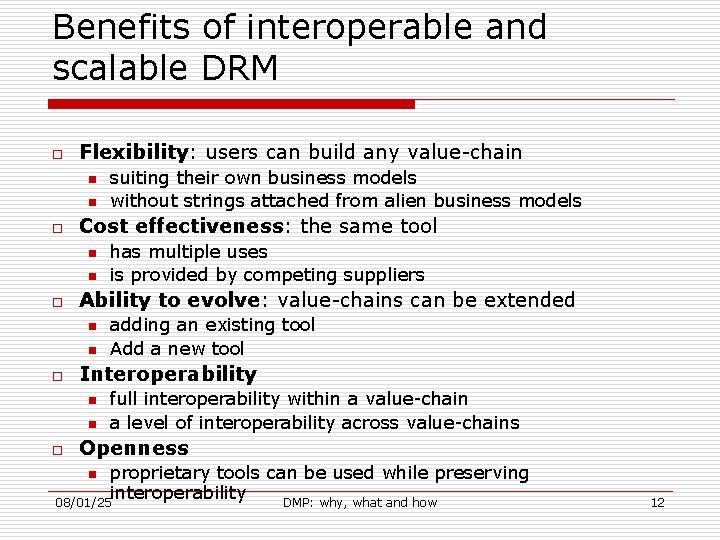
Benefits of interoperable and scalable DRM o Flexibility: users can build any value-chain n n o Cost effectiveness: the same tool n n o n adding an existing tool Add a new tool Interoperability n n o has multiple uses is provided by competing suppliers Ability to evolve: value-chains can be extended n o suiting their own business models without strings attached from alien business models full interoperability within a value-chain a level of interoperability across value-chains Openness proprietary tools can be used while preserving interoperability 08/01/25 DMP: why, what and how n 12
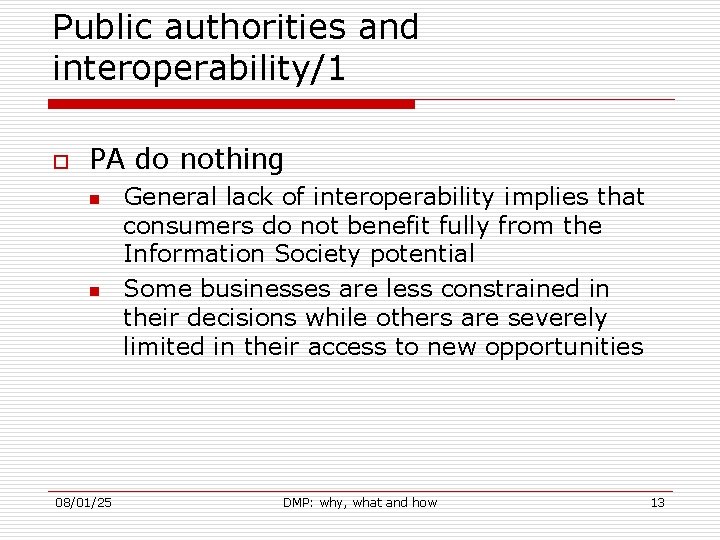
Public authorities and interoperability/1 o PA do nothing n n 08/01/25 General lack of interoperability implies that consumers do not benefit fully from the Information Society potential Some businesses are less constrained in their decisions while others are severely limited in their access to new opportunities DMP: why, what and how 13
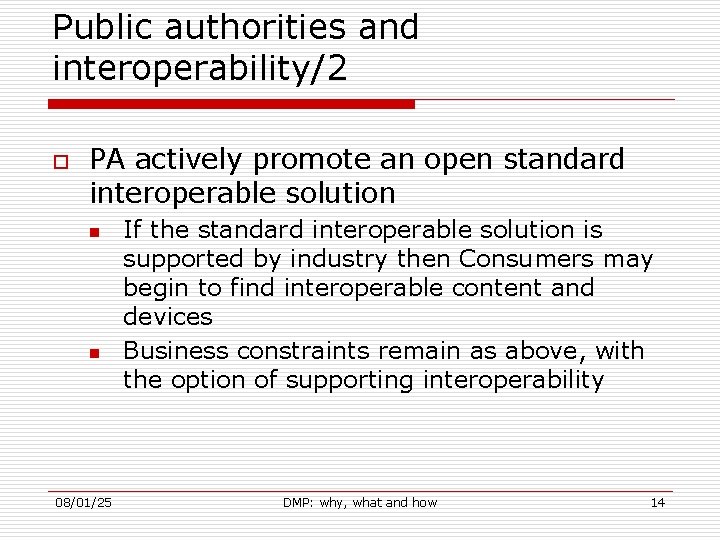
Public authorities and interoperability/2 o PA actively promote an open standard interoperable solution n n 08/01/25 If the standard interoperable solution is supported by industry then Consumers may begin to find interoperable content and devices Business constraints remain as above, with the option of supporting interoperability DMP: why, what and how 14
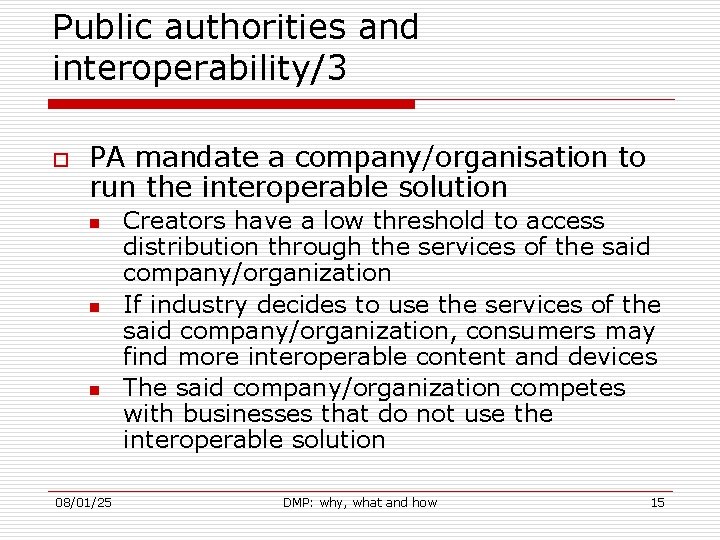
Public authorities and interoperability/3 o PA mandate a company/organisation to run the interoperable solution n 08/01/25 Creators have a low threshold to access distribution through the services of the said company/organization If industry decides to use the services of the said company/organization, consumers may find more interoperable content and devices The said company/organization competes with businesses that do not use the interoperable solution DMP: why, what and how 15
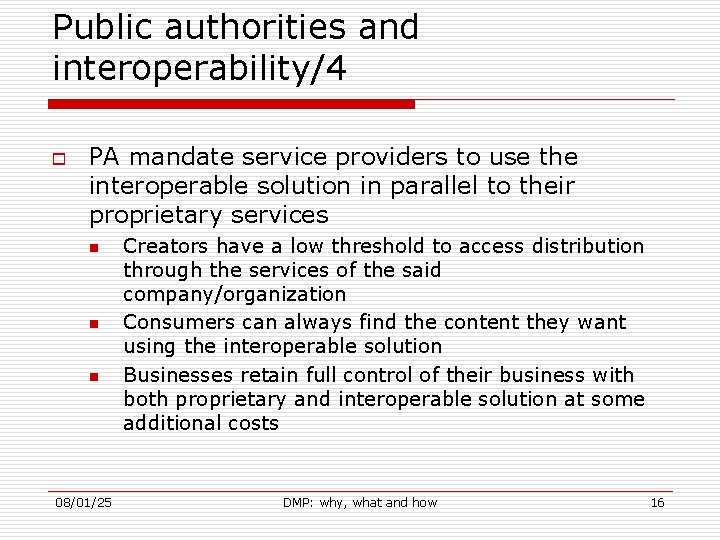
Public authorities and interoperability/4 o PA mandate service providers to use the interoperable solution in parallel to their proprietary services n n n 08/01/25 Creators have a low threshold to access distribution through the services of the said company/organization Consumers can always find the content they want using the interoperable solution Businesses retain full control of their business with both proprietary and interoperable solution at some additional costs DMP: why, what and how 16
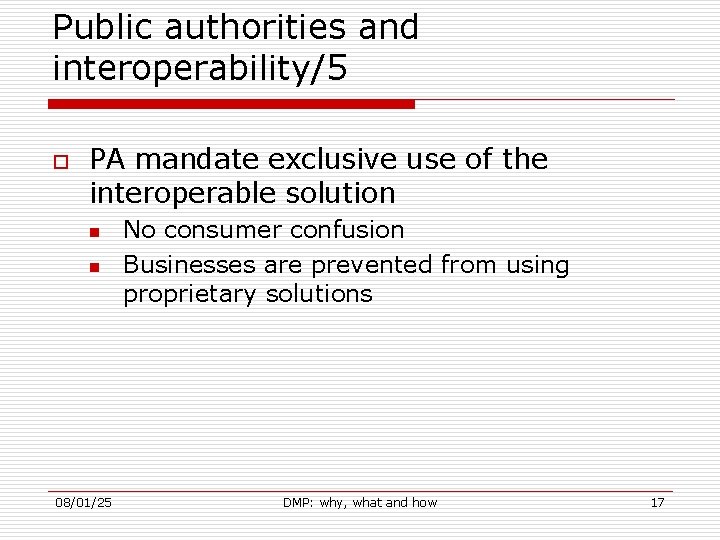
Public authorities and interoperability/5 o PA mandate exclusive use of the interoperable solution n n 08/01/25 No consumer confusion Businesses are prevented from using proprietary solutions DMP: why, what and how 17
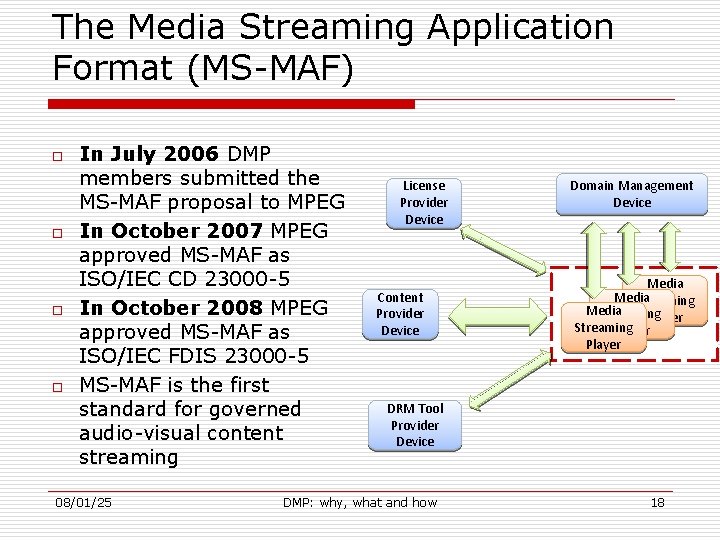
The Media Streaming Application Format (MS-MAF) o o In July 2006 DMP members submitted the MS-MAF proposal to MPEG In October 2007 MPEG approved MS-MAF as ISO/IEC CD 23000 -5 In October 2008 MPEG approved MS-MAF as ISO/IEC FDIS 23000 -5 MS-MAF is the first standard for governed audio-visual content streaming 08/01/25 License Provider Device Content Provider Device Domain Management Device Media Streaming Player DRM Tool Provider Device DMP: why, what and how 18
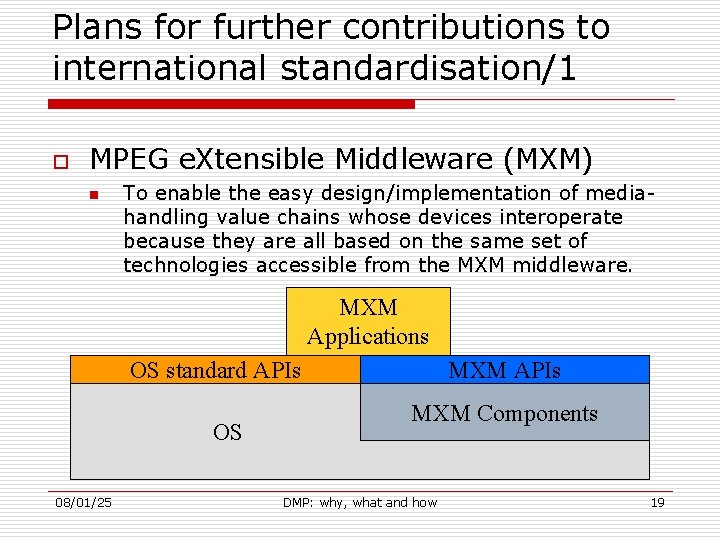
Plans for further contributions to international standardisation/1 o MPEG e. Xtensible Middleware (MXM) n To enable the easy design/implementation of mediahandling value chains whose devices interoperate because they are all based on the same set of technologies accessible from the MXM middleware. MXM Applications OS standard APIs OS OS 08/01/25 MXM APIs MXM Components DMP: why, what and how 19
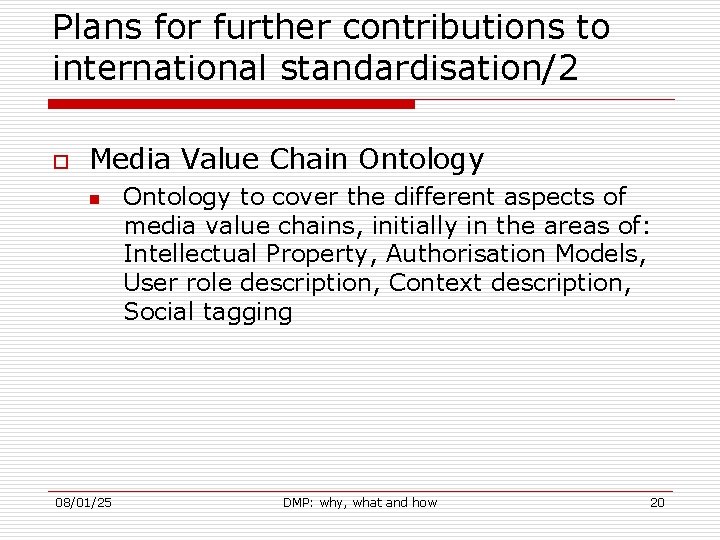
Plans for further contributions to international standardisation/2 o Media Value Chain Ontology n 08/01/25 Ontology to cover the different aspects of media value chains, initially in the areas of: Intellectual Property, Authorisation Models, User role description, Context description, Social tagging DMP: why, what and how 20
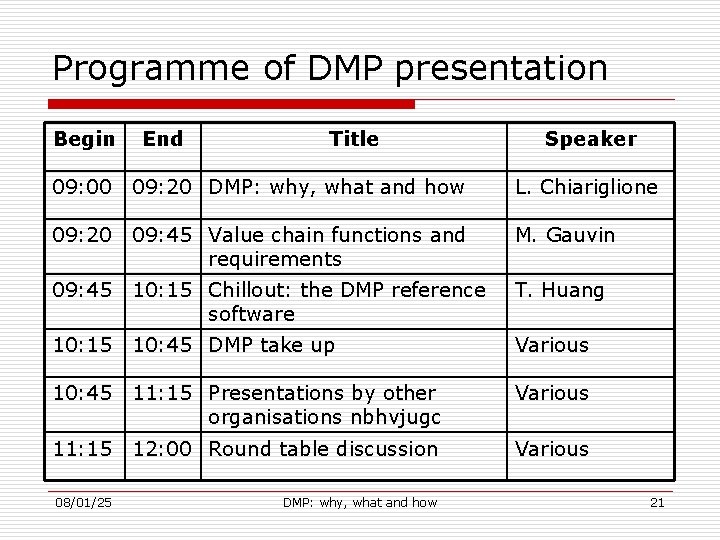
Programme of DMP presentation Begin End Title Speaker 09: 00 09: 20 DMP: why, what and how L. Chiariglione 09: 20 09: 45 Value chain functions and requirements M. Gauvin 09: 45 10: 15 Chillout: the DMP reference software T. Huang 10: 15 10: 45 DMP take up Various 10: 45 11: 15 Presentations by other organisations nbhvjugc Various 11: 15 12: 00 Round table discussion Various 08/01/25 DMP: why, what and how 21
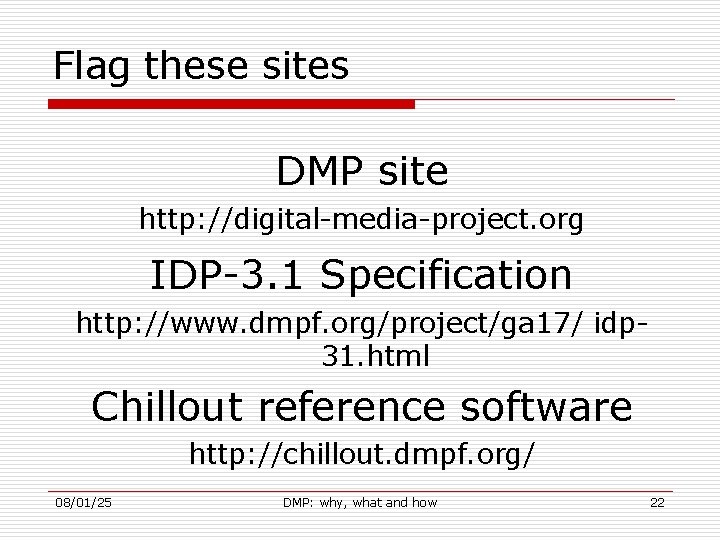
Flag these sites DMP site http: //digital-media-project. org IDP-3. 1 Specification http: //www. dmpf. org/project/ga 17/ idp 31. html Chillout reference software http: //chillout. dmpf. org/ 08/01/25 DMP: why, what and how 22