
DLR de Chart 1 OSA Fourier Transform Spectroscopy
- Slides: 23
DLR. de • Chart 1 > OSA Fourier Transform Spectroscopy > M. Birk • Recent Developments in FT Laboratory Spectroscopy at DLR > March 24, 2015 Recent Developments in FT Laboratory Spectroscopy at DLR Manfred Birk, Georg Wagner, Joep Loos German Aerospace Center, Remote Sensing Technology Institute
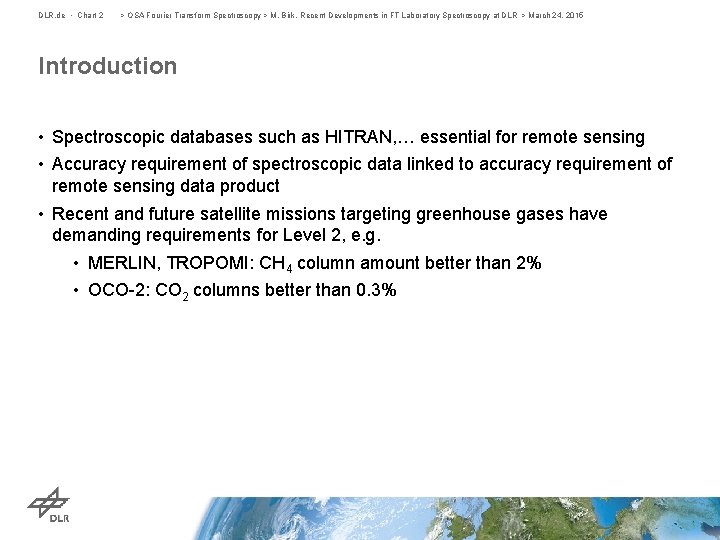
DLR. de • Chart 2 > OSA Fourier Transform Spectroscopy > M. Birk, Recent Developments in FT Laboratory Spectroscopy at DLR > March 24, 2015 Introduction • Spectroscopic databases such as HITRAN, … essential for remote sensing • Accuracy requirement of spectroscopic data linked to accuracy requirement of remote sensing data product • Recent and future satellite missions targeting greenhouse gases have demanding requirements for Level 2, e. g. • MERLIN, TROPOMI: CH 4 column amount better than 2% • OCO-2: CO 2 columns better than 0. 3%
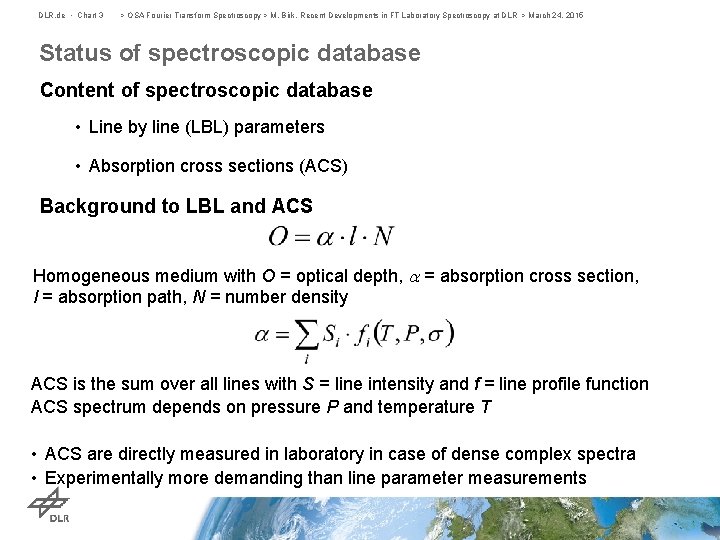
DLR. de • Chart 3 > OSA Fourier Transform Spectroscopy > M. Birk, Recent Developments in FT Laboratory Spectroscopy at DLR > March 24, 2015 Status of spectroscopic database Content of spectroscopic database • Line by line (LBL) parameters • Absorption cross sections (ACS) Background to LBL and ACS Homogeneous medium with O = optical depth, = absorption cross section, l = absorption path, N = number density ACS is the sum over all lines with S = line intensity and f = line profile function ACS spectrum depends on pressure P and temperature T • ACS are directly measured in laboratory in case of dense complex spectra • Experimentally more demanding than line parameter measurements
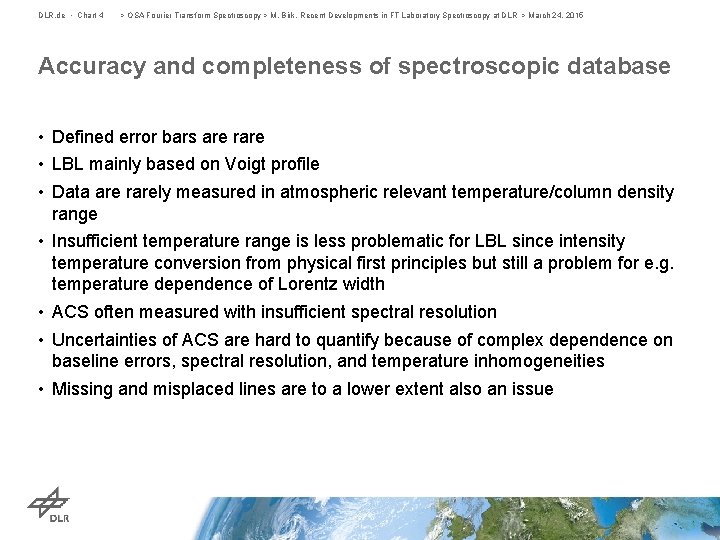
DLR. de • Chart 4 > OSA Fourier Transform Spectroscopy > M. Birk, Recent Developments in FT Laboratory Spectroscopy at DLR > March 24, 2015 Accuracy and completeness of spectroscopic database • Defined error bars are rare • LBL mainly based on Voigt profile • Data are rarely measured in atmospheric relevant temperature/column density range • Insufficient temperature range is less problematic for LBL since intensity temperature conversion from physical first principles but still a problem for e. g. temperature dependence of Lorentz width • ACS often measured with insufficient spectral resolution • Uncertainties of ACS are hard to quantify because of complex dependence on baseline errors, spectral resolution, and temperature inhomogeneities • Missing and misplaced lines are to a lower extent also an issue
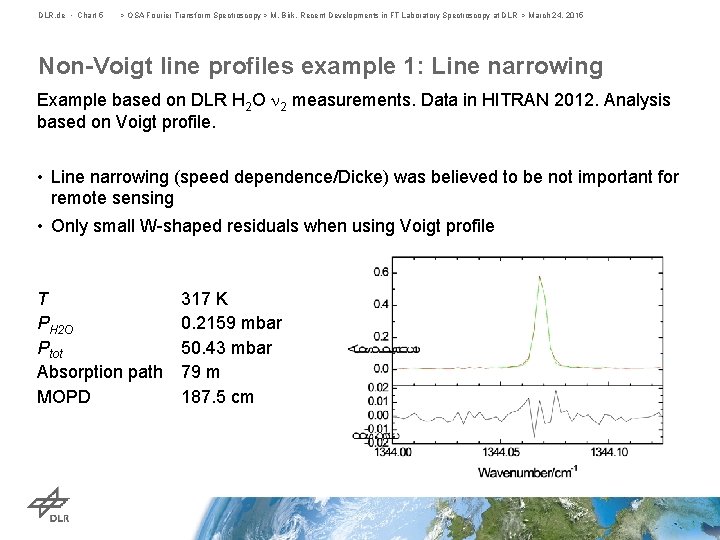
DLR. de • Chart 5 > OSA Fourier Transform Spectroscopy > M. Birk, Recent Developments in FT Laboratory Spectroscopy at DLR > March 24, 2015 Non-Voigt line profiles example 1: Line narrowing Example based on DLR H 2 O 2 measurements. Data in HITRAN 2012. Analysis based on Voigt profile. • Line narrowing (speed dependence/Dicke) was believed to be not important for remote sensing • Only small W-shaped residuals when using Voigt profile T PH 2 O Ptot Absorption path MOPD 317 K 0. 2159 mbar 50. 43 mbar 79 m 187. 5 cm
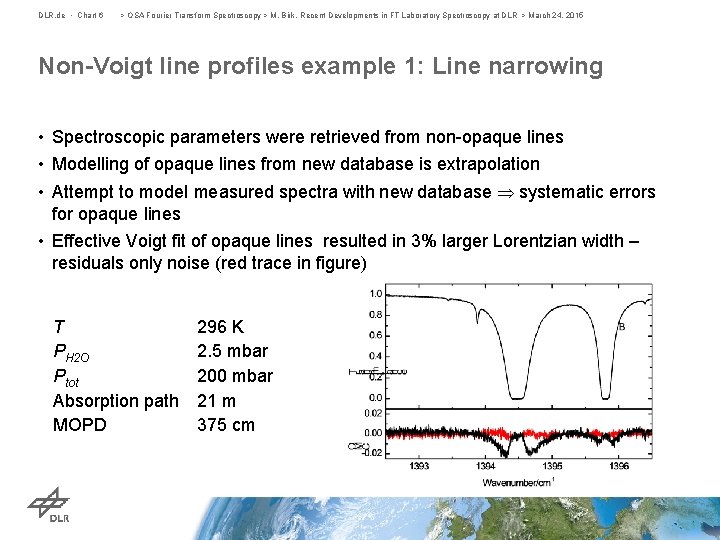
DLR. de • Chart 6 > OSA Fourier Transform Spectroscopy > M. Birk, Recent Developments in FT Laboratory Spectroscopy at DLR > March 24, 2015 Non-Voigt line profiles example 1: Line narrowing • Spectroscopic parameters were retrieved from non-opaque lines • Modelling of opaque lines from new database is extrapolation • Attempt to model measured spectra with new database systematic errors for opaque lines • Effective Voigt fit of opaque lines resulted in 3% larger Lorentzian width – residuals only noise (red trace in figure) T PH 2 O Ptot Absorption path MOPD 296 K 2. 5 mbar 200 mbar 21 m 375 cm
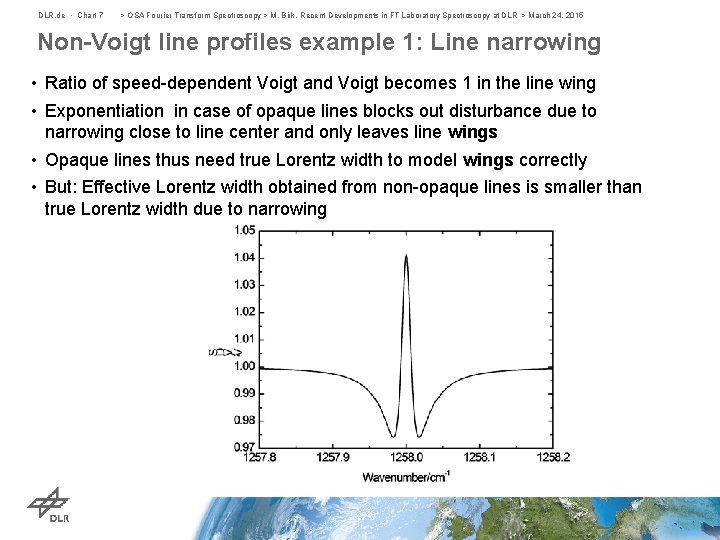
DLR. de • Chart 7 > OSA Fourier Transform Spectroscopy > M. Birk, Recent Developments in FT Laboratory Spectroscopy at DLR > March 24, 2015 Non-Voigt line profiles example 1: Line narrowing • Ratio of speed-dependent Voigt and Voigt becomes 1 in the line wing • Exponentiation in case of opaque lines blocks out disturbance due to narrowing close to line center and only leaves line wings • Opaque lines thus need true Lorentz width to model wings correctly • But: Effective Lorentz width obtained from non-opaque lines is smaller than true Lorentz width due to narrowing
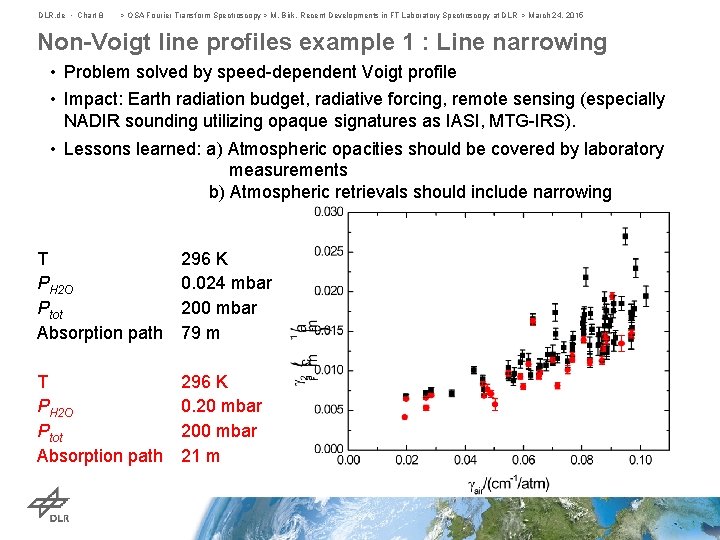
DLR. de • Chart 8 > OSA Fourier Transform Spectroscopy > M. Birk, Recent Developments in FT Laboratory Spectroscopy at DLR > March 24, 2015 Non-Voigt line profiles example 1 : Line narrowing • Problem solved by speed-dependent Voigt profile • Impact: Earth radiation budget, radiative forcing, remote sensing (especially NADIR sounding utilizing opaque signatures as IASI, MTG-IRS). • Lessons learned: a) Atmospheric opacities should be covered by laboratory measurements b) Atmospheric retrievals should include narrowing T PH 2 O Ptot Absorption path 296 K 0. 024 mbar 200 mbar 79 m T PH 2 O Ptot Absorption path 296 K 0. 20 mbar 200 mbar 21 m
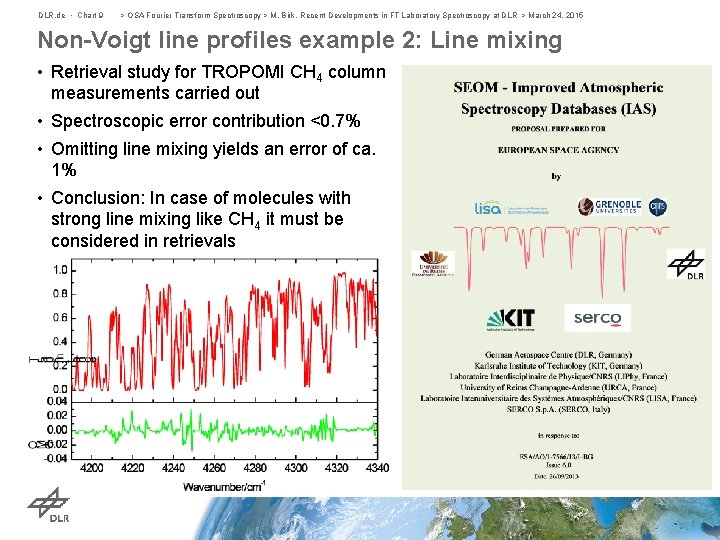
DLR. de • Chart 9 > OSA Fourier Transform Spectroscopy > M. Birk, Recent Developments in FT Laboratory Spectroscopy at DLR > March 24, 2015 Non-Voigt line profiles example 2: Line mixing • Retrieval study for TROPOMI CH 4 column measurements carried out • Spectroscopic error contribution <0. 7% • Omitting line mixing yields an error of ca. 1% • Conclusion: In case of molecules with strong line mixing like CH 4 it must be considered in retrievals
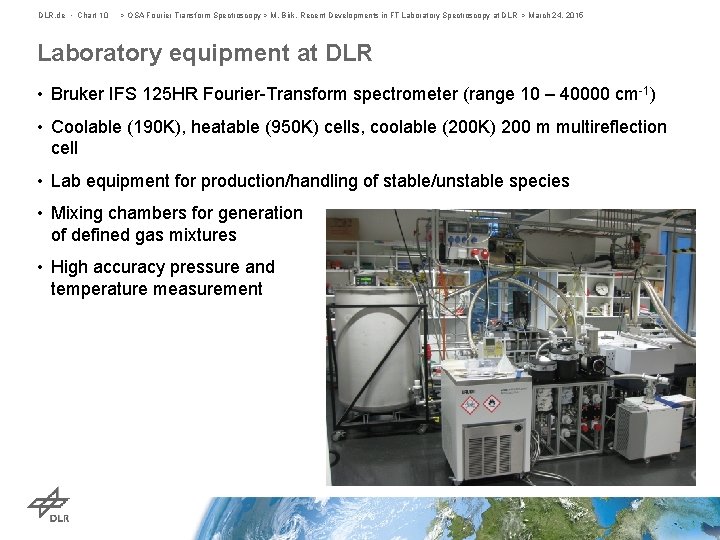
DLR. de • Chart 10 > OSA Fourier Transform Spectroscopy > M. Birk, Recent Developments in FT Laboratory Spectroscopy at DLR > March 24, 2015 Laboratory equipment at DLR • Bruker IFS 125 HR Fourier-Transform spectrometer (range 10 – 40000 cm-1) • Coolable (190 K), heatable (950 K) cells, coolable (200 K) 200 m multireflection cell • Lab equipment for production/handling of stable/unstable species • Mixing chambers for generation of defined gas mixtures • High accuracy pressure and temperature measurement
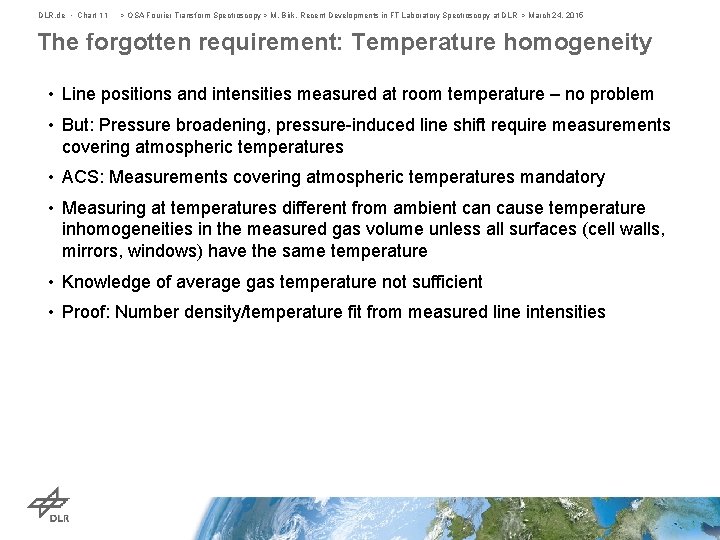
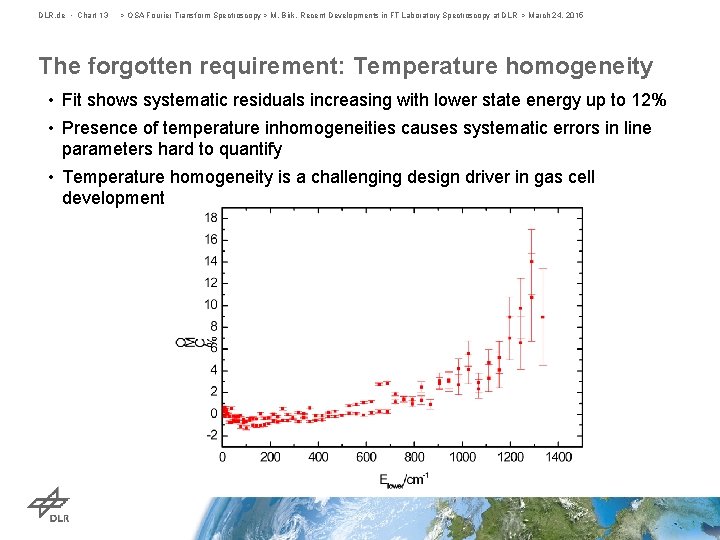
DLR. de • Chart 11 > OSA Fourier Transform Spectroscopy > M. Birk, Recent Developments in FT Laboratory Spectroscopy at DLR > March 24, 2015 The forgotten requirement: Temperature homogeneity • Line positions and intensities measured at room temperature – no problem • But: Pressure broadening, pressure-induced line shift require measurements covering atmospheric temperatures • ACS: Measurements covering atmospheric temperatures mandatory • Measuring at temperatures different from ambient can cause temperature inhomogeneities in the measured gas volume unless all surfaces (cell walls, mirrors, windows) have the same temperature • Knowledge of average gas temperature not sufficient • Proof: Number density/temperature fit from measured line intensities
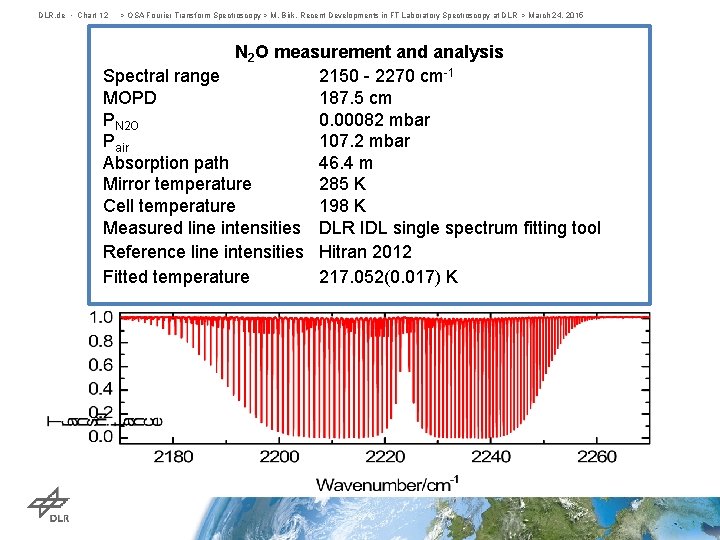
DLR. de • Chart 12 > OSA Fourier Transform Spectroscopy > M. Birk, Recent Developments in FT Laboratory Spectroscopy at DLR > March 24, 2015 N 2 O measurement and analysis Spectral range 2150 - 2270 cm-1 MOPD 187. 5 cm PN 2 O 0. 00082 mbar Pair 107. 2 mbar Absorption path 46. 4 m Mirror temperature 285 K Cell temperature 198 K Measured line intensities DLR IDL single spectrum fitting tool Reference line intensities Hitran 2012 Fitted temperature 217. 052(0. 017) K
DLR. de • Chart 13 > OSA Fourier Transform Spectroscopy > M. Birk, Recent Developments in FT Laboratory Spectroscopy at DLR > March 24, 2015 The forgotten requirement: Temperature homogeneity • Fit shows systematic residuals increasing with lower state energy up to 12% • Presence of temperature inhomogeneities causes systematic errors in line parameters hard to quantify • Temperature homogeneity is a challenging design driver in gas cell development
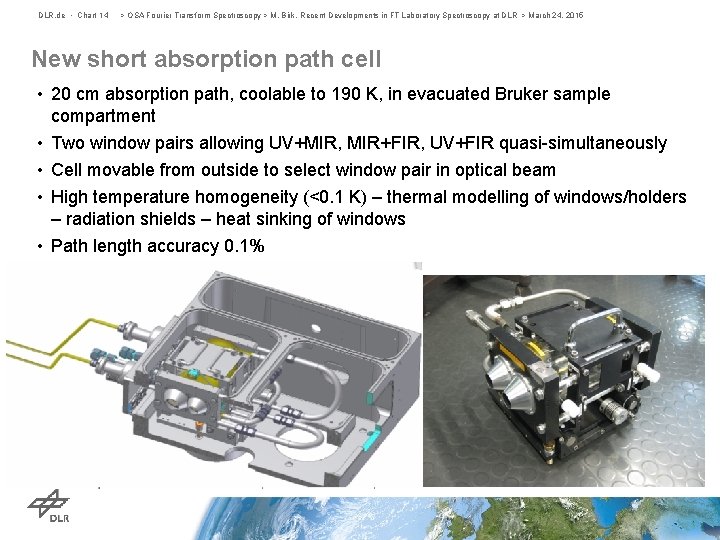
DLR. de • Chart 14 > OSA Fourier Transform Spectroscopy > M. Birk, Recent Developments in FT Laboratory Spectroscopy at DLR > March 24, 2015 New short absorption path cell • 20 cm absorption path, coolable to 190 K, in evacuated Bruker sample compartment • Two window pairs allowing UV+MIR, MIR+FIR, UV+FIR quasi-simultaneously • Cell movable from outside to select window pair in optical beam • High temperature homogeneity (<0. 1 K) – thermal modelling of windows/holders – radiation shields – heat sinking of windows • Path length accuracy 0. 1%
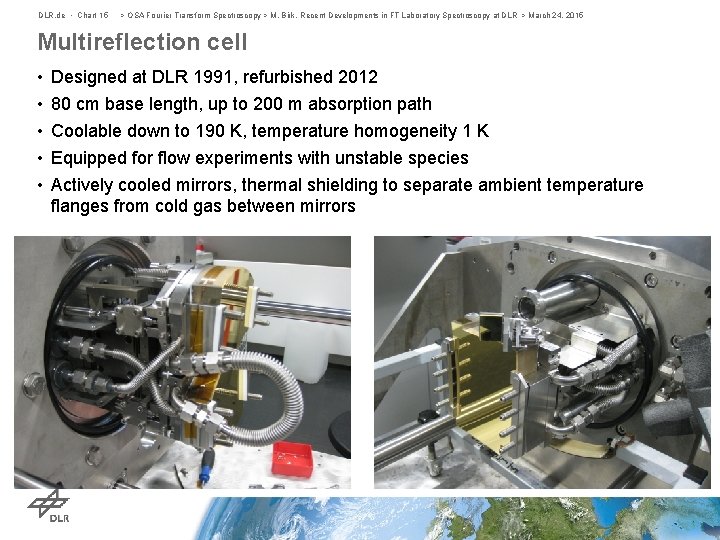
DLR. de • Chart 15 > OSA Fourier Transform Spectroscopy > M. Birk, Recent Developments in FT Laboratory Spectroscopy at DLR > March 24, 2015 Multireflection cell • • • Designed at DLR 1991, refurbished 2012 80 cm base length, up to 200 m absorption path Coolable down to 190 K, temperature homogeneity 1 K Equipped for flow experiments with unstable species Actively cooled mirrors, thermal shielding to separate ambient temperature flanges from cold gas between mirrors
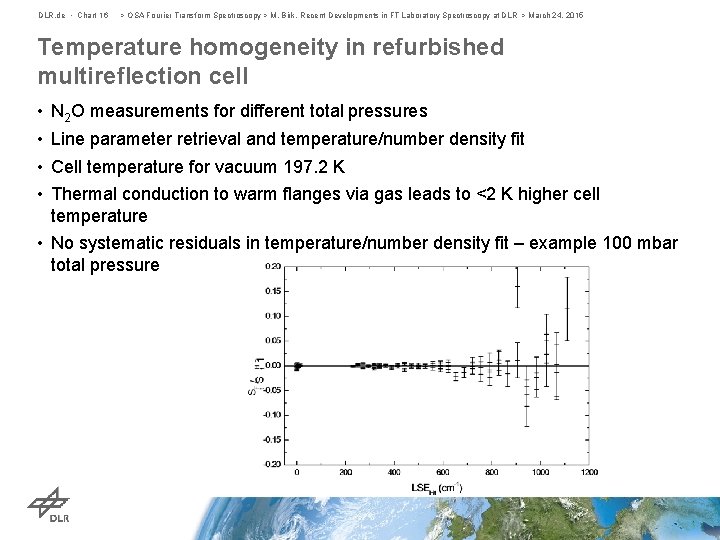
DLR. de • Chart 16 > OSA Fourier Transform Spectroscopy > M. Birk, Recent Developments in FT Laboratory Spectroscopy at DLR > March 24, 2015 Temperature homogeneity in refurbished multireflection cell • • N 2 O measurements for different total pressures Line parameter retrieval and temperature/number density fit Cell temperature for vacuum 197. 2 K Thermal conduction to warm flanges via gas leads to <2 K higher cell temperature • No systematic residuals in temperature/number density fit – example 100 mbar total pressure
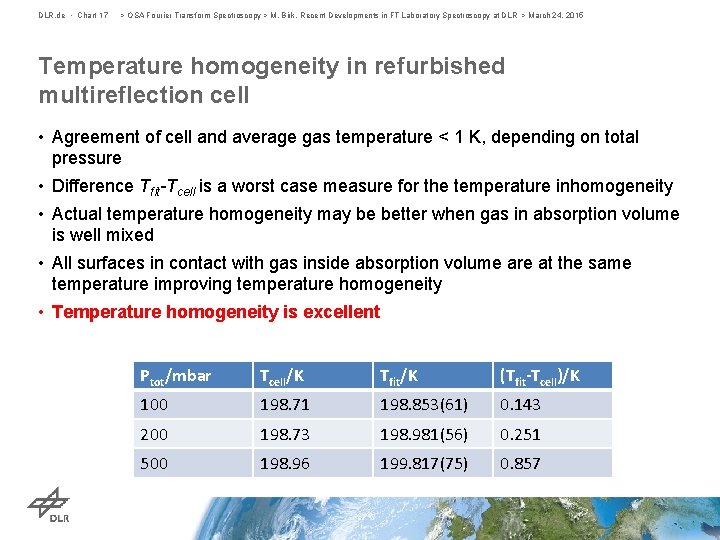
DLR. de • Chart 17 > OSA Fourier Transform Spectroscopy > M. Birk, Recent Developments in FT Laboratory Spectroscopy at DLR > March 24, 2015 Temperature homogeneity in refurbished multireflection cell • Agreement of cell and average gas temperature < 1 K, depending on total pressure • Difference Tfit-Tcell is a worst case measure for the temperature inhomogeneity • Actual temperature homogeneity may be better when gas in absorption volume is well mixed • All surfaces in contact with gas inside absorption volume are at the same temperature improving temperature homogeneity • Temperature homogeneity is excellent Ptot/mbar Tcell/K Tfit/K (Tfit-Tcell)/K 100 198. 71 198. 853(61) 0. 143 200 198. 73 198. 981(56) 0. 251 500 198. 96 199. 817(75) 0. 857
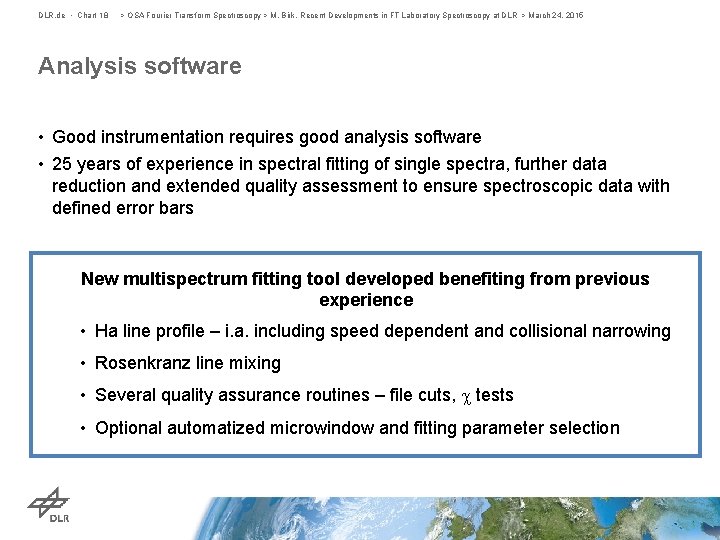
DLR. de • Chart 18 > OSA Fourier Transform Spectroscopy > M. Birk, Recent Developments in FT Laboratory Spectroscopy at DLR > March 24, 2015 Analysis software • Good instrumentation requires good analysis software • 25 years of experience in spectral fitting of single spectra, further data reduction and extended quality assessment to ensure spectroscopic data with defined error bars New multispectrum fitting tool developed benefiting from previous experience • Ha line profile – i. a. including speed dependent and collisional narrowing • Rosenkranz line mixing • Several quality assurance routines – file cuts, tests • Optional automatized microwindow and fitting parameter selection
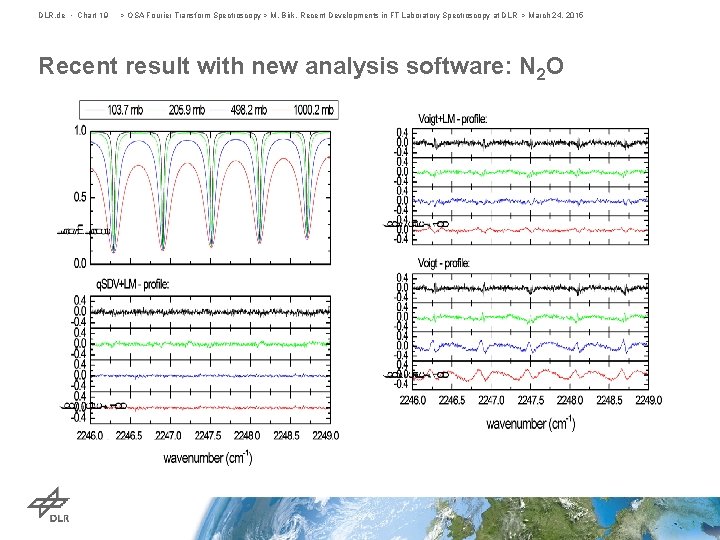
DLR. de • Chart 19 > OSA Fourier Transform Spectroscopy > M. Birk, Recent Developments in FT Laboratory Spectroscopy at DLR > March 24, 2015 Recent result with new analysis software: N 2 O
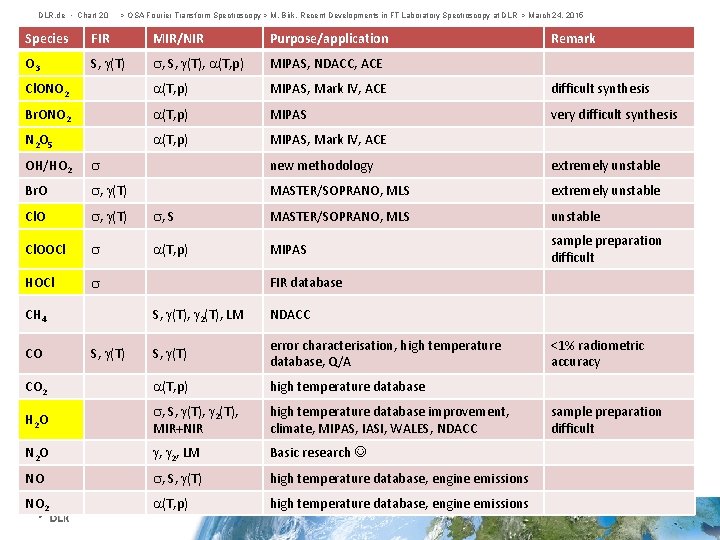
DLR. de • Chart 20 > OSA Fourier Transform Spectroscopy > M. Birk, Recent Developments in FT Laboratory Spectroscopy at DLR > March 24, 2015 Species FIR MIR/NIR Purpose/application Remark O 3 S, (T) , S, (T), (T, p) MIPAS, NDACC, ACE Cl. ONO 2 (T, p) MIPAS, Mark IV, ACE difficult synthesis Br. ONO 2 (T, p) MIPAS very difficult synthesis N 2 O 5 (T, p) MIPAS, Mark IV, ACE OH/HO 2 new methodology extremely unstable Br. O , (T) MASTER/SOPRANO, MLS extremely unstable Cl. O , (T) , S MASTER/SOPRANO, MLS unstable Cl. OOCl (T, p) MIPAS sample preparation difficult HOCl FIR database S, (T), 2(T), LM NDACC S, (T) error characterisation, high temperature database, Q/A CO 2 (T, p) high temperature database H 2 O , S, (T), 2(T), MIR+NIR high temperature database improvement, climate, MIPAS, IASI, WALES, NDACC N 2 O , 2, LM Basic research NO , S, (T) high temperature database, engine emissions NO 2 (T, p) high temperature database, engine emissions CH 4 CO S, (T) <1% radiometric accuracy sample preparation difficult
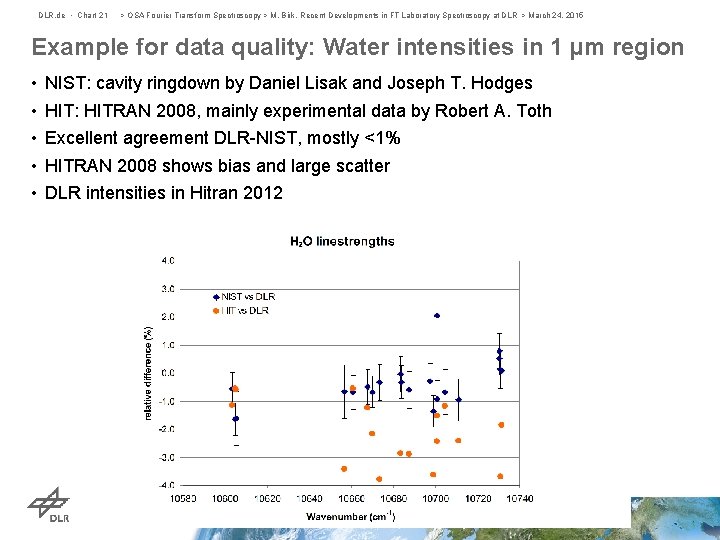
DLR. de • Chart 21 > OSA Fourier Transform Spectroscopy > M. Birk, Recent Developments in FT Laboratory Spectroscopy at DLR > March 24, 2015 Example for data quality: Water intensities in 1 µm region • • • NIST: cavity ringdown by Daniel Lisak and Joseph T. Hodges HIT: HITRAN 2008, mainly experimental data by Robert A. Toth Excellent agreement DLR-NIST, mostly <1% HITRAN 2008 shows bias and large scatter DLR intensities in Hitran 2012
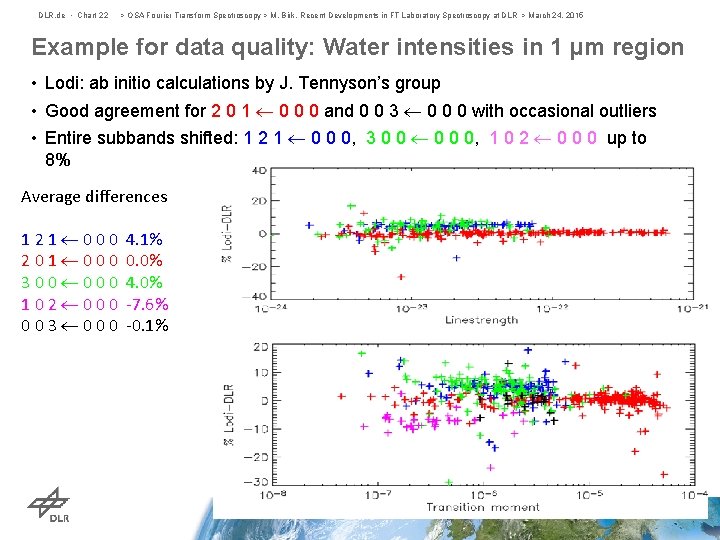
DLR. de • Chart 22 > OSA Fourier Transform Spectroscopy > M. Birk, Recent Developments in FT Laboratory Spectroscopy at DLR > March 24, 2015 Example for data quality: Water intensities in 1 µm region • Lodi: ab initio calculations by J. Tennyson’s group • Good agreement for 2 0 1 0 0 0 and 0 0 3 0 0 0 with occasional outliers • Entire subbands shifted: 1 2 1 0 0 0, 3 0 0 0, 1 0 2 0 0 0 up to 8% Average differences 121 000 201 000 300 000 102 000 003 000 4. 1% 0. 0% 4. 0% -7. 6% -0. 1%
DLR. de • Chart 23 > OSA Fourier Transform Spectroscopy > M. Birk, Recent Developments in FT Laboratory Spectroscopy at DLR > March 24, 2015 Summary and Conclusion • Current and future remote sensing instruments have demanding requirements regarding spectroscopic database • Remote sensing needs extended line profile, Voigt profile mostly not sufficient • To obtain spectroscopic data with quantified uncertainties dedicated hardware is required, especially temperature homogeneity is a key issue • At DLR absorption cells were developed to ensure high temperature homogeneity • Atmospheric relevant temperature range covered • Absorption path 0. 2 – 200 m • Multispectrum fitting tool developed with most recent line profiles • Example of line parameters with defined uncertainties: 1 µm H 2 O intensities – agreement with other experimental work and theoretical calculations