
DLC 2208 Material Science tcheropmust ac ug 256783233736
- Slides: 27
DLC 2208: Material Science tcherop@must. ac. ug +256783233736 +256750304481 Lecture : Ceramics (Ceramic Materials) 05 June 2021 Mr. Cherop Tonny 2019/2020 1
Ceramics • A ceramic material is an inorganic, non-metallic solid prepared by the action of heat and subsequent cooling. • Most of the ceramic materials are crystalline or partly crystalline solids except glass which is amorphous. • They are generally ionic or covalent compounds. • Historically, the 1 st ceramic materials where pottery objects made from clay, either itself or mixed with other materials, hardened in fire by firing. 05 June 2021 Mr. Cherop Tonny 2019/2020 2
Cont…. • Later ceramic materials were glazed and fired to create a colored smooth surface. • Ceramic materials now include, domestic, industrial and building products and art objects. 05 June 2021 Mr. Cherop Tonny 2019/2020 3
Applications of Ceramic Products • Structural (construction)-bricks, pipes, floor and roof tiles. • Refractories-kiln linings (hot ovens), gas fire radiants, steel and crucibles. • White wares (table ware)-cups, plates, spoons, wall tiles, pottery products and sanitary ware. • Technical/engineering, advanced, special an in Japan fine ceramics- Tiles used in space shuttle programs, gas burner nozzles, ballistic protection, biomedical implants, missile nozzle cones, and jet engine turbine blades. 05 June 2021 Mr. Cherop Tonny 2019/2020 4
Cont…. . • Used in the manufacture of knives-the blades of the ceramic knife will remain sharper more longer than for stainless steel. Disadvantage- they are brittle and can be snapped by dropping it on a hard surface. • Used to replace steel in ball bearings Advantages: Harder- less prone to wear and more durable. Chemically resistant to corrosion-used in wet environments where steel ball bearings would rust. Disadvantages : they are costly & prone to damage under shock loads. 05 June 2021 Mr. Cherop Tonny 2019/2020 5
Cont…. • Used in the manufacture of bio-ceramics such as dental implants and synthetic bones. • Used in watchmaking for producing watch cases because of its lightness, scratch-resistance, durability and smooth touch. 05 June 2021 Mr. Cherop Tonny 2019/2020 6
General Properties of Ceramic Materials They are crystalline solids and inert. They are resistant to corrosion and oxidation. They can withstand very high temperatures (1000 -1600ᴼC). They are strong, hard, high compression strength but brittle, and weak in shearing and tension. • They have good thermal and insulating properties. • • 05 June 2021 Mr. Cherop Tonny 2019/2020 7
Structural Components of Ceramic Materials • Ceramics mainly contains two structural components i. e. (i) Refractory crystalline structure. • They are refractory skeletal structures made up of particles of metal oxides such as alumina, silica etc. Properties: • It does not melt at normal kiln temperatures. • It retains its crystalline structure throughout all the stages of ceramic production. (ii) Glass Part (feldspar) Properties: • It does not have a coherent internal structure of its own and thus melts at normal kiln temperatures. 05 June 2021 Mr. Cherop Tonny 2019/2020 8
Cont…. • All ceramic bodies contain, at minimum a refractory skeletal structure made up of particles of metal oxide. most frequently it is composed of particles of Al 2 O 3 in the form of alumina, and silicon dioxide in the form of silica. Think of this particles as tiny individual rocks. Silica is really just quartz, while aluminium is a common rock called corundum. • When heated to relatively low kiln temperatures, these refractory particles fuse together at their points of contact. • Sintering is a process of heating a mass of refractory particle until they fuse together at their points of contact. 05 June 2021 Mr. Cherop Tonny 2019/2020 9
Cont…. • Most ceramic bodies also contain varying amounts of glass which is mostly an amorphous gel. • In ceramics, glass is infiltrated between the sintered refractory particles. • Interestingly, glass is also made up of silicon dioxide and aluminium oxide, the same components that makes up the refractory particles. However neither silicon dioxide nor aluminium oxide in glass retains their crystalline identities. • It seals the spaces between the sintered refractory particles against water, and helps the refractory particles from coming apart in the even of tension. 05 June 2021 Mr. Cherop Tonny 2019/2020 10
Classification of ceramic materials 1. Naturally occurring ceramics • Natural Rocks & their products such as gravel, sand, clay etc. • Most of the Rocks contain silica (60%), alumina (15%), & oxides of K, Na, Ca, Mg, Fe, & Ti. • Other ceramic materials include- clay, quartz, mica, granite, dolerite, sand stones, pebbles of various sizes, limestone. • NB: very hard materials are- granite, dolerite & quartz. 05 June 2021 Mr. Cherop Tonny 2019/2020 11
Cont…. . 2. Clay products • Ceramics produced from minerals by the action of heat by different techniques. • They form important engineering materials such as bricks, mortar, tiles, porcelain, cement, glass, chinaware, lime, gypsum, plasters etc. 3. Refractory ceramic materials. • Materials with very high melting points. • Capable of withstanding very high temperatures without appreciable softening. 05 June 2021 Mr. Cherop Tonny 2019/2020 12
Cont…. Examples • fire clay, high alumina-silica composition , dolomite , Zircon, magnesite , silicon carbide , boron-carbides. • High grade refractory materials- alumina, silica, magnesia, zirconia, & beryllia. Properties: -have high melting points (2500ᴼC) - have high thermal shock resistance. • Carbides of; - tungsten, cerium, molybdenum, titanium, & boron Properties: - have high wear resistance. - have high strength. 05 June 2021 Mr. Cherop Tonny 2019/2020 13
Cont…. • Silicon carbide Properties • Have high thermal conductivity • Have low thermal expansion • High density • High abrasion resistance • Have high chemical resistance • Borides of chromium, tungsten, titanium Properties • They are hard • They are highly resistant towards chemical attack. 05 June 2021 Mr. Cherop Tonny 2019/2020 14
Contd…… • Nitrites of boron Properties • High hardness equal to that of diamond. • Graphite and carbon Properties • They are resistant to acids, alkalis and solvents • Graphite has no definite melting point but it sublimes at 4200ᴼC • Uses: -making rocket nozzles 05 June 2021 Mr. Cherop Tonny 2019/2020 15
4. Glass Ceramic Materials. Glass is an inorganic product of fusion. Special catalysts are used to accelerate their process of manufacture. They usually contain magnesium or lithium ions & silica as the ideal glass forming materials. This materials have very high melting point. 05 June 2021 Mr. Cherop Tonny 2019/2020 16
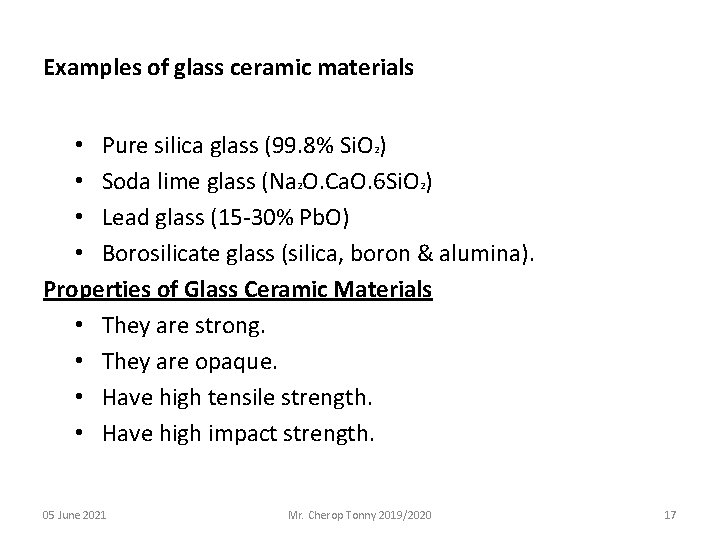
Examples of glass ceramic materials • Pure silica glass (99. 8% Si. O ) • Soda lime glass (Na O. Ca. O. 6 Si. O ) • Lead glass (15 -30% Pb. O) • Borosilicate glass (silica, boron & alumina). Properties of Glass Ceramic Materials • They are strong. • They are opaque. • Have high tensile strength. • Have high impact strength. 2 2 05 June 2021 2 Mr. Cherop Tonny 2019/2020 17
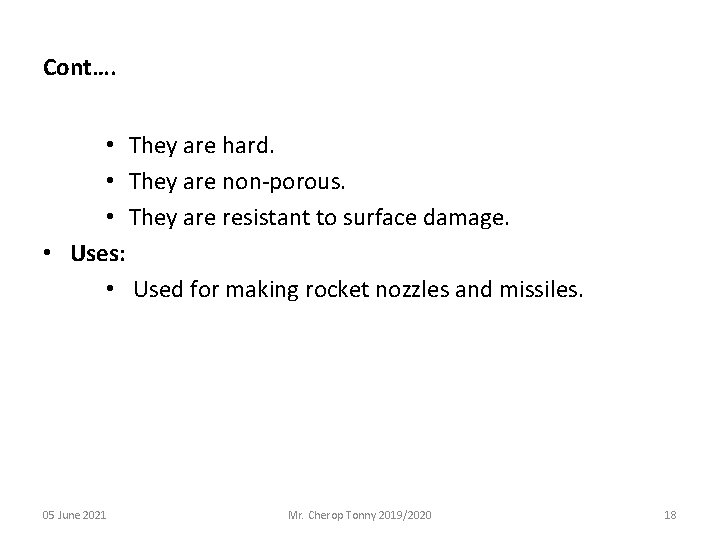
Cont…. • They are hard. • They are non-porous. • They are resistant to surface damage. • Uses: • Used for making rocket nozzles and missiles. 05 June 2021 Mr. Cherop Tonny 2019/2020 18
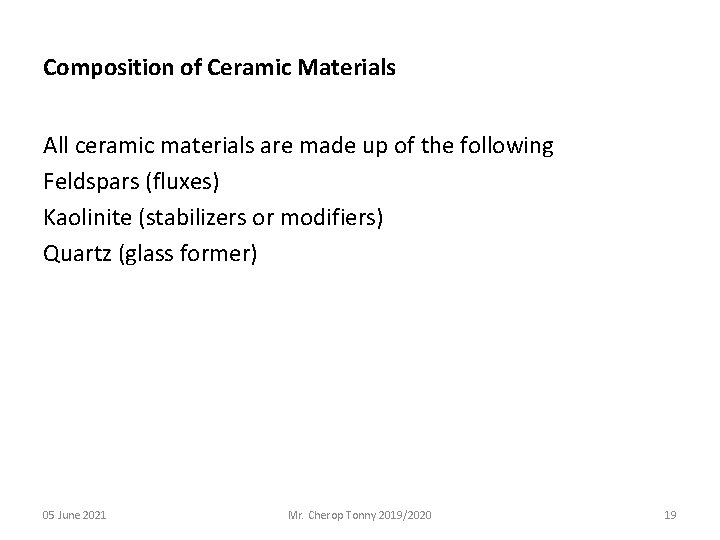
Composition of Ceramic Materials All ceramic materials are made up of the following Feldspars (fluxes) Kaolinite (stabilizers or modifiers) Quartz (glass former) 05 June 2021 Mr. Cherop Tonny 2019/2020 19
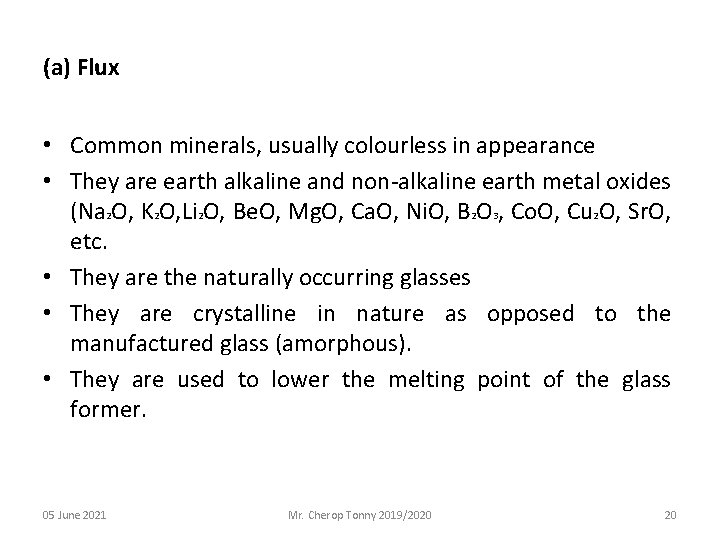
(a) Flux • Common minerals, usually colourless in appearance • They are earth alkaline and non-alkaline earth metal oxides (Na O, K O, Li O, Be. O, Mg. O, Ca. O, Ni. O, B O , Co. O, Cu O, Sr. O, etc. • They are the naturally occurring glasses • They are crystalline in nature as opposed to the manufactured glass (amorphous). • They are used to lower the melting point of the glass former. 2 05 June 2021 2 2 2 Mr. Cherop Tonny 2019/2020 3 2 20
(b) Kaolinite (stabilizer/ modifiers • The most common stabilizer is Alumina (corundum) • It is added to the glass ceramic materials to improve on the properties of the final product (resistance to corrosion, wearing resistance • Examples of stabilizers( Pb. O, Al O , Ca. O, B O , etc) 2 05 June 2021 3 Mr. Cherop Tonny 2019/2020 2 3 21
(c) Quartz (glass former) • Quartz is pure, crystalline silica with a melting point of 1713ᴼC • It does not melt under normal kiln temperatures (1000 -1320ᴼC) and thus, forms the refractory part (body) of the ceramic material. • Glass formers are metal oxides which are able to retain the amorphous property of their molten state when setting to a solid. Examples of glass formers • • • 05 June 2021 Boron oxide- borosilicate glass Calcium oxide- soda lime glass Phosphorous pentaoxide Arsenic trioxide, Selenium oxide, Germanium oxide Mr. Cherop Tonny 2019/2020 22
Basic Ceramic Manufacturing Process • It comprises of 4 basic stages i. e. Shaping, Drying, Firing and Glazing. Step 1: Shaping • The clay materials are thoroughly mixed with water. • The excess water is squeezed out to form a workable clay mix. • The material is shaped by casting in enclosed moulds which open in half to release the formed article. 05 June 2021 Mr. Cherop Tonny 2019/2020 23
Step 2: Drying • Before the ware is fired to high temperatures, it must be dried to remove water which was added to increase the plasticity of the clay. • The water must migrate through the spaces btn the particles of clay, silica, and feldspar to evaporate from the surface. • During the drying period, the body will shrink by a significant amount. Shrinkages stops when the particles come into contact. • If the drying is not uniform, stresses can build to the extend that the body warps or possibly cracks. 05 June 2021 Mr. Cherop Tonny 2019/2020 24
Step 3: firing • Firing- heating the clay particles until they fuse together at the points of contact. • During firing, the bound moisture is evaporated off. • All unglazed articles and many glazed ones are fired using the “once firing method” 05 June 2021 Mr. Cherop Tonny 2019/2020 25
Step 4: Glazing • Glaze- a thin layer of glass or glass & crystals that adheres to the surface of the clay body • importance's: -to provide a smooth, non-absorbent surface that can be colored and textured in a manner not possible on the clay body itself. • Glazes are composed of various oxides combined in proportions that will yield the desired properties. • Silica & boric oxide are the glass formers but oxides such as Na 2 O, 2 K 2 O, Ca. O, Pb. O, & Al 2 O 3 must be present in stoichiometric sense to give the desired properties. 05 June 2021 Mr. Cherop Tonny 2019/2020 26
05 June 2021 Mr. Cherop Tonny 2019/2020 27