
DL HF AMAP linking method for IEEE 802
![HF-A-MAP indication method [1] q HF-A-MAP indication • Key features of implicit indication proposed](https://slidetodoc.com/presentation_image_h2/e45e487e0a25d6f70821a7c2369692c4/image-2.jpg "HF-A-MAP indication method [1] q HF-A-MAP indication • Key features of implicit indication proposed")
![HF-A-MAP indication method [2] • Used resource comparison of implicit mapping and explicit mapping](https://slidetodoc.com/presentation_image_h2/e45e487e0a25d6f70821a7c2369692c4/image-3.jpg "HF-A-MAP indication method [2] • Used resource comparison of implicit mapping and explicit mapping")
![HF-A-MAP indication method [3] ü Explicit mapping / Semi-explicit mapping – 16 HF A-MAP](https://slidetodoc.com/presentation_image_h2/e45e487e0a25d6f70821a7c2369692c4/image-4.jpg "HF-A-MAP indication method [3] ü Explicit mapping / Semi-explicit mapping – 16 HF A-MAP")
![HF-A-MAP indication method [4] – In case of 20 MHz system BW • Since](https://slidetodoc.com/presentation_image_h2/e45e487e0a25d6f70821a7c2369692c4/image-5.jpg "HF-A-MAP indication method [4] – In case of 20 MHz system BW • Since")
![HF-A-MAP indication method [5] • On consideration of MU-MIMO ü Implicit mapping – In](https://slidetodoc.com/presentation_image_h2/e45e487e0a25d6f70821a7c2369692c4/image-6.jpg "HF-A-MAP indication method [5] • On consideration of MU-MIMO ü Implicit mapping – In")
![HF-A-MAP indication method [6] • SFBC symbol pairing problem ü Implicit mapping – Since](https://slidetodoc.com/presentation_image_h2/e45e487e0a25d6f70821a7c2369692c4/image-7.jpg "HF-A-MAP indication method [6] • SFBC symbol pairing problem ü Implicit mapping – Since")
![HF-A-MAP indication method [7] • Overhead comparison depending on data stream in MU-MIMO ü](https://slidetodoc.com/presentation_image_h2/e45e487e0a25d6f70821a7c2369692c4/image-8.jpg "HF-A-MAP indication method [7] • Overhead comparison depending on data stream in MU-MIMO ü")
![HF-A-MAP indication method [8] • 4 data streams case (20 MHz) w/ indication method](https://slidetodoc.com/presentation_image_h2/e45e487e0a25d6f70821a7c2369692c4/image-9.jpg "HF-A-MAP indication method [8] • 4 data streams case (20 MHz) w/ indication method")
![HF-A-MAP indication method [9] q Extension of HF A-MAP IE implicit indication for Nsubframe,](https://slidetodoc.com/presentation_image_h2/e45e487e0a25d6f70821a7c2369692c4/image-10.jpg "HF-A-MAP indication method [9] q Extension of HF A-MAP IE implicit indication for Nsubframe,")
![HF-A-MAP indication method [10] q Possible broadcasting information (If it can be supported) •](https://slidetodoc.com/presentation_image_h2/e45e487e0a25d6f70821a7c2369692c4/image-11.jpg "HF-A-MAP indication method [10] q Possible broadcasting information (If it can be supported) •")
- Slides: 12
DL HF A-MAP linking method for IEEE 802. 16 m IEEE 802. 16 Presentation Submission Template (Rev. 9) Document Number: IEEE C 802. 16 m-09/1421 Date Submitted: 2009 -07 -06 Source: Hyungho Park, Jinsoo Choi, Jin Sam Kwak LG Electronics, Inc. LG R&D Complex, 533 Hogye-1 dong, Dongan-gu, Anyang, 431 -749, Korea *<http: //standards. ieee. org/faqs/affiliation. FAQ. html> Voice: +82 -31 -450 -1934 E-mail: hyunghopark@lge. com, emptlie@lge. com , samji@lge. com Re: IEEE 802. 16 m-09/0028 r 1, “Call for Comments and Contributions on Project 802. 16 m Amendment Content” Target topic: “DL Control Structure” Section Purpose: To provide details on HF A-MAP linking method for UL data transmission and adopt text proposal for the amendment text Notice: This document does not represent the agreed views of the IEEE 802. 16 Working Group or any of its subgroups. It represents only the views of the participants listed in the “Source(s)” field above. It is offered as a basis for discussion. It is not binding on the contributor(s), who reserve(s) the right to add, amend or withdraw material contained herein. Release: The contributor grants a free, irrevocable license to the IEEE to incorporate material contained in this contribution, and any modifications thereof, in the creation of an IEEE Standards publication; to copyright in the IEEE’s name any IEEE Standards publication even though it may include portions of this contribution; and at the IEEE’s sole discretion to permit others to reproduce in whole or in part the resulting IEEE Standards publication. The contributor also acknowledges and accepts that this contribution may be made public by IEEE 802. 16. Patent Policy: The contributor is familiar with the IEEE-SA Patent Policy and Procedures: <http: //standards. ieee. org/guides/bylaws/sect 6 -7. html#6> and <http: //standards. ieee. org/guides/opman/sect 6. html#6. 3>. Further information is located at <http: //standards. ieee. org/board/pat-material. html> and <http: //standards. ieee. org/board/pat >.
HF-A-MAP indication method [1] q HF-A-MAP indication • Key features of implicit indication proposed by LG ü By linking LRU index to HF A-MAP IE, AMS is able to acquire ACK/NACK feedback information sent from BS. ü With consideration of current UL HARQ operation, LRU based implicit mapping is feasible. ü There is no additional overhead in A-A-MAP IE. ü The amount of resource assigned for HF-A-MAP is 1/2 RU in case of 10 MHz system BW. ü Since 1 HF A-MAP IE per 1 LRU is generated, 48 HF A-MAP IEs are transmitted in 10 MHz. Effect of repetition 3 2
HF-A-MAP indication method [2] • Used resource comparison of implicit mapping and explicit mapping ü Implicit mapping – Option 1) 48 HF A-MAP IEs (10 MHz) x 4 repetition rate = 192 repeated HF A-MAP IEs = 96 QPSK modulated symbols (1 LRU) • In case that 2 LRUs or more assigned to a MS, the reliability of HF-A-MAP IEs can be improved by combining multiple HF A-MAP IEs. • When 16 MSs are assigned in HF A-MAP resource of 1 LRU for UL transmission, one MS has 3 average HF-A-MAP IEs. For each MS, 1 HF A-MAP IEs (10 MHz) x 12 repetition rate (4 repetition rate x 3 multiple HF A MAP IEs)= 12 repeated HF A MAP IEs = 6 QPSK symbols – Option 2) 48 HF A-MAP IEs (10 MHz) x 2 repetition rate = 96 repeated HF A-MAP IEs = 48 QPSK modulated symbols (1/2 LRU) • When 16 MSs are assigned, for each MS, 1 HF A-MAP IEs (10 MHz) x 6 repetition rate (2 repetition rate x 3 multiple HF A MAP IEs)= 6 repeated HF A MAP IEs = 3 QPSK symbols. This repetition rate is enough to satisfy the requirement of ACK/NACK transmission. – With implicit method, it is considered the amount of HF-A-MAP resource is 1/2 LRU or 1 LRU in case of 10 MHz 3
HF-A-MAP indication method [3] ü Explicit mapping / Semi-explicit mapping – 16 HF A-MAP IEs for UL data bursts in case of 10 MHz system BW (assuming 6 repetitions) • Required HF-A-MAP resource: 16 HF A-MAP IEs x 6 repetition rate = 96 repeated HF AMAP IEs = 48 QPSK symbols (1/2 LRU) • Additional overhead in A-MAP is increased, e. g. 16 MS x 4 bit (indication bit) = 64 bits. If we consider coding rate of 1/2, the additional overhead for all MSs is increased by 64 subcarriers. This requires 2/3 LRU (with QPSK) • Comparison on the total overhead : HF A-MAP resource overhead + indication overhead in A-A-MAP 10 MHz 4
HF-A-MAP indication method [4] – In case of 20 MHz system BW • Since more than 16 MSs can be assigned in a subframe, the indication overhead in A-AMAP is increased. • In multi carrier system, the total overhead of explicit mapping is increased as the number of MS is increased with expanded bandwidth 20 MHz • For explicit mapping, indication field of 5 bits in a A-A-MAP is needed for supporting up to 32 MSs with increased bandwidth (6 bits for 48 MSs). • Semi-explicit mapping can save about 2 bits in A-A-MAP. In this comparison, the signaling overhead of non user specific A-MAP is excluded. 5
HF-A-MAP indication method [5] • On consideration of MU-MIMO ü Implicit mapping – In case of MU-MIMO, multiple MSs share the same time-frequency resource for UL data transmission. – The overhead in implicit mapping depends on the number of data streams in MU-MIMO. However HF A-MAP IEs can be differently indicated to a MS through different pilot index even if same resource units are assigned to multiple MSs – We expect that the large amount of shared resource (more than 4 LRUs) should be used for MU-MIMO configuration. Therefore, the restriction in resource scheduling can be ignored. A half number (compared to non-MU-MIMO) of HF IEs per each MS is applied for linking, which may cause degraded repetition effect, but considering amount of RUs for most MSs may be more than 1 RUs, the degradation is not critical. ü Explicit/semi-explicit mapping – No impact to the total overhead. The total overhead only depends on the number of MSs. 6
HF-A-MAP indication method [6] • SFBC symbol pairing problem ü Implicit mapping – Since all of HF A-MAP IEs corresponding to the total number of LRUs are transmitted, it’s free from SFBC symbol pairing problem. ü Explicit/semi-explicit mapping – No impact 7
HF-A-MAP indication method [7] • Overhead comparison depending on data stream in MU-MIMO ü 2 data stream case (20 MHz) w/ different indication using pilot index w/o different indication using pilot index 8
HF-A-MAP indication method [8] • 4 data streams case (20 MHz) w/ indication method using different pilot index w/o indication method using different pilot index 9
HF-A-MAP indication method [9] q Extension of HF A-MAP IE implicit indication for Nsubframe, A-MAP = 2 In the case of ‘n’=2, a half number of HF IEs is applied for linking to the burst • • HF A-MAP IE(k) = ACK/NACK info. linking to the MS LRUs with (k% Nsubframe) subframe position if TTI =1 subframe, 0=<k< NHF A-MAP IE, Max-1, 0=<m< Nsubframe-1 HF A-MAP IE(k) = ACK/NACK info. linking to the MS LRUs with (Nsubframe-1) subframe position if TTI > 1 subframe, 0=<k< NHF A-MAP IE, Max-1, 0=<m< Nsubframe-1 10
HF-A-MAP indication method [10] q Possible broadcasting information (If it can be supported) • More flexible/efficient resource allocation for ACK/NACK channel can be applied by some broadcasted signaling. ü NHF-A-MAP IE (TBD bits) : The number of HF-A-MAP IE to be supported ü E. g. 2 bits - 00: 8 HF A-MAP IEs, 01: 16 HF A-MAP IEs, 10: 24 HF A-MAP IEs, 11: 32 HF-A -MAP IEs ü Others (FFS) 11
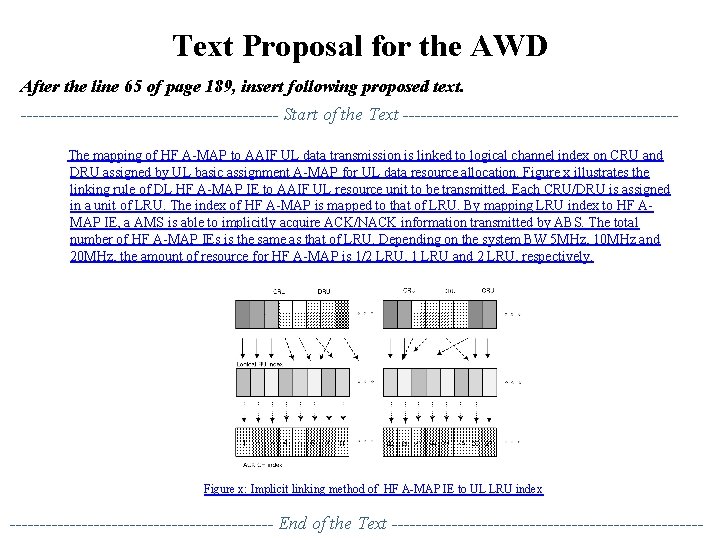
Text Proposal for the AWD After the line 65 of page 189, insert following proposed text. ---------------------- Start of the Text -----------------------The mapping of HF A-MAP to AAIF UL data transmission is linked to logical channel index on CRU and DRU assigned by UL basic assignment A-MAP for UL data resource allocation. Figure x illustrates the linking rule of DL HF A-MAP IE to AAIF UL resource unit to be transmitted. Each CRU/DRU is assigned in a unit of LRU. The index of HF A-MAP is mapped to that of LRU. By mapping LRU index to HF AMAP IE, a AMS is able to implicitly acquire ACK/NACK information transmitted by ABS. The total number of HF A-MAP IEs is the same as that of LRU. Depending on the system BW 5 MHz, 10 MHz and 20 MHz, the amount of resource for HF A-MAP is 1/2 LRU, 1 LRU and 2 LRU, respectively. Figure x: Implicit linking method of HF A-MAP IE to UL LRU index ---------------------- End of the Text --------------------------