
DJECTIVES AND DVERBS Adjectives Vs Adverbs Adjectives describe
DJECTIVES AND DVERBS
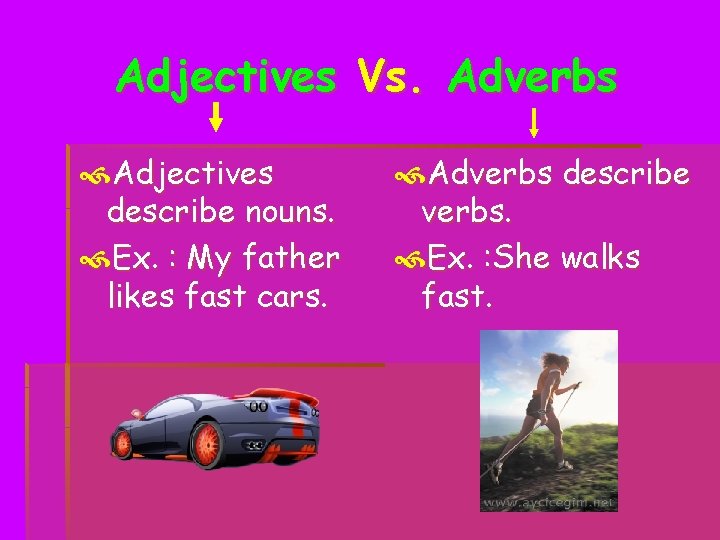
Adjectives Vs. Adverbs Adjectives describe nouns. Ex. : My father likes fast cars. Adverbs describe verbs. Ex. : She walks fast.
Adjectives ending in ‘‘ –ing ’’ ( e. g. interesting, boring, amazing, etc. ) are used to describe what somebody or something is like. Ex. : The game was amazing. Adverbs describe other adverbs. Ex. : He speaks very well.
Adjectives ending in ‘‘ –ed ’’ ( e. g. amazed, surprised, puzzled, etc. ) are used to describe how somebody feels. Ex. : My sister’s gift surprised me. Adverbs describe adjectives. Ex. : Jane is a wonderfully beautiful girl.
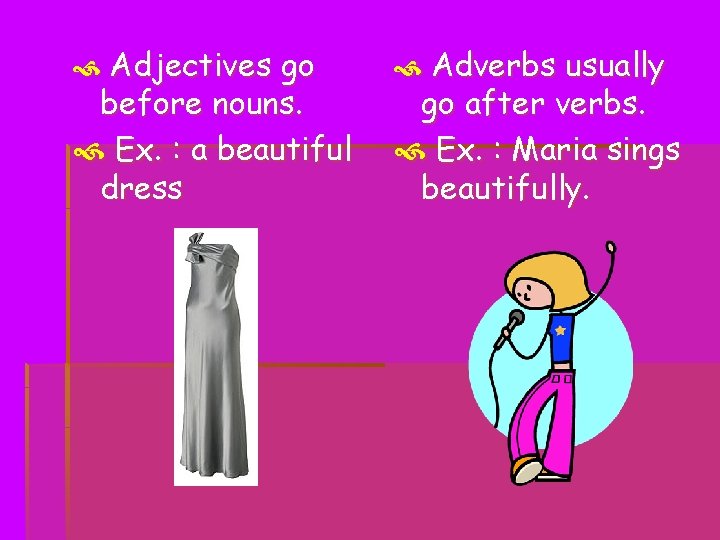
Adjectives go before nouns. Ex. : a beautiful dress Adverbs usually go after verbs. Ex. : Maria sings beautifully.
FORM We usually form an adverb by adding ‘‘ –ly ’’ to the adjective. Ex. : loud - loudly When the adjective ends in ‘‘-le ’’ we drop the ‘‘-e’’ and add ‘‘-y ’’. Ex. : gentle - gently
When the adjective ends in a consonant + y we drop the ‘‘-y ’’ and add ‘‘-ily ’’. Ex. : easy – easily When the adjective ends in ‘‘-l ’’ we add ‘‘ –ly ’’. Ex. : careful - carefully
Some adverbs have either a totaly different form or the same form as the adjective. Adjective good hard early late Adverb well hard early late
NOTE 2: The following words end in ‘‘ –ly ’’ but they are adjectives : friendly, lively, lonely, lovely, silly, ugly. Ex. : John is a lonely man.
EXERCISES Garfield is a (slow) ____ animal. It’s (fresh) ____ ground coffee. The little girl smiled sweet / sweetly at his mother. I worked very (hard) _____ all year.
- Slides: 10