
DIZZINESS VERTIGO Trevor Langhan PGY5 Resident rounds Dizziness


- Slides: 34
DIZZINESS & VERTIGO Trevor Langhan PGY-5 Resident rounds
Dizziness - Background Dizziness = sensation of abnormal orientation in space Very common complaint in the ED Common cause for repeat physician visits Patients older than 60 years 20% have experienced dizziness severe enough to affect their daily activity
Case 1 75 year old lady PMHx: DM, OA, Gout Meds: metformin, glyburide, Vit B, multivit, Iron Cc: Dizzy HPI: stood up after lunch in mall +++ lightheaded Everything was fading to black Mild nausea with sweating Needed to sit or would have fainted Layed down on bench in mall. Now feels better
Case 1 HR 88 BP 110/70 RR 16 Sat 95% afeb Hgb 73, platelet 410, WBC 7. 5 Lytes, Creat, Gluc, troponin, U/A all normal CXR normal EKG normal sinus Physical exam Unremarkable Neuro exam normal, gait normal PLAN?
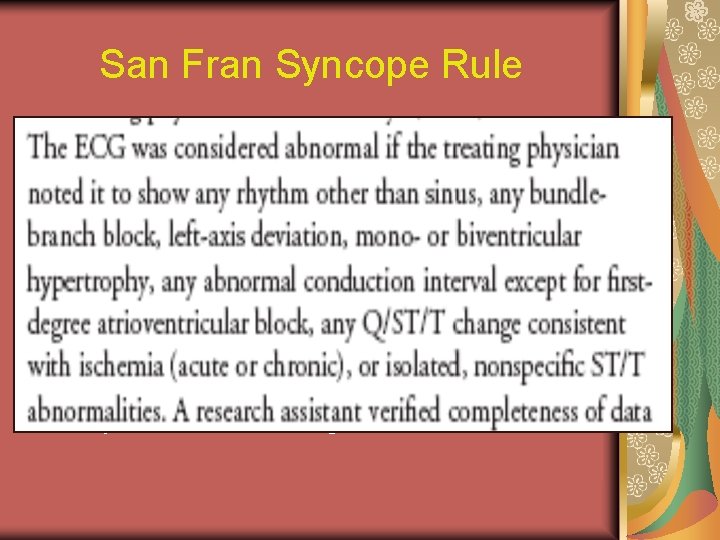
San Fran Syncope Rule 1 -3 % of ED visits are for syncope or pre-syncope 50% of patients don’t have a diagnosis at d/c SF rule criteria are: Abnormal EKG Hematocrit < 30% History of CHF Complaint of SOB Systolic BP < 90 mm. Hg
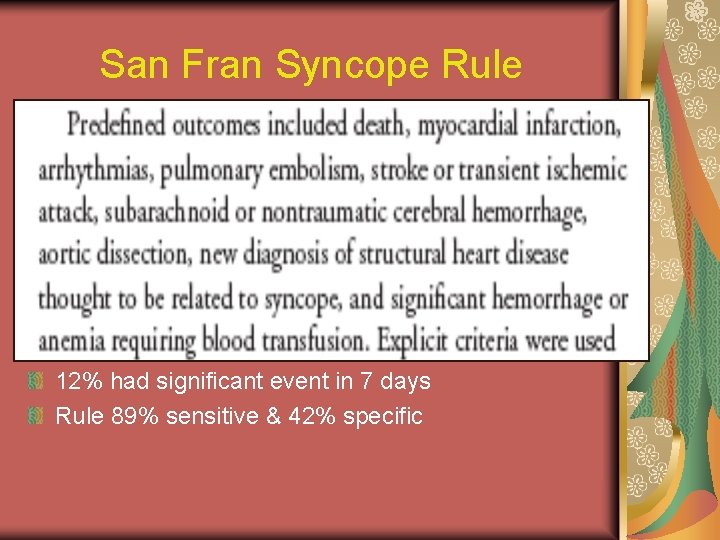
San Fran Syncope Rule Who will have a serious event within 7 days Derivation and validation study 98% and 96% sensitive External Validation study: Prospectively enrolled syncope and nearsyncope 477 patients (good f/u in 93%) 12% had significant event in 7 days Rule 89% sensitive & 42% specific
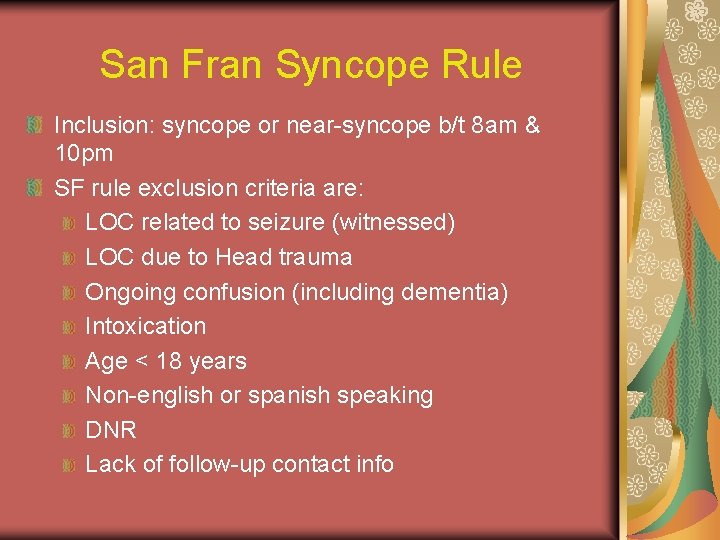
San Fran Syncope Rule Inclusion: syncope or near-syncope b/t 8 am & 10 pm SF rule exclusion criteria are: LOC related to seizure (witnessed) LOC due to Head trauma Ongoing confusion (including dementia) Intoxication Age < 18 years Non-english or spanish speaking DNR Lack of follow-up contact info
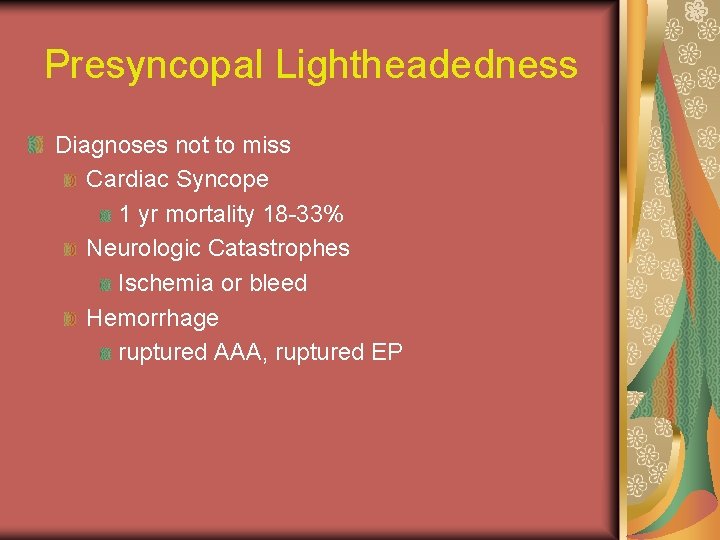
Presyncopal Lightheadedness Diagnoses not to miss Cardiac Syncope 1 yr mortality 18 -33% Neurologic Catastrophes Ischemia or bleed Hemorrhage ruptured AAA, ruptured EP
Dizzy vs. Vertigo Key to history is trying to differentiate ‘what’s dizzy to you? ’ Fading to black vs. room spinning?
Neuro Exam Most of us can do a rudimentary exam Finer details often lacking Some questions to consider: Rhomberg? Nystagmus? Dysmetria? EOM exam? Pupillary findings?
Vertigo – defined more clearly as a sensation of disorientation in space combined with a sensation of motion. Usually 2 o to pathological basis, but need to differentiate benign from sinister Most NB is to differentiate peripheral and central vertigo
Vertigo Vestibular apparatus 3 semi-circular canals with cristae Provide info about body angles and movement Travel by CN VIII Enter brainstem near Pons Travels down two paths MLF – medial longitudinal fasciculus Vestibulospinal tract
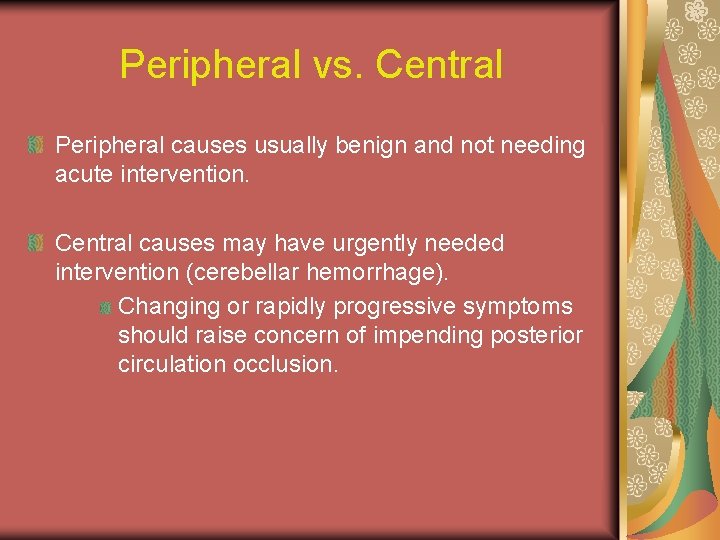
Peripheral vs. Central Peripheral causes usually benign and not needing acute intervention. Central causes may have urgently needed intervention (cerebellar hemorrhage). Changing or rapidly progressive symptoms should raise concern of impending posterior circulation occlusion.
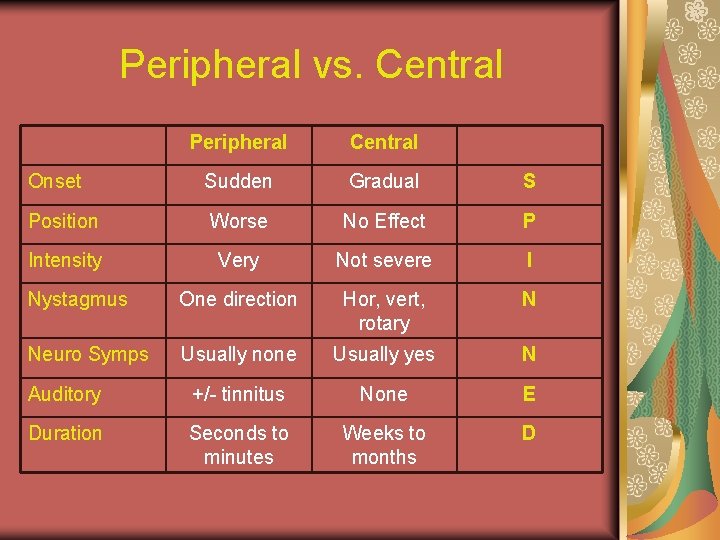
Peripheral vs. Central Peripheral Central Onset Sudden Gradual S Position Worse No Effect P Intensity Very Not severe I Nystagmus One direction Hor, vert, rotary N Neuro Symps Usually none Usually yes N Auditory +/- tinnitus None E Duration Seconds to minutes Weeks to months D
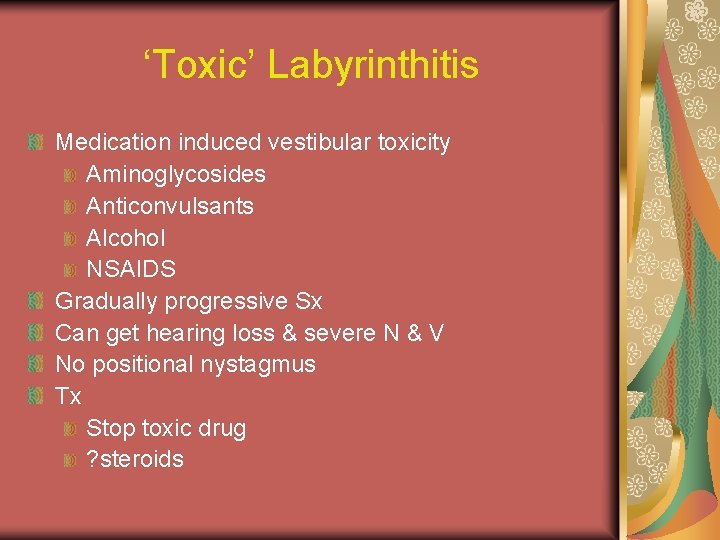
‘Toxic’ Labyrinthitis Medication induced vestibular toxicity Aminoglycosides Anticonvulsants Alcohol NSAIDS Gradually progressive Sx Can get hearing loss & severe N & V No positional nystagmus Tx Stop toxic drug ? steroids
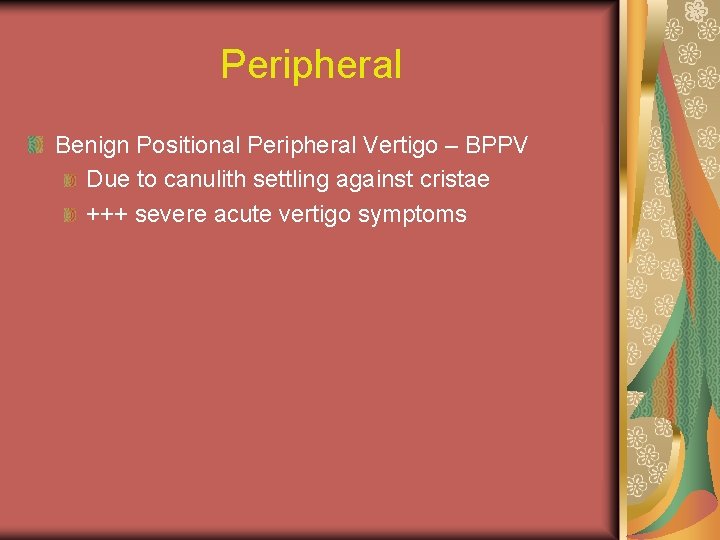
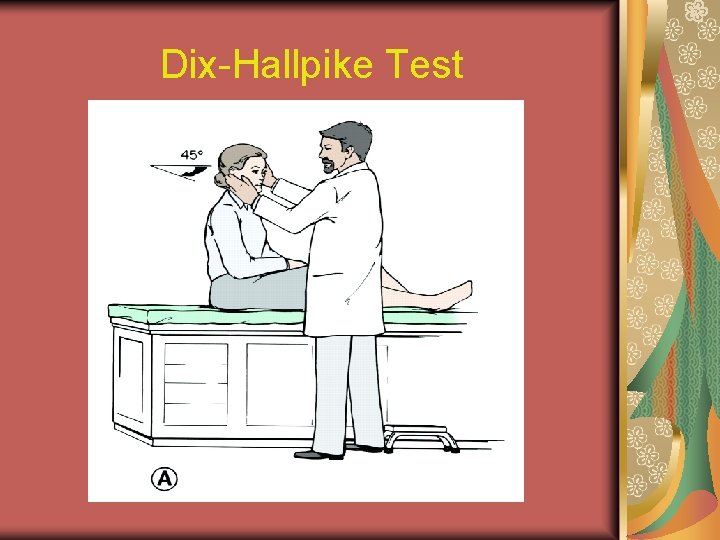
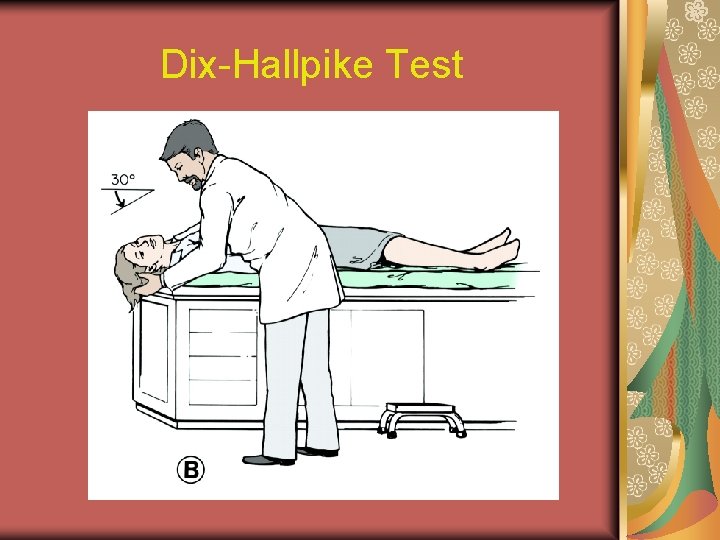
Peripheral Benign Positional Peripheral Vertigo – BPPV Due to canulith settling against cristae +++ severe acute vertigo symptoms
Dix-Hallpike Test
Dix-Hallpike Test
Particle Repositioning Maneuvers Cochrane (2005) – ”some evidence that the Epley manoeuvre is a safe effective treatment for posterior canal BPPV” Studies vary from 66 -100% success in alleviating or decreasing Sx Effective in subjective vertigo 30 -50% will have recurrence requiring repeat Tx
CASE 44 year old woman complains of ringing in her ears, needing to listen to the TV at higher volume, and the sensation that the room is spinning. Her presentation is typical for: Meniere’s Disease
Meniere’s Dz No positional nystagmus on exam Associated tinnitus & fluctuating hearing loss (low frequency senorineural) Hearing loss may persist between episodes (need to consider acoustic neuroma in the Ddx) Tx Low Na diet (<2 g/d) Antihistamines, diuretics, betahisitine (Serc) Chemical ablation of vestibular function (gentamicin) Surgery
Labyrinthitis & Neuronitis Suspected viral etiology Peak incidence in 30 to 50 s Acute severe vertigo increases rapidly in intensity (hrs) & subsides gradually (days) Can have mild persistent positional vertigo for wks to mos Get N & V, but NO auditory Sx Tx Prednisone for 10 d may shorten course Vestibular rehab
Acute Suppurative Labyrinthitis Coexisting acute exudative bacterial inner ear infection Vertigo, severe N & V & hearing loss Febrile toxic pt Tx Admit for IV Abx +/- surgical I & D
Central Vertigo May be gradual progressive symptoms over time or an acute worsening of a chronic complaint Cerebellar testing: Cerebellar gait wide base, unsteady, irregular steps, unable to heel/toe walk Dysdiadochokinesia rapid alternating movements Dysmetria inability to arrest movement at desired point (finger/nose testing)
Case 79 y lady c/o sudden dizziness and nausea PMHx: a fib, hypertension, DM Meds: Glyburide, altace, coumadin HR 80, BP 120/80, RR 12, Sat 97% Unsteady gait, falling to left Numbness to right face Decreased sensation to left arm and leg Right eyelid is drooped and pupil is small
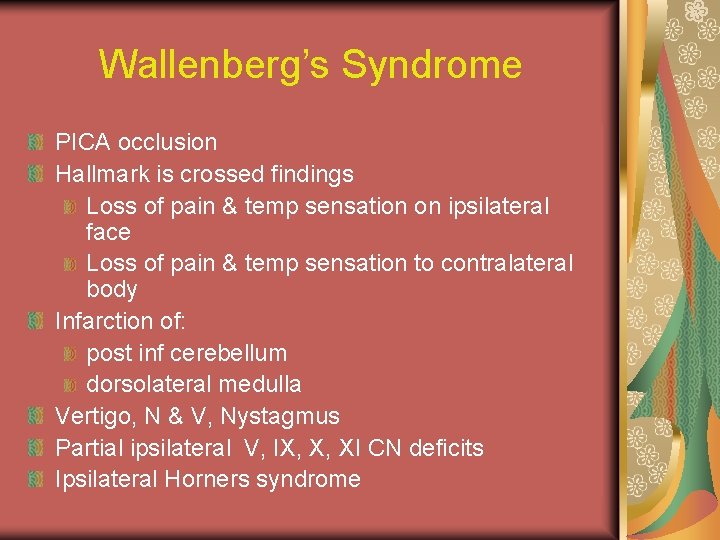
Wallenberg’s Syndrome PICA occlusion Hallmark is crossed findings Loss of pain & temp sensation on ipsilateral face Loss of pain & temp sensation to contralateral body Infarction of: post inf cerebellum dorsolateral medulla Vertigo, N & V, Nystagmus Partial ipsilateral V, IX, X, XI CN deficits Ipsilateral Horners syndrome
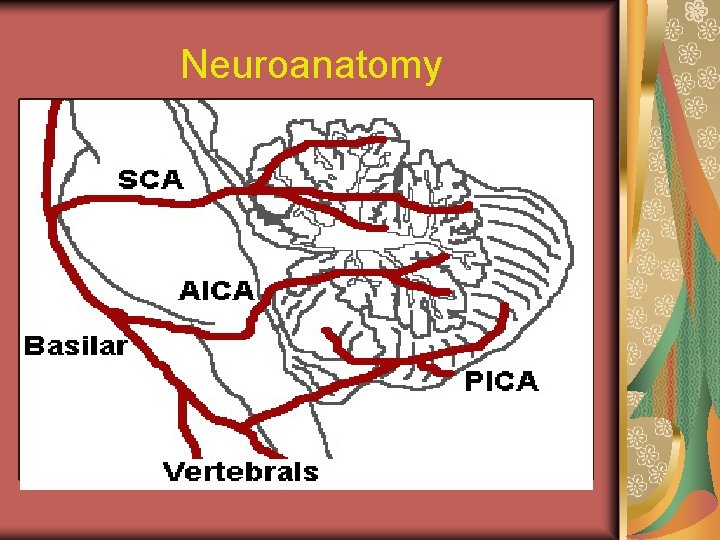
Neuroanatomy lateral spinothalamic tract contralateral deficits in pain and temperature sensation from body spinal trigeminal nucleus ipsilateral loss of pain and temperature sensation from face nucleus ambiguus dysphagia, hoarseness, diminished gag reflex vagus and glossopharyngeal nerves vestibular system vertigo, diplopia, nystagmus, vomiting descending sympathetic fibers ipsilateral Horner's syndrome
Cerebellar Stroke Account for ~1. 5% of all strokes Sudden onset severe vertigo, H/A, N & V, ataxia May have a “drop attack” CT usually will not visualize posterior fossa well If you want to r/o posterior fossa stroke you need a MRI 25% of patients with RF for stroke who present to the ED with severe vertigo, nystagmus and postural instability will have a inferior cerebellar stroke
Cerebellar Stroke What does one do in the elderly or those with stroke RFs that appear to have peripheral vertigo? Tx Antiplatelet Tx +/- warfarin, CVS RF modification Treatment of elevated ICP and emergent surgical decompression may be life saving Vestibular rehab once past acute phase
Cerebellar Hemorrhage Similar presentation to cerebellar stroke Often require surgical decompression and hematoma evacuation With appropriate surgical treatment, prognosis is good CN VI palsy (inability to abduct the eye) can occur with cerebellar hemorrhage and ipsilateral nerve VI compression.
Vertebrobasilar Migraine Typically begins in adolescence Multiple neuro Sx followed by headache: Vertigo Dysarthria Ataxia Visual disturbances Paresthesias Complete resolution of neuro abnormalities after attack subsides
Vertigo Ddx Vertigo Lasting for Seconds BPV Vertigo Lasting for Minutes or Hours Meniere’s Disease, Vertebrobasilar Insufficiency (TIA), Migraine, Partial Sz, Perilymph fistula Vertigo Lasting for a Day or Longer Vestibular Neuronitis/Labyrinthitis, Brainstem or Cerebellar Stroke
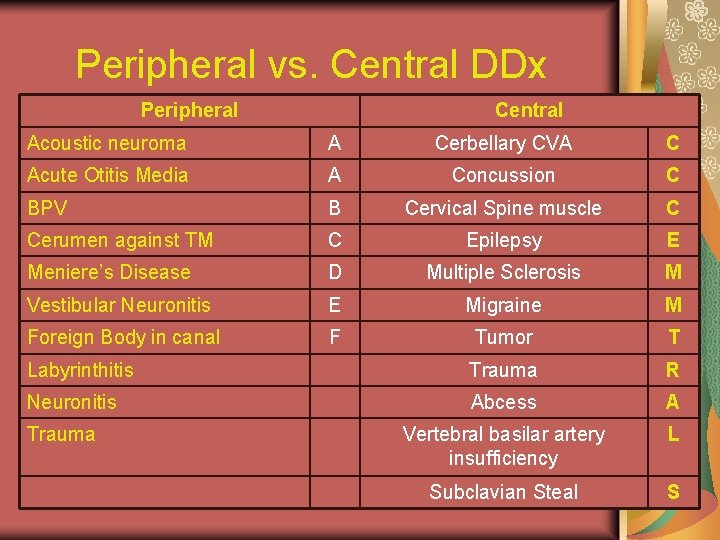
Peripheral vs. Central DDx Peripheral Central Acoustic neuroma A Cerbellary CVA C Acute Otitis Media A Concussion C BPV B Cervical Spine muscle C Cerumen against TM C Epilepsy E Meniere’s Disease D Multiple Sclerosis M Vestibular Neuronitis E Migraine M Foreign Body in canal F Tumor T Labyrinthitis Trauma R Neuronitis Abcess A Vertebral basilar artery insufficiency L Subclavian Steal S Trauma