
DIVISION OF ZAMBOANGA CITY 2018 2019 STRATEGIC DIRECTION
DIVISION OF ZAMBOANGA CITY 2018 -2019 STRATEGIC DIRECTION
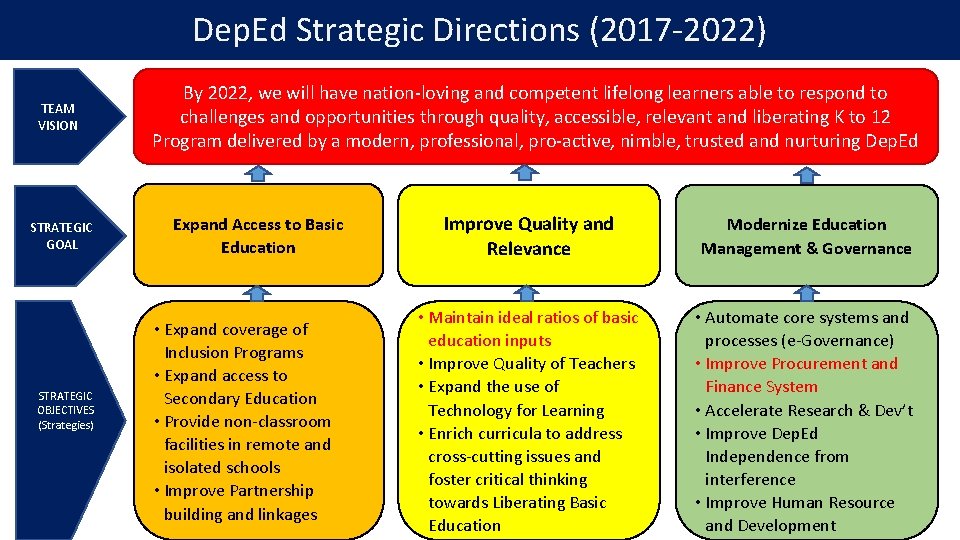
Dep. Ed Strategic Directions (2017 -2022) TEAM VISION STRATEGIC GOAL STRATEGIC OBJECTIVES (Strategies) By 2022, we will have nation-loving and competent lifelong learners able to respond to challenges and opportunities through quality, accessible, relevant and liberating K to 12 Program delivered by a modern, professional, pro-active, nimble, trusted and nurturing Dep. Ed Expand Access to Basic Education • Expand coverage of Inclusion Programs • Expand access to Secondary Education • Provide non-classroom facilities in remote and isolated schools • Improve Partnership building and linkages Improve Quality and Relevance Modernize Education Management & Governance • Maintain ideal ratios of basic education inputs • Improve Quality of Teachers • Expand the use of Technology for Learning • Enrich curricula to address cross-cutting issues and foster critical thinking towards Liberating Basic Education • Automate core systems and processes (e-Governance) • Improve Procurement and Finance System • Accelerate Research & Dev’t • Improve Dep. Ed Independence from interference • Improve Human Resource and Development
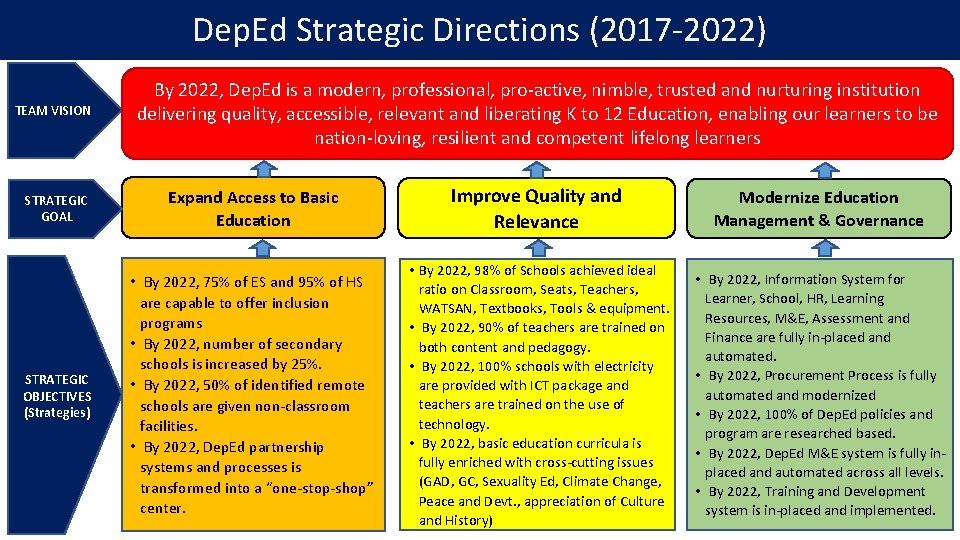
Dep. Ed Strategic Directions (2017 -2022) TEAM VISION By 2022, Dep. Ed is a modern, professional, pro-active, nimble, trusted and nurturing institution delivering quality, accessible, relevant and liberating K to 12 Education, enabling our learners to be nation-loving, resilient and competent lifelong learners STRATEGIC GOAL Expand Access to Basic Education Improve Quality and Relevance Modernize Education Management & Governance STRATEGIC OBJECTIVES (Strategies) • By 2022, 75% of ES and 95% of HS are capable to offer inclusion programs • By 2022, number of secondary schools is increased by 25%. • By 2022, 50% of identified remote schools are given non-classroom facilities. • By 2022, Dep. Ed partnership systems and processes is transformed into a “one-stop-shop” center. • By 2022, 98% of Schools achieved ideal ratio on Classroom, Seats, Teachers, WATSAN, Textbooks, Tools & equipment. • By 2022, 90% of teachers are trained on both content and pedagogy. • By 2022, 100% schools with electricity are provided with ICT package and teachers are trained on the use of technology. • By 2022, basic education curricula is fully enriched with cross-cutting issues (GAD, GC, Sexuality Ed, Climate Change, Peace and Devt. , appreciation of Culture and History) • By 2022, Information System for Learner, School, HR, Learning Resources, M&E, Assessment and Finance are fully in-placed and automated. • By 2022, Procurement Process is fully automated and modernized • By 2022, 100% of Dep. Ed policies and program are researched based. • By 2022, Dep. Ed M&E system is fully inplaced and automated across all levels. • By 2022, Training and Development system is in-placed and implemented.
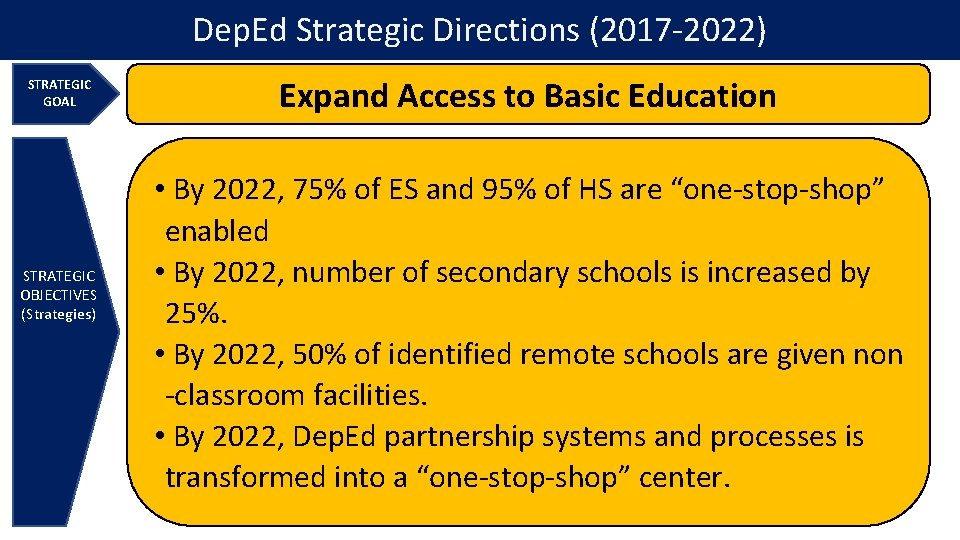
Dep. Ed Strategic Directions (2017 -2022) STRATEGIC GOAL STRATEGIC OBJECTIVES (Strategies) Expand Access to Basic Education • By 2022, 75% of ES and 95% of HS are “one-stop-shop” enabled • By 2022, number of secondary schools is increased by 25%. • By 2022, 50% of identified remote schools are given non -classroom facilities. • By 2022, Dep. Ed partnership systems and processes is transformed into a “one-stop-shop” center.
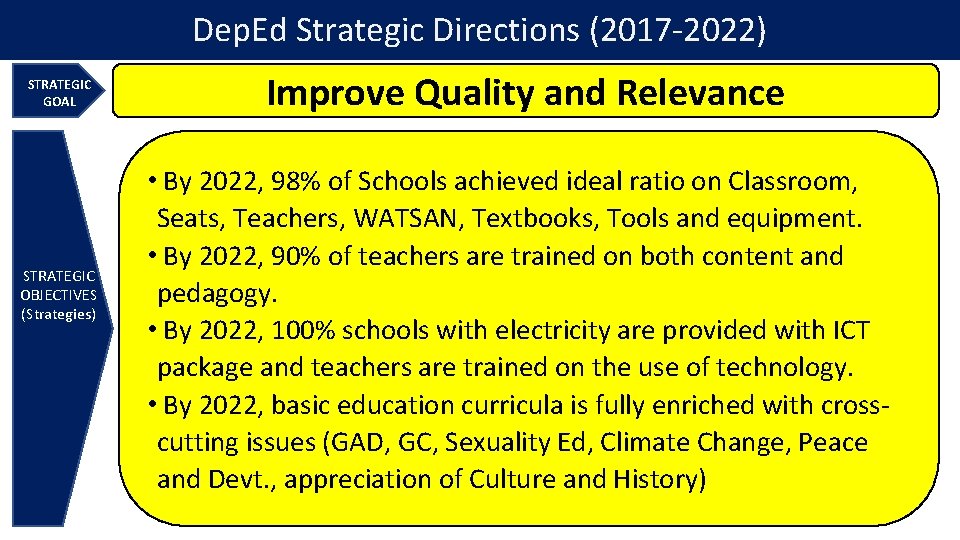
Dep. Ed Strategic Directions (2017 -2022) STRATEGIC GOAL STRATEGIC OBJECTIVES (Strategies) Improve Quality and Relevance • By 2022, 98% of Schools achieved ideal ratio on Classroom, Seats, Teachers, WATSAN, Textbooks, Tools and equipment. • By 2022, 90% of teachers are trained on both content and pedagogy. • By 2022, 100% schools with electricity are provided with ICT package and teachers are trained on the use of technology. • By 2022, basic education curricula is fully enriched with crosscutting issues (GAD, GC, Sexuality Ed, Climate Change, Peace and Devt. , appreciation of Culture and History)
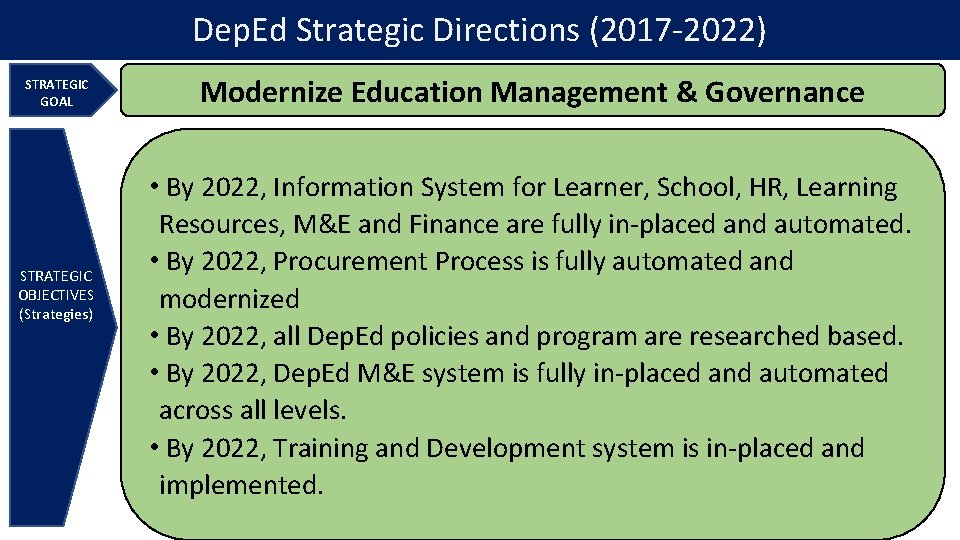
Dep. Ed Strategic Directions (2017 -2022) STRATEGIC GOAL STRATEGIC OBJECTIVES (Strategies) Modernize Education Management & Governance • By 2022, Information System for Learner, School, HR, Learning Resources, M&E and Finance are fully in-placed and automated. • By 2022, Procurement Process is fully automated and modernized • By 2022, all Dep. Ed policies and program are researched based. • By 2022, Dep. Ed M&E system is fully in-placed and automated across all levels. • By 2022, Training and Development system is in-placed and implemented.
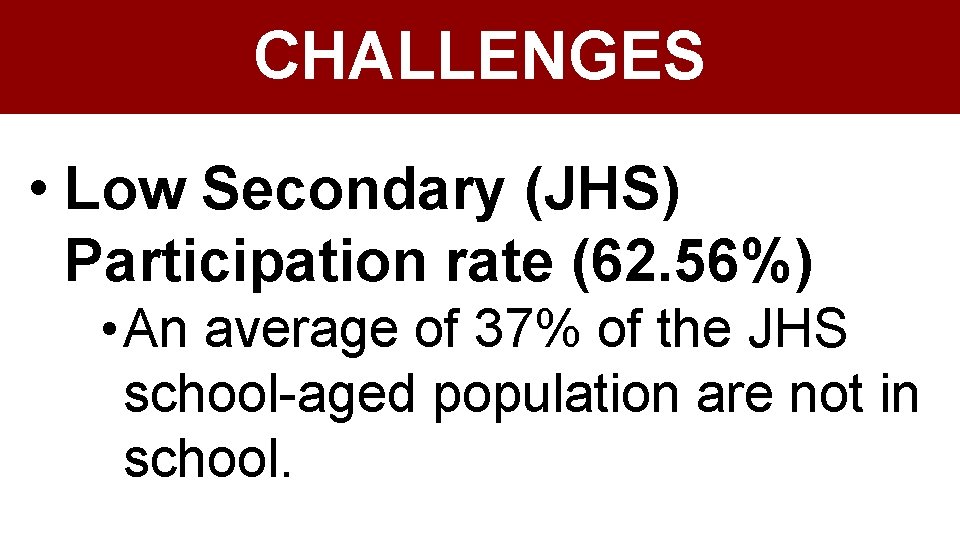
CHALLENGES • Low Secondary (JHS) Participation rate (62. 56%) • An average of 37% of the JHS school-aged population are not in school.
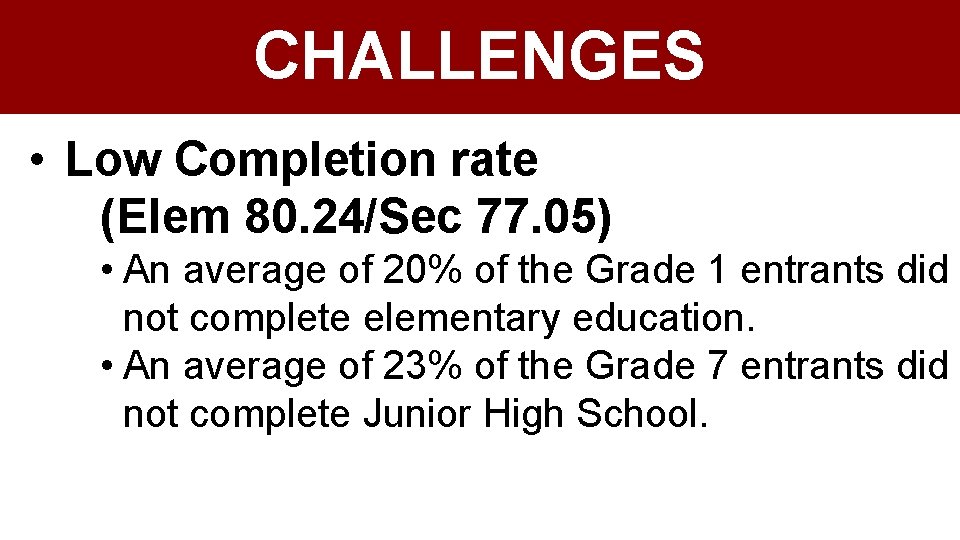
CHALLENGES • Low Completion rate (Elem 80. 24/Sec 77. 05) • An average of 20% of the Grade 1 entrants did not complete elementary education. • An average of 23% of the Grade 7 entrants did not complete Junior High School.
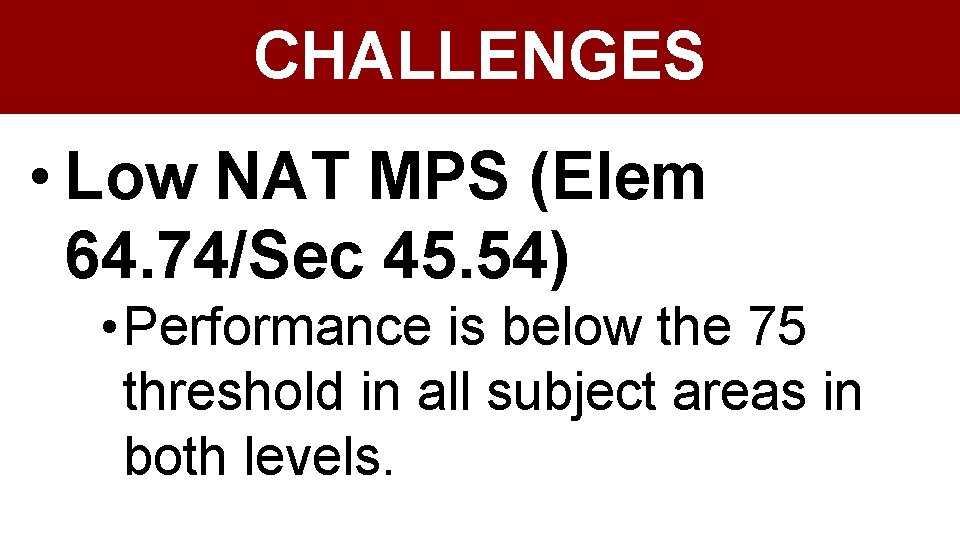
CHALLENGES • Low NAT MPS (Elem 64. 74/Sec 45. 54) • Performance is below the 75 threshold in all subject areas in both levels.
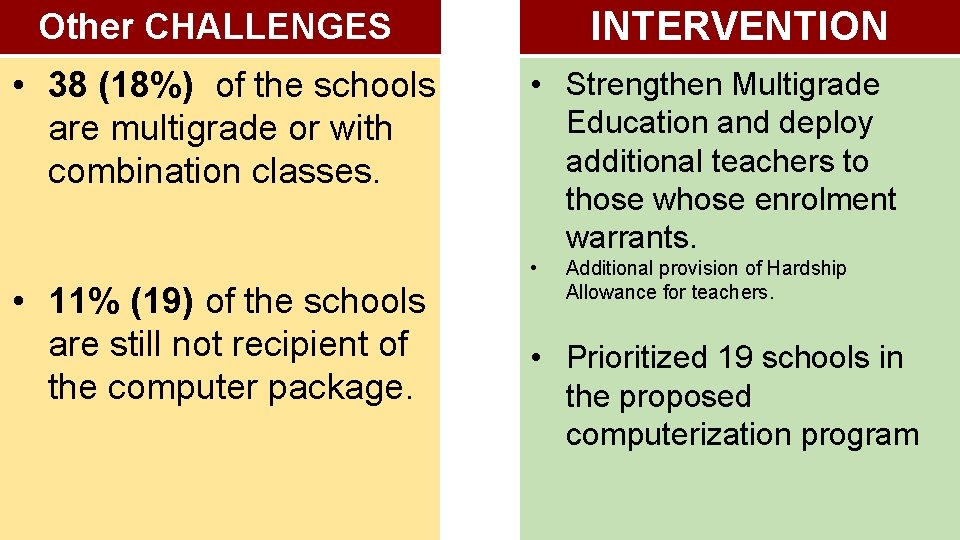
INTERVENTION Other CHALLENGES • 38 (18%) of the schools are multigrade or with combination classes. • Strengthen Multigrade Education and deploy additional teachers to those whose enrolment warrants. • • 11% (19) of the schools are still not recipient of the computer package. Additional provision of Hardship Allowance for teachers. • Prioritized 19 schools in the proposed computerization program
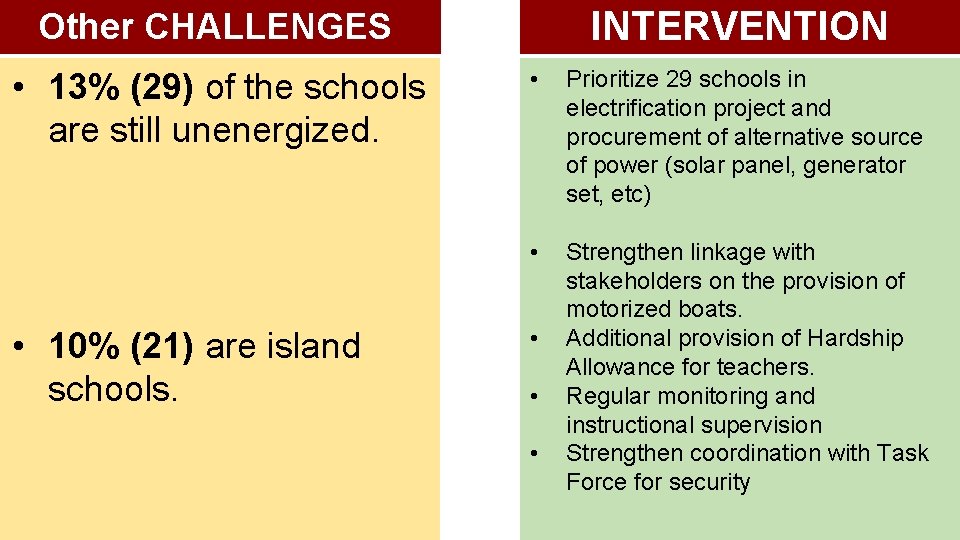
INTERVENTION Other CHALLENGES • 13% (29) of the schools are still unenergized. • 10% (21) are island schools. • Prioritize 29 schools in electrification project and procurement of alternative source of power (solar panel, generator set, etc) • Strengthen linkage with stakeholders on the provision of motorized boats. Additional provision of Hardship Allowance for teachers. Regular monitoring and instructional supervision Strengthen coordination with Task Force for security • • •
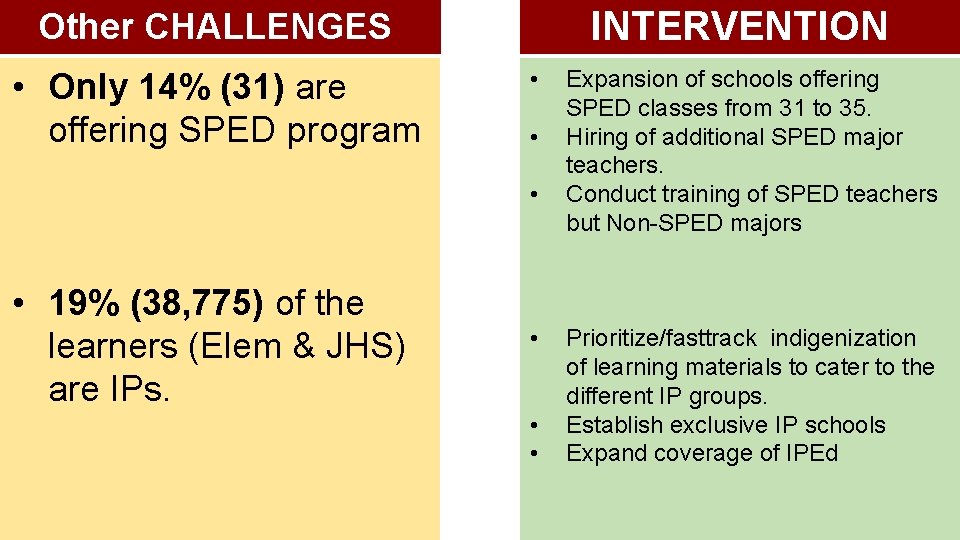
INTERVENTION Other CHALLENGES • Only 14% (31) are offering SPED program • • 19% (38, 775) of the learners (Elem & JHS) are IPs. • • • Expansion of schools offering SPED classes from 31 to 35. Hiring of additional SPED major teachers. Conduct training of SPED teachers but Non-SPED majors Prioritize/fasttrack indigenization of learning materials to cater to the different IP groups. Establish exclusive IP schools Expand coverage of IPEd
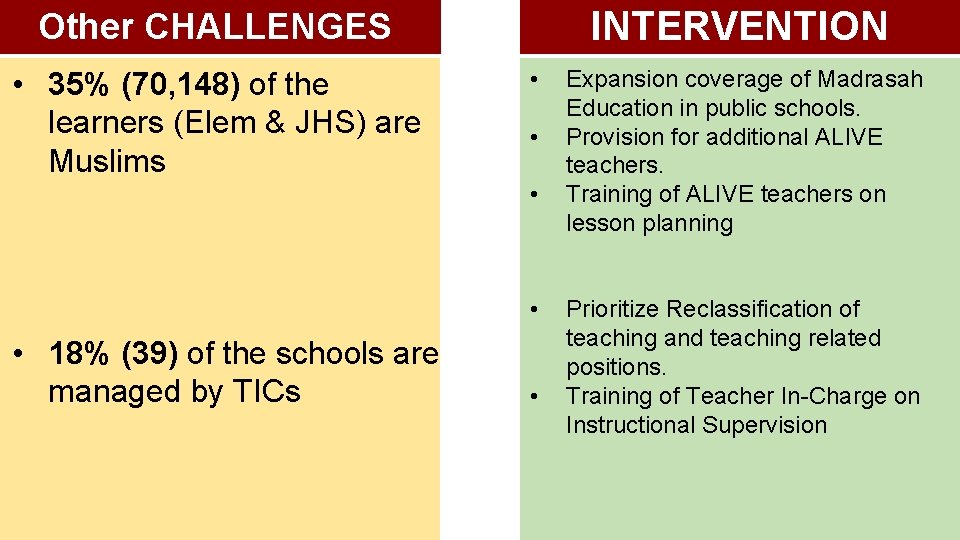
INTERVENTION Other CHALLENGES • 35% (70, 148) of the learners (Elem & JHS) are Muslims • • • 18% (39) of the schools are managed by TICs • Expansion coverage of Madrasah Education in public schools. Provision for additional ALIVE teachers. Training of ALIVE teachers on lesson planning Prioritize Reclassification of teaching and teaching related positions. Training of Teacher In-Charge on Instructional Supervision
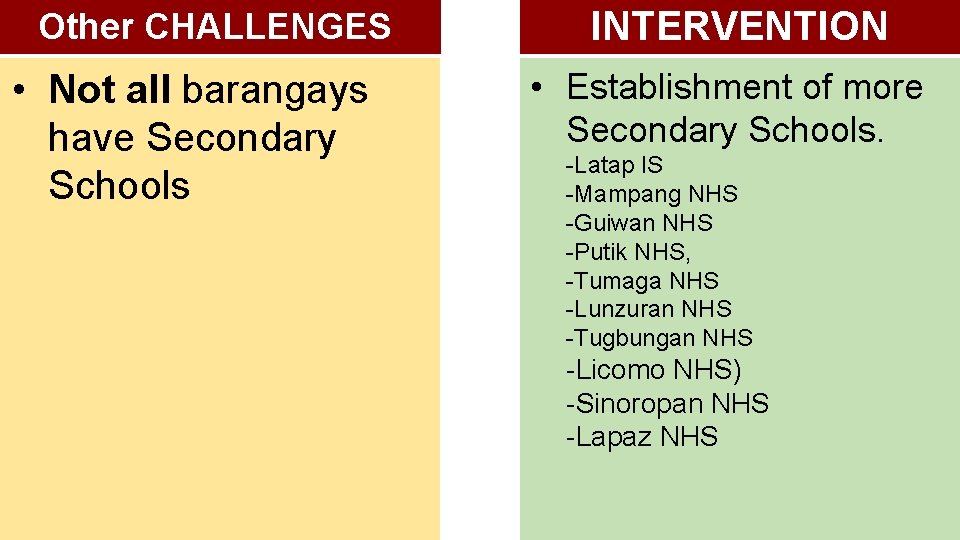
Other CHALLENGES • Not all barangays have Secondary Schools INTERVENTION • Establishment of more Secondary Schools. -Latap IS -Mampang NHS -Guiwan NHS -Putik NHS, -Tumaga NHS -Lunzuran NHS -Tugbungan NHS -Licomo NHS) -Sinoropan NHS -Lapaz NHS
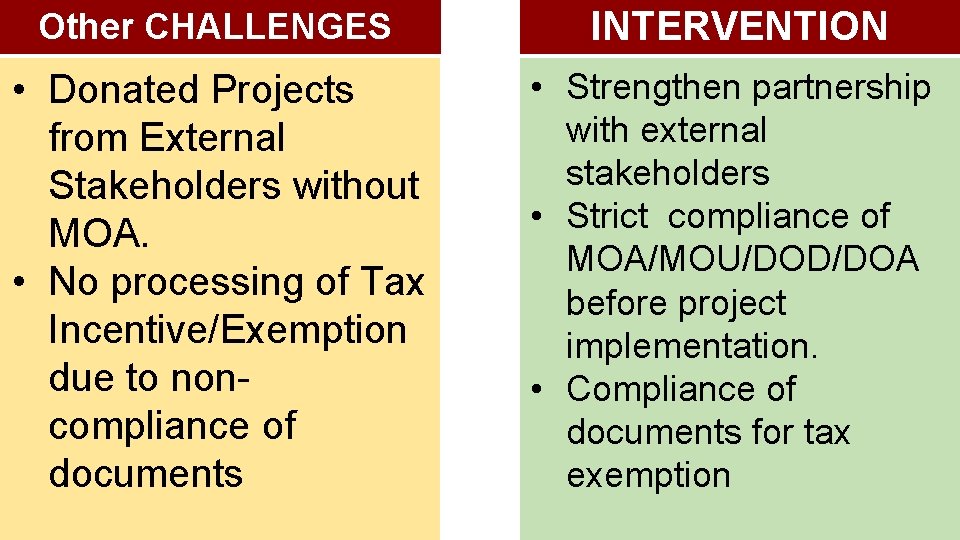
Other CHALLENGES INTERVENTION • Donated Projects from External Stakeholders without MOA. • No processing of Tax Incentive/Exemption due to noncompliance of documents • Strengthen partnership with external stakeholders • Strict compliance of MOA/MOU/DOD/DOA before project implementation. • Compliance of documents for tax exemption
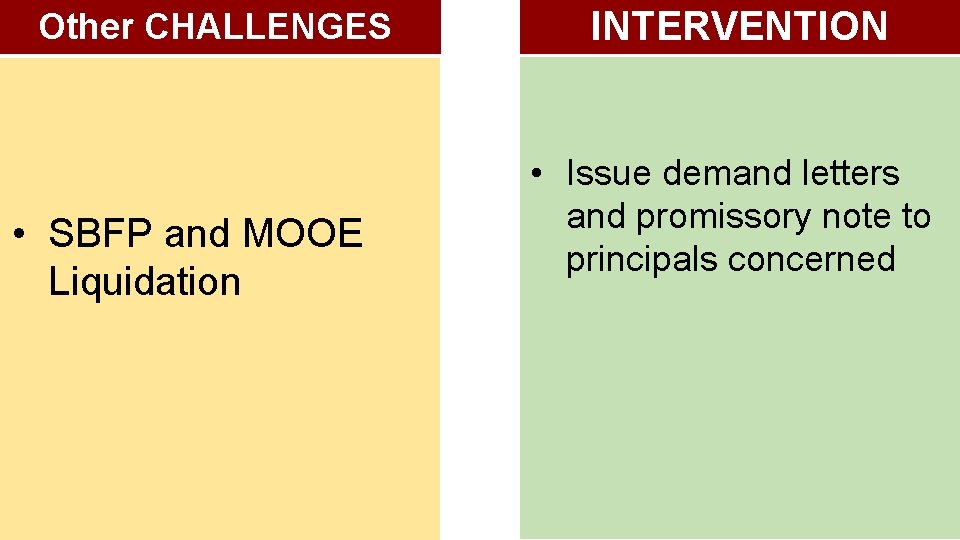
Other CHALLENGES • SBFP and MOOE Liquidation INTERVENTION • Issue demand letters and promissory note to principals concerned
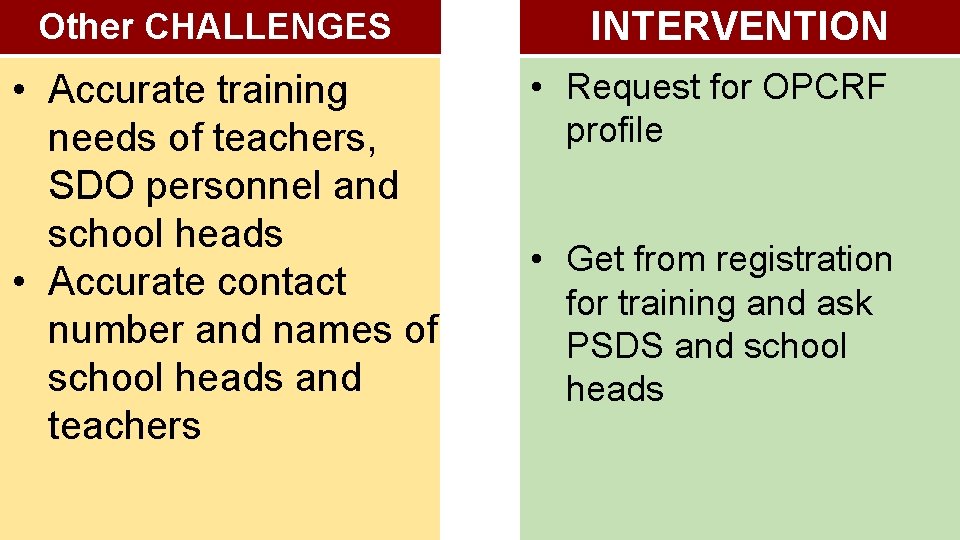
Other CHALLENGES • Accurate training needs of teachers, SDO personnel and school heads • Accurate contact number and names of school heads and teachers INTERVENTION • Request for OPCRF profile • Get from registration for training and ask PSDS and school heads
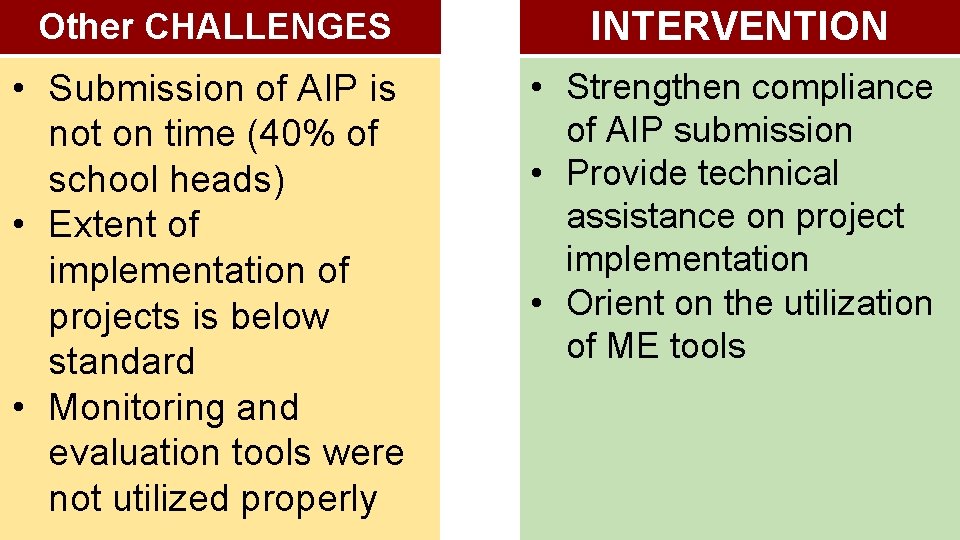
Other CHALLENGES INTERVENTION • Submission of AIP is not on time (40% of school heads) • Extent of implementation of projects is below standard • Monitoring and evaluation tools were not utilized properly • Strengthen compliance of AIP submission • Provide technical assistance on project implementation • Orient on the utilization of ME tools
Other CHALLENGES INTERVENTION • Submission of AIP is not on time (40% of school heads) • Extent of implementation of projects is below standard • Monitoring and evaluation tools were not utilized properly • Strengthen compliance of AIP submission • Provide technical assistance on project implementation • Orient on the utilization of ME tools
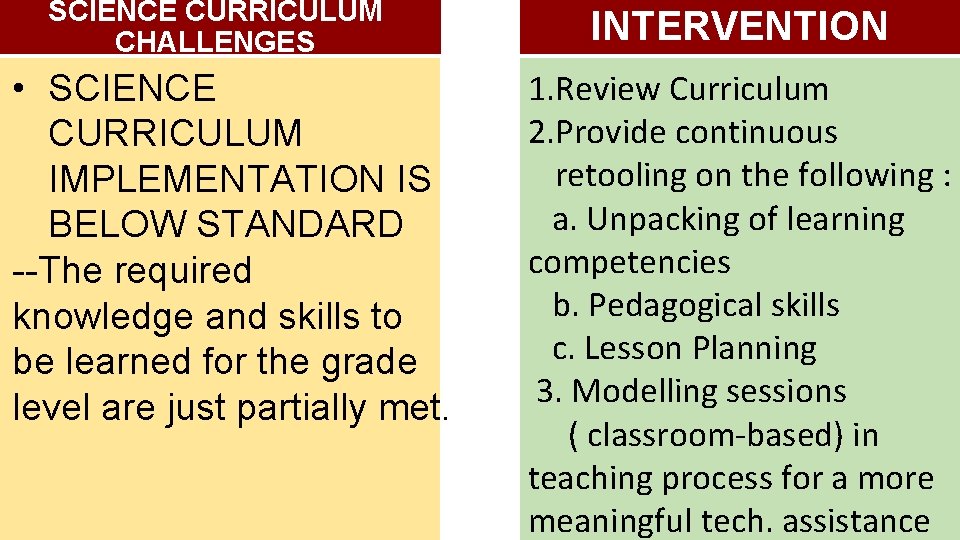
SCIENCE CURRICULUM CHALLENGES • SCIENCE CURRICULUM IMPLEMENTATION IS BELOW STANDARD --The required knowledge and skills to be learned for the grade level are just partially met. INTERVENTION 1. Review Curriculum 2. Provide continuous retooling on the following : a. Unpacking of learning competencies b. Pedagogical skills c. Lesson Planning 3. Modelling sessions ( classroom-based) in teaching process for a more meaningful tech. assistance
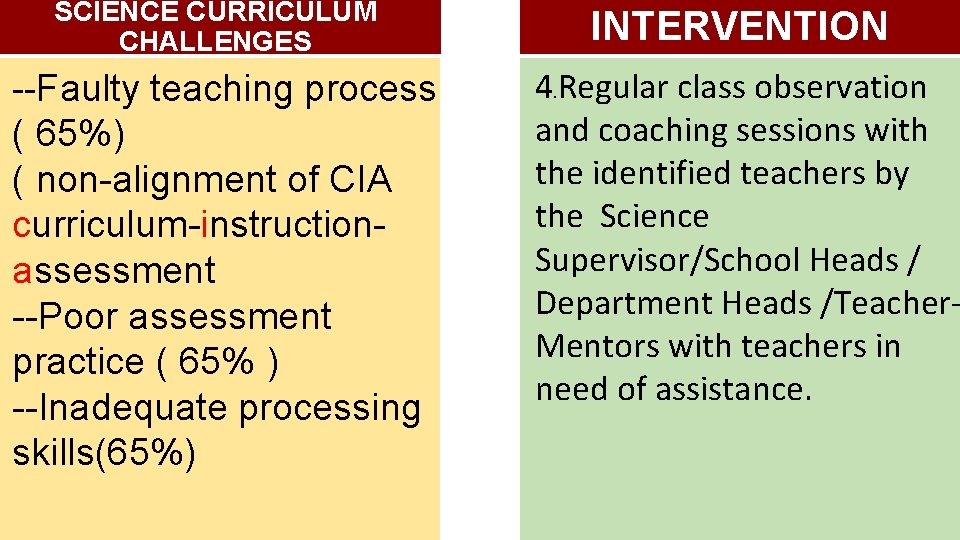
SCIENCE CURRICULUM CHALLENGES --Faulty teaching process ( 65%) ( non-alignment of CIA curriculum-instructionassessment --Poor assessment practice ( 65% ) --Inadequate processing skills(65%) INTERVENTION 4. Regular class observation and coaching sessions with the identified teachers by the Science Supervisor/School Heads / Department Heads /Teacher. Mentors with teachers in need of assistance.
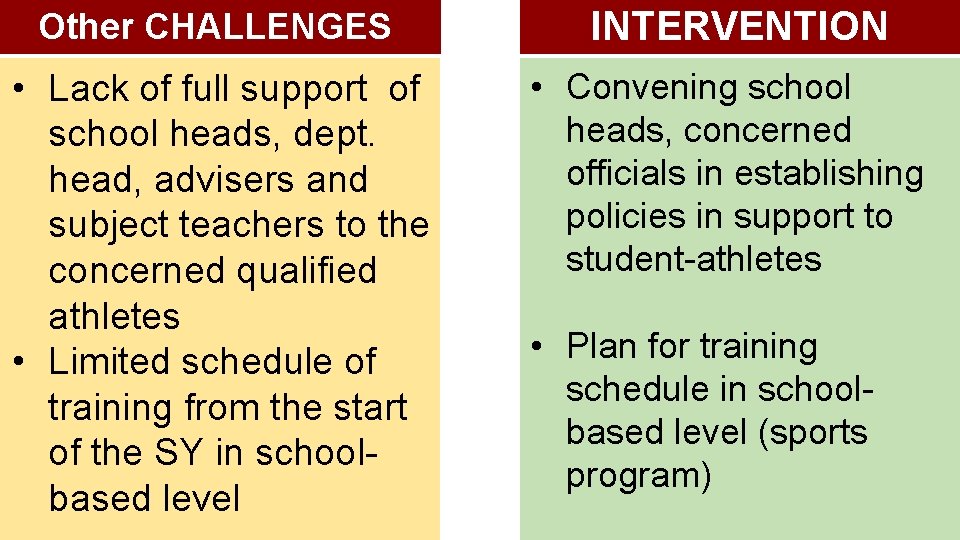
Other CHALLENGES • Lack of full support of school heads, dept. head, advisers and subject teachers to the concerned qualified athletes • Limited schedule of training from the start of the SY in schoolbased level INTERVENTION • Convening school heads, concerned officials in establishing policies in support to student-athletes • Plan for training schedule in schoolbased level (sports program)
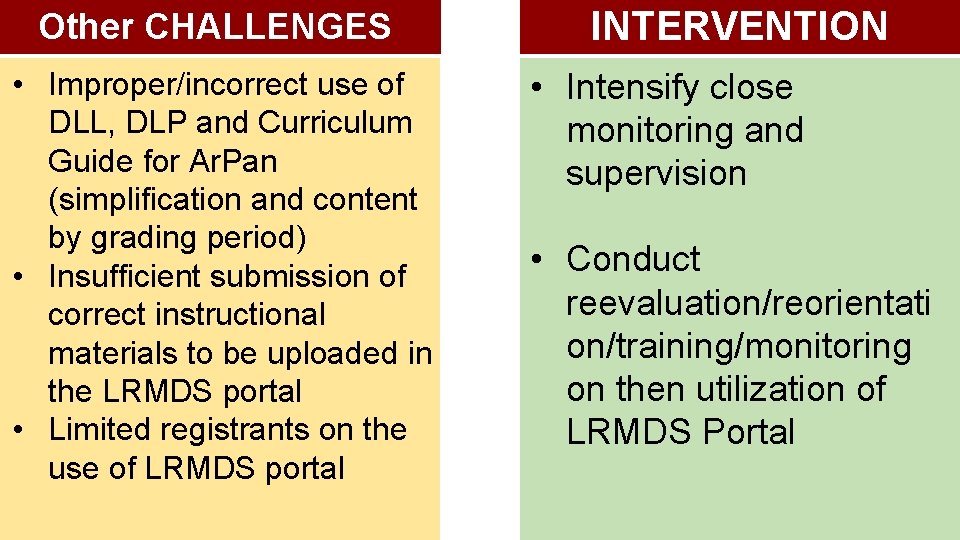
Other CHALLENGES • Improper/incorrect use of DLL, DLP and Curriculum Guide for Ar. Pan (simplification and content by grading period) • Insufficient submission of correct instructional materials to be uploaded in the LRMDS portal • Limited registrants on the use of LRMDS portal INTERVENTION • Intensify close monitoring and supervision • Conduct reevaluation/reorientati on/training/monitoring on then utilization of LRMDS Portal
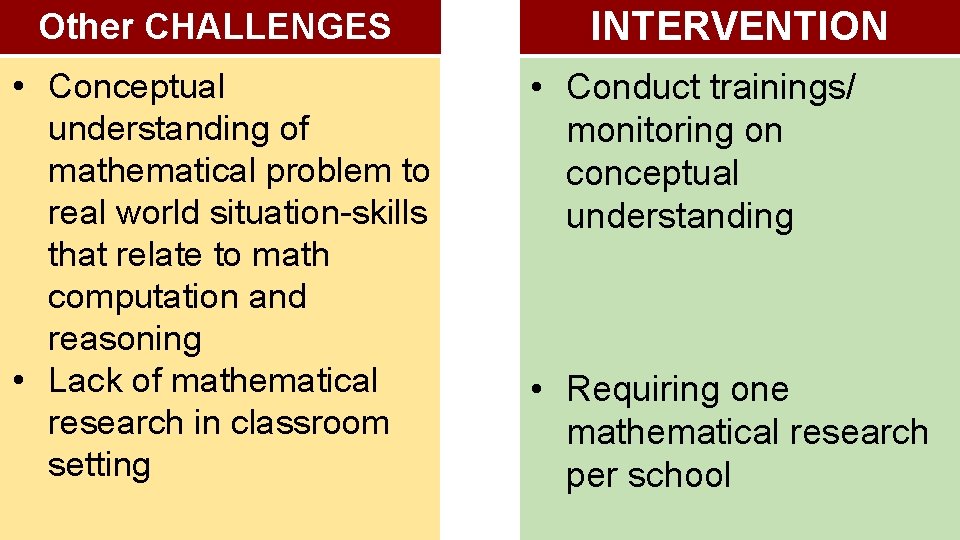
Other CHALLENGES • Conceptual understanding of mathematical problem to real world situation-skills that relate to math computation and reasoning • Lack of mathematical research in classroom setting INTERVENTION • Conduct trainings/ monitoring on conceptual understanding • Requiring one mathematical research per school
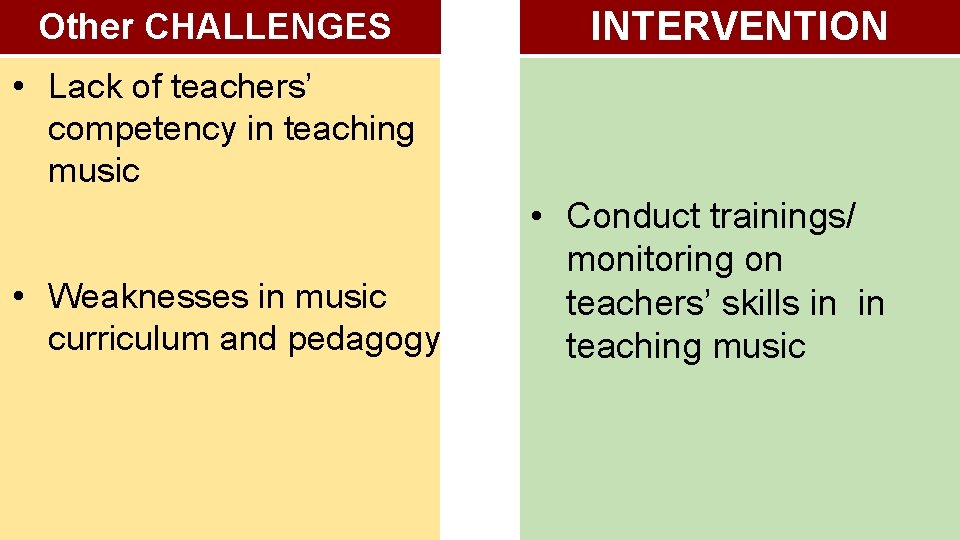
Other CHALLENGES INTERVENTION • Lack of teachers’ competency in teaching music • Weaknesses in music curriculum and pedagogy • Conduct trainings/ monitoring on teachers’ skills in in teaching music
Other CHALLENGES • Incorrect format of instructional materials in Filipino INTERVENTION • Submission of Strategic Intervention Materials in Filipino
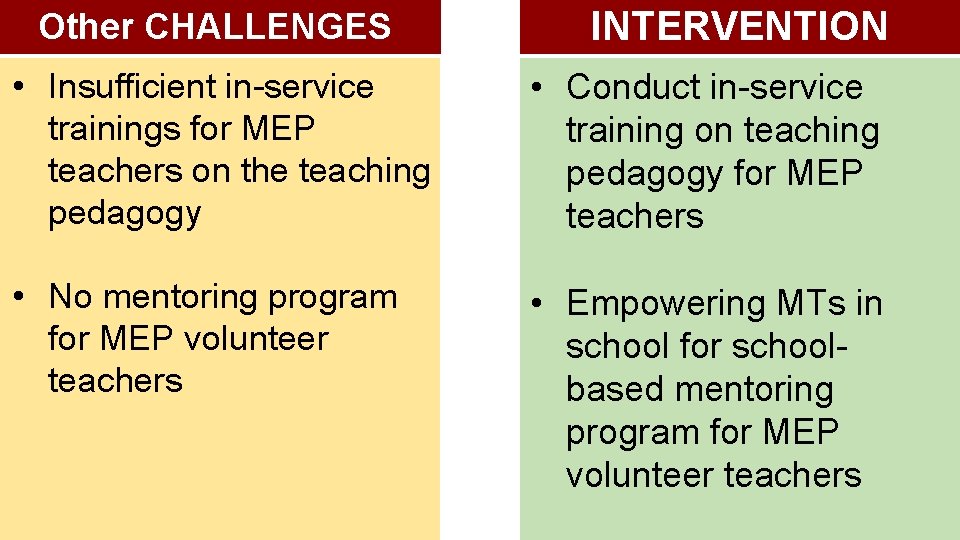
Other CHALLENGES INTERVENTION • Insufficient in-service trainings for MEP teachers on the teaching pedagogy • Conduct in-service training on teaching pedagogy for MEP teachers • No mentoring program for MEP volunteer teachers • Empowering MTs in school for schoolbased mentoring program for MEP volunteer teachers
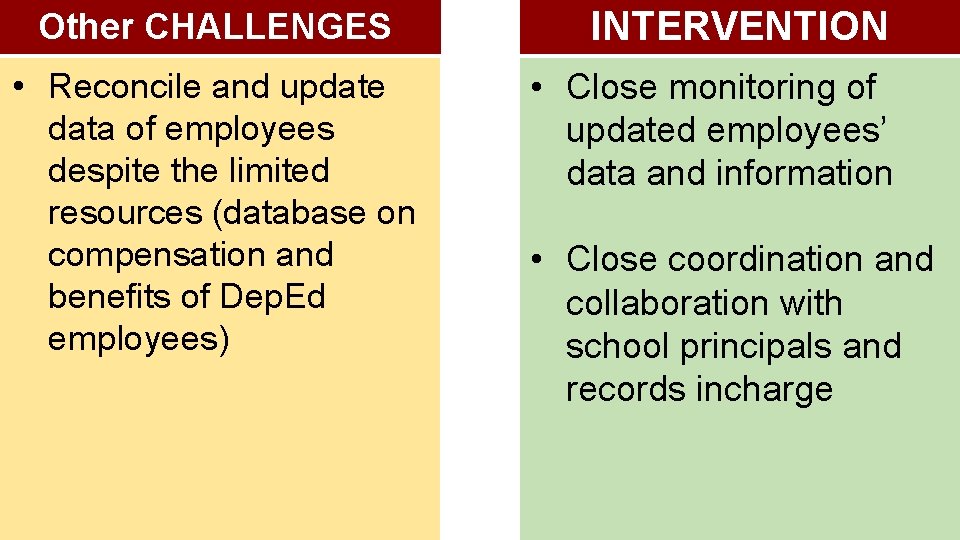
Other CHALLENGES • Reconcile and update data of employees despite the limited resources (database on compensation and benefits of Dep. Ed employees) INTERVENTION • Close monitoring of updated employees’ data and information • Close coordination and collaboration with school principals and records incharge
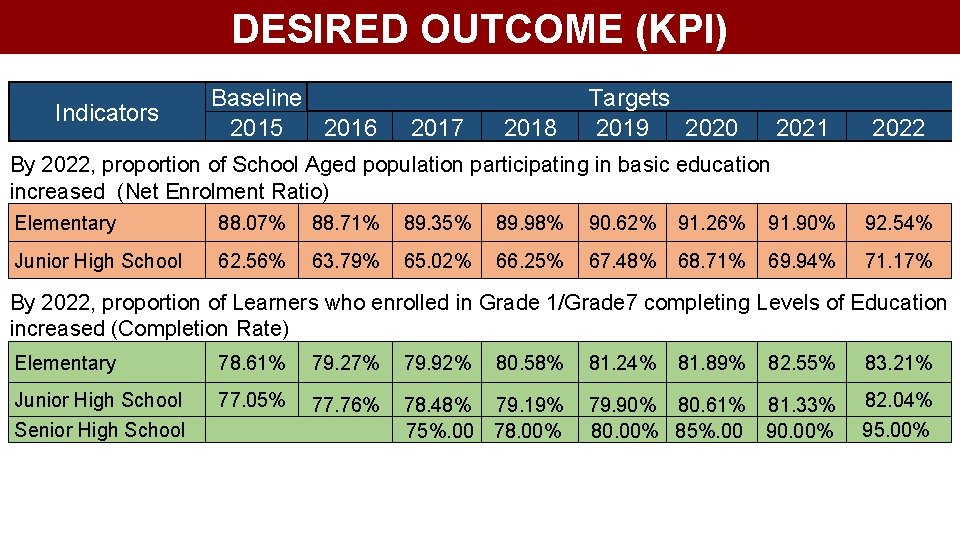
DESIRED OUTCOME (KPI) Indicators Baseline 2015 2016 2017 2018 Targets 2019 2020 2021 2022 By 2022, proportion of School Aged population participating in basic education increased (Net Enrolment Ratio) Elementary 88. 07% 88. 71% 89. 35% 89. 98% 90. 62% 91. 26% 91. 90% 92. 54% Junior High School 62. 56% 63. 79% 65. 02% 66. 25% 67. 48% 68. 71% 69. 94% 71. 17% By 2022, proportion of Learners who enrolled in Grade 1/Grade 7 completing Levels of Education increased (Completion Rate) Elementary 78. 61% 79. 27% 79. 92% 82. 55% 83. 21% Junior High School 77. 05% 77. 76% 78. 48% 79. 19% 79. 90% 80. 61% 81. 33% 75%. 00 78. 00% 80. 00% 85%. 00 90. 00% 82. 04% Senior High School 80. 58% 81. 24% 81. 89% 95. 00%
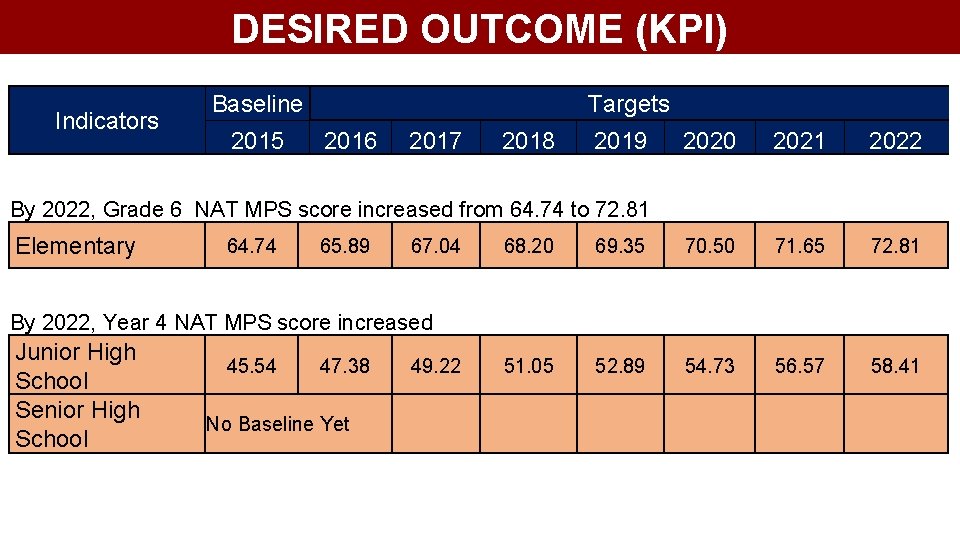
DESIRED OUTCOME (KPI) Indicators Baseline 2015 Targets 2016 2017 2018 2019 2020 2021 2022 By 2022, Grade 6 NAT MPS score increased from 64. 74 to 72. 81 Elementary 64. 74 65. 89 67. 04 68. 20 69. 35 70. 50 71. 65 72. 81 49. 22 51. 05 52. 89 54. 73 56. 57 58. 41 By 2022, Year 4 NAT MPS score increased Junior High School Senior High School 45. 54 47. 38 No Baseline Yet

- Slides: 31