
Division of Resource Economics Introduction to Property Rights



- Slides: 36
Division of Resource Economics Introduction to Property Rights Theory Dr. Violeta Dirimanova DAAD Workshop Kiev, 7 -11, September, 2009 E-mail: violeta_dirimanova@yahoo. com Violeta Dirimanova 1 / 12 11/30/2020
Division of Resource Economics Outline • Basic concept • Property and its ‘bundles’ of rights • Natural Resources and Property Regimes • Property rights and transaction costs, productivity, interest and value • Conclusions Violeta Dirimanova 2 / 12 11/30/2020
Division of Resource Economics Basic concept Violeta Dirimanova 3 / 12 11/30/2020
Division of Resource Economics Based on … • What is property? • What are rights? • What is a property right? Photo credit: Fine Arts Museum of San Franciso, http: //www. thinker. org/ Violeta Dirimanova 4 / 12 11/30/2020
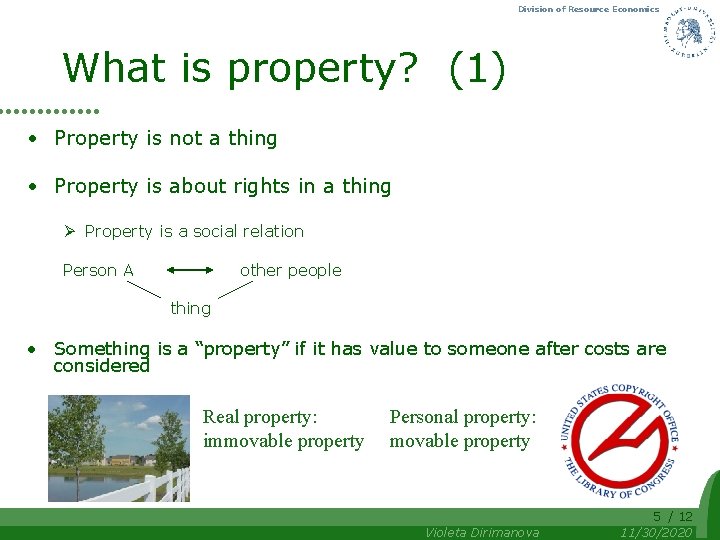
Division of Resource Economics What is property? (1) • Property is not a thing • Property is about rights in a thing Ø Property is a social relation Person A other people thing • Something is a “property” if it has value to someone after costs are considered Real property: immovable property Personal property: movable property Violeta Dirimanova 5 / 12 11/30/2020
Division of Resource Economics A simple framework • Social actors – Individuals, groups, legal persons • Objects – Material or immaterial value • Relations – Rights – Duties Violeta Dirimanova 6 / 12 11/30/2020
Division of Resource Economics What is a right? • Relationships among “social actors” having an interest in a “thing” – Individuals, groups, legal people… – Relationships - legal, commercial, social, family, personal • Exist only to extent Enforcement – Recognized, – Enforced, – Rationale - value of right exceeds cost of enforcement • A ‘bundle’ of rights Goodwill Violeta Dirimanova 7 / 12 11/30/2020
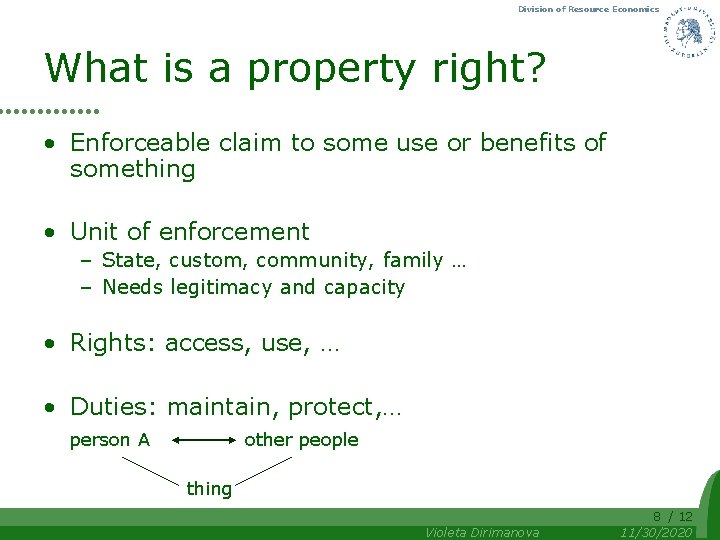
Division of Resource Economics What is a property right? • Enforceable claim to some use or benefits of something • Unit of enforcement – State, custom, community, family … – Needs legitimacy and capacity • Rights: access, use, … • Duties: maintain, protect, … person A other people thing Violeta Dirimanova 8 / 12 11/30/2020
Division of Resource Economics Property rights: de jure and de facto • de jure: property as defined legally • de facto: property in practice Ø Difference is unit of enforcement • Relationship between de jure and de facto • Match • Co-existence • Conflict Violeta Dirimanova 9 / 12 11/30/2020
Division of Resource Economics Property and its ‘bundles’ of rights Violeta Dirimanova 10/ 12 11/30/2020
Division of Resource Economics Property ≠ ownership • Property: many kinds of relationships • Ownership (or private property) has bundle of rights (Schlager and Ostrom 1992) – Access – the right to enter a defined physical property – Withdrawal – the right to obtain the ‘products’ of a resource – Management – the right to regulate internal use patterns and transform the resource by making improvements – Exclude – the right to determinate who will have an access right, and how that right may be transferred – Alienate – the right to sell or lease the rights of management and exclusion • Divided ownership may increase total wealth to society Violeta Dirimanova 11/ 12 11/30/2020
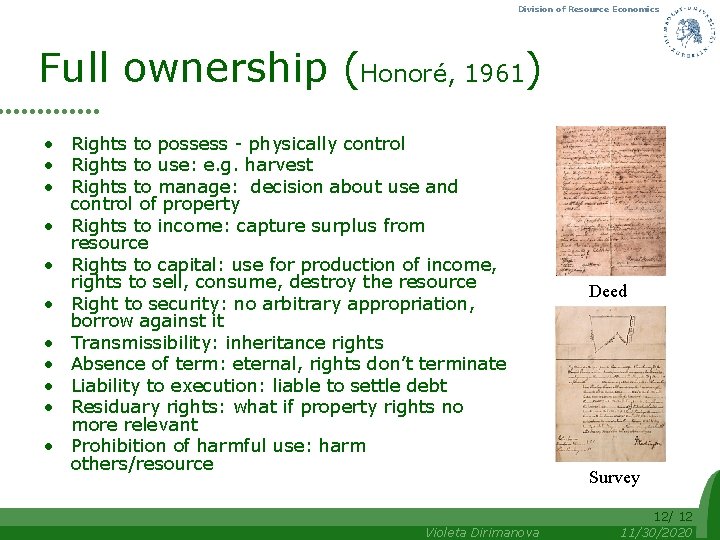
Division of Resource Economics Full ownership (Honoré, 1961) • Rights to possess - physically control • Rights to use: e. g. harvest • Rights to manage: decision about use and control of property • Rights to income: capture surplus from resource • Rights to capital: use for production of income, rights to sell, consume, destroy the resource • Right to security: no arbitrary appropriation, borrow against it • Transmissibility: inheritance rights • Absence of term: eternal, rights don’t terminate • Liability to execution: liable to settle debt • Residuary rights: what if property rights no more relevant • Prohibition of harmful use: harm others/resource Violeta Dirimanova Deed Survey 12/ 12 11/30/2020
Division of Resource Economics Use version control rights • Use rights – Access – Withdrawal • Control rights – Management – Exclusion – Alienation Violeta Dirimanova 13/ 12 11/30/2020
Division of Resource Economics Individual rights, collective control • Collective bodies: state, community … • Facilitate individual rights • Impose duties on land holders • Examples: – Communal land tenure – Forest concessions – Farmland in the European Union Violeta Dirimanova 14/ 12 11/30/2020
Division of Resource Economics What does this imply for CEE? • The changes are not from state ownership to private ownership • The changes are – From extensive control rights held by the state – To more limited control rights held by the state • And – From limited use rights – To more extensive use rights Violeta Dirimanova 15/ 12 11/30/2020
Division of Resource Economics Natural Resources and Property Rights Violeta Dirimanova 16/ 12 11/30/2020
Division of Resource Economics Natural resource as a property • Most resources have a range of attributes (bundles) • For instance, “land” can be considered as a “property”: – – – – Till - grow crops Pasture - graze Timber - harvest Non-timber forest products - gather Wildlife - harvest Minerals - extract Improvements - buildings Access – recreation Violeta Dirimanova 17/ 12 11/30/2020
Division of Resource Economics Ownership and natural resources • Elements overlap (i. e. Honore) • Ownership may not be full: e. g. use rights, but not full right to capital (special resources) • Harmful use included or not? If included in interconnected (eco-)systems constrains other rights! • Need for careful description of owner, manager, worker and content of rights and duties involved Violeta Dirimanova 18/ 12 11/30/2020
Division of Resource Economics Natural resources and property rights (1) • Seminal work by Coase (1960) and Demsetz (1967) • Coase theorem: property rights should be well-defined, no transaction costs, perfect competition and perfect market, and then resources can be used efficiently Is this theorem applicable? For instance to air, groundwater, fish in ocean? • Demsetz: property rights is an instrument of the society to identify who has rights to benefit and harm from the resource Violeta Dirimanova 19/ 12 11/30/2020
Division of Resource Economics Natural resources and property rights (2) • Property right holder has an “ability, without penalty to exercise a choice over a good, service, or person” (Allen 1998) • Property rights to a resource are social and institutional arrangements by which individuals are aware of what parts of the resource are their and others’ property, what duties are imposed on them and upheld by the state (Bromley 1991) • Property rights define: “who has access to which resources or benefit streams and under what conditions” (Vatn 2005) • Property rights are ‘rules of the game’ (Williamson 1998) Violeta Dirimanova 20/ 12 11/30/2020
Division of Resource Economics Natural Resources and Property Regimes Violeta Dirimanova 23/ 12 11/30/2020
Division of Resource Economics Defining natural resources • Multi-attributes, complex interrelationships • Property rights are incomplete, ill-defined, or even missing due to multi-attribute character of natural resources (complexity) • Prohibitively costly to measure all attributes of a resource and capture their potential value in property rights (Cheung, 1970) • Each attribute may require further specification which can affect the exchange (e. g. land size, land quality and quantity, soil characteristics, etc) • For instance, land resource attributes: varying attributes (characteristics) and these attributes also vary in quantity, quality and relations among people Violeta Dirimanova 24/ 12 11/30/2020
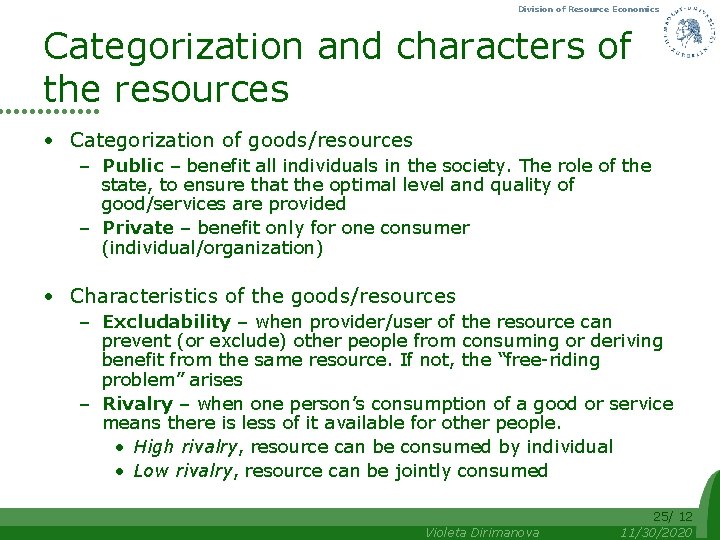
Division of Resource Economics Categorization and characters of the resources • Categorization of goods/resources – Public – benefit all individuals in the society. The role of the state, to ensure that the optimal level and quality of good/services are provided – Private – benefit only for one consumer (individual/organization) • Characteristics of the goods/resources – Excludability – when provider/user of the resource can prevent (or exclude) other people from consuming or deriving benefit from the same resource. If not, the “free-riding problem” arises – Rivalry – when one person’s consumption of a good or service means there is less of it available for other people. • High rivalry, resource can be consumed by individual • Low rivalry, resource can be jointly consumed Violeta Dirimanova 25/ 12 11/30/2020
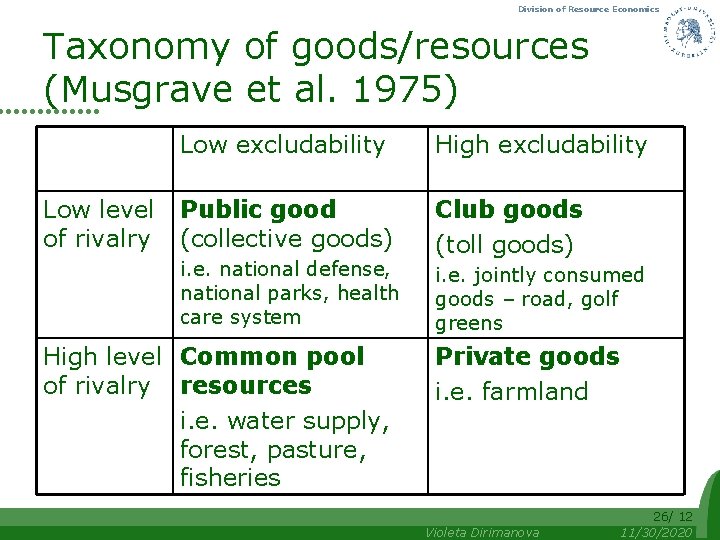
Division of Resource Economics Taxonomy of goods/resources (Musgrave et al. 1975) Low level of rivalry Low excludability High excludability Public good (collective goods) Club goods (toll goods) i. e. national defense, national parks, health care system High level Common pool of rivalry resources i. e. water supply, forest, pasture, fisheries i. e. jointly consumed goods – road, golf greens Private goods i. e. farmland Violeta Dirimanova 26/ 12 11/30/2020
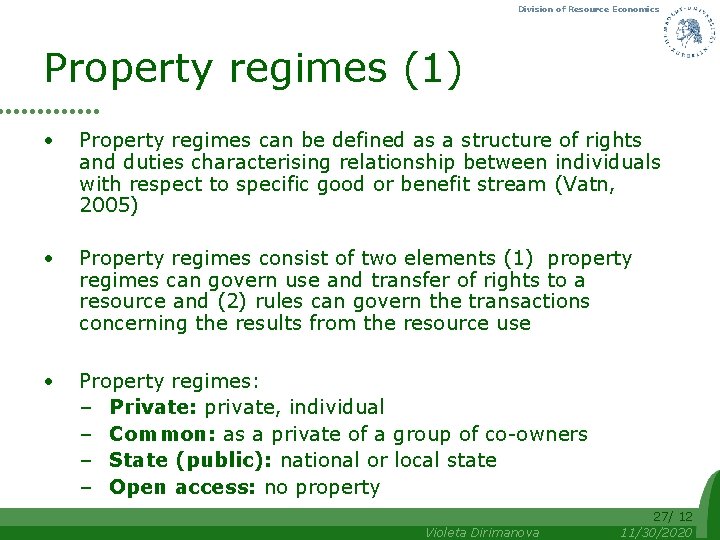
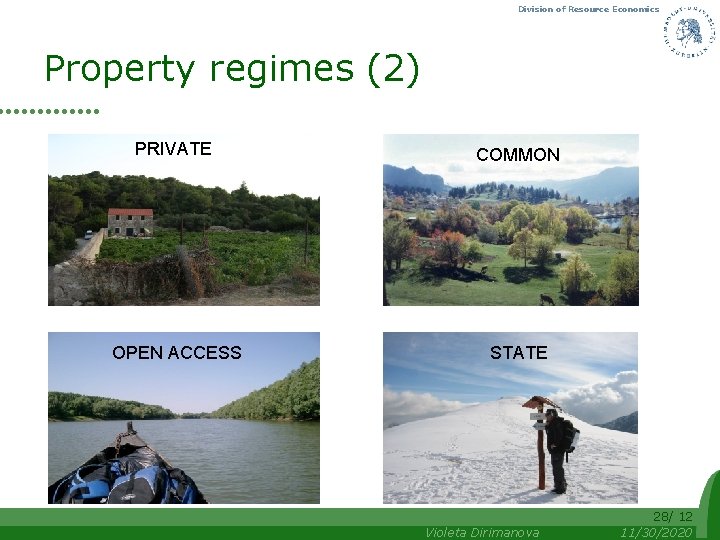
Division of Resource Economics Property regimes (1) • Property regimes can be defined as a structure of rights and duties characterising relationship between individuals with respect to specific good or benefit stream (Vatn, 2005) • Property regimes consist of two elements (1) property regimes can govern use and transfer of rights to a resource and (2) rules can govern the transactions concerning the results from the resource use • Property regimes: – Private: private, individual – Common: as a private of a group of co-owners – State (public): national or local state – Open access: no property Violeta Dirimanova 27/ 12 11/30/2020
Division of Resource Economics Property regimes (2) PRIVATE COMMON OPEN ACCESS STATE Violeta Dirimanova 28/ 12 11/30/2020
Division of Resource Economics Private Property Rights • Private ownership may lead to most efficient resource use and management • Private ownership must be consistent with the social norms and traditions of the society and then they could work appropriately Violeta Dirimanova 29/ 12 11/30/2020
Division of Resource Economics Advantages of Private PRs • Private PRs can decrease transaction costs • Government allocates property rights; market allocates resources • Private PRs have low administration costs & minimize government price intervention • Private PRs can be decreased to remove externalities • Private PRs adjust automatically to market changes • Regardless of distribution, efficiency can be ensured Violeta Dirimanova 30/ 12 11/30/2020
Division of Resource Economics Limitations of Private PPs • Distribution of property rights is subject to rentseeking, corruption, & political interest • Major distributional implications: give rights to whom, for free or for a price, through auction? • Private PRs are most applicable to land & soils, water, and minerals but less applicable to mobile resources • Not suitable if the resource itself generates significant, widespread externalities Violeta Dirimanova 31/ 12 11/30/2020
Division of Resource Economics Common Property Rights • They could be defined as private rights to a group of coowners (Bromley 1991) • They are more appropriate if externalities or public goods are not dominating • They consist of access, use and control rights to the resource • At local level, they could be combined with private use rights (regulated by the community institutions) • ‘Tragedy of the commons’ (Hardin 1968) Violeta Dirimanova 32/ 12 11/30/2020
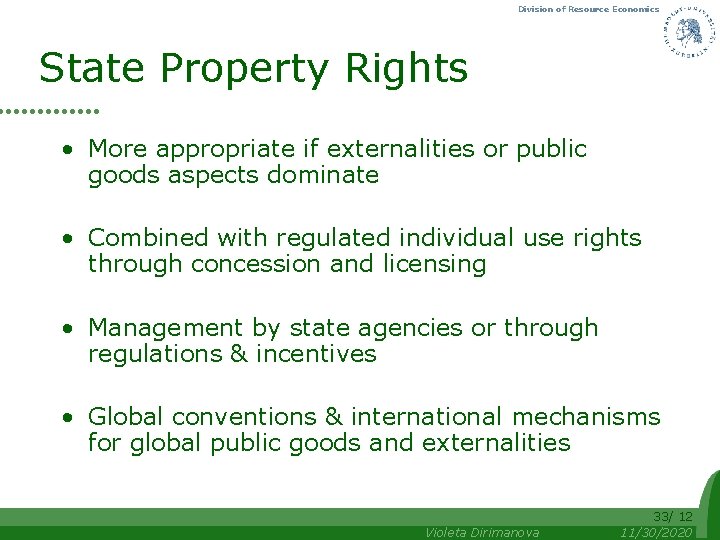
Division of Resource Economics State Property Rights • More appropriate if externalities or public goods aspects dominate • Combined with regulated individual use rights through concession and licensing • Management by state agencies or through regulations & incentives • Global conventions & international mechanisms for global public goods and externalities Violeta Dirimanova 33/ 12 11/30/2020
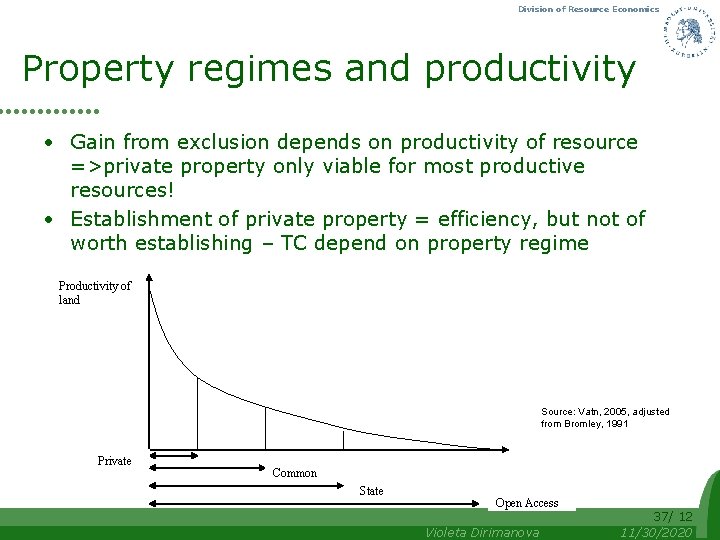
Division of Resource Economics Property regimes and productivity • Gain from exclusion depends on productivity of resource =>private property only viable for most productive resources! • Establishment of private property = efficiency, but not of worth establishing – TC depend on property regime Productivity of land Source: Vatn, 2005, adjusted from Bromley, 1991 Private Common State Open Access Violeta Dirimanova 37/ 12 11/30/2020
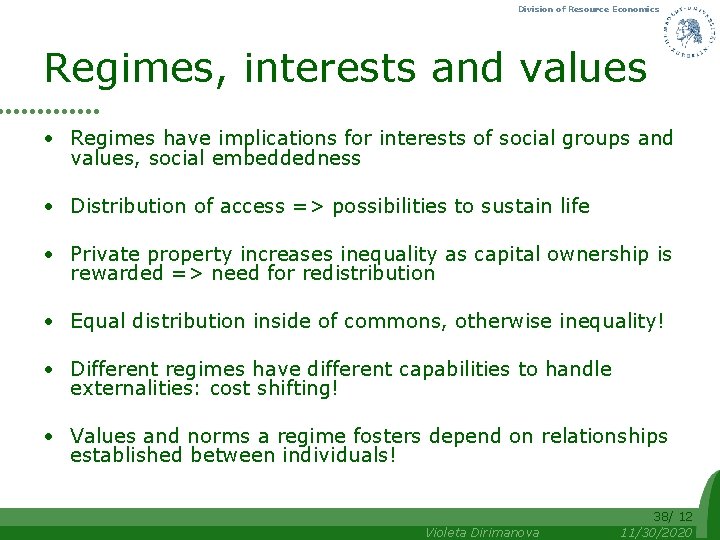
Division of Resource Economics Regimes, interests and values • Regimes have implications for interests of social groups and values, social embeddedness • Distribution of access => possibilities to sustain life • Private property increases inequality as capital ownership is rewarded => need for redistribution • Equal distribution inside of commons, otherwise inequality! • Different regimes have different capabilities to handle externalities: cost shifting! • Values and norms a regime fosters depend on relationships established between individuals! Violeta Dirimanova 38/ 12 11/30/2020
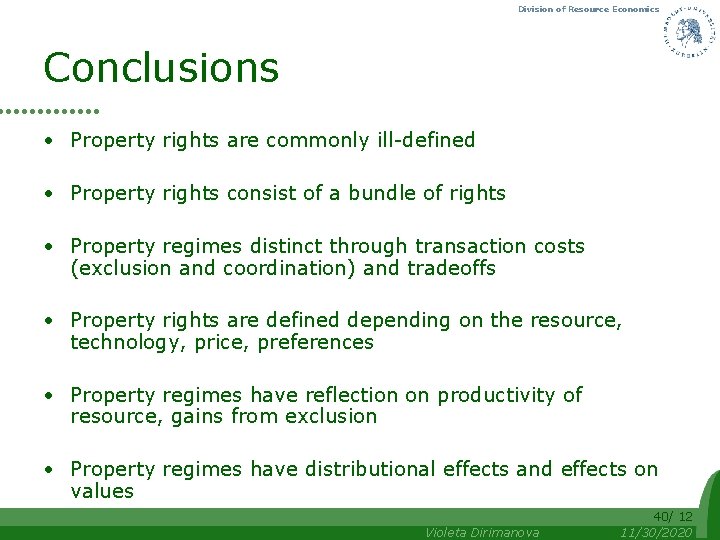
Division of Resource Economics Conclusions • Property rights are commonly ill-defined • Property rights consist of a bundle of rights • Property regimes distinct through transaction costs (exclusion and coordination) and tradeoffs • Property rights are defined depending on the resource, technology, price, preferences • Property regimes have reflection on productivity of resource, gains from exclusion • Property regimes have distributional effects and effects on values Violeta Dirimanova 40/ 12 11/30/2020
Division of Resource Economics References Books: • Anderson, T. L. and Mc. Chesney, F. S. (2003). Property rights Cooperation, Conflict and Law, Princetion University Press • Barzel, Y. (1989). Economic analysis of property rights. Cambridge, Cambridge University Press. • Coase, R. (1960). The nature of the firm. The Firm, the Market and the Law, 1988. University of Chicago Press • Vatn, A. (2005). Institutions and the Environment. Edward Elgar Articles: • Alchian, A. and Demsetz, H. (1973). The Property Rights Paradigm. The Journal of Economics History. 33 (1): 16 -27 • Demsetz H. (1967). Toward a Theory of Property Rights. The American Economic Review. 57 (2): 345 -359 • Pejovich, E. G. F. S. (1972). Property Rights and Economic Theory: A Survey of Recent Literature. Journal of Economic Literature 10(4): 11371162 • Schlager, Edella and Elinor, Ostrom. (1992). Property Rights, Regimes and Natural Resources: A Conceptual Analysis. Land Economics 68(3): 249262. Violeta Dirimanova 41/ 12 11/30/2020
Division of Resource Economics Thank You and Questions Violeta Dirimanova 42/ 12 11/30/2020