
Division of Quality Improvement Updates New Review Protocols



- Slides: 91
Division of Quality Improvement Updates < < New Review Protocols Update HCBS Settings Regulations & Related Activities Barbara Van Vechten Ellie Smith Alicia Matulewicz DQI - Continuous Quality Improvement 1
New Regulatory Survey Protocols 2
INCIDENT MANAGEMENT Part 624 and Part 625 Two Parts 1. Agency Level Central Review 2. Site/Service Level Review
Incident Management Protocol AGENCY LEVEL CENTRAL REVIEW
Overview: Central Review - BPC Verification • • • Required Notifications occurring Jonathan’s Law activities implemented IRC membership and activities appropriate IRMA Compliance Integrity of information in IRMA Agency analyzes and documents events, trends, and root causes • Agency identifies needed systemic changes • Agency implements needed systemic changes
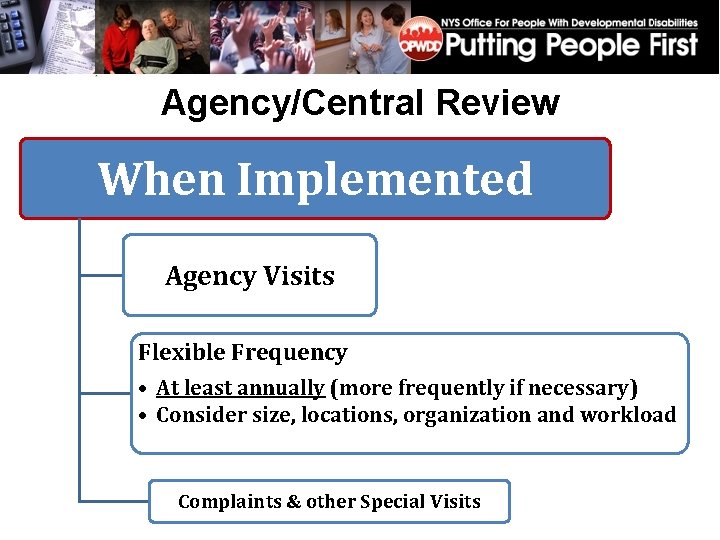
Agency/Central Review When Implemented Agency Visits Flexible Frequency • At least annually (more frequently if necessary) • Consider size, locations, organization and workload Complaints & other Special Visits
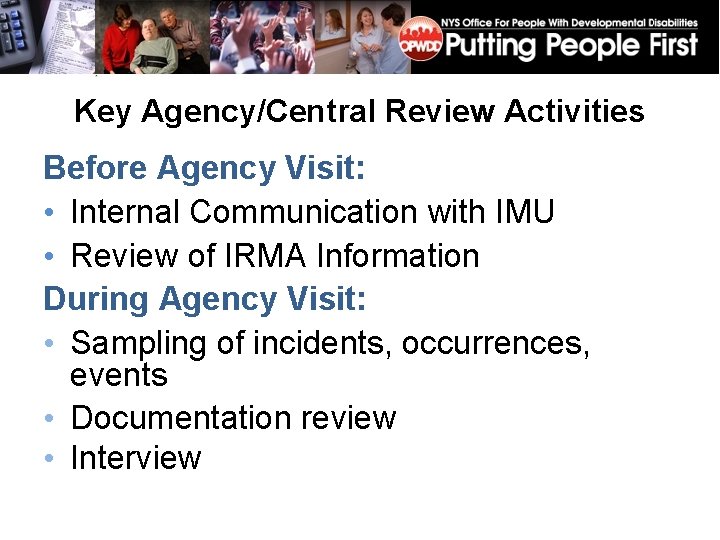
Key Agency/Central Review Activities Before Agency Visit: • Internal Communication with IMU • Review of IRMA Information During Agency Visit: • Sampling of incidents, occurrences, events • Documentation review • Interview
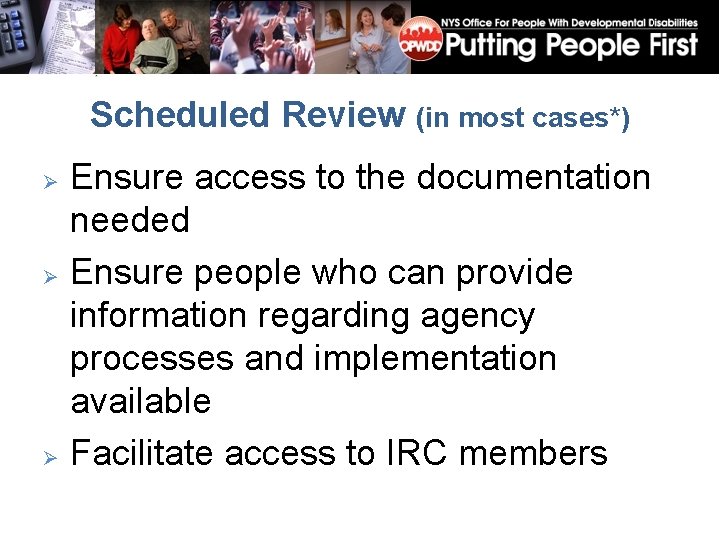
Scheduled Review (in most cases*) Ø Ø Ø Ensure access to the documentation needed Ensure people who can provide information regarding agency processes and implementation available Facilitate access to IRC members
Central Agency Sampling
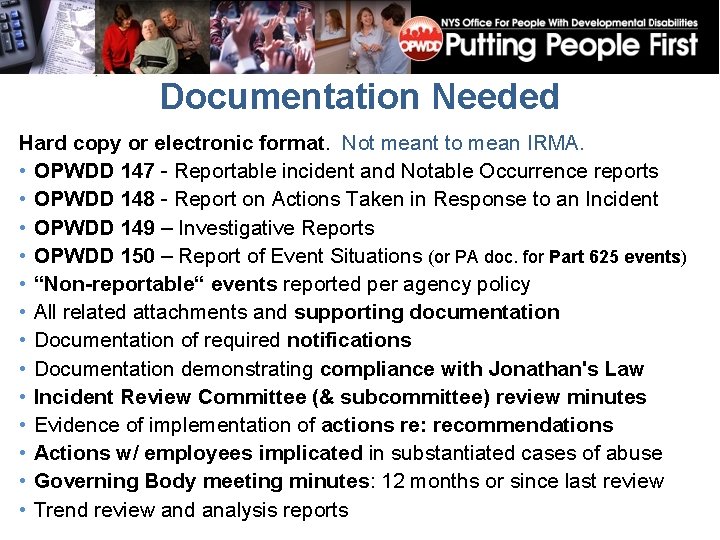
Documentation Needed Hard copy or electronic format. Not meant to mean IRMA. • OPWDD 147 - Reportable incident and Notable Occurrence reports • OPWDD 148 - Report on Actions Taken in Response to an Incident • OPWDD 149 – Investigative Reports • OPWDD 150 – Report of Event Situations (or PA doc. for Part 625 events) • “Non-reportable“ events reported per agency policy • All related attachments and supporting documentation • Documentation of required notifications • Documentation demonstrating compliance with Jonathan's Law • Incident Review Committee (& subcommittee) review minutes • Evidence of implementation of actions re: recommendations • Actions w/ employees implicated in substantiated cases of abuse • Governing Body meeting minutes: 12 months or since last review • Trend review and analysis reports
Agency/Central: Requirements Reviewed: Effective agency communication of P & P as requested to: • individuals • family/guardian/advocate prn • agency employees, interns, volunteers, consultants, contractors, & family care providers
Agency Level: Reporting Requirements • Incidents, occurrences, events were identified and reported • Incidents, occurrences, deaths and events were reported to CEO, OPWDD, Justice Center • Reporting within time frames • Reporting documented in IMRA • Reporting as required to VPCR – agency has process to ensure • IRMA Entry and Updates • Assurances that reporting occurred as entered into IRMA- IRMA integrity
Agency Level: Notifications • MHLS, BOV, Coroner, Law Enforcement • Verbal and document communications per Jonathan’s Law • Resignations and Terminations to the JC • Service Coordinator notifications and provision of additional info assist in assurance of necessary actions • IRMA closure and final reports
Agency Level: Incident Review Committee • • Membership No Conflict of Interest Training and Ethics Meetings Review and monitoring Recommendations and follow-up Minutes
Agency Level: Trending • Trending conducted • Analysis of trends • Recommendations to address • Recommendations implemented
Agency Level: Part 625 • Reporting as required • IRMA entry • Interventions and actions taken by agency as needed are appropriate and accurate based on IRMA information
PROTOCOL: INCIDENT MANAGEMENT PROTECTIONS SITE/SERVICE REVIEW
Focus of Protocol Review Requirements most closely related to ensuring the protection of individuals 18
Requirements Reviewed • All events are reported (RI, NO, Events) • Needed immediate care and protection is provided and documented • Investigations thorough, timely, documented • Recommendations & preventive measures implemented at person-siteservice level
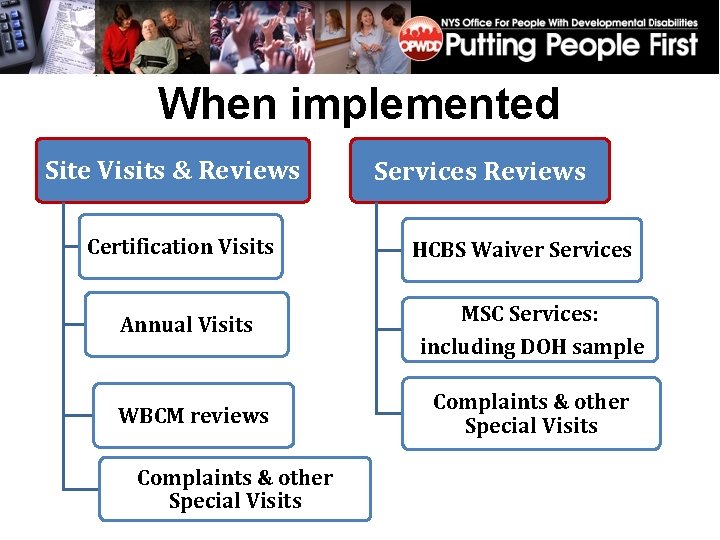
When implemented Site Visits & Reviews Certification Visits Annual Visits WBCM reviews Complaints & other Special Visits Services Reviews HCBS Waiver Services MSC Services: including DOH sample Complaints & other Special Visits
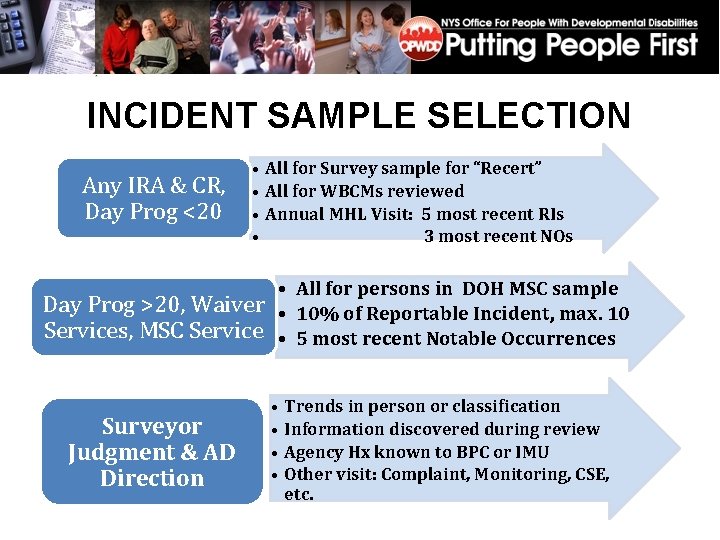
INCIDENT SAMPLE SELECTION Any IRA & CR, Day Prog <20 • All for Survey sample for “Recert” • All for WBCMs reviewed • Annual MHL Visit: 5 most recent RIs • 3 most recent NOs • All for persons in DOH MSC sample Day Prog >20, Waiver • 10% of Reportable Incident, max. 10 Services, MSC Service • 5 most recent Notable Occurrences Surveyor Judgment & AD Direction • Trends in person or classification • Information discovered during review • Agency Hx known to BPC or IMU • Other visit: Complaint, Monitoring, CSE, etc.
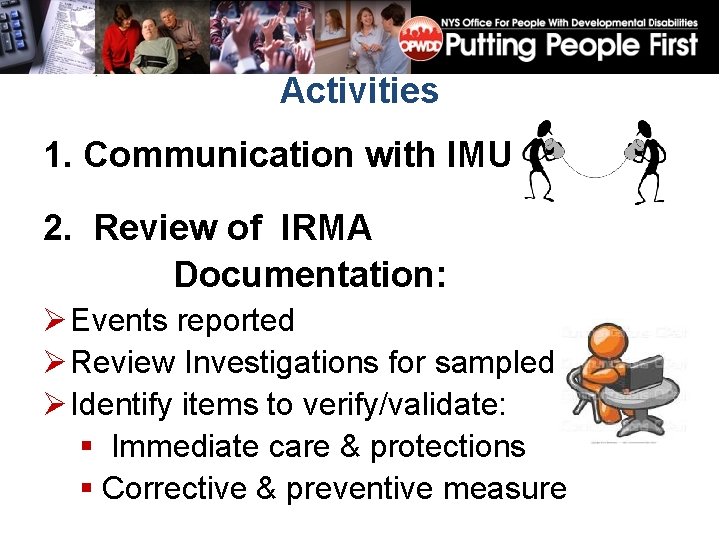
Activities 1. Communication with IMU 2. Review of IRMA Documentation: Ø Events reported Ø Review Investigations for sampled Ø Identify items to verify/validate: § Immediate care & protections § Corrective & preventive measure
On-Site Activities VERIFY Ø Events meeting 624 or 625 definitions were reported Ø Initial actions documented as implemented were implemented Ø Items recommended & agreed upon were implemented (as they relate to the site/service) – – – Plan revisions & resultant changes to services & supports Staff changes, training, supervision Equipment and renovations Monitoring actions Recommendations from OPWDD: OIIA investigation (IRMA); IMU (as informed) – Justice Center Corrective Action Plans (CAPs)
Behavior Services Part 633. 16
3 Tools for Behavior Services Review 1. “Routine Review” Protocol 2. “Agency Level” Review Protocol 3. Time Out Rooms supplement as part of Physical Plant review
Behavior Services “Routine Review” • Reviews the practical application of the regulations. • Evidenced in the planning and implementation of Behavior Services for individuals • Review implemented in conjunction with reviews of sites and services
Behavior Supports “Routine Review” Application • All residential facilities certified or operated by OPWDD, (including family care homes); for this protocol, only staff are referenced. • All facilities certified by OPWDD: (Day Programs) except: free standing respite; clinic treatment facilities; and diagnostic and research clinics • Day habilitation services (whether or not provided in a certified facility); • Prevocational services (whether or not provided in a certified facility); and • Community habilitation (low frequency)
When Used • Recertification Visits/Full reviews – At applicable certified programs – where Behavior Services are provided • Review of services to WBCMs in IRAs • Review of services for the individuals in the DOH Sample receiving applicable services
Sampling • All WBCMs in IRAs • All DOH sample individuals receiving applicable services • Sub-Sample of individuals in Certified residences and day programs
Section 1 -General Requirements • Applies to all Behavior Support Plans regardless of the specific strategies • Functional Behavioral Analysis • BSP Development: Who involved • BSP Content
Section 2: Plans w/ Restrictive, Intrusive or Rights Limiting Strategies • Ensure development by Licensed Psychologist or CSW or BIS supervised by same • Written Informed Consent • HRC approval
Section 2: Plans with Restrictions/Limitations Plans describe: – Necessity of restriction – Previously attempted but unsuccessful strategies – Guidance for postponement of activity – Plan for fading or elimination of restrictions – How to document intervention use – Plan to review/analyze use of interventions
• • Section 3: Mechanical Restraints Justification Staff Actions Use Criteria: application, removal &duration Monitoring the person’s needs, comfort, and safety Reduction/elimination of use Physician's order Full documentation of implementation Device Modification
Section 4: Medications 4 a. General Medication Requirements 4 b. PRN Medications 4 c. Medications for Symptoms of cooccurring diagnosed psychiatric disorder
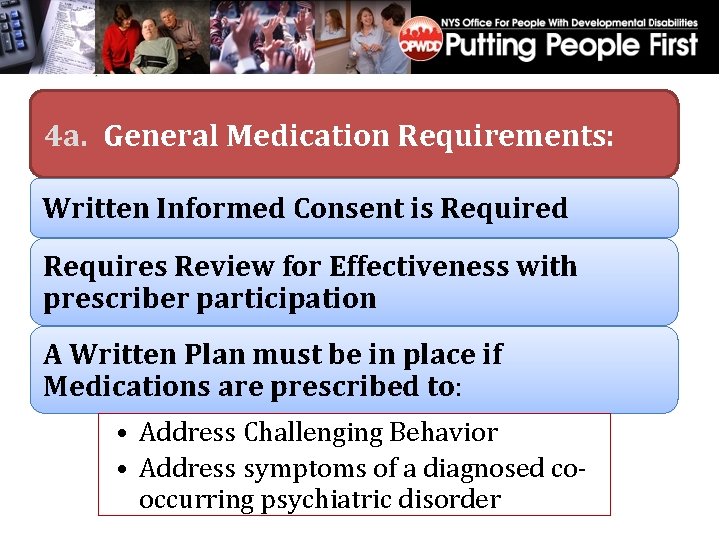
4 a. General Medication Requirements: Written Informed Consent is Required Requires Review for Effectiveness with prescriber participation A Written Plan must be in place if Medications are prescribed to: • Address Challenging Behavior • Address symptoms of a diagnosed cooccurring psychiatric disorder
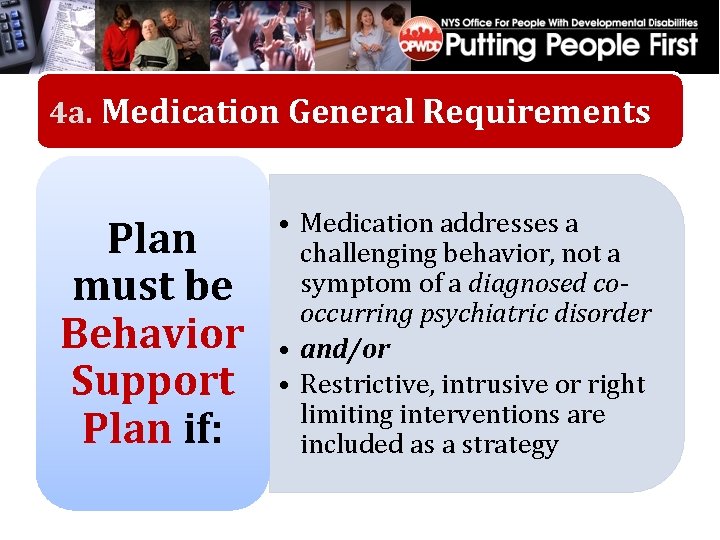
4 a. Medication General Requirements Plan must be Behavior Support Plan if: • Medication addresses a challenging behavior, not a symptom of a diagnosed cooccurring psychiatric disorder • and/or • Restrictive, intrusive or right limiting interventions are included as a strategy
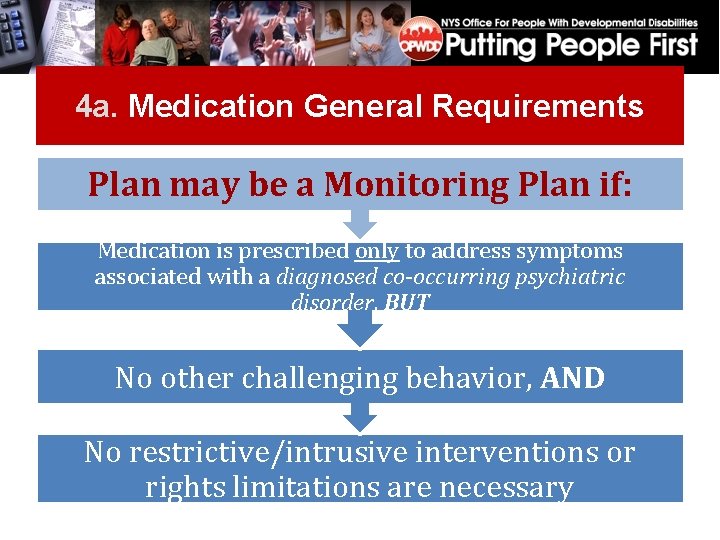
4 a. Medication General Requirements Plan may be a Monitoring Plan if: Medication is prescribed only to address symptoms associated with a diagnosed co-occurring psychiatric disorder, BUT No other challenging behavior, AND No restrictive/intrusive interventions or rights limitations are necessary
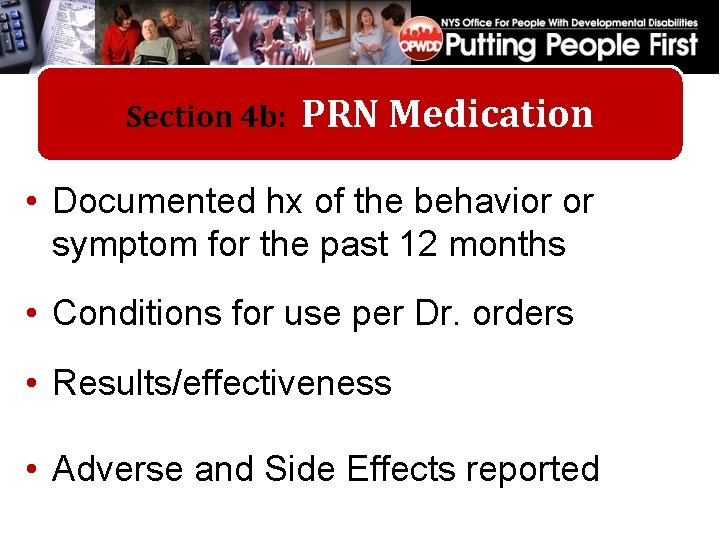
Section 4 b: PRN Medication • Documented hx of the behavior or symptom for the past 12 months • Conditions for use per Dr. orders • Results/effectiveness • Adverse and Side Effects reported
Section 4 c: Meds for symptoms of diagnosed co-occurring psychiatric disorder • Documentation of connecting symptom to psychiatric diagnosis to medication • Plan clearly identifies target symptoms to be addressed by medication • Plan clearly identifies how to evaluate and document symptoms and absence of same to measure improvement • Plan includes strategies in addition to medication • Plan developed by qualified person
BSP Implementation & Safeguard Requirements Organized by Behavioral Interventions/Strategies: 5 a 5 b 5 c 5 d 5 e Physical Interventions Mechanical Restraints Medication use and review Rights Limitations Time-Out Rooms
Section 5 a-e Monitoring & Safeguards for Use of Intrusive Strategies • • • Staff trained in the Plan Trained in each specific intervention technique Strategies implemented correctly per the plan Strategies were terminated per the plan Strategies were interrupted when necessary for safety and/or comfort • Assessment of persons condition, oversight, monitoring • Documentation of implementation • Required notifications
Behavior Services-Agency Level Two Components: Annual Review Ad Hoc Policy and Procedure Review
Behavior Services Agency Annual Review 7 Standards Related to: • Staff Qualifications • Staff Training provided and monitored • Human Rights Committee aka Behavior Review Committee – Has required membership – completes it review activities
Behavior Services Ad Hoc Agency Review • Policy and procedure review • At this time will only be conducted : – if routine reviews indicate systemic problems – Complaints – Other indicators, such a RIA or Incident Management raise concern – Consult with Area Director as needed
TIME OUT ROOMS • Standards added to Safety/Physical Plant Proto • Review during walk through at sites with T. O. room • ONLY APPLIES TO: – New or significantly modified T. O. rooms since April 01, 2013 – However may assist in identify hazards that should not be present whether or not the room is new.
Protocols can be found on OPWDD website: http: //www. opwdd. ny. gov/opwdd_se rvices_supports/service_providers/ division_of_quality_improvement_ protocols
QUESTIONS
HCBS Settings Requirements • An Overview for Day Services Providers 48
HCBS Rules in a Nutshell q Enhancement/Expansion of Rights—Same as everyone else q Requirements for demonstrated/evidence based individualized and persondirected service delivery q People must be supported to have maximum control over their lives and day-to-day decision making q Feds are raising the bar; not just CMS, Justice Dept. too, i. e. , Olmstead enforcement • Over time, this means DQI will be holding providers to a higher degree/expectations for true personcenteredness in our future compliance/ enforcement activities • OPWDD regulations to come 49
Key Elements Ø Final rule - effective March 17 th (up to five year transition plan) Ø Consistent definition of ‘community settings’ across all HCBS Medicaid authorities Ø Defines person centered planning requirements and process (effective now) Ø Applies to all settings (includes day settings); CMS guidance for non-residential settings pending… yet they say don’t wait…. . 50
General HCBS Settings Requirements Allowable HCBS Setting: q is integrated in & supports full access to the greater community; q is selected by the Person from among options; q ensures individual rights: privacy; dignity & respect; freedom from coercion & restraint; q optimizes autonomy & independence in making life choices; q facilitates choice among types of services & who provides them. 51
Home and Community-Based Setting Requirements ALLOWABLE Home and Community-Based Settings: q Integrated in & support access to greater community; q Opportunities: to seek employment & work in competitive integrated settings; engage in community life; control personal resources; q Ensure same degree of access for to the community for HCBS Persons compared with non-Medicaid persons; q Enable choices by the Individual from among setting options, (including non-disability specific settings); q Person-centered service plans document the options based on the Individual’s needs & preferences. 52
New HCBS Settings Requirements Ensures RIGHTS of ALL people receiving HCBS = same RIGHTS of All Citizens q q q Modification to the additional requirements (RIGHTS) must be: Supported by specific assessed need; Justified and documented in the Person. Centered Service Plan; Meet the additional specific criteria outlined in the regulations 53
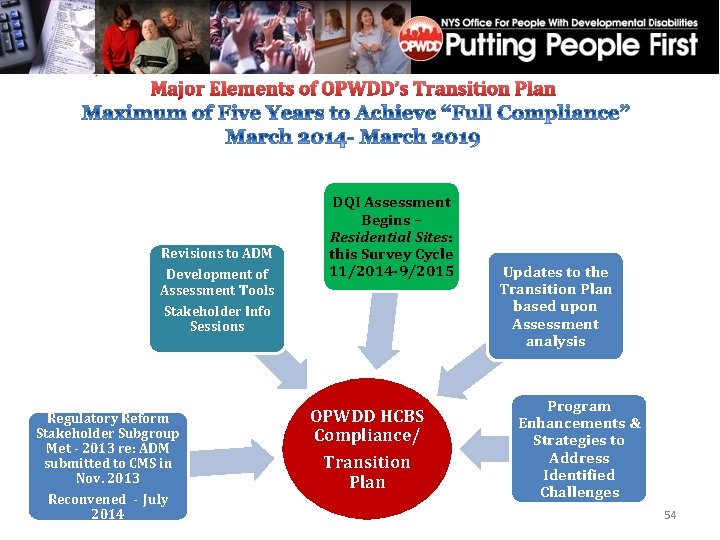
Major Elements of OPWDD’s Transition Plan Revisions to ADM Development of Assessment Tools Stakeholder Info Sessions Regulatory Reform Stakeholder Subgroup Met - 2013 re: ADM submitted to CMS in Nov. 2013 Reconvened - July 2014 DQI Assessment Begins – Residential Sites: this Survey Cycle 11/2014 -9/2015 OPWDD HCBS Compliance/ Transition Plan Updates to the Transition Plan based upon Assessment analysis Program Enhancements & Strategies to Address Identified Challenges 54
Revised HCBS Settings ADM Sets Stage For: ü Implementation of HCBS Settings Assessment Tool (residences); ü Interpretation and Understanding of the HCBS Settings Standards; and ü OPWDD’s promulgation of Future Regulations on this topic • Challenges: ü Interpretation of CMS regulations in order to “assess” the standards ü Practical realities of the service system vs. need to “push the envelope” We are pushing the envelope for the assessment ü The person’s experience in the setting is a major determining factor according to structure of CMS 55 exploratory questions
HCBS Settings ADM q The ADM describes the quality principles and standards that OPWDD will be assessing beginning November 2014 q It is expected that providers will use the following to actively plan and develop approaches to work towards maintaining full compliance with the HCBS Settings federal requirements: q ADM #2014 -04 q OPWDD’s HCBS Setting Assessment Tools q CMS guidance and Exploratory Questions. 56
HCBS Settings ADM q. The standards in the ADM specifically address: Ø the person-centered habilitation planning process; Ø delivery of person-centered HCBS funded supports and services in integrated settings; Ø promotion and support of informed choice and rights; and, Ø standards applicable to the nature and experience of each person’s living situation. 57
HCBS Settings ADM: A. Guidance on Hab Planning Process and Service Delivery q Federal PCP regulations are weaved in where applicable; q PCP Process not end goal—designed to result in outcomes to ensure the person has more choice and control in his/her life; q Habilitation Plans are a required attachment to the Person-centered Plan (i. e. , ISP) and must be coordinated with the ISP. As such the Habilitation Plan is encompassed in the person’s service plan; q Habilitation Plans are person-centered/person-directed, individualized, and include activities and interactions 58 that are meaningful to the person;
A. Guidance on Hab Planning q Habilitation supports/services should focus on developing skills that are needed in order to facilitate greater degrees of choice, independence, autonomy and full participation in community life; q Exploration of new experiences is an acceptable component of the Habilitation Plan. Learning about the community and forming relationships often require a person to try new experiences to determine life directions. o This trial-and-error process eventually enables the person to make informed choices o To identify new valued outcomes that then become part of the ISP and Hab Plan; o q The Habilitation Plan (or alternative documentation that becomes part of the habilitation/service plan) should reflect: o the personally meaningful community inclusion/integration activities, o the timing and desired frequency/duration of these activities, and 59 o the supports needed for the person to fully participate
A. Guidance on Hab Planning q Whenever possible, supports are provided in a way that maximizes use of natural and peer supports in the community, not just paid staff and providers; q The Habilitation Plan must be updated in accordance with ADM #2012 -01, when the individual’s circumstances or needs change, or at the request of the individual. q Residential providers should ensure that individuals are aware of their right to request a Habilitation Plan change. Residential providers are expected to take timely action to honor these requests. 60
HCBS ADM: B. HCBS Waiver Service Provision Is Required to Support Full Access to the Greater Community to the Same Degree of Access as Individuals Not Receiving HCBS: q HCB services, supports, and settings must be designed to: q facilitate full access to engage in community life; q seek employment and work in competitive integrated settings; engage in meaningful activities; q explore meaningful relationships and social roles; q reside in the home of choice; q share in other hallmarks of community living in accordance with individualized needs and preferences identified in the person’s habilitation/service plan and to the same degree of access as individuals without disabilities. q HCBS settings (and services and supports) must seek to optimize and not regiment individual initiative, autonomy, and independence in making life choices 61
B. HCBS Waiver Service Provision Is Required to Support Full Access to the Greater Community to the Same Degree of Access as Individuals Not Receiving HCBS, (Cont. ) • For “same degree of access” to life in the community, we need to ensure that people with disabilities are not segregated or isolated from people without disabilities and ensure that support and service delivery practices are not “institutional” in nature. 62
HCBS Waiver Service Provision Is Required to Support Full Access to the Greater Community to the Same Degree of Access as Individuals Not Receiving HCBS, (Cont. ) q Facilitate Informed Choice and Protect Rights: Encourage and support individuals to choose and control their own schedules and activities including both scheduled and unscheduled activities Ø The provider/site must ensure that sufficient support is available based upon peoples’ priorities in their Plans for scheduling and activity preferences. Ø Spontaneity in choice of activities encouraged and supported whenever possible, no different than non-disabled Ø May need to consider use of natural supports and creative resources Ø a person may not be able to participate in a regularly scheduled/planned activity due to illness or other reason—this must also be supported by the provider. 63
HCBS Waiver Service Provision Is Required to Support Full Access to the Greater Community to the Same Degree of Access as Individuals Not Receiving HCBS, (Cont. ) q Facilitate Informed Choice and Protect Rights: Ø Support informed choice by exploring with the person the potential consequences and responsibilities of decision making Ø Employ positive approaches w/ safeguards and honor “dignity of risk” Ø Protect individuals from coercion, and unnecessary use of restrictive interventions Ø Provide mechanisms for people to file anonymous complaints Ø Encourage, respect and support peoples’ observance of cultural, religious/spiritual, and other preferences Ø Ensure that individual freedom and independence is not abridged through administrative operations Ø Use plain language and accessible communication 64
What about circumstances where a person’s needs may dictate that he/she cannot safely access the HCBS Settings Rights? Rights must not be modified outside of the person centered planning process or without the informed consent of the person or authorized surrogate unless there is an immediate, serious and credible threat (this is a high bar). 65
Federal Requirements if Rights Modification is Necessary • • • Must be supported in the Plan as follows: 1. ID of specific assessed need 2. Documentation of positive interventions and supports used prior to modification 3. Documentation of less intrusive methods tried 4. clear description of condition in direct proportion to the assessed need 5. Inclusion of regular collection/review of data to measure effectiveness of modification 6. Established timeframes for periodic review 7. Informed Consent of the person 8. Assurance that interventions/supports will cause no harm to the person 66
Implementation by DQI 67
Why is DQI doing an HCBS Settings “Assessment” for Certified Residential Settings? q q q Part of OPWDD’s HCBS Settings Transition Plan To Collect Baseline Information To Identify Major Challenges that OPWDD Must Address Systemically to Work Towards Full Compliance After the Assessment, the OPWDD Transition Plan will need to be revised to include the specific activities to ensure full compliance (i. e. , programmatic changes, reinvestment strategies, etc. ) An opportunity for providers to learn, grow, and enhance person centered practices during the transition period 68
General Implementation Information about DQI’s Assessment The HCBS Assessment for IRAs and CRs will begin in November 2014 and run through September 2015 (the end of DQI’s survey cycle) 69
General Implementation Information q “No’s/Not Mets” are not a bad thing for the Assessment—rather, they will help OPWDD to identify where to focus in transition planning q It is an opportunity for the provider to grow, learn, make enhancements and changes for the better. q OPWDD will use a conservative approach to selecting Yes for any assessment standard i. e. , in most cases evidence of a Yes is necessary, otherwise, standard is “Not Met/No” 70
General Information For the Assessment, a YES means that THIS PERSON IS TRULY RECEIVING SUPPORTS IN A PERSON CENTERED MANNER AND ENVIRONMENT • Assessment Tool is designed for use with the Guidance Document to help determine the criteria that leads to whether a standard is a “Yes” or a “No”. 71
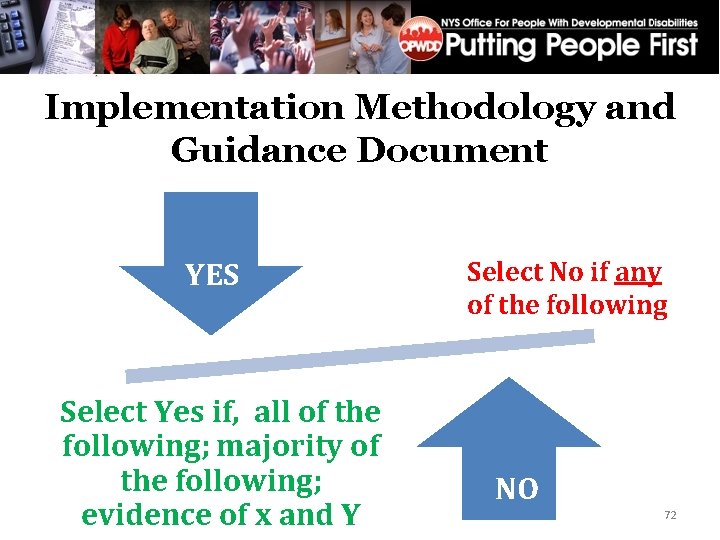
Implementation Methodology and Guidance Document YES Select Yes if, all of the following; majority of the following; evidence of x and Y Select No if any of the following NO 72
General Implementation Information —Key Themes of the Assessment § The final rules establishes an outcome oriented definition that focuses on the nature and quality of individuals’ experiences § The new standards are “experiential” and about “qualities” of the setting § The regulations focus on whether individuals supported have the “same degree of access” as others in the community 73
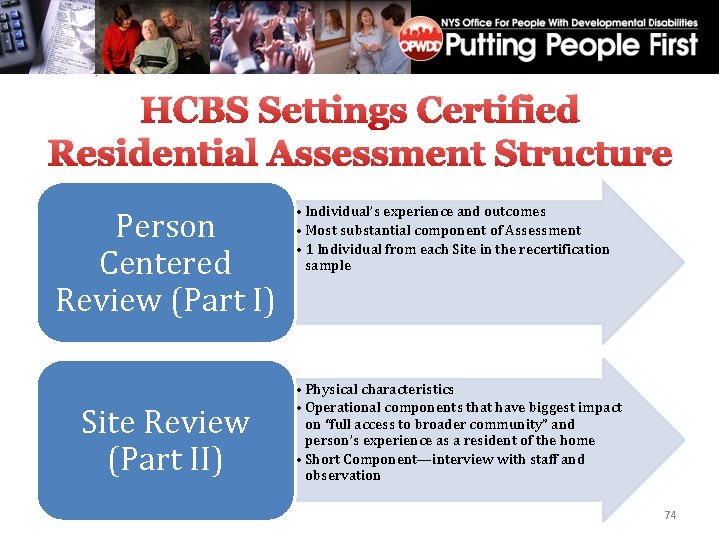
HCBS Settings Certified Residential Assessment Structure Person Centered Review (Part I) Site Review (Part II) • Individual’s experience and outcomes • Most substantial component of Assessment • 1 Individual from each Site in the recertification sample • Physical characteristics • Operational components that have biggest impact on “full access to broader community” and person’s experience as a resident of the home • Short Component—interview with staff and observation 74
q Will aggregate results by domain area/section: Percentage of sites that have achieved standards Percentage moving towards standards achievement Percentage likely to achieve during transition period Percentage unlikely to achieve standards during transition q Actual results will help OPWDD Target areas/action plan for training and quality improvements at systems level to finalize the OPWDD Transition Plan. q Data aggregation over time will help target quality improvement strategies and identify successes 75
Next Steps and What You Can Do to Prepare: Agency Survey 76
So what to do…. CMS: Use ‘Exploratory Questions’ as they relate to Day Services; e. g. § http: //www. opwdd. ny. gov/node/5553 ? Was the Individual given a choice of available options regarding service options and environments? Ø Were the different services and service mechanisms explained? o Day Hab, Community Hab, Pre-Voc, PTE, SEMP, Volunteer? Ø Opportunity to talk with people who receive services differently? ? Was the Individual given opportunities to visit other settings and service providers? Ø Visits/Experiences: varied day hab services & activities; volunteer sites; college campuses; observe jobs at local employers; fitness centers, etc. 77
? Does the individual chooses from whom they receive services and supports? Ø Were options regarding provider agencies provided? Ø Can the individual identify other providers who render the services s/he receives? Ø Does the individual express satisfaction with the provider selected ? Ø Does the individual know how and to whom to make a request for a new provider? ? Does the setting/service reflect the Individual’s needs & preferences? Ø A Person Centered Planning methodology used to identify needs/preferences reveals ideal service settings 78
? Is the individual is employed or active in the community outside of the setting? Ø Does the individual work in an integrated community setting? Ø If the individual would like to work, is there activity that ensures the option is pursued? Ø Does the individual participate regularly in meaningful non-work activities in integrated community settings? The setting does not isolate individuals supported from individuals in the broader community (those not receiving HCBS). Ø Is the setting in the community? Ø Is there sufficient transportation available to access the community? Ø Is there sufficient support to access the community? 79
? Are individual choices incorporated into the services and supports received? Ø Ø Do staff ask the individual about needs and preferences? Does the individual express satisfaction with the services? Are individuals aware of how to make a service request? Is individual choice facilitated in a manner that leaves the individual feeling empowered to make decisions? ? Is/are the Individual/chosen representative(s) actively involved in Person-Centered Planning meetings? Ø Person is part of or directs meeting time, location, invitation process and frequency Ø Was the Individual present during the planning meeting? Ø Did/does the planning meeting occur at a time and place convenient for the individual to attend? 80
Agency Survey q Provider agencies and DDROs will be asked to complete a survey through survey monkey q The purpose of the agency survey is to gather contextual information on organizational systems and provider preparations for HCBS Settings Transition and Compliance q The survey will also ask for information on homes that may trigger “heightened scrutiny” so that OPWDD can begin an inventory for 81 transition planning activities
Involve your Stakeholders: q Engage the Board of Directors in the direction, oversight, and approval of transition strategies/activities, review of data/surveys, and quality improvement approaches q Actively communicate with staff and people supported and their family members and advocates on these standards, compliance strategies and changes necessary and involve them in the improvement process q Solicit feedback from individuals served and their advocates on how to do better through satisfaction surveys, focus groups, residence meetings, and other applicable forums. 82
Review All Organizational and Site/Program Policies, Procedures, Practices, Training Materials, Forms, etc. q. Ensure consistency with HCBS Settings requirements; q. Ensure no blanket rules/restrictions/practices that limit individual choice, autonomy or rights; q. Ensure that materials for people are written in plain language and are accessible 83
Enhance Training & Communication Approaches to Integrate HCBS Settings Principles q Training, orientation, etc. should reflect these expectations q Reinforce with staff how to support individuals to exercise control and choice in their lives q Cultural competency training q Adopt and implement Direct Support Professional Competencies 84
Implement Organizational Self-Assessment Practices for HCBS Settings and Person Centered/Directed Service provision q Use the OPWDD HCBS Settings Assessment Tools and Guidance Document and the CMS Exploratory Questions to assess the homes that you operate 85
Enhance Person Centered/Directed Planning and Service Delivery Practices Systemically Throughout the Organization and its Services and Support Delivery infrastructure Use OPWDD’s optional Strengths and Risks Inventory when planning with people http: //www. opwdd. ny. gov/node/5521 86
The HCBS federal regulations specify: “the written plan must reflect risk factors and measures in place to minimize them, including individualized back-up plans and strategies”. [CFR 441. l 301 (C)(2)(vi)] •
Some of NYS OPWDD’s Major System Challenges q q q OPWDD’s Infrastructure/service delivery dollars heavily invested in facility based service delivery ‘Bundled’ rate setting methodologies Large residences (many former ICFs) vs CMS’s 2008 NPRM re homes of 4 beds or less Balancing ‘Protection’ vs. Individual Choice and Autonomy i. e. , Justice Center/ provider/staff fear of liability Staffing/Resource/Transportation Unmet training needs re truly person centered planning & supporting people to maximize their control over their lives 88
The Bottom Line • “The new rule seeks to improve quality of life for people with disabilities by ensuring • that HCBS funding is used only for services in settings that are truly integrated, as opposed to those that replicate institutional environments in all but name. ” • ASAN Policy Brief, “Defining Community: Implementing the new Medicaid HCBS Rules”, 9/2014 89
OPWDD HCBS Settings Transition Plan Web Page: http: //www. opwdd. ny. gov/opwdd_services_supports/HCBS/home ü OPWDD Transition Plan materials and response to public comments ü Link to NYS Transition Plan and materials ü Link to CMS Resource Materials and Tool Box ü OPWDD HCBS Settings Tool Box ü Materials from Stakeholder Work Group Meetings • Feedback and suggestions are welcome and appreciated! 90
QUESTIONS? 91