
Division of Powers Separation and Balance of Powers
Division of Powers Separation and Balance of Powers
Enlightenment Principles The power of the govt should be limited Govt should protect people’s rights The constitution creates three branches of govt Govt get their power from the people (Popular Sovereignty) Constitution includes protections for citizen's rights Govt powers should be divided (Separation of Powers) Constitution defines and restricts power Representative elected govt No govt official can ignore the law (Rule of Law)
Expressed (enumerated) Powers specifically listed in the articles of the constitution 27 listed in Article I Sect 8 Wanted to create a limited government
Implied Powers (Article I Sec 8) Not listed in the constitution BUT necessary to carry out an intended action Power “to make all laws necessary and proper for carrying into executing the forgoing powers, ” Necessary and Proper Clause (Elastic Clause) Expands the powers of Congress so that Congress can carry out its duties Examples Funding schools (tax money spent for the general welfare of the people) Drafting soldiers (the power to organize and maintain a standing army) Minimum Wage (the power to regulate trade)
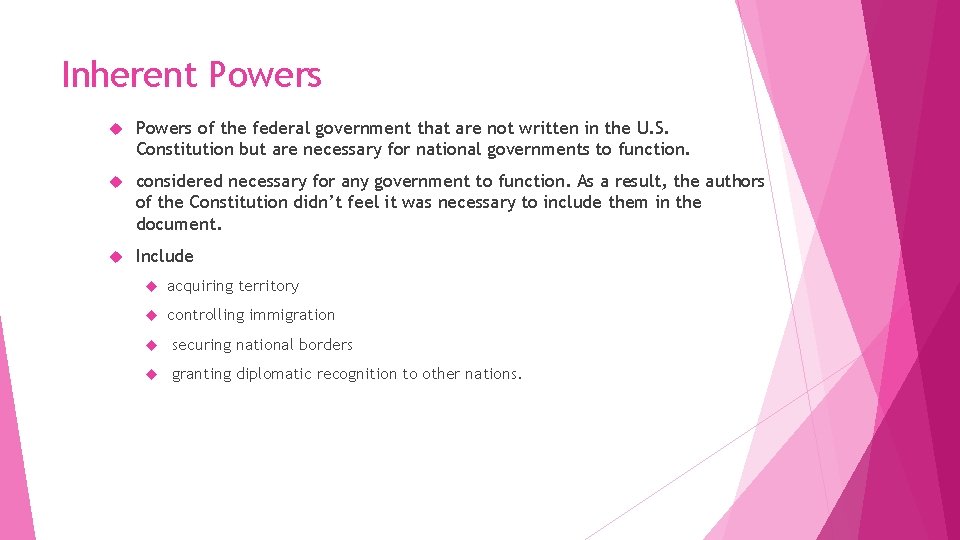
Inherent Powers of the federal government that are not written in the U. S. Constitution but are necessary for national governments to function. considered necessary for any government to function. As a result, the authors of the Constitution didn’t feel it was necessary to include them in the document. Include acquiring territory controlling immigration securing national borders granting diplomatic recognition to other nations.
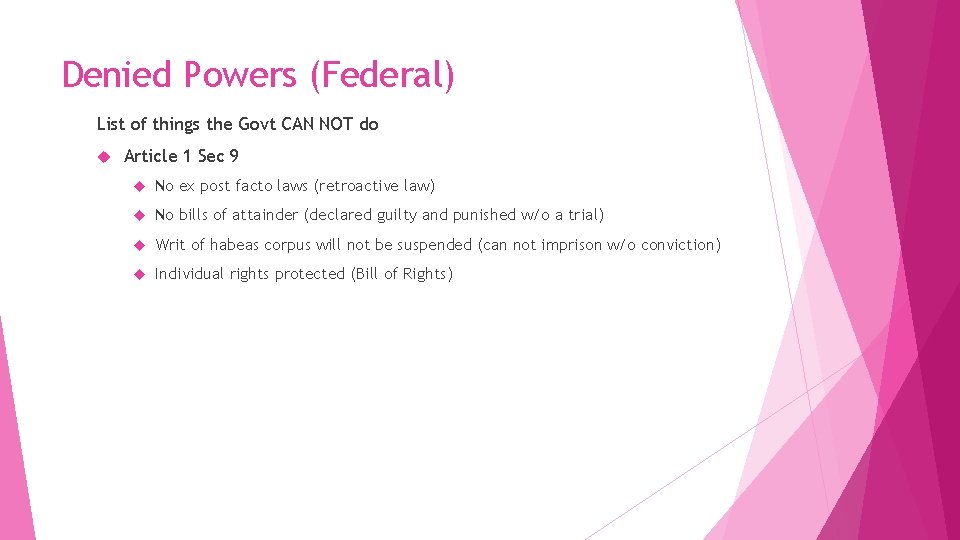
Denied Powers (Federal) List of things the Govt CAN NOT do Article 1 Sec 9 No ex post facto laws (retroactive law) No bills of attainder (declared guilty and punished w/o a trial) Writ of habeas corpus will not be suspended (can not imprison w/o conviction) Individual rights protected (Bill of Rights)

Checks and Balances powers of one branch can be challenged by another branch Makes sure no branch develops too much power
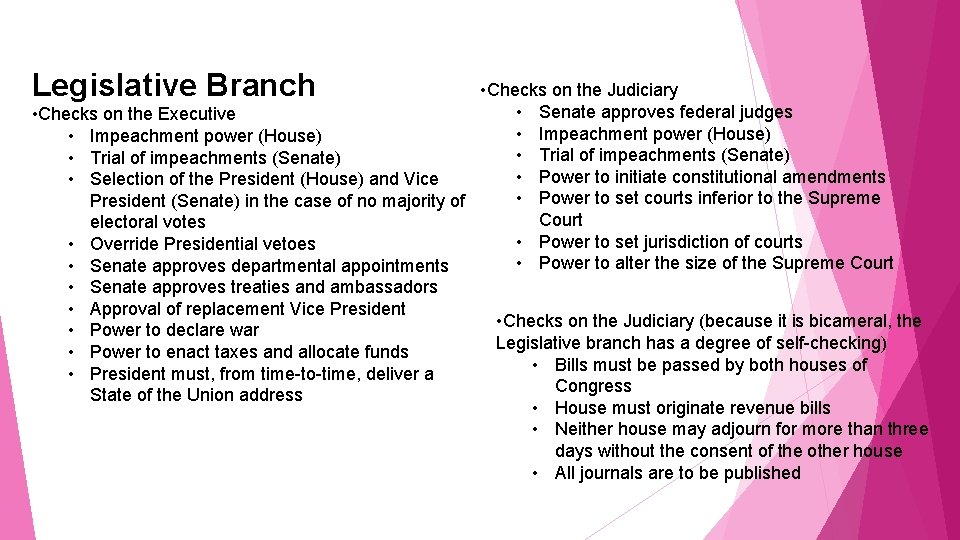
Legislative Branch • Checks on the Judiciary • Senate approves federal judges • Checks on the Executive • Impeachment power (House) • Trial of impeachments (Senate) • Power to initiate constitutional amendments • Selection of the President (House) and Vice • Power to set courts inferior to the Supreme President (Senate) in the case of no majority of Court electoral votes • Power to set jurisdiction of courts • Override Presidential vetoes • Power to alter the size of the Supreme Court • Senate approves departmental appointments • Senate approves treaties and ambassadors • Approval of replacement Vice President • Checks on the Judiciary (because it is bicameral, the • Power to declare war Legislative branch has a degree of self-checking) • Power to enact taxes and allocate funds • Bills must be passed by both houses of • President must, from time-to-time, deliver a Congress State of the Union address • House must originate revenue bills • Neither house may adjourn for more than three days without the consent of the other house • All journals are to be published
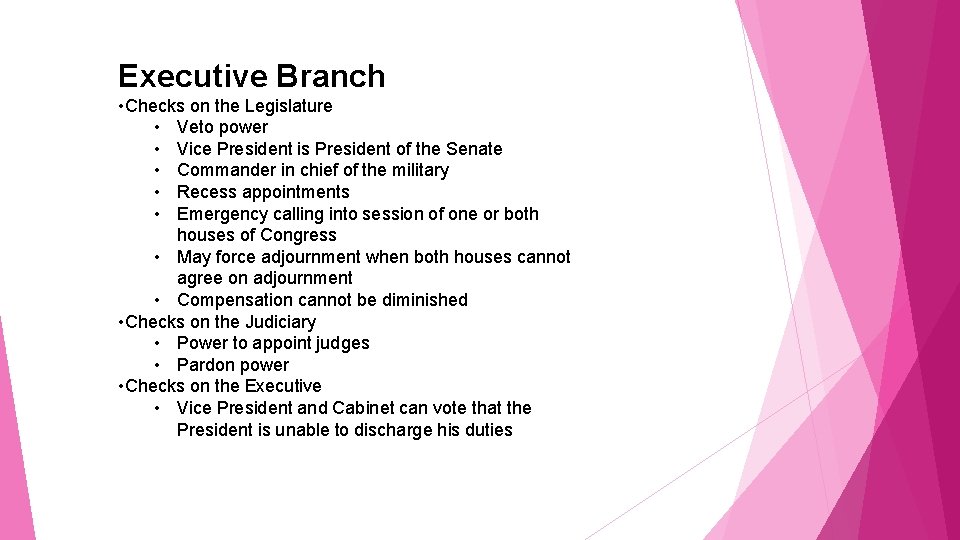
Executive Branch • Checks on the Legislature • Veto power • Vice President is President of the Senate • Commander in chief of the military • Recess appointments • Emergency calling into session of one or both houses of Congress • May force adjournment when both houses cannot agree on adjournment • Compensation cannot be diminished • Checks on the Judiciary • Power to appoint judges • Pardon power • Checks on the Executive • Vice President and Cabinet can vote that the President is unable to discharge his duties
Judicial Branch • Checks on the Legislature • Judicial review • Seats are held on good behavior • Compensation cannot be diminished • Checks on the Executive • Judicial review • Chief Justice sits as President of the Senate during presidential impeachment
Federalism The division of powers between the national and state governments. Dual Federalism A system in which power is clearly divided between federal and state governments. Caused state laws to go against federal laws (Supremacy Clause was created) Cooperative Federalism A system in which the federal and state govts collaborate on national policies Since the Great Depression, the federal govt has become more active in affairs once reserved for the state

Delegated Powers given to the federal government by the U. S. Constitution. All powers that are not delegated to the federal government are set aside for the states. Include Printing money Regulate trade with other countries and between states Declare war Maintain Army and Navy Make treaties and conduct foreign policy Establish post office
Reserved Powers (States) The constitution does not list the power states have 10 th Amendment of constitution states that any powers not delegated (given) to the national govt are reserved (set aside) for the states. Include Issue licenses Regulate business within the state Conduct elections Establish local govt Ratify amendments to the state constitution
Concurrent Powers both Federal and State govt share Include Building infrastructure (roads, bridges) Aid and assistance to citizens Collect taxes Make and enforce laws Borrow money Establish courts

Federalism Checks and Balances Quiz Name, Date and period on the paper Number from 1 -10 Only put the letter of the correct answer on the paper Hand USE in for credit YOUR NOTES… IF YOU FAIL YOU WILL HAVE TO TAKE 2 10 QUESTIONS QUIZZES
1. Which feature of the U. S. government is based on the principle of federalism? A. The division of powers between the federal government and the states B. The protections of individual liberties enshrined in the Bill of Rights C. The existence of three branches of government that limit one another's power D. The ability of the Supreme Court to declare laws unconstitutional
2. What are delegated powers? A. Powers that the Constitution sets aside for state governments B. Powers that are shared between the federal government and the states, according to the Constitution C. Powers that the Constitution assumes a government must have in order to act effectively D. Powers that the Constitution gives to the federal government
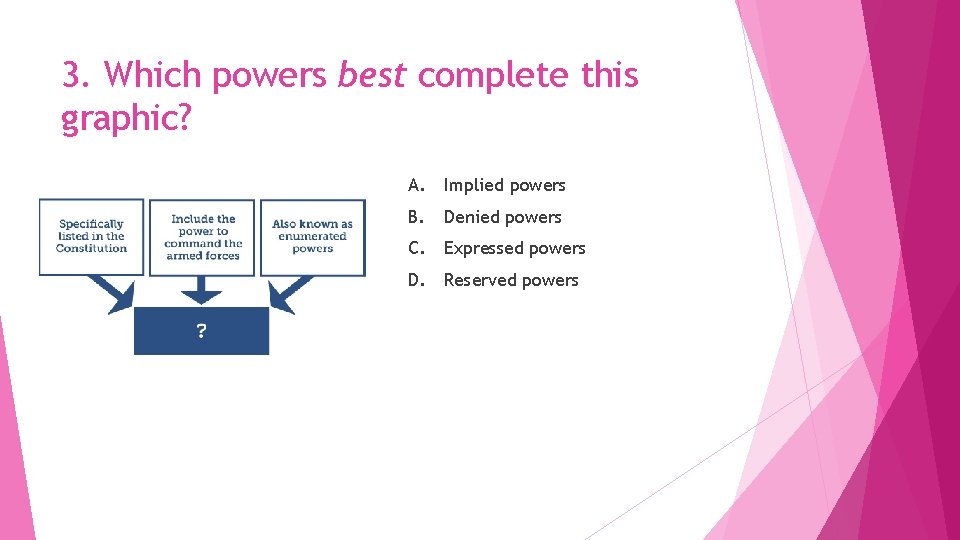
3. Which powers best complete this graphic? A. Implied powers B. Denied powers C. Expressed powers D. Reserved powers
4. What is the constitutional basis for the implied powers of the federal government? A. They were assumed by the writers of the Constitution to be necessary for the government to function. B. C. They are spelled out in the Bill of Rights. They are allowed by the necessary and proper clause of the Constitution. D. They are directly listed in the Constitution.
5. Which of these powers does the Constitution deny the federal government? A. Passing laws that apply to actions taken before the law was passed B. Compelling citizens to serve in the military against their will C. Declaring a state law to be unconstitutional D. Building roads and structures that local citizens do not want
6. Which of these powers is shared between states and the federal government? A. Collecting taxes B. Setting up public schools C. Making treaties D. Establishing post offices
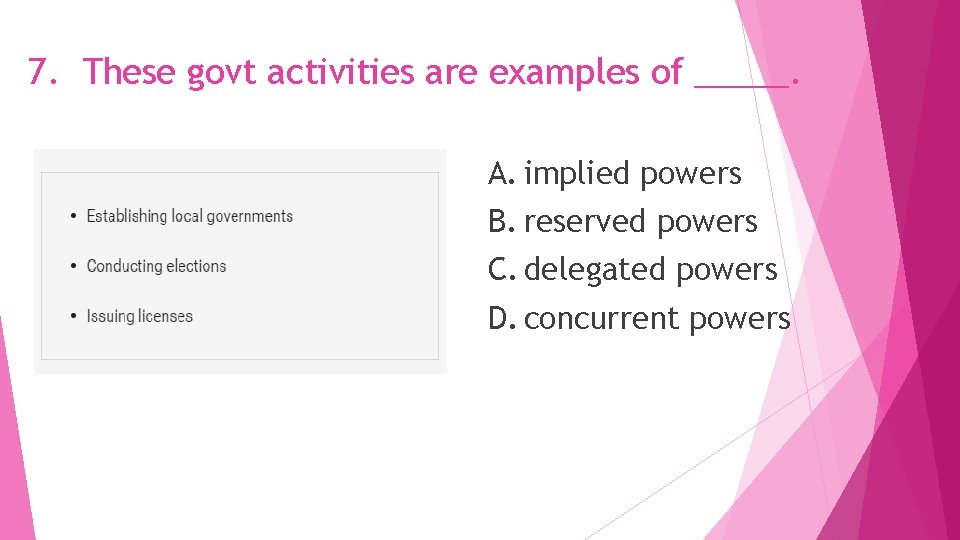
7. These govt activities are examples of _____. A. implied powers B. reserved powers C. delegated powers D. concurrent powers
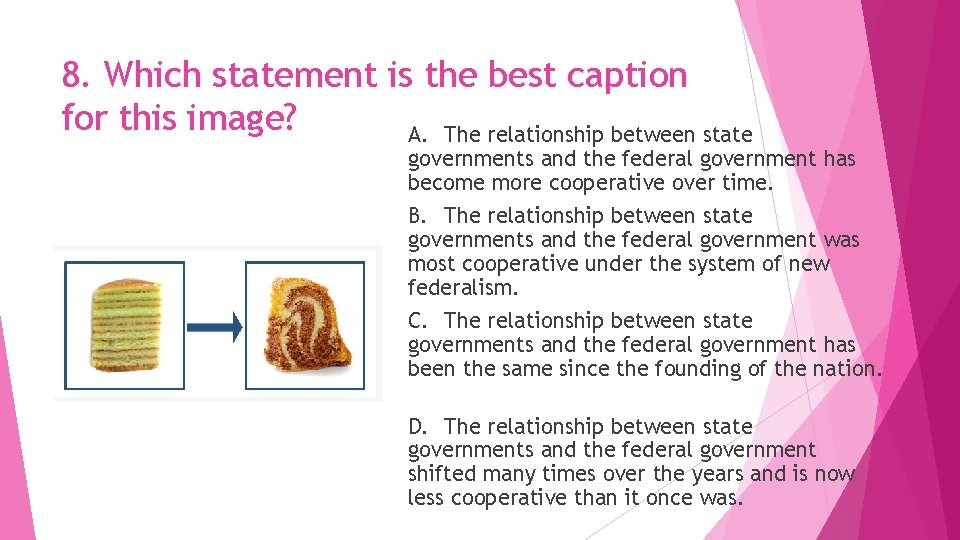
8. Which statement is the best caption for this image? A. The relationship between state governments and the federal government has become more cooperative over time. B. The relationship between state governments and the federal government was most cooperative under the system of new federalism. C. The relationship between state governments and the federal government has been the same since the founding of the nation. D. The relationship between state governments and the federal government shifted many times over the years and is now less cooperative than it once was.
9. Read this statement: “Powers not explicitly reserved for the federal government are given to the states. ” What does the statement describe? A. How the Supreme Court oversees the powers of individual states B. How Supreme Court justices interpret the powers of the federal government C. How the Constitution attempts to prevent conflicts between states and the federal government D. How the Constitution gives the states control of the federal government
10. Article IV, Section 1, of the Constitution helps define the relationship between the state and federal governments by stating that: A. all states must accept the laws and records of other states as valid. B. each state has a separate and equal relationship with the federal government. C. all states must return fugitives to the state in which they are accused of a crime. D. the federal government will always be a republican form of government.
- Slides: 25