
Division of labour EMILE DURKHEIM 1858 1917 BIOGRAPHY
Division of labour
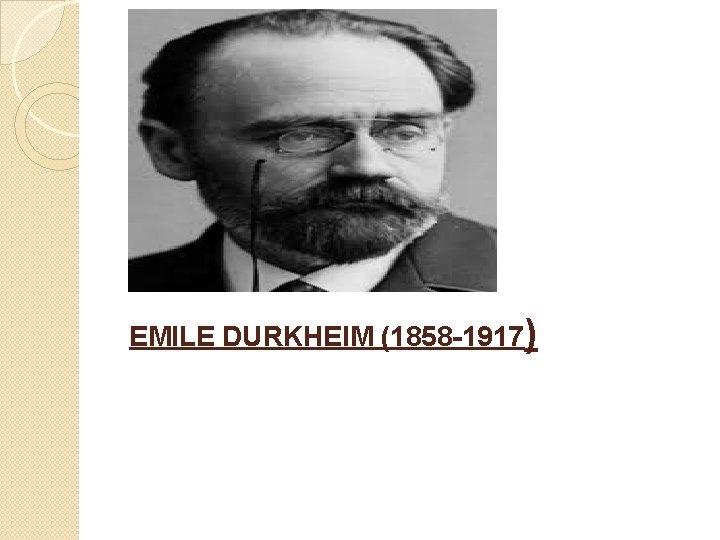
EMILE DURKHEIM (1858 -1917)
�BIOGRAPHY OF EMILE DURKHEIM �David Émile Durkheim was born 15 April 1858 in Épinal, Lorraine, France. �Durkheim, coming from a long lineage of devout French Jews. �As his father, grandfather, and greatgrandfather had all been rabbis (A rabbi is a spiritual leader or religious teacher in Judaism). �Young Durkheim began his education in a rabbinical school. �However, at an early age, he switched schools, deciding not to follow in his family's footsteps. �In fact, Durkheim led a completely secular life, whereby much of his work would be dedicated to demonstrating that religious phenomena stemmed from social rather than
� A precocious student, Durkheim entered the École Normale Supérieure (ENS) in 1879, at his third attempt. � At the same time, he read Auguste Comte and Herbert Spencer, whereby Durkheim became interested in a scientific approach to society very early on in his career. � From 1882 to 1887 he taught philosophy at several provincial schools. In 1885 he decided to leave for Germany, where for two years he studied sociology at the universities of Marburg, Berlin and Leipzig. � By 1886, as part of his doctoral dissertation, he had completed the draft of his The Division of Labour in Society, and was working towards establishing the new science of sociology. � In 1895, he published The Rules of Sociological Method, a manifesto stating what sociology is and how it ought to be done, and founded the first European department of sociology at the University of Bordeaux. � In 1898, he founded L'Année Sociologique, the first French social science journal
� MAJOR WORK �The Division of Labour in Society (1893), �Rules of the Sociological Method (1895), �On the Normality of Crime (1895), � Suicide (1897), �Sociology and Its Scientific Domain (1900) and �The Elementary Forms of Religious Life (1912). � Education and Sociology (1922), �Sociology and Philosophy (1924) and �Pragmatism and Sociology (1955).
DEATH �The outbreak of World War-I was to have a tragic effect on Durkheim's life. Durkheim own son, André, died on the war front in December 1915—a loss from which Durkheim never recovered. Emotionally devastated, Durkheim collapsed of a stroke in Paris on 15 November, two years later in 1917. He was buried at the Montparnasse Cemetery in Paris.
Durkheim sociological method � social fact � Comparative method Division of labour Law and punishment
Durkheim major concern as a Sociologist �What holds society together? �What keeps it in an integrated whole? Auguste Comte suggests that it is social and moral consensus that holds society together. Common ideas, values, norms and mores bind individuals and society together. Herbert Spencer puts across a different view. According to Spencer, it is an interplay of individual interests that holds society together. It serves the selfish
� Durkheim was at variance with these views. If, as Comte suggests, it is moral consensus that holds society together, then would not modern industrial society crumble? After all, modern society is characterised by heterogeneity, mobility, and diversity in activities and values. It is a society where individualism is valued. Spencer’s suggestion that selfish interests hold society together was also found to be faulty by Durkheim. If indeed, individual interests hold sway, the resulting competition and antagonism would break the backbone of society. Each would struggle for his own profit even at the expense of the other. Conflict and tension
�Durkheim studies division of labour in terms of 1) the function of division of labour 2) the causes underlying division of labour 3) deviations from the normal type of division of labour, i. e. abnormal forms. �FUNCTIONS OF DIVISION OF LABOUR � Durkheim classifies human societies into �those based on ‘mechanical solidarity’ and
Mechanical Solidarity: � mechanical solidarity refers to solidarity of resemblance or likeness. � There exists a great deal of homogeneity and tightly-knit social bonds which serve to make the individual members one with their society. � The collective conscience is extremely strong. By collective conscience we mean the system of beliefs and sentiments held in common by members of a society which defines what their mutual relations ought to be. � The strength of the collective conscience integrates such societies, binding together individual members through strong beliefs and values. � Violation of or deviation from these values is viewed very seriously. � repressive punishment is given to offenders. Once again, it must be pointed out that this is a solidarity or unity of likeness and homogeneity. � Individual differences are extremely limited and division of labour is at a relatively simple level. Briefly, in such societies, individual conscience is merged with the collective conscience. �
Organic Solidarity: �Durkheim means solidarity based on difference and complementarity of differences. Take factory, for example. There is a great deal of difference in the work, social status, income, etc. of a worker and a manager. Yet, the two complement each other. Being a manager is meaningless without the cooperation of workers and workers need to be organised by managers. Thus they are vital for each other’s survival. �The violation of norms and rules in
� Societies based on organic solidarity are touched and transformed by the growth of industrialisation. � Thus, division of labour is a very important aspect of such societies. A society based on organic solidarity is thus one where heterogeneity, differentiation and variety exist. � The growing complexity of societies reflects in personality types, relationships and problems. � In such societies, the strength of the collective conscience lessens, as individual conscience becomes more and more distinct, more easily distinguished from the collective conscience. � Individualism becomes increasingly valued. The kind of grip that social norms have on individuals in mechanical solidarity loosens. � Individual autonomy and personal freedom become as important in organic solidarity as social solidarity and integration in societies characterised by mechanical solidarity.
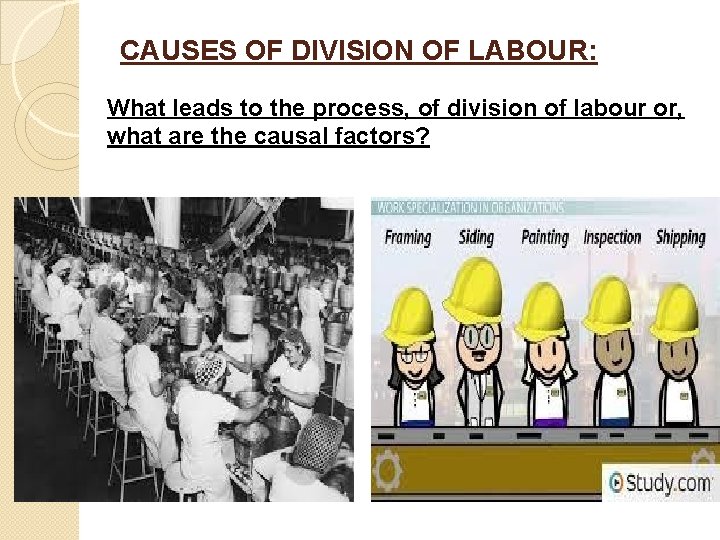
CAUSES OF DIVISION OF LABOUR: What leads to the process, of division of labour or, what are the causal factors?
�Durkheim provides a sociological answer to this question. �According to him, division of labour arises as a result of increased material and moral density in society. �Material density Durkheim means the sheer increase in the number of individuals in a society, in other words, population growth. �By moral density he means the increased interaction that result between individuals as a consequence of growth in numbers. �The growth in material and moral density results in a struggle for existence.
If, as in societies characterised by mechanical solidarity, individuals tend to be very similar, doing the same things, they would also struggle or compete for the same resources and rewards. � � Growth of population and shrinking of natural resources would make competition bitterer. � But division of labour ensures that individuals specialise in different fields and areas. Thus they can coexist and, in fact complement each other.
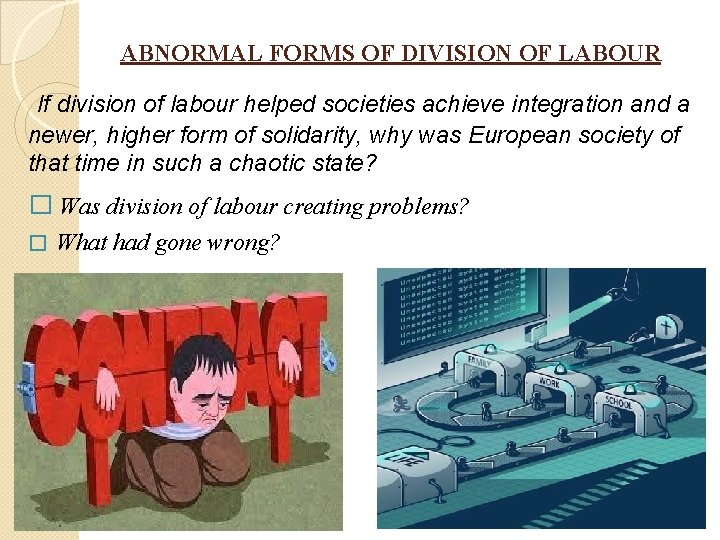
ABNORMAL FORMS OF DIVISION OF LABOUR If division of labour helped societies achieve integration and a newer, higher form of solidarity, why was European society of that time in such a chaotic state? � Was division of labour creating problems? � What had gone wrong?
�Durkheim, the kind of division of labour that was taking place was not the ‘normal’-type that he wrote about. �Abnormal types or deviations from the normal were being observed in society.
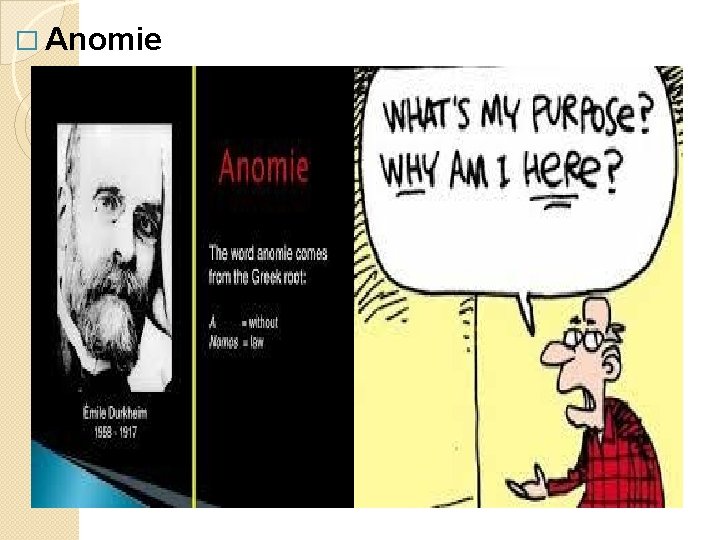
� Anomie
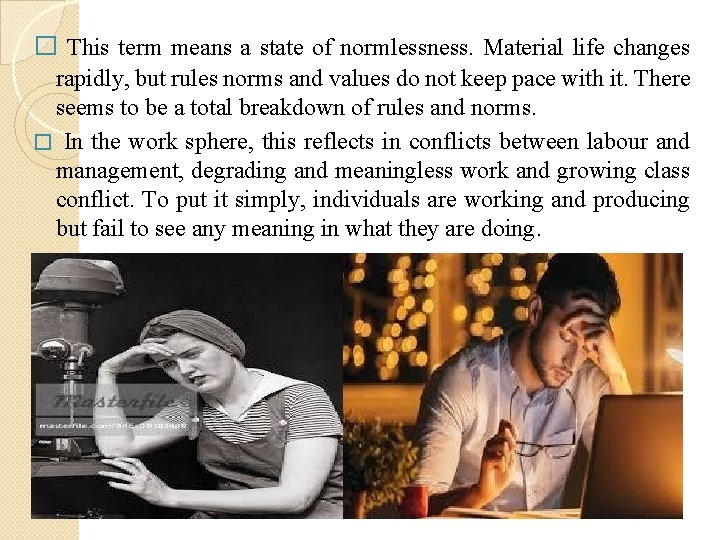
� This term means a state of normlessness. Material life changes rapidly, but rules norms and values do not keep pace with it. There seems to be a total breakdown of rules and norms. � In the work sphere, this reflects in conflicts between labour and management, degrading and meaningless work and growing class conflict. To put it simply, individuals are working and producing but fail to see any meaning in what they are doing.
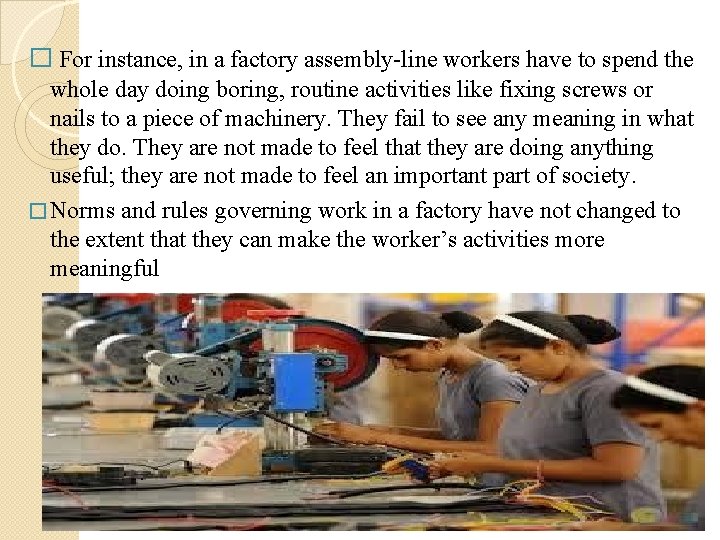
� For instance, in a factory assembly-line workers have to spend the whole day doing boring, routine activities like fixing screws or nails to a piece of machinery. They fail to see any meaning in what they do. They are not made to feel that they are doing anything useful; they are not made to feel an important part of society. � Norms and rules governing work in a factory have not changed to the extent that they can make the worker’s activities more meaningful
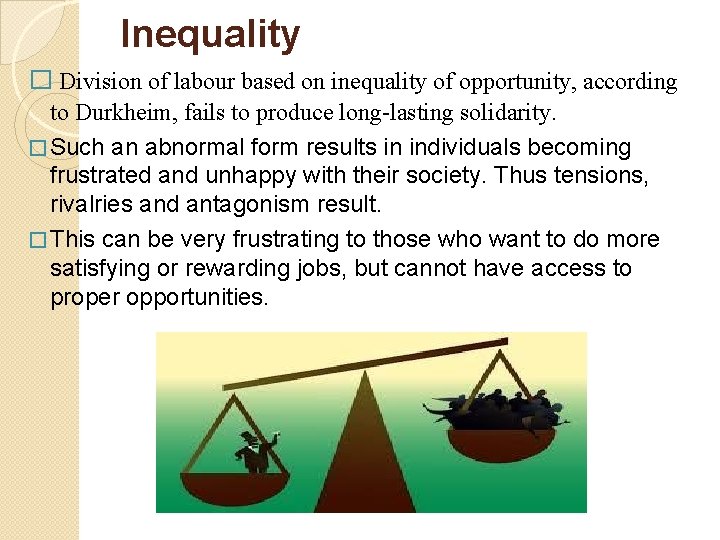
Inequality � Division of labour based on inequality of opportunity, according to Durkheim, fails to produce long-lasting solidarity. � Such an abnormal form results in individuals becoming frustrated and unhappy with their society. Thus tensions, rivalries and antagonism result. � This can be very frustrating to those who want to do more satisfying or rewarding jobs, but cannot have access to proper opportunities.
Inadequate organisation � In this abnormal form the very purpose of division of labour is destroyed. Work is not well organised and coordinated. �Workers are often engaged in doing meaningless tasks. There is no unity of action. Thus solidarity breaks down and disorder results. �You may have observed that in many offices, a lot of people are sitting around idly doing little or nothing. Many are unaware of their responsibilities. �Collective action becomes difficult when most people are not very sure of what they have to do. �Division of labour is supposed to increase
�Conclusion: So far we have seen how Durkheim views division of labour not just as an economic process but a social one. Its primary role, according to him, is to help modern industrial societies become integrated. It would perform the same function for organic solidarity that the collective conscience performed in mechanical solidarity. Division of labour arises as a result of the competition for survival brought about by growing material and moral density. Specialisation offers a way whereby various individuals may coexist and cooperate. But in the European society of the time, division of labour seemed to be producing entirely different and negative results.
KARL MARX THEORY ON DIVISION OF LABOUR
Marx pin-points two types of division of labour, namely, �Social division of labour and �Division of labour in manufacture. Social division of labour �This exists in all societies. It is a process that is bound to exist in order that members of a society may successfully undertake the tasks that are necessary to maintain social and economic life.
�It is a complex system of dividing all the useful forms of labour in a society. �For instance, some individuals produce food, some produce handicrafts, weapons and so on. �Social division of labour promotes the process of exchange of goods between groups, e. g. , the earthenware pots produced by a potter may be exchanged for a farmer’s rice or a weaver’s cloth.
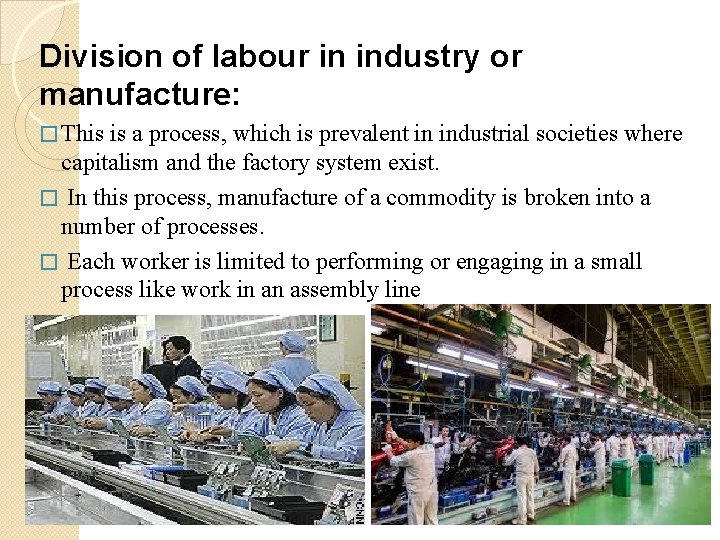
Division of labour in industry or manufacture: � This is a process, which is prevalent in industrial societies where capitalism and the factory system exist. � In this process, manufacture of a commodity is broken into a number of processes. � Each worker is limited to performing or engaging in a small process like work in an assembly line
� This is usually boring, monotonous and repetitive work. The purpose of this division of labour is simple; it is to increase productivity. � The greater the productivity the greater the surplus value generated � It is generation of surplus value that motivates capitalists to organise manufacture in a manner that maximises output and minimises costs. � It is division of labour, which makes mass production of goods possible in modern, industrial societies. � Social division of labour where independent producers create products and exchange them with other independent producers, division of labour in manufacture completely divorces the worker from his product.
IMPLICATIONS OF DIVISION OF LABOUR IN MANUFACTURE 1. Profits accrue to the capitalist �Division of labour in manufacture help to generate more and more surplus value leading to capital accumulation. �Marx tackles a crucial question, namely, who takes away the profits? � Not the workers, says Marx, but the capitalists. Not those who actually produce, but those who own the means of production. �According to him, division of labour and the existence of private property together consolidate the power of the capitalist. �Since the capitalist owns the means of production, the production process is designed and operated in such a way that the capitalist benefits the most from it.
� Workers lose control over what they produce � According to Marx with division of labour in manufacture workers tend to lose their status as the real creators of goods. � Rather, they become mere links in a production chain designed and operated by the capitalists. � Workers are separated from the products of their labour; in fact, they hardly ever see the end result of their work. � They have no control over its sale and purchase. � For example, does a worker in an assembly line in a factory producing washing-machines really get to see the finished product? � He/she might see it in an advertisement or at a shop window. � The worker will not be able to sell it or afford to buy it, having been merely a small part of the production of that machine. The actual control over it is exercised by the
�The worker will not be able to sell it or afford to buy it, having been merely a small part of the production of that machine. �The actual control over it is exercised by the capitalist. �The worker as an independent producer no longer exists. �The worker has become enslaved by the production process
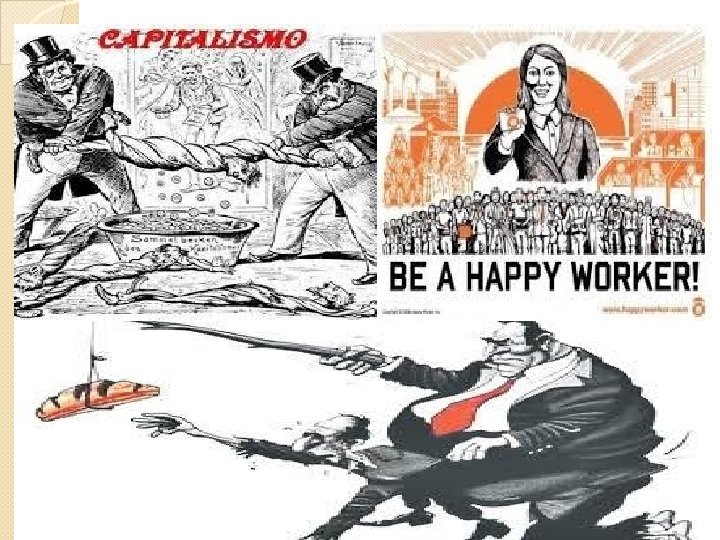
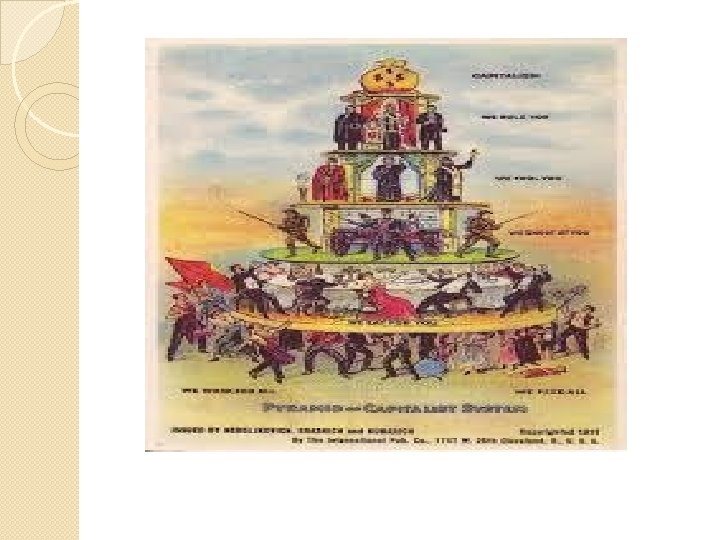
Dehumanisation of the Working Class �The capitalist system characterised by division of labour is one where workers stop being independent producers of goods. �They become suppliers of labour-power, which is needed for production. �The worker’s individual personality needs and desires mean nothing to the capitalist. �It is only the worker’s labour-power which is sold to the capitalist in exchange for wages that concerns the capitalist. �The working class is thus stripped of its humanness and labour-power becomes a mere commodity purchased by the capitalist, in Marx’s view.
�MARX’S REMEDY - REVOLUTION AND CHANGE �For Marx it is the abolition of private property, and the establishment of a classless society is the way out. �Marx holds that social division of labour has to exist in order that the material conditions of human life may be met. �But it is division of labour in production that has to be reorganised. It is only when private property is abolished through the revolution of the proletariat the workers can gain freedom from the alienative division of labour that has been thrust upon them.
� The establishment of a communist society according to Marx will enable workers to own and control the means of production. �The reorganised production process will enable each individual to realise his/her potential and exercise creativity. �In the above discussion, we saw how Marx distinguished between social division of labour and division of labour in manufacture. Social division of labour is essential for the basis of material life in all societies. �Division of labour in manufacture, however, comes into existence with the development of industrialisation and capitalism.
� CONCLUSION: �Both, Durkheim and Marx make a very clear distinction between division of labour in simple societies and complex industrial societies. Division of labour is an inevitable and necessary aspect of the socio-economic life of any society. But they are more concerned and interested in the division of labour that takes place in industrial societies. �Durkheim explains division of labour in industrial societies as a consequence of increased material and moral density BUT
�Marx too considers division of labour in manufacture a feature of industrial society. But unlike Durkheim, he does not see it as a means of cooperation and coexistence. Rather, he views it as a process forced upon workers in order that the capitalist might extract profit. He sees it as a process closely linked with the existence of private property. The means of production are concentrated in the hands of the capitalist.
�Durkheim says the causes of division of labour lie in the fact that individuals need to cooperate and do a variety of tasks in order that industrial society may survive. � According to Marx, division of labour is imposed on workers so that the capitalists may benefit. � Durkheim stresses cooperation, whilst Marx stresses exploitation and conflict.
- Slides: 40