
Division of Developmental Disabilities Amy Nutter Service District
Division of Developmental Disabilities Amy Nutter, Service District Administrator District 1 Kelly Mand, Service Coordinator Supervisor Tricia Stone, Service Coordinator Supervisor August 30, 2016 Helping People Live Better Lives
Governor’s Priorities A more efficient and effective state government A more customer-focused state government Grow Nebraska Improve public safety Reduce regulation and regulatory complexity
DHHS Accomplishments SNAP timeliness in processing applications improved to 99. 28 percent on time for October 2015 - March 2016. Due to the improved performance, Nebraska is no longer on the list to potentially lose federal funds. Nebraska’s most recent ranking in processing SNAP applications improved from 50 th of 53 one year ago to 23 rd. As of August 1 st , Alternative Response is being used in 57 counties. Nebraska Pre-Admission Screening & Resident Review (PASRR) Program improved turnaround time from seven days to less than three days. DHHS Business Plan released with 25 initiatives to improve services and deliver better results. Division of Public Health achieved national accreditation. Division of Behavioral Health implemented COMPASS data management platform on May 16 to support its new Centralized Data System. All eight DHHS Legislative bills passed to provide more effective state government and improve supports for our most vulnerable citizens. Six of seven federal child welfare standards exceeded. ACCESSNebraska average call wait times for Economic Assistance and Medicaid in 2016 average below 5 minutes ACCESSNebraska improves services to participants by taking applications over the phone, and sending emails about participant communications to expedite services and benefits. Grand Island Veterans’ Home earned 2016 Bronze National Commitment to Quality Award. Nurse licensing improvements – simplified license applications, streamlined screening, and faster tutorial time.
Looking Ahead – DHHS Priorities Heritage Health Medicaid Managed Care to integrate physical and behavioral health care and pharmacy services effective Jan. 2017 System of Care for children and youth with a serious emotional disturbance, and their parents, through partnerships with public and private agencies, families and youth. Behavioral health supported employment and housing as key supports to recovery. Long-Term Services and Supports Redesign. Renewal of Medicaid adult waivers and one children’s waiver for people with developmental disabilities Coordinated efforts of Behavioral Health, Public Health, and Medicaid and Long-Term Care to combat opioid addiction and over prescribing of opioids. Reduction in out-of-home placements for state wards. Improved DD application and eligibility determination processes. Medicaid Management Information System (MMIS) replacement planning process. Prescription Drug Overdose Prevention – $3. 5 million in federal grants to help reduce misuse and abuse of prescription drugs. DHHS Divisions of Public Health, Behavioral Health and Medicaid and Long-Term Care collaborating to address the issue.
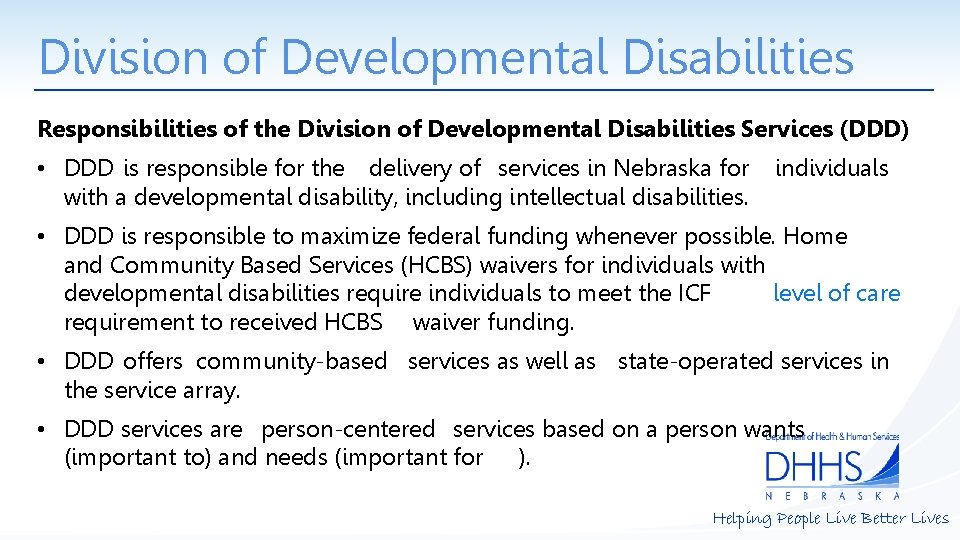
Division of Developmental Disabilities Responsibilities of the Division of Developmental Disabilities Services (DDD) • DDD is responsible for the delivery of services in Nebraska for with a developmental disability, including intellectual disabilities. individuals • DDD is responsible to maximize federal funding whenever possible. Home and Community Based Services (HCBS) waivers for individuals with developmental disabilities require individuals to meet the ICF level of care requirement to received HCBS waiver funding. • DDD offers community-based services as well as state-operated services in the service array. • DDD services are person-centered services based on a person wants (important to) and needs (important for ). Helping People Live Better Lives
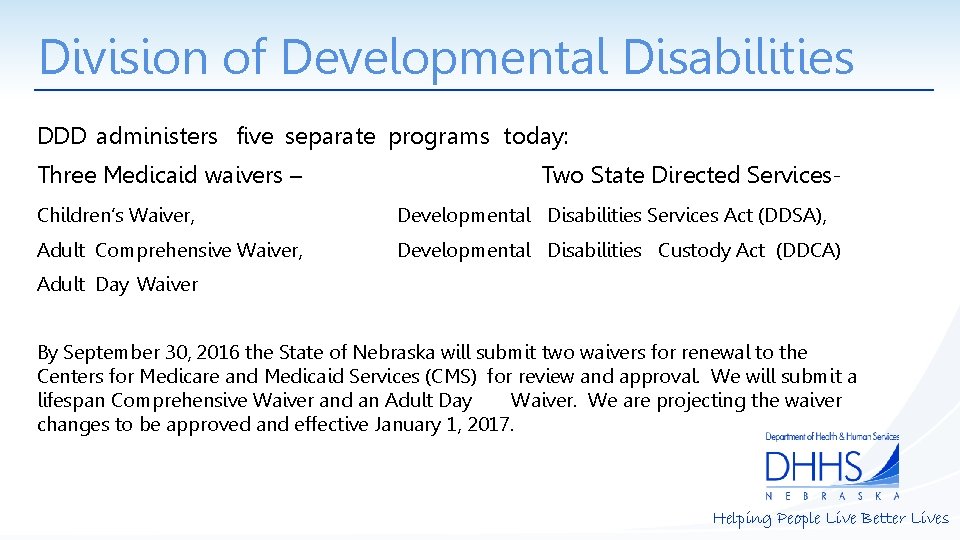
Division of Developmental Disabilities DDD administers five separate programs today: Three Medicaid waivers – Two State Directed Services- Children’s Waiver, Developmental Disabilities Services Act (DDSA), Adult Comprehensive Waiver, Developmental Disabilities Custody Act (DDCA) Adult Day Waiver By September 30, 2016 the State of Nebraska will submit two waivers for renewal to the Centers for Medicare and Medicaid Services (CMS) for review and approval. We will submit a lifespan Comprehensive Waiver and an Adult Day Waiver. We are projecting the waiver changes to be approved and effective January 1, 2017. Helping People Live Better Lives
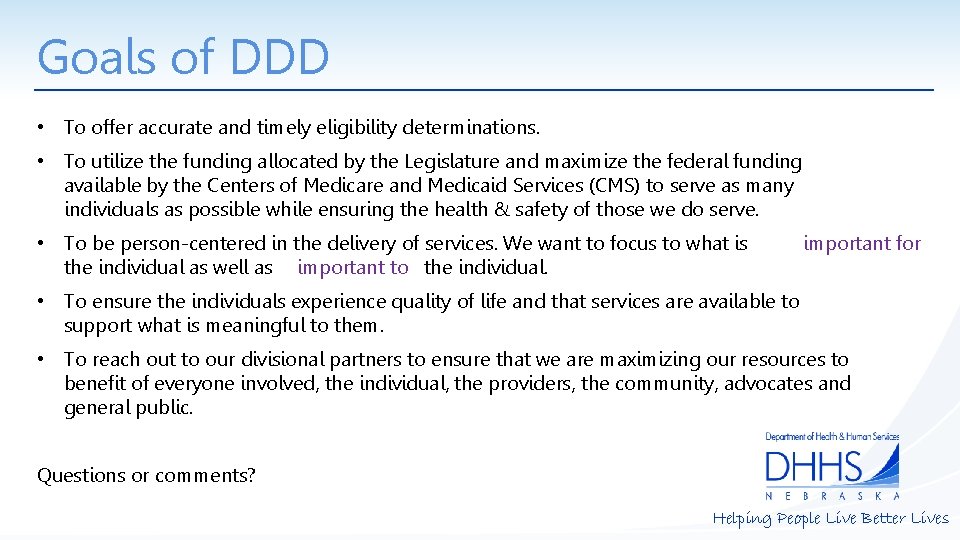
Goals of DDD • To offer accurate and timely eligibility determinations. • To utilize the funding allocated by the Legislature and maximize the federal funding available by the Centers of Medicare and Medicaid Services (CMS) to serve as many individuals as possible while ensuring the health & safety of those we do serve. • To be person-centered in the delivery of services. We want to focus to what is the individual as well as important to the individual. important for • To ensure the individuals experience quality of life and that services are available to support what is meaningful to them. • To reach out to our divisional partners to ensure that we are maximizing our resources to benefit of everyone involved, the individual, the providers, the community, advocates and general public. Questions or comments? Helping People Live Better Lives
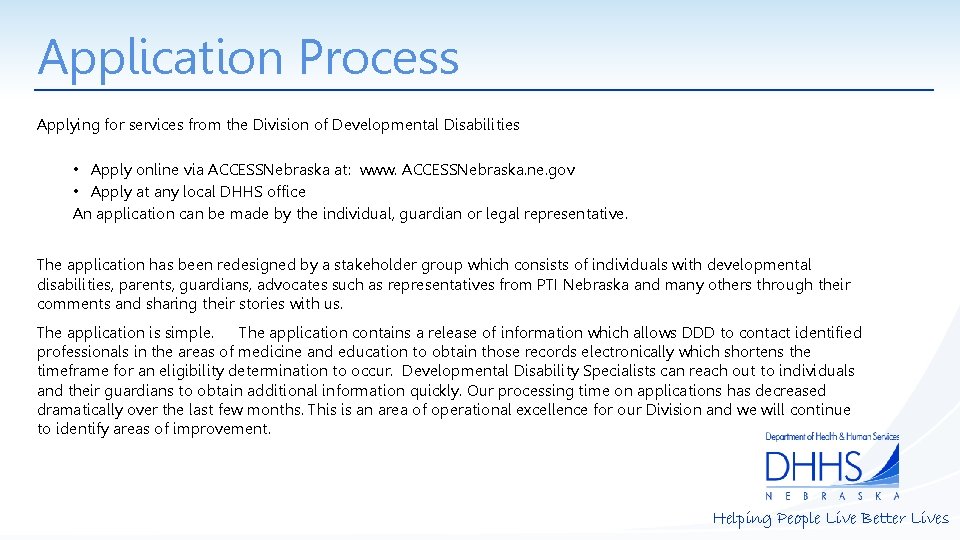
Application Process Applying for services from the Division of Developmental Disabilities • Apply online via ACCESSNebraska at: www. ACCESSNebraska. ne. gov • Apply at any local DHHS office An application can be made by the individual, guardian or legal representative. The application has been redesigned by a stakeholder group which consists of individuals with developmental disabilities, parents, guardians, advocates such as representatives from PTI Nebraska and many others through their comments and sharing their stories with us. The application is simple. The application contains a release of information which allows DDD to contact identified professionals in the areas of medicine and education to obtain those records electronically which shortens the timeframe for an eligibility determination to occur. Developmental Disability Specialists can reach out to individuals and their guardians to obtain additional information quickly. Our processing time on applications has decreased dramatically over the last few months. This is an area of operational excellence for our Division and we will continue to identify areas of improvement. Helping People Live Better Lives
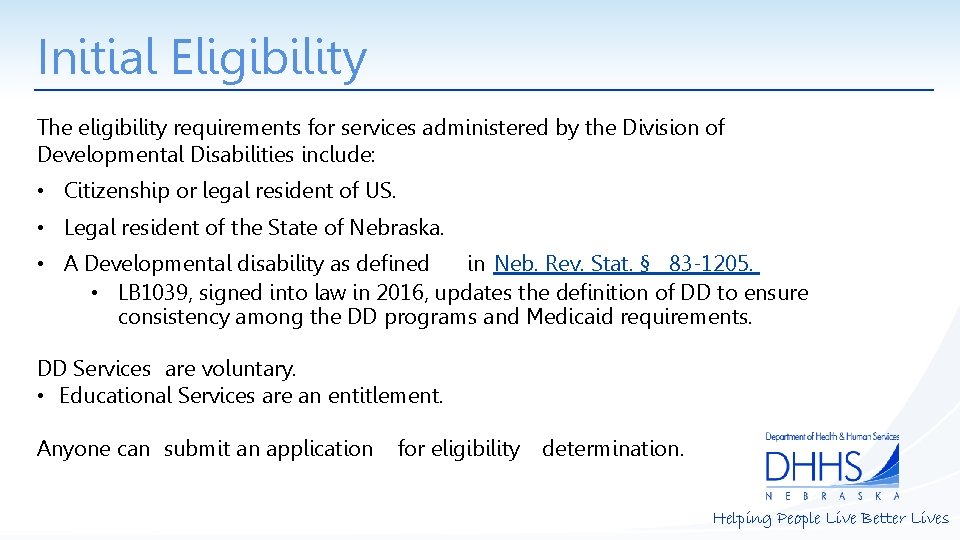
Initial Eligibility The eligibility requirements for services administered by the Division of Developmental Disabilities include: • Citizenship or legal resident of US. • Legal resident of the State of Nebraska. • A Developmental disability as defined in Neb. Rev. Stat. § 83 -1205. • LB 1039, signed into law in 2016, updates the definition of DD to ensure consistency among the DD programs and Medicaid requirements. DD Services are voluntary. • Educational Services are an entitlement. Anyone can submit an application for eligibility determination. Helping People Live Better Lives
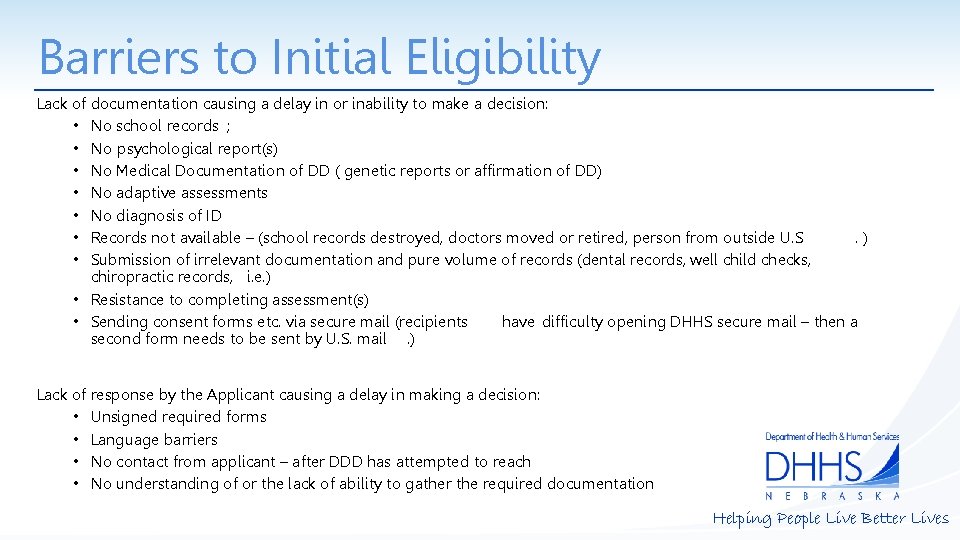
Barriers to Initial Eligibility Lack of documentation causing a delay in or inability to make a decision: • No school records ; • No psychological report(s) • No Medical Documentation of DD ( genetic reports or affirmation of DD) • No adaptive assessments • No diagnosis of ID • Records not available – (school records destroyed, doctors moved or retired, person from outside U. S. ) • Submission of irrelevant documentation and pure volume of records (dental records, well child checks, chiropractic records, i. e. ) • Resistance to completing assessment(s) • Sending consent forms etc. via secure mail (recipients have difficulty opening DHHS secure mail – then a second form needs to be sent by U. S. mail. ) Lack of response by the Applicant causing a delay in making a decision: • Unsigned required forms • Language barriers • No contact from applicant – after DDD has attempted to reach • No understanding of or the lack of ability to gather the required documentation Helping People Live Better Lives
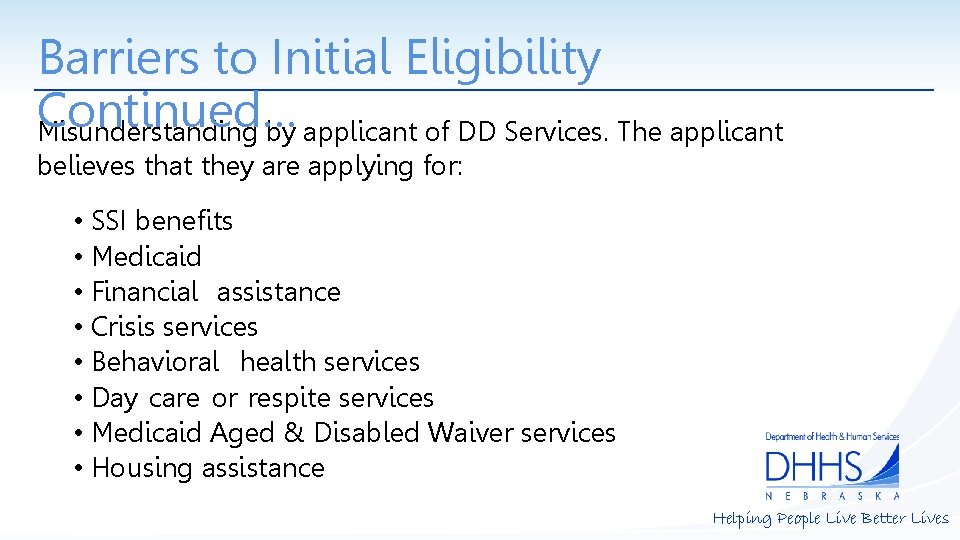
Barriers to Initial Eligibility Continued… Misunderstanding by applicant of DD Services. The applicant believes that they are applying for: • SSI benefits • Medicaid • Financial assistance • Crisis services • Behavioral health services • Day care or respite services • Medicaid Aged & Disabled Waiver services • Housing assistance Helping People Live Better Lives
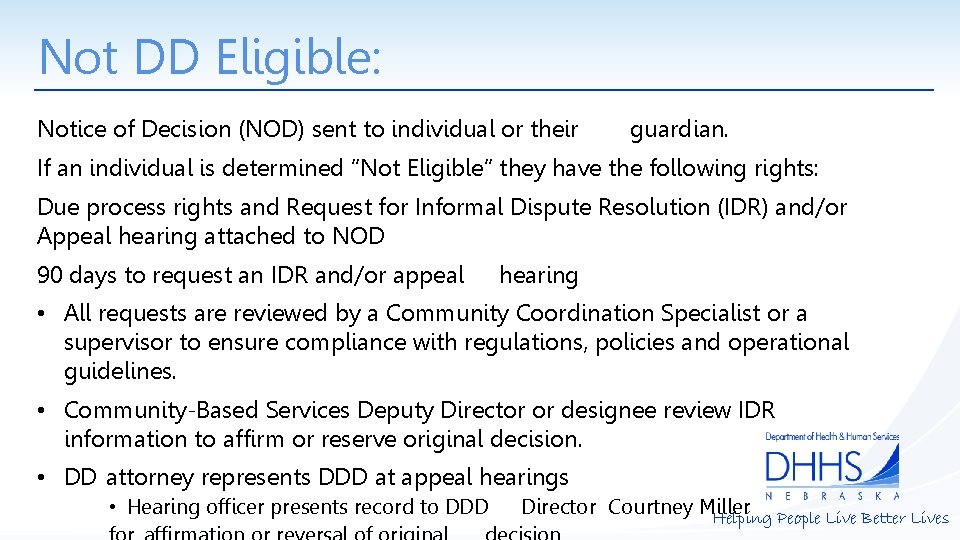
Not DD Eligible: Notice of Decision (NOD) sent to individual or their guardian. If an individual is determined “Not Eligible” they have the following rights: Due process rights and Request for Informal Dispute Resolution (IDR) and/or Appeal hearing attached to NOD 90 days to request an IDR and/or appeal hearing • All requests are reviewed by a Community Coordination Specialist or a supervisor to ensure compliance with regulations, policies and operational guidelines. • Community-Based Services Deputy Director or designee review IDR information to affirm or reserve original decision. • DD attorney represents DDD at appeal hearings • Hearing officer presents record to DDD Director Courtney Miller Helping People Live Better Lives
DD Eligible: After an individual is determined eligible: • Notice of Decision (NOD) sent to individual or guardian • Designated Service Coordination staff contact applicant and determine what services are needed • Individuals are then placed on the registry of unmet needs with the date of need (the date they are found eligible) Helping People Live Better Lives
Registry of Unmet Need • Services are offered based on who has been on the registry of unmet needs the longest unless the individual meets “priority one” funding. • All other funding offers occur when funding is appropriated from the Legislature. • If individual is over age 21 and has graduated from a high school on or after September 6, 1993, day services are automatically funded according to § 83 -1216. • Services not available until end of school year in which they turn 21. • Division cannot pay for (supplant) services that are available from the educational system. Helping People Live Better Lives
Funding prioritization as outlined by statute and regulations: 83 -1202. Legislative Intent: The first priority of the State in responding to the needs of persons with developmental disabilities should be to ensure that all such persons have sufficient food, housing, clothing, medical care, protection from abuse or neglect, and protection from harm; 404 NAC 3 -002. 02 Funding Prioritization: As funding is available, the Department will authorize funding of specialized services for individuals who meet priority criteria. Priority is given to: 1. Individuals who need immediate intervention to prevent imminent • a. Abuse or neglect; • b. Lack of medical care; • c. Lack of food, housing or clothing; or physical harm caused by: 2. Individuals for whom immediate intervention by the Department is needed to prevent harm to themselves or others; or 3. All other eligible individuals waiting the longest. Helping People Live Better Lives
Objective Assessment Process (OAP) • DD utilizes an OAP process to determine a participant’s funding amount • Once funding is offered and accepted, Inventory for Client and Agency Planning (ICAP) is administered. • Needs revealed in the ICAP translate into Individual Budgeted Amount (IBA) which is an annual budget amount for participants to choose services that meet their goals and preferences. Helping People Live Better Lives
What is next? • Once IBA is determined, assigned Service Coordinator ( SC) will meet with the individual/guardian to discuss service options available. • Proposed budget is developed to purchase services needed within the individual’s IBA. • Providers are selected based on individual’s/guardian’s choice • A team meeting is held to develop the Individualized Support Plan (ISP ) Helping People Live Better Lives
Role of a Service Coordination is responsible for the delivery of targeted case management services. • This includes completing screenings and assessments to identify a person’s needs or what is important for them. • Complete a personal focus worksheet which identifies what is important to the individual. • Share the services available in the service array to ensure informed consent occurs when an individual or guardian (if one exists) select their services and their service provider. • Develops a plan that the providers. individual designs with their team, including guardians and • Assure adherence to the plan designed by the individual or guardian (if one exists) by collecting and analyzing data and monitoring through site visits. • Assists the individual in accessing other formal supports such as Medicaid, Social Security Benefits, etc. • Advocate for the individual by ensuring that their voice is heard and respected. Helping People Live Better Lives
Services Funded through DDD include: Habilitation is defined as the assistance provided to an individual with achieving developmental skills when impairments have caused delaying or blocking of initial acquisition of the skills. This can include cognitive, social, fine motor, gross motor or other skills that contribute to mobility, communication, and performance of activities of daily living (ADL) and enhance the quality of life. Day Habilitation - These may include vocational planning , integrated community employment , workstation and day habilitation training and supports designed to assist in becoming employed. Services may range from teaching job skills prior to becoming employed, assisting in acquiring a job, and supporting a person in a community integrated job. Day Habilitation provide opportunities during the day that are focused on community inclusion and integration activities. Residential Habilitation – these services may be provided in the individual’s home, the family home or at a provider operated home and include training and supports designed to assist the individual in acquiring independent living skills. Some examples include in-home services, companion homes, extended family home (EFH ), and group homes. Respite – services to provide occasional relief to a non-paid caregiver that lives with the individual receiving services. Helping People Live Better Lives
Helpful Resources… • Ready Set Go ! • http: //readysetgo. site. esu 9. org/ • Transition Booklet to Resources • http: //dhhswebsiteauthoring/developmental_disabilities/Documents/ DD-PUB-7. pdf • Home and Community Based Services Medicaid Waiver Initiatives • http: // dhhs. ne. gov/medicaid/Medicaid. Waiver. Initiative/Pages/Home. aspx • PTI Nebraska • 2564 Leavenworth St, Suite 202 Omaha, NE 68105 In the Alliance Group Building (402) 346 -0525 (800) 284 -8520 info@pti-nebraska. org Helping People Live Better Lives
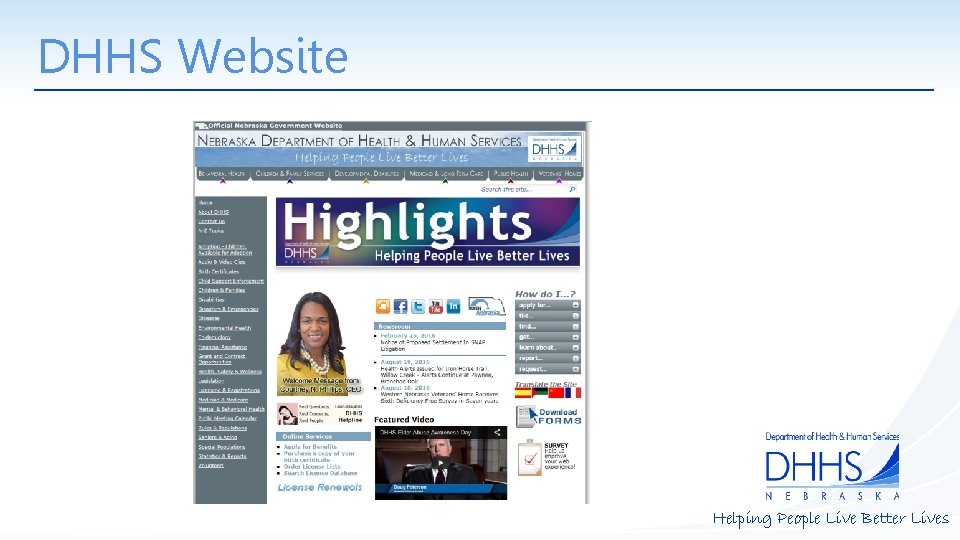
DHHS Website Helping People Live Better Lives
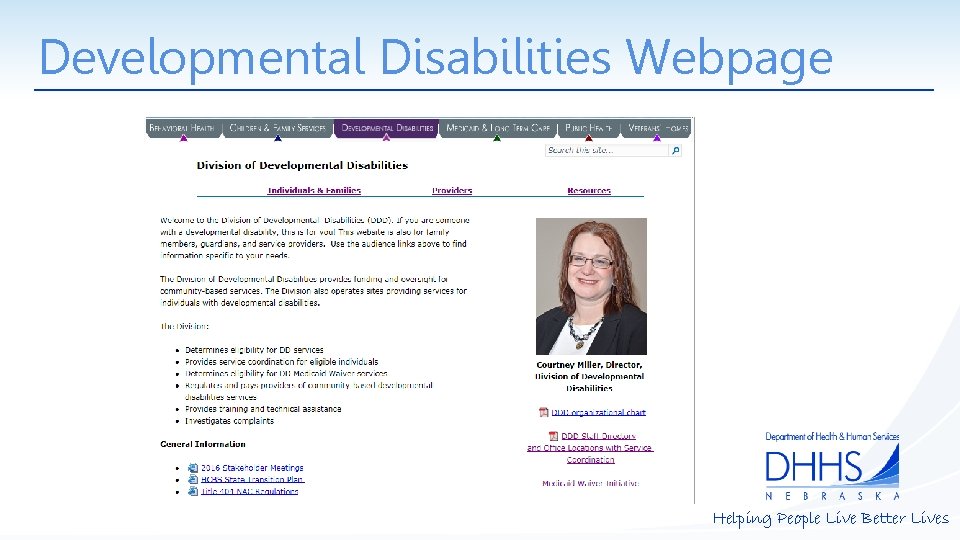
Developmental Disabilities Webpage Helping People Live Better Lives
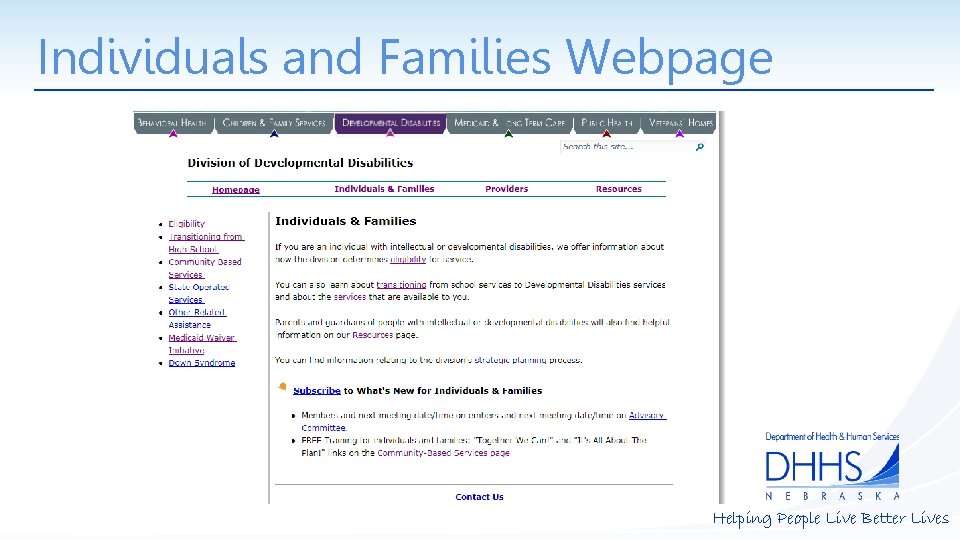
Individuals and Families Webpage Helping People Live Better Lives
Questions? Helping People Live Better Lives
Contacts Courtney Miller, Director Courtney. Miller@Nebraska. gov or 402 -471 -6038 Lori Harder, Deputy Director of Community Based Services Lori. Harder@Nebraska. gov or 402 -471 -8714 Tony Green, Deputy Director of Policy and Communication Tony. Green@Nebraska. gov Megan Gumbel, Deputy Director of State Operated Facilities Megan. Gumbel@Nebraska. gov or 402 -223 -6858 Angie Ludemann, Field Operations Administrator Angie. Ludemann@Nebraska. gov or 402 -471 -8662 dhhs. ne. gov DHHS Helpline: 800 -254 -4202 DHHS. helpline@Nebraska. gov Helping People Live Better Lives
- Slides: 25