
Division of Applied Nuclear Physics Division of Applied
- Slides: 13
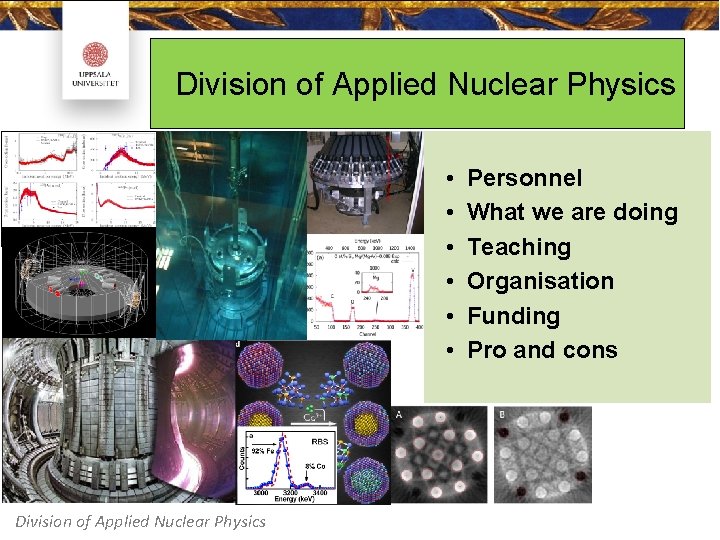
Division of Applied Nuclear Physics • • • Division of Applied Nuclear Physics Personnel What we are doing Teaching Organisation Funding Pro and cons
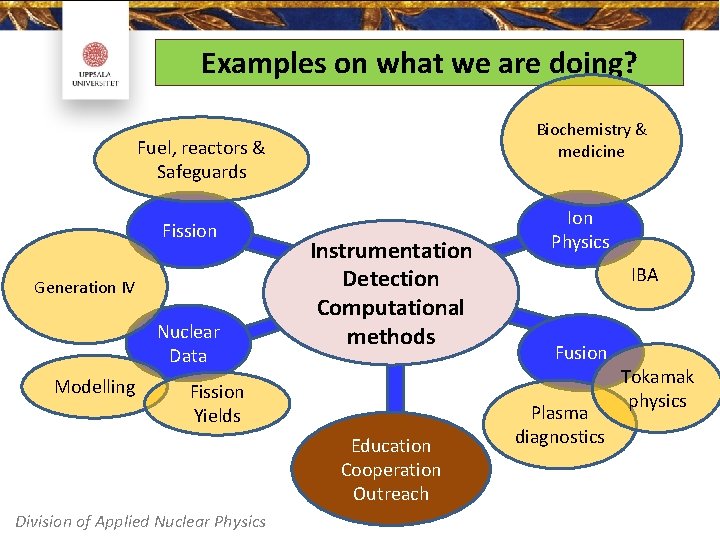
Examples on what we are doing? Biochemistry & medicine Fuel, reactors & Safeguards Fission Generation IV Nuclear Data Modelling Instrumentation Detection Computational methods Fission Yields Education Cooperation Outreach Division of Applied Nuclear Physics Ion Physics IBA Fusion Plasma diagnostics Tokamak physics
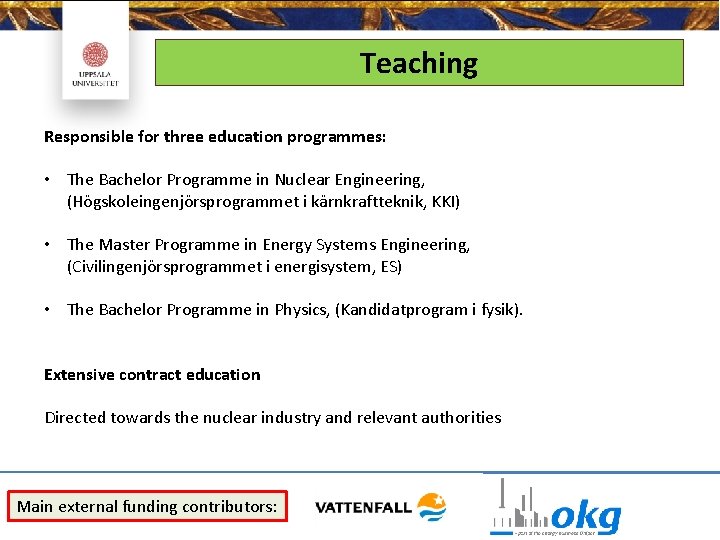
Teaching Responsible for three education programmes: • The Bachelor Programme in Nuclear Engineering, (Högskoleingenjörsprogrammet i kärnkraftteknik, KKI) • The Master Programme in Energy Systems Engineering, (Civilingenjörsprogrammet i energisystem, ES) • The Bachelor Programme in Physics, (Kandidatprogram i fysik). Extensive contract education Directed towards the nuclear industry and relevant authorities Main external funding contributors:
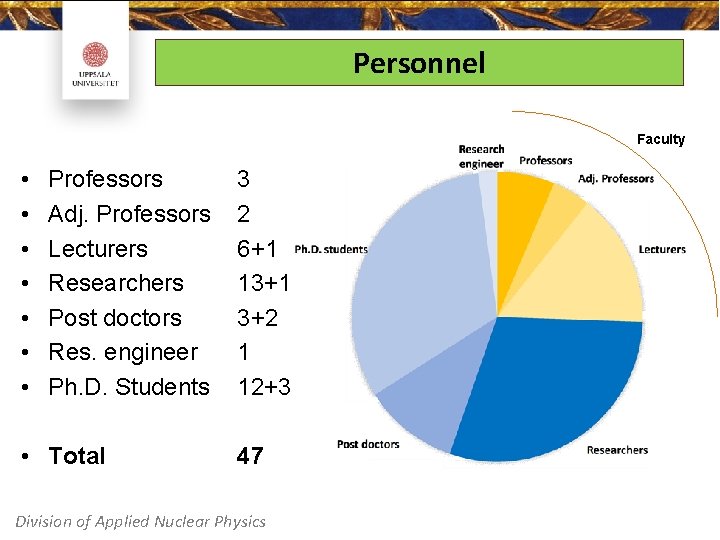
Personnel Faculty • • Professors Adj. Professors Lecturers Researchers Post doctors Res. engineer Ph. D. Students • Total 3 2 6+1 13+1 3+2 1 12+3 47 Division of Applied Nuclear Physics
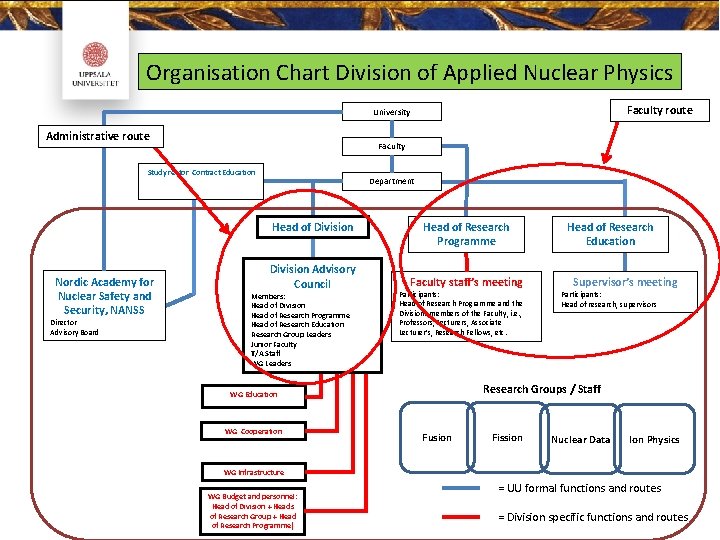
Organisation Chart Division of Applied Nuclear Physics Faculty route University Administrative route Faculty Study rector Contract Education Department Head of Division Nordic Academy for Nuclear Safety and Security, NANSS Director Advisory Board Division Advisory Council Members: Head of Division Head of Research Programme Head of Research Education Research Group Leaders Junior Faculty T/A Staff WG Leaders Head of Research Programme Faculty staff’s meeting Participants: Head of Research Programme and the Divisions members of the Faculty, i. e. , Professors, Lecturers, Associate Lecturer’s, Research Fellows, etc. Supervisor’s meeting Participants: Head of research, supervisors Research Groups / Staff WG Education WG Cooperation Head of Research Education Fusion Fission Nuclear Data Ion Physics WG Infrastructure WG Budget and personnel: Head of Division + Heads of Research Group + Head of Research Programme) = UU formal functions and routes = Division specific functions and routes
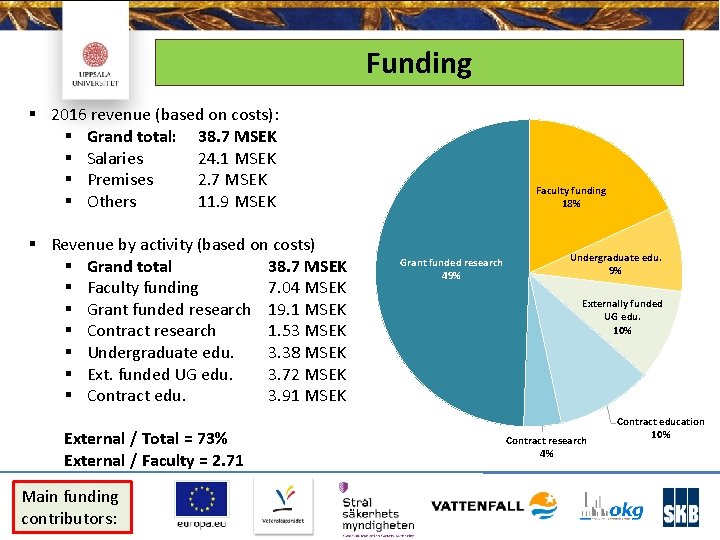
Funding § 2016 revenue (based on costs): § Grand total: 38. 7 MSEK § Salaries 24. 1 MSEK § Premises 2. 7 MSEK § Others 11. 9 MSEK § Revenue by activity (based on costs) § Grand total 38. 7 MSEK § Faculty funding 7. 04 MSEK § Grant funded research 19. 1 MSEK § Contract research 1. 53 MSEK § Undergraduate edu. 3. 38 MSEK § Ext. funded UG edu. 3. 72 MSEK § Contract edu. 3. 91 MSEK External / Total = 73% External / Faculty = 2. 71 Main funding contributors: Faculty funding 18% Grant funded research 49% Undergraduate edu. 9% Externally funded UG edu. 10% Contract research 4% Contract education 10%
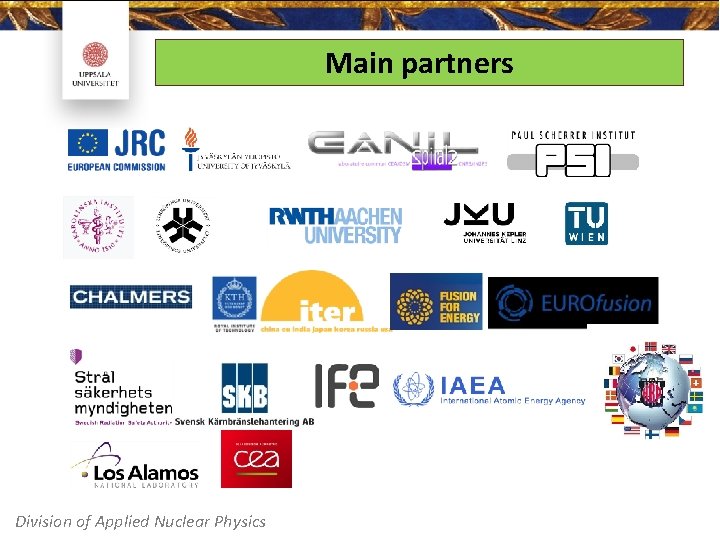
Main partners Division of Applied Nuclear Physics
Pro and cons We are generally happy with our situation Our organisation has been chiselled for many years and serves us well in our context. In particular, the management of the dual responsibilities (Head of Research Programme and Head of Division) is taken care of in a rational and appropriate way. Our approach has enabled the volume to grow from approximately 15 employees (Ko. F-07) to around 50 currently. Things that need to be addressed • The level and quality of UU administrative support (or lack of these) do not currently comply with reasonably set expectations. We also need dedicated department support regarding economics analysis, follow-ups etc. • The relatively small faculty funding makes it hard to find adequate time for involvement in pure academic work e. g. writing books and reviews, exploring new research possibilities and collaborations, strategic planning etc. • The lack of efficient tools for promoting young bright researchers (tenure track or similar). • The gender aspect must be lifted (again).
Thank you for your attention
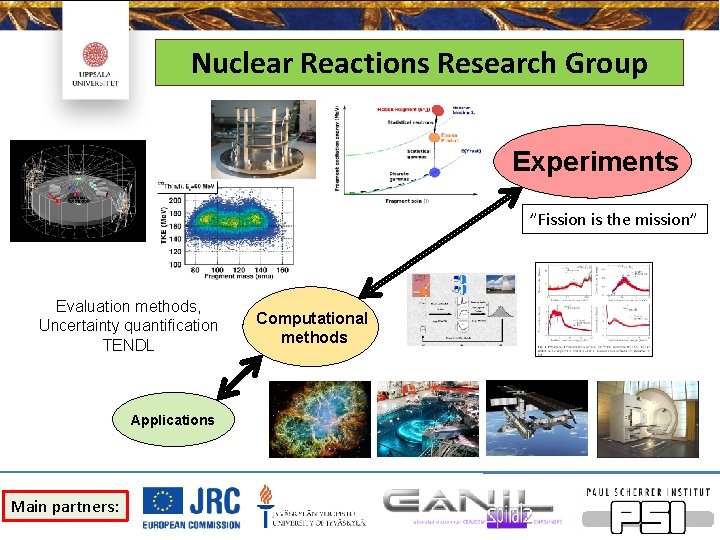
Nuclear Reactions Research Group Experiments ”Fission is the mission” Evaluation methods, Uncertainty quantification TENDL Applications Main partners: Computational methods
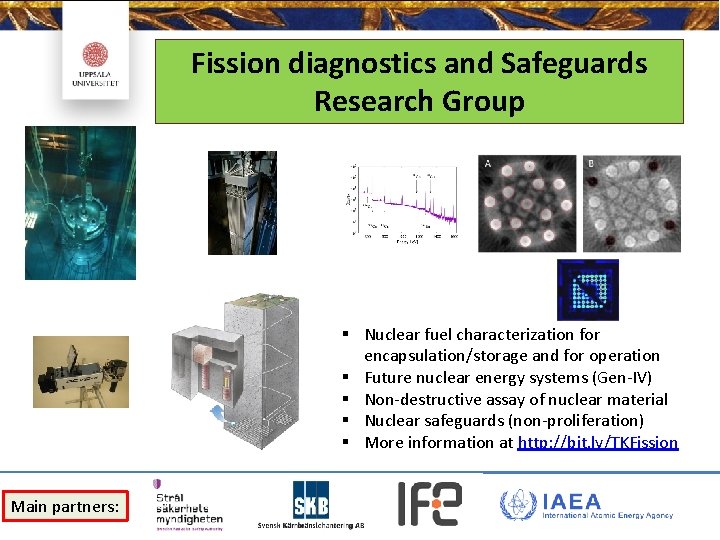
Fission diagnostics and Safeguards Research Group § Nuclear fuel characterization for encapsulation/storage and for operation § Future nuclear energy systems (Gen-IV) § Non-destructive assay of nuclear material § Nuclear safeguards (non-proliferation) § More information at http: //bit. ly/TKFission Main partners:
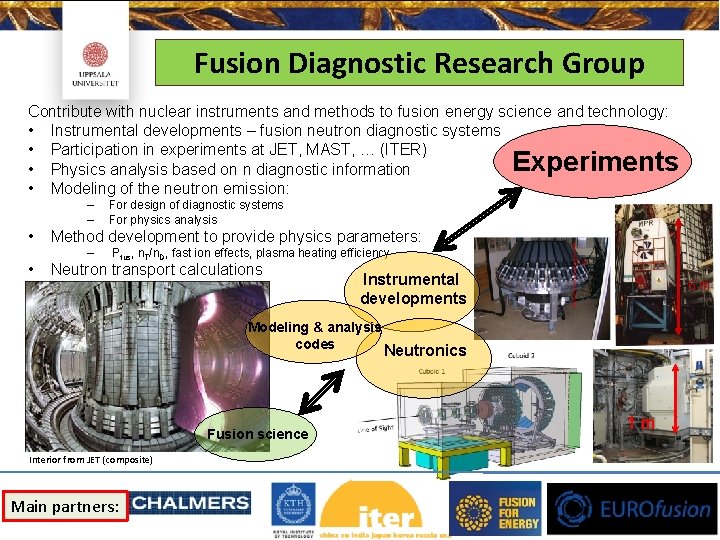
Fusion Diagnostic Research Group Contribute with nuclear instruments and methods to fusion energy science and technology: • Instrumental developments – fusion neutron diagnostic systems • Participation in experiments at JET, MAST, … (ITER) • Physics analysis based on n diagnostic information • Modeling of the neutron emission: Experiments – – • Method development to provide physics parameters: – • For design of diagnostic systems For physics analysis Pfus, n. T/n. D, fast ion effects, plasma heating efficiency Neutron transport calculations Instrumental developments Modeling & analysis codes Fusion science Interior from JET (composite) Main partners: 6 m Neutronics 1 m
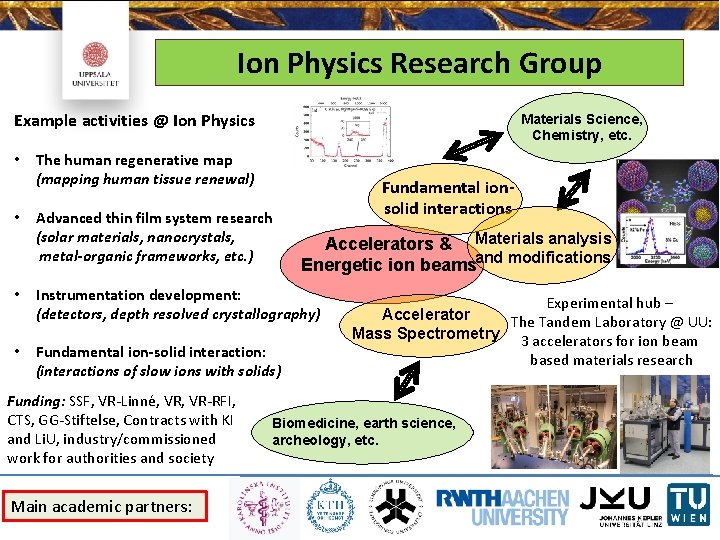
Ion Physics Research Group Example activities @ Ion Physics • • Materials Science, Chemistry, etc. The human regenerative map (mapping human tissue renewal) Advanced thin film system research (solar materials, nanocrystals, metal-organic frameworks, etc. ) Fundamental ionsolid interactions Accelerators & Materials analysis Energetic ion beamsand modifications • Instrumentation development: (detectors, depth resolved crystallography) • Fundamental ion-solid interaction: (interactions of slow ions with solids) Funding: SSF, VR-Linné, VR-RFI, CTS, GG-Stiftelse, Contracts with KI and Li. U, industry/commissioned work for authorities and society Main academic partners: Experimental hub – Accelerator The Tandem Laboratory @ UU: Mass Spectrometry 3 accelerators for ion beam based materials research Biomedicine, earth science, archeology, etc.