
Division 2 3 Ways to Write a Division




- Slides: 17
Division 2
3 Ways to Write a Division Calculation: 12 ÷ 4 = 12 = 4 4 1 2 3
Sharing To begin to understand division children will see division as sharing so 8÷ 4 will be interpreted as: 8 shared between 4 people 4
Sharing a number 8÷ 4=2 ‘ 8 shared between 4 people’ Children will begin to use apparatus or draw their interpretation of a calculation. Then they may also be asked to write the calculation for a diagram. 5
In Reception and Year 1… • Children will be introduced to counting in 2 s, 5 s and 10 s • It will be achieved through using apparatus, pictures or songs e. g. The Animals went in Two by Two • It begins with looking at sets of a number e. g. pairs of shoes • Pupils begin to find doubles then halves of numbers • They begin to share a number using apparatus or pictures between people or objects • Teachers begin to show numbers in arrays • You can help by encouraging, and practising with, your child as they learn to count in 2 s, 5 s and 10 s 6
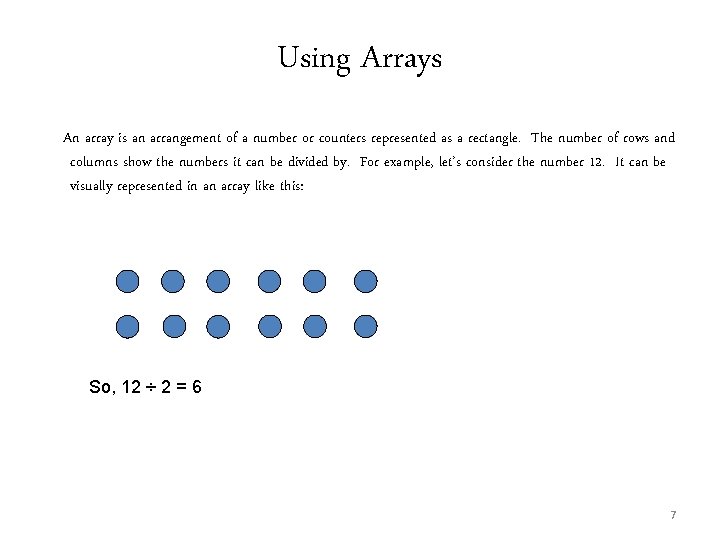
Using Arrays An array is an arrangement of a number or counters represented as a rectangle. The number of rows and columns show the numbers it can be divided by. For example, let’s consider the number 12. It can be visually represented in an array like this: So, 12 ÷ 2 = 6 7
Interpreting Arrays By showing division in this way and by ringing rows, it is very clear to see that 12 ÷ 2 = 6 12 ÷ 6 = 2 By ringing columns instead of rows the introduction to thinking of division as grouping can be made 8
Beginning to solve division problems Visualising division problems and number sentences is a good foundation to division learning. Children need to understand ‘sharing’ first before ‘groups into’. Using pictures and apparatus to show this is an important part of their learning. It should be fun and practical, and practised in small but frequent steps. Without this introduction, learning division facts will mean nothing to your child. Children won’t be given pages of calculations to solve for homework. At this stage practical work and discussion is important. Practical examples and discussion about right and wrong answers are extremely beneficial. A good understanding now, will help with application of division facts in the future. 9
Locating Division Facts from a Multiplication Square • Once children understand what division is, they will need to know facts by heart. • Children will begin to see calculations written in a line e. g. as 15 ÷ 5 = or maybe in the other 2 ways (see previous slide) They should use instant recall of facts to help them know the answer. • It is important that children know their tables and division facts quickly. If they do not, they need to be able to access these to solve division problems. • This can be achieved using the times tables square in reverse. • It would be to your child’s advantage if you practised this at home. Make it fun. Race each other. Children will want to be first to ‘know’ the answer and so will begin to memorise division facts. 10
Standard division methods – Finding ‘how many groups go into’ Short division means a number divided by a single digit. When the number to be divided is larger than a number known by division facts, an efficient method of calculation is needed. At first there will be no remainders. Children will set these calculation out as: 2 2 8 6 Interpreted as ‘how many groups of 2 can be made from 286? ’ With each step being ‘how many 2 s go into…? ’ 11
Standard division • There are many ways to tackle this calculation set out like this. • It will be introduced practically, beginning with apparatus. Children will then record calculations using apparatus for as long as needed. • The standard method is thought of by some as the ‘bus stop’ method. This is because it is like each number is in a queue under a bus shelter waiting to be dealt with! 12
Standard Division (no remainders) 2 2 4 3 6 2 4 4 We always work from left to right 8 13
Remainders • Remainders are introduced once children have a good understanding of short division. • Children may describe remainders as ‘left over’ when they first meet them until they are happy with the word ‘remainder’ 14
Standard Division (with a remainder in the answer) 2 2 4 3 6 2 4 4 r 1 9 Place the remainder after the letter ‘r’ at the end of the answer 15
Standard Division with a Decimal Number with Carrying and Remainder 2 2 4 3 7 7 1 4 • • 4 9 5 1 0 16
Dividing a number by 10 Please take note: When dividing a single digit by 10, many believe that all that happens is a zero is taken from the end. But that is not the rule! It certainly appears that way. Let’s take 30 as an example. If you divide 30 by 10 the answer is 3. But when you divide 23 by 10 there is no 0 to remove. Please help your child to divide by 10 by supporting them to learn the rule of moving the digits one place to the right. (Dividing by 100 means move the digits 2 places etc) e. g. T U 3 0 3 H T U. t h 7 8 0 1 6. 0 7 8 The last 0 here is not needed as there is no digit after it 1. 6 0 17