
Divisibility Rules RULE 2 The number has a
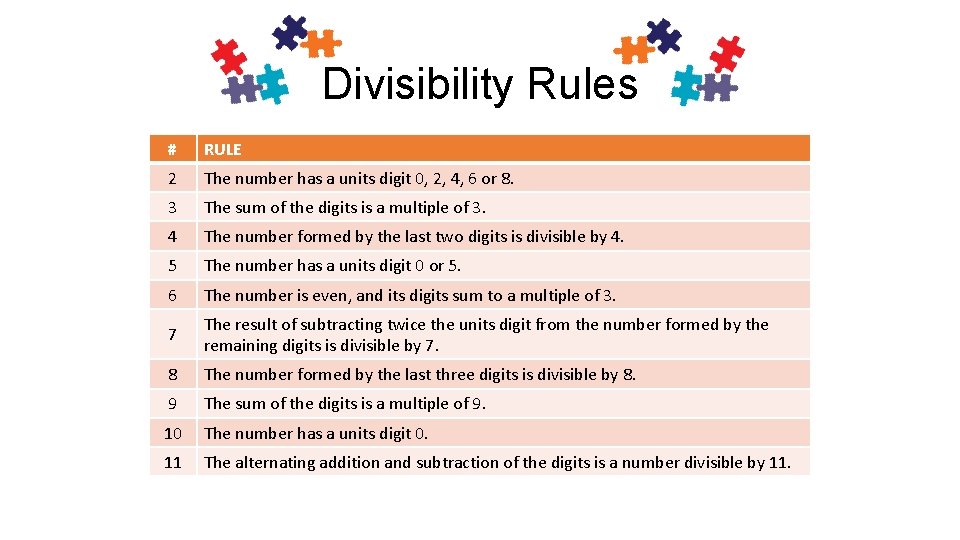
Divisibility Rules # RULE 2 The number has a units digit 0, 2, 4, 6 or 8. 3 The sum of the digits is a multiple of 3. 4 The number formed by the last two digits is divisible by 4. 5 The number has a units digit 0 or 5. 6 The number is even, and its digits sum to a multiple of 3. 7 The result of subtracting twice the units digit from the number formed by the remaining digits is divisible by 7. 8 The number formed by the last three digits is divisible by 8. 9 The sum of the digits is a multiple of 9. 10 The number has a units digit 0. 11 The alternating addition and subtraction of the digits is a number divisible by 11.
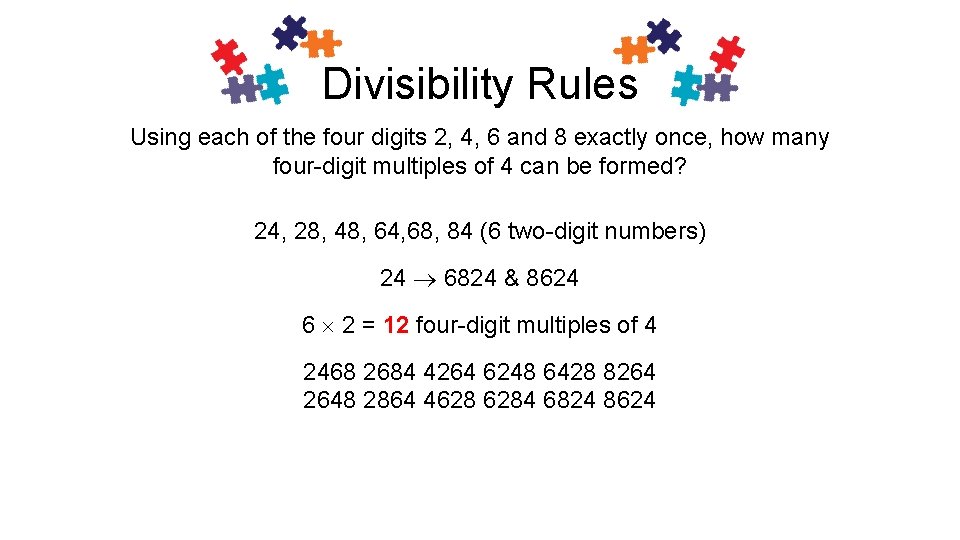
Divisibility Rules Using each of the four digits 2, 4, 6 and 8 exactly once, how many four-digit multiples of 4 can be formed? 24, 28, 48, 64, 68, 84 (6 two-digit numbers) 24 6824 & 8624 6 2 = 12 four-digit multiples of 4 2468 2684 4264 6248 6428 8264 2648 2864 4628 6284 6824 8624
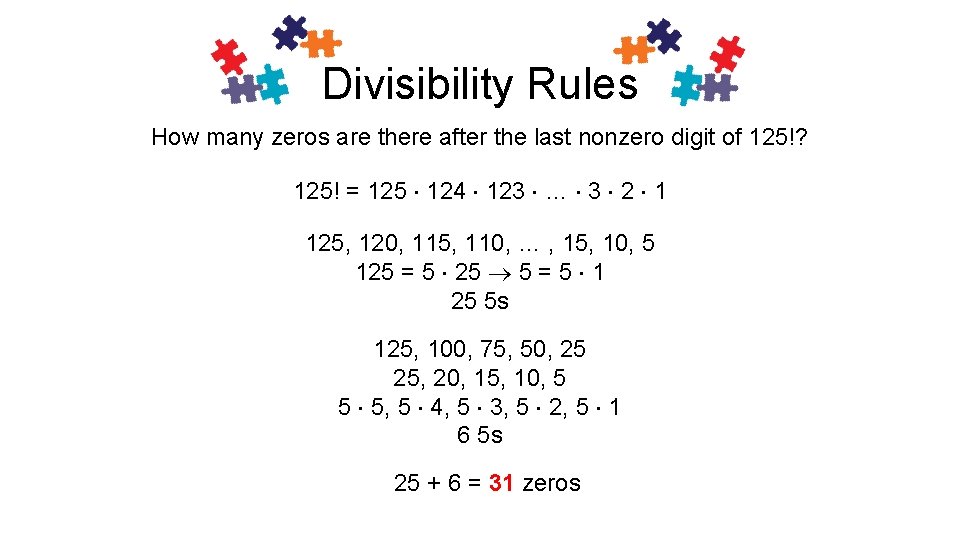
Divisibility Rules How many zeros are there after the last nonzero digit of 125!? 125! = 125 124 123 … 3 2 1 125, 120, 115, 110, … , 15, 10, 5 125 = 5 25 5 = 5 1 25 5 s 125, 100, 75, 50, 25 25, 20, 15, 10, 5 5 5, 5 4, 5 3, 5 2, 5 1 6 5 s 25 + 6 = 31 zeros
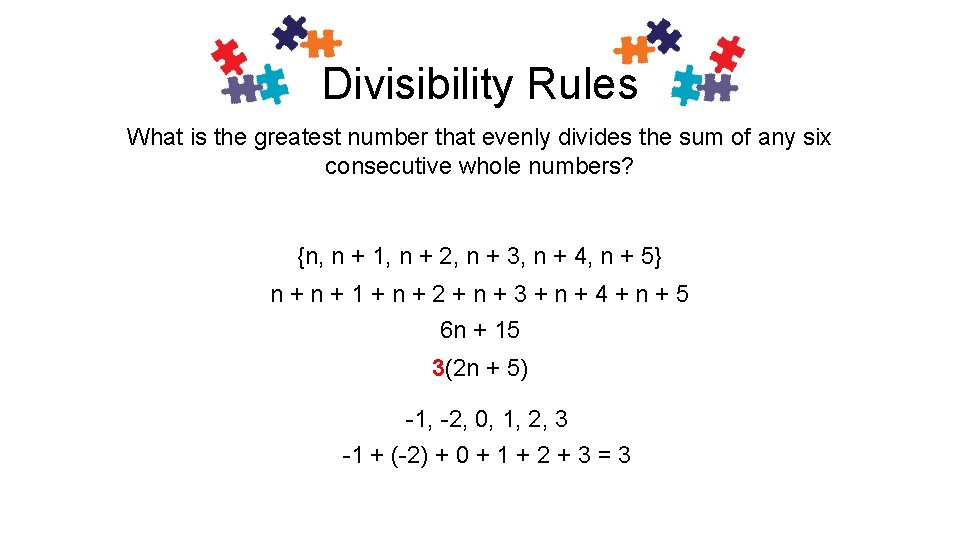
Divisibility Rules What is the greatest number that evenly divides the sum of any six consecutive whole numbers? {n, n + 1, n + 2, n + 3, n + 4, n + 5} n+n+1+n+2+n+3+n+4+n+5 6 n + 15 3(2 n + 5) -1, -2, 0, 1, 2, 3 -1 + (-2) + 0 + 1 + 2 + 3 = 3
- Slides: 4