
Diving into NYSSLS and NGSS Performance Expectations By
Diving into NYSSLS and NGSS: Performance Expectations By Ana Appel
“As we implement the NGSS, it is important to remember that education is a journey, not a destination. ” Stephen Pruitt, Former Commissioner of Education in Kentucky, Science Educator, and President of Southern Regional Education Board.
The Shift
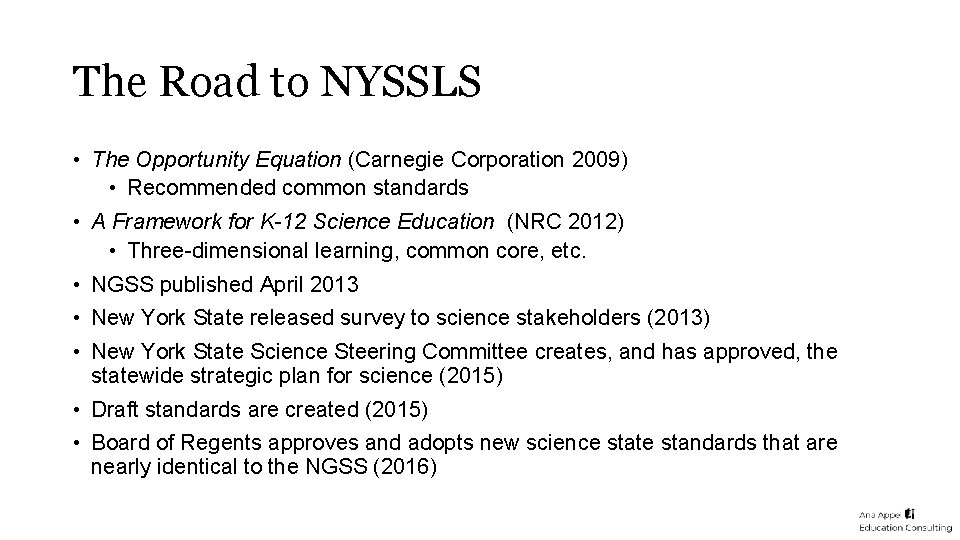
The Road to NYSSLS • The Opportunity Equation (Carnegie Corporation 2009) • Recommended common standards • A Framework for K-12 Science Education (NRC 2012) • Three-dimensional learning, common core, etc. • NGSS published April 2013 • New York State released survey to science stakeholders (2013) • New York State Science Steering Committee creates, and has approved, the statewide strategic plan for science (2015) • Draft standards are created (2015) • Board of Regents approves and adopts new science state standards that are nearly identical to the NGSS (2016)
Educators will be able to identify the components of three-dimensional learning.
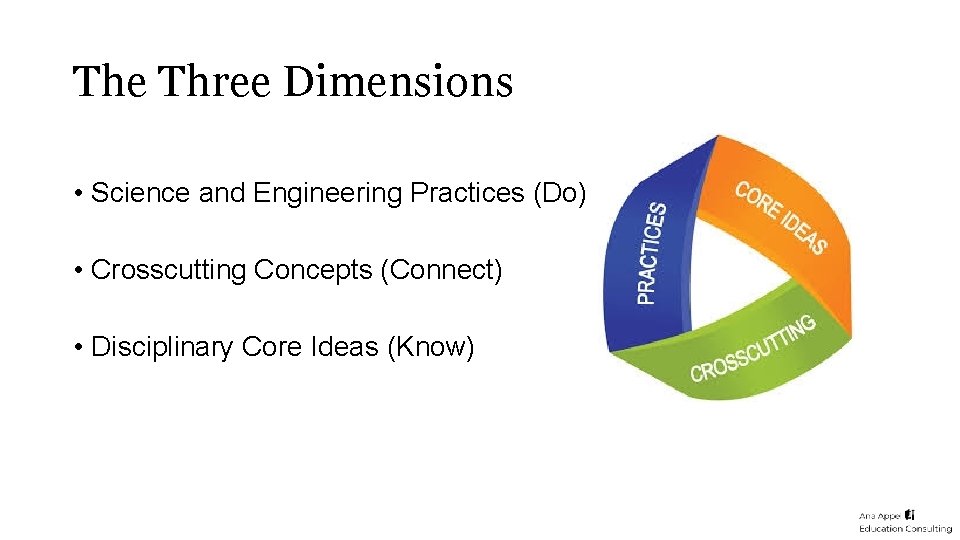
The Three Dimensions • Science and Engineering Practices (Do) • Crosscutting Concepts (Connect) • Disciplinary Core Ideas (Know)
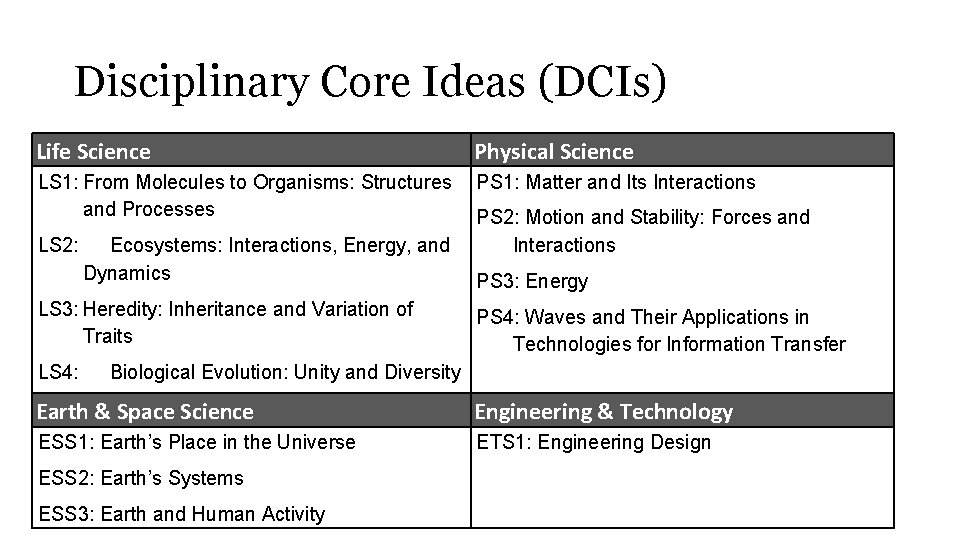
Disciplinary Core Ideas (DCIs) Life Science Physical Science LS 1: From Molecules to Organisms: Structures and Processes PS 1: Matter and Its Interactions LS 2: Ecosystems: Interactions, Energy, and Dynamics LS 3: Heredity: Inheritance and Variation of Traits LS 4: PS 2: Motion and Stability: Forces and Interactions PS 3: Energy PS 4: Waves and Their Applications in Technologies for Information Transfer Biological Evolution: Unity and Diversity Earth & Space Science Engineering & Technology ESS 1: Earth’s Place in the Universe ETS 1: Engineering Design ESS 2: Earth’s Systems ESS 3: Earth and Human Activity
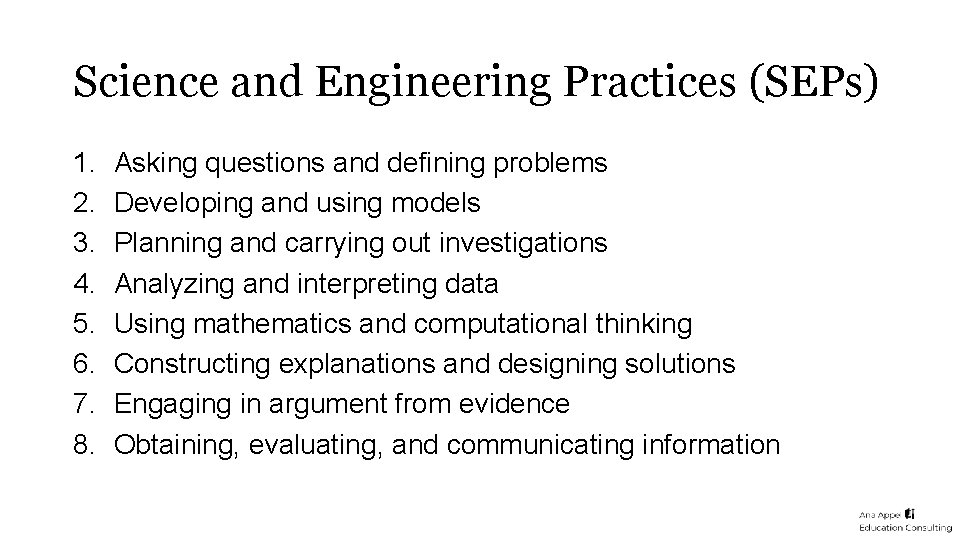
Science and Engineering Practices (SEPs) 1. 2. 3. 4. 5. 6. 7. 8. Asking questions and defining problems Developing and using models Planning and carrying out investigations Analyzing and interpreting data Using mathematics and computational thinking Constructing explanations and designing solutions Engaging in argument from evidence Obtaining, evaluating, and communicating information
Crosscutting Concepts (CCCs) 1. 2. 3. 4. 5. 6. 7. Patterns Cause and effect Scale, proportion, and quantity Systems and system models Energy and matter Structure and function Stability and change
Reflect • Which dimension do you use most heavily now? • Which dimension do you think you could start applying in your classroom?
Educators will be able to articulate how the three dimensions build a performance expectation and dissect a performance expectation
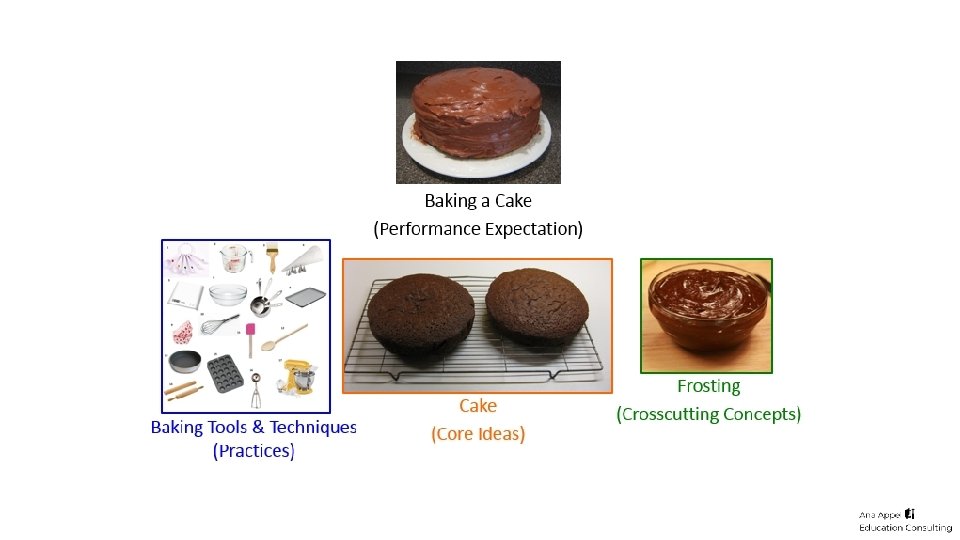
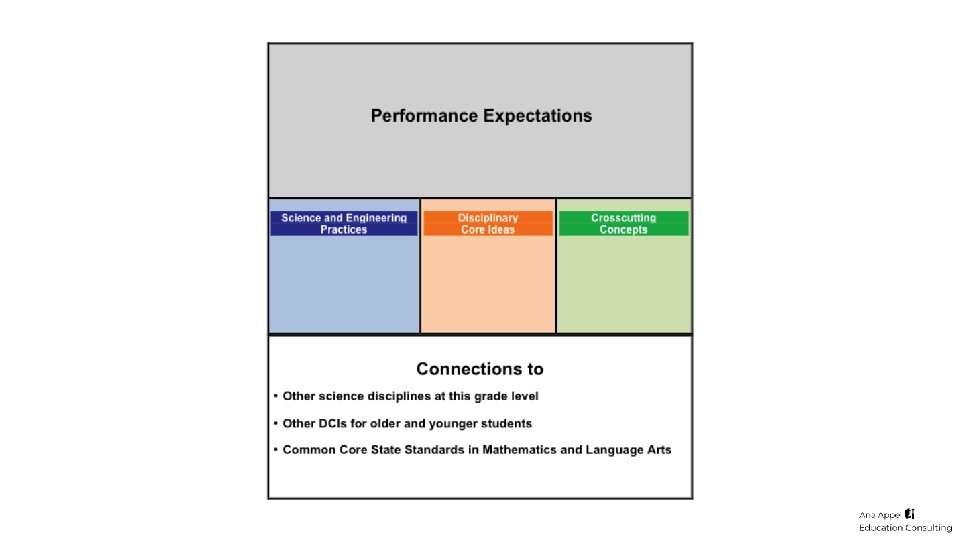
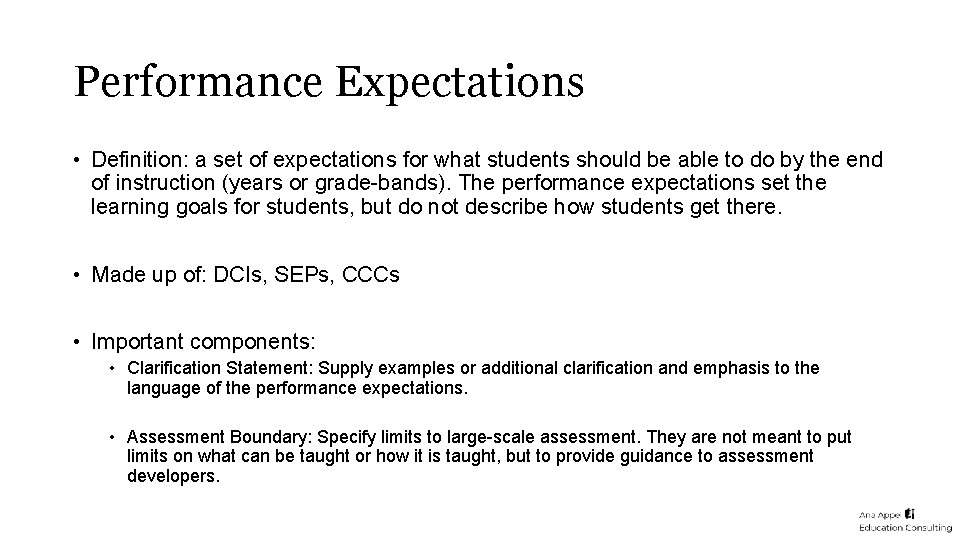
Performance Expectations • Definition: a set of expectations for what students should be able to do by the end of instruction (years or grade-bands). The performance expectations set the learning goals for students, but do not describe how students get there. • Made up of: DCIs, SEPs, CCCs • Important components: • Clarification Statement: Supply examples or additional clarification and emphasis to the language of the performance expectations. • Assessment Boundary: Specify limits to large-scale assessment. They are not meant to put limits on what can be taught or how it is taught, but to provide guidance to assessment developers.
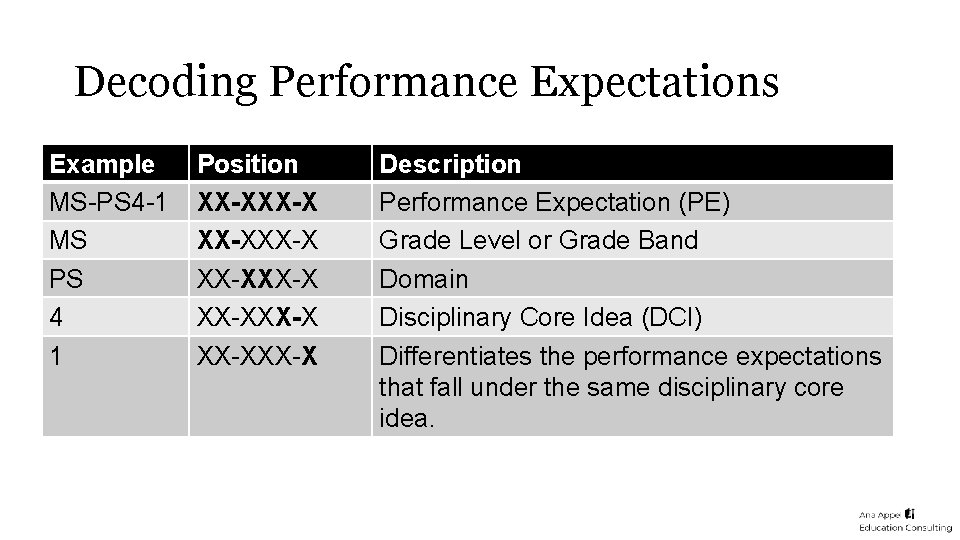
Decoding Performance Expectations Example MS-PS 4 -1 MS PS 4 1 Position XX-XXX-X XX-X Description Performance Expectation (PE) Grade Level or Grade Band Domain Disciplinary Core Idea (DCI) Differentiates the performance expectations that fall under the same disciplinary core idea.
Educators will be able to apply performance expectations to an upcoming lesson or unit.
Application Consider your classroom and complete one of the following: • Align a performance expectation to an upcoming lesson. • Align a performance expectation to an upcoming unit. Start to think about… • How will you implement all three dimensions?
“As we implement the NGSS, it is important to remember that education is a journey, not a destination. ” Stephen Pruitt, Former Commissioner of Education in Kentucky, Science Educator, and President of Southern Regional Education Board.
Reflection • What is one thing you can apply in your class immediately? • What is one thing you can apply in your class next school year?
Next Steps • Presentation materials and additional resources available at www. anaappel. com • Follow me on twitter @Ana. Appel. Ed • Reach out to me for more support and consulting at a. appel 3@gmail. com
- Slides: 20