
Diving into Mastery Guidance for Educators Each activity

- Slides: 9
Diving into Mastery Guidance for Educators Each activity sheet is split into three sections, diving, deeper and deepest, which are represented by the following icons: Diving Deeper Deepest These carefully designed activities take your children through a learning journey, initially ensuring they are fluent with the key concept being taught; then applying this to a range of reasoning and problem-solving activities. These sheets might not necessarily be used in a linear way. Some children might begin at the ‘Deeper’ section and in fact, others may ‘dive straight in’ to the ‘Deepest’ section if they have already mastered the skill and are applying this to show their depth of understanding.
Aim • Use written division methods in cases where the answer has up to two decimal places.
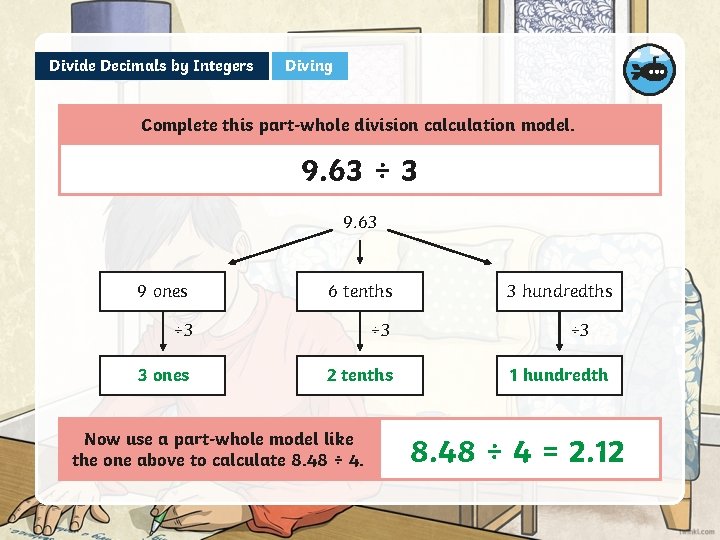
Divide Decimals by Integers Diving Complete this part-whole division calculation model. 9. 63 ÷ 3 9. 63 9 ones 6 tenths ÷ 3 3 ones 2 tenths Now use a part-whole model like the one above to calculate 8. 48 ÷ 4. 3 hundredths ÷ 3 1 hundredth 8. 48 ÷ 4 = 2. 12
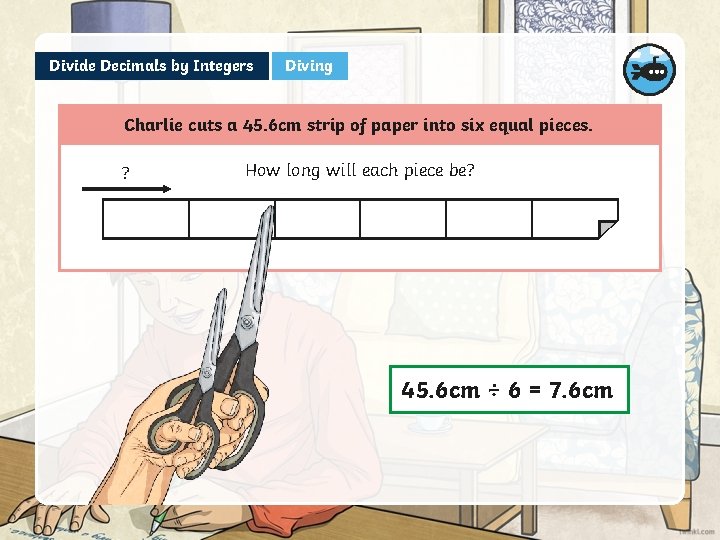
Divide Decimals by Integers Diving Charlie cuts a 45. 6 cm strip of paper into six equal pieces. ? How long will each piece be? 45. 6 cm ÷ 6 = 7. 6 cm
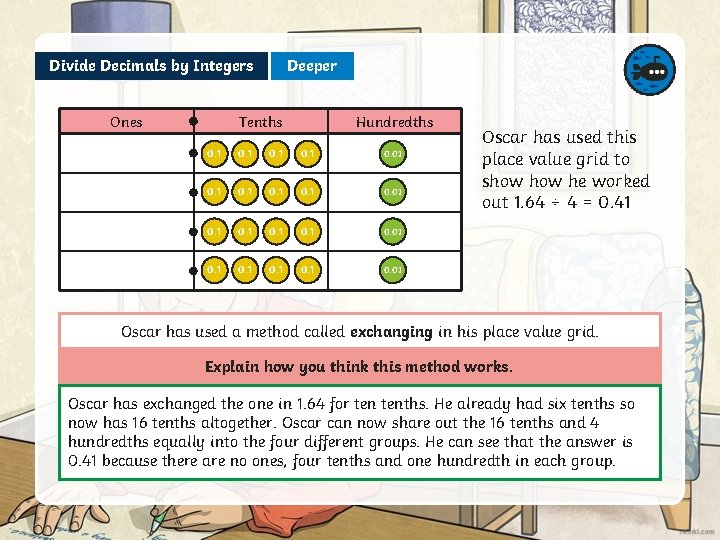
Deeper Divide Decimals by Integers Ones Tenths Hundredths 0. 1 0. 01 Oscar has used this place value grid to show he worked out 1. 64 ÷ 4 = 0. 41 Oscar has used a method called exchanging in his place value grid. Explain how you think this method works. Oscar has exchanged the one in 1. 64 for tenths. He already had six tenths so now has 16 tenths altogether. Oscar can now share out the 16 tenths and 4 hundredths equally into the four different groups. He can see that the answer is 0. 41 because there are no ones, four tenths and one hundredth in each group.
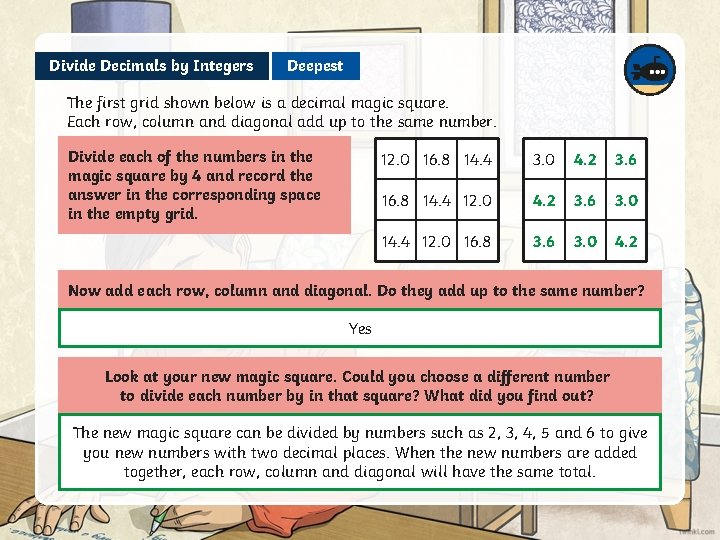
Divide Decimals by Integers Deepest The first grid shown below is a decimal magic square. Each row, column and diagonal add up to the same number. Divide each of the numbers in the magic square by 4 and record the answer in the corresponding space in the empty grid. 12. 0 16. 8 14. 4 3. 0 4. 2 3. 6 16. 8 14. 4 12. 0 4. 2 3. 6 3. 0 14. 4 12. 0 16. 8 3. 6 3. 0 4. 2 Now add each row, column and diagonal. Do they add up to the same number? Yes Look at your new magic square. Could you choose a different number to divide each number by in that square? What did you find out? The new magic square can be divided by numbers such as 2, 3, 4, 5 and 6 to give you new numbers with two decimal places. When the new numbers are added together, each row, column and diagonal will have the same total.
Divide Decimals by Integers Dive in by completing your own activity!
Go to: https: //whiterosemaths. com/ho melearning/year-6/ Summer Term - Week 5 (w/c 18 th May) Lesson 3 - Divide decimals by integers Watch the video and complete the worksheet