
Diversity of Fishes III Fish Taxa Diversity Phylum




- Slides: 27
Diversity of Fishes III
Fish Taxa Diversity • Phylum Chordata – Superclass Agnatha • Class Pteraspidomorphi † • Class Myxini (? ) • Class Cephalaspidomorphi – Superclass Gnathostomata • Class Placodermi † • Class Chondrychthyes • Class Acanthodii † • Class Sarcopterygii • Class Actinopterygii
Evolution of Fishes
Superclass Gnathostomata • Class Acanthodii † (“spiny sharks”) – Cartilaginous skeletons with ossified pieces & characteristic spines – Pelagic habitat (FW & SW) – Considered sister group of bony fish (still)
Teleostomi or Osteichthyes (Bony Fishes) Sarcopterygi Actinopterygi
Superclass Gnathostomata • Class Sarcopterygii (lobed fins) – Coelacanths and lungfishes – Osteolepimorphi † • Class Actinopterygii (ray fins) - Ray finned fishes
Class Sarcopterygii • Order Coelacanthiformes – - Family Coelacanthidae (coelecanths) Fleshy lobed fins Characteristic osteological features (fig 13. 6) Choanae (internal nostrils) 2 spp.
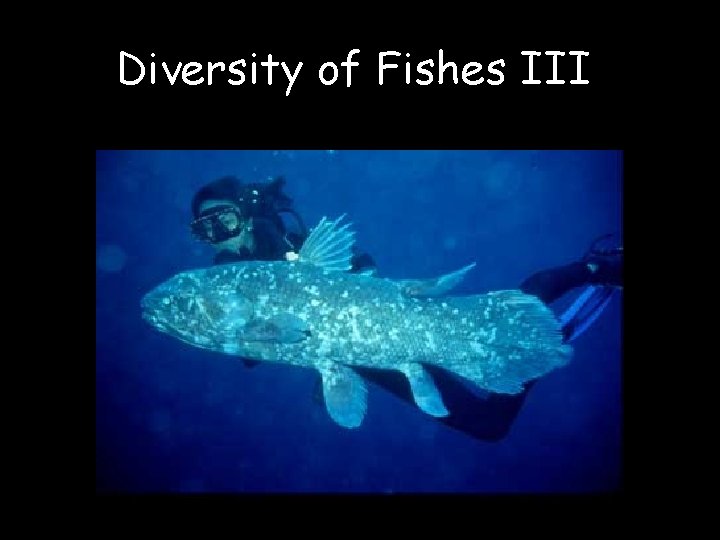
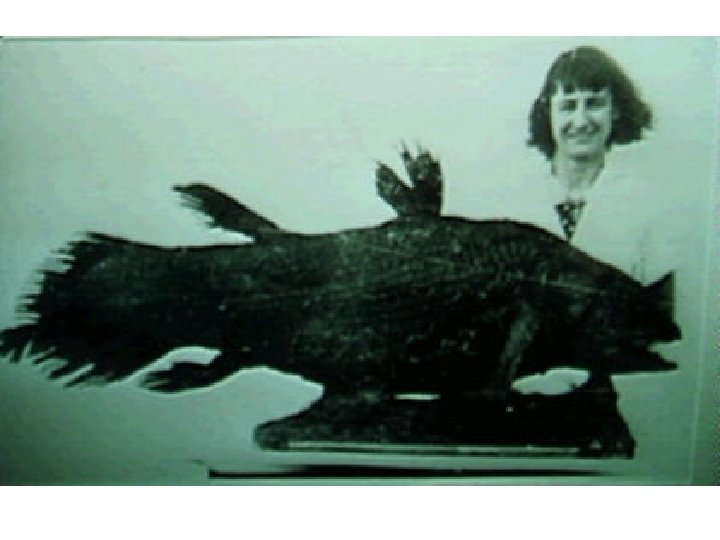
Latimeria chalumane (“Old fourlegs”) • Marjorie Courtenay-Latimer (1939) • J. L. B. Smith – 2 nd specimen (1952) • Comoro Islands (now Kenia, Madagascar, South Africa…) • French embargo • Conservation issues • Live observations (nocturnal, 200 m) • Ovoviviparous
Latimeria menadoensis (“King of the Sea”) • • • Mark Erdmann (1998) Indonesia (Sulawesi) Conservation issues Genetics study Live observations
Other Coelacanth Locations? Meso-american silver jewelry 1800’s
Extra Credit: +3% total grade A Fish Caught in Time : The Search for the Coelacanth by Samantha Weinberg ($10. 50 @ www. amazon. com) Read the book, and write a 1 page essay, clearly expressing YOUR interpretation and opinions of it, as well as how the reading affected your opinion on ichthyology.
Class Sarcopterygii • Infraclass Dipnoi (lungfishes) – – – Massive toothplates Maxillae and Premaxillae bones missing Functional Lung, choanae (internal nostrils) Family Ceratodontidae (Australia, 1 spp. ) Family Lepidosirenidae (S. America, 1 spp. ) Family Protopteridae (Africa, 4 spp. )
Ceratodontidae Australian lungfish Neoceratus forsteri
Lepidosirenidae S. American lungfish Lepidosiren paradoxa Protopteridae African lungfishes Protopterus sp.
Class Sarcopterygii • Infraclass Osteolepimorphi † – Sister group of modern tetrapods – Similar fins to Devonian Amphibians limbs – Other morphological similarities
Teleostomi or Osteichthyes (Bony Fishes) Sarcopterygi Actinopterygi
Class Actinopterygii
Class Actinopterygii
TELEOSTEI
Class Actinopterygii • Order Polypteriformes – Family Polypteridae (bichirs & reedfish) • 10 spp. (African rivers) • Facultative airbreathers (spiracle exhalation) • Lobed fins, ganoid scales, heterocercal tail, spiral intestine. • Flagfins (vertical spine with horizontal rays)
Class Actinopterygii • Order Acipenseriformes (secondary cartilaginous skeleton, heterocercal tail, fin rays, spiral valve intestine). Sturgeons and Paddlefish – Family Acipenseridae (sturgeons) • • 24 spp. (northern hemisphere) 5 rows bony scutes (modified ganoid scales) 4 barbels in front of ventral mouth Fresh water spawning (typically Anadromous)
Class Actinopterygii • Order Acipenseriformes (secondary cartilaginous skeleton, heterocercal tail, fin rays, spiral valve intestine) – Family Polyodontidae (paddlefishes) • 2 spp. (N. American and Chinese paddlefishes) • No bony scutes, small scales, ossified head plates • Freshwater open water plankton feeders • Paddle as electroreceptor?
Class Actinopterygii • Order Semionotiformes – Family Lepisosteidae (garfish) • • • 7 spp. (North and Central America) Ossified skeleton Ganoid scales Slightly heterocercal caudal fin Backwaters in lakes and rivers, predatory fish Toxic eggs
Class Actinopterygii • Order Amiiformes – Family Amiidae (bowfin) • • • 1 spp. (Amia calva, Eastern North America) Ossified skeleton Slightly heterocercal caudal fin Cycloid scales Swims through dorsal fin ondulations Backwaters in lakes and rivers