
Diversity of Angiosperms What is the diversity of



- Slides: 13
Diversity of Angiosperms What is the diversity of Angiosperms on the Riverside campus?
Part 1: Model (with class in notebook)
Part 2: Field Study – Link to GEOFORM: http: //arcg. is/28 Ny 9 Pm – APPS to have: Leaf Snap i. HANDY
Part 2: Field Study (cont. ) Materials: 1. lab notebook (each member needs one) 2. something to write in your notebook with (pencil preferred) 3. plastic bags to collect leafs 4. sharpie 5. tape measurer 6. cell phone for APPS and to take pictures (to be used in your brochure)
Part 2: Field Study (cont. ) Procedures: 1. Open the Geo. Form 2. Find your tree with the correct number (silver tag) 3. Mark the GPS coordinates on the ESRI collector APP 4. Take a picture of the tree 5. Possibly take a picture of your group with the tree (this is your company photo) 6. Take a leaf sample (one is enough) – put in plastic bag and label the bag 7. Take a picture of the leaf with Leaf. Snap and identify the type of tree
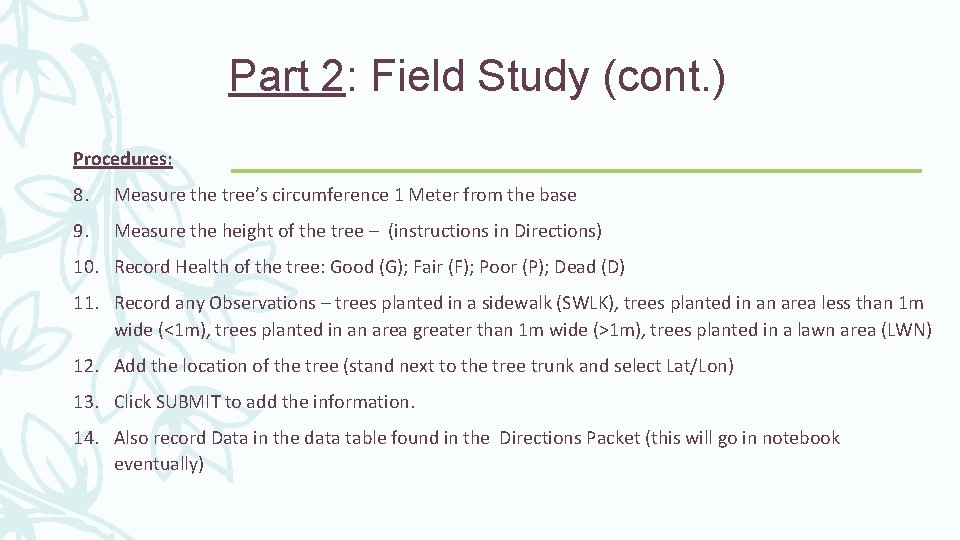
Part 2: Field Study (cont. ) Procedures: 8. Measure the tree’s circumference 1 Meter from the base 9. Measure the height of the tree – (instructions in Directions) 10. Record Health of the tree: Good (G); Fair (F); Poor (P); Dead (D) 11. Record any Observations – trees planted in a sidewalk (SWLK), trees planted in an area less than 1 m wide (<1 m), trees planted in an area greater than 1 m wide (>1 m), trees planted in a lawn area (LWN) 12. Add the location of the tree (stand next to the tree trunk and select Lat/Lon) 13. Click SUBMIT to add the information. 14. Also record Data in the data table found in the Directions Packet (this will go in notebook eventually)
Part 2: Field Study (cont. ) Back in the Classroom: 1. Fill out the notebook if needed with any observations or student understandings. 2. With your group, choose an IV to focus your research on (refer to our model!).
Homework: – Unit 2 Classification Review and Test – Begin work on Citations & Journals Project
Day 2: Data Analysis & Notebook: 1. Research Model 2. Student Understandings • Vocabulary (Angiosperm, Biodiversity, etc. ( • Write 1 -2 sentences about why you think the lab is important to our understanding of science.
Notebook (Cont. ) 3. Experimental Design • Research Question • Hypotheses: Null and Alternative • Independent Variable WITH Experimental Group • Dependent Variable (units when appropriate) • Control Group • Constants
Notebook (Cont. ) 4. Materials & Methods (See Part 2 above) 5. Table Data – include the trees you measured 6. Graph – 7. Descriptive Statistics – include calculations for mean, mode, median, etc.
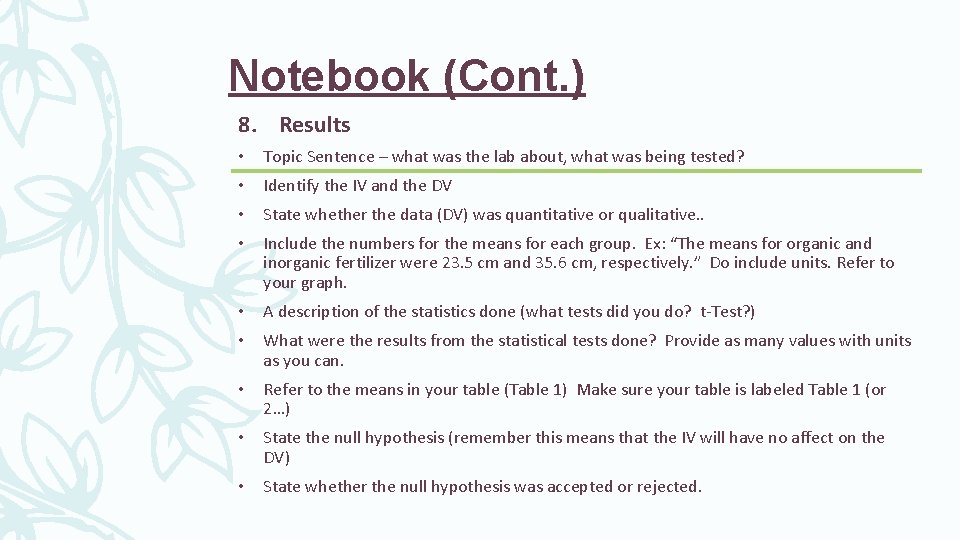
Notebook (Cont. ) 8. Results • Topic Sentence – what was the lab about, what was being tested? • Identify the IV and the DV • State whether the data (DV) was quantitative or qualitative. . • Include the numbers for the means for each group. Ex: “The means for organic and inorganic fertilizer were 23. 5 cm and 35. 6 cm, respectively. ” Do include units. Refer to your graph. • A description of the statistics done (what tests did you do? t-Test? ) • What were the results from the statistical tests done? Provide as many values with units as you can. • Refer to the means in your table (Table 1) Make sure your table is labeled Table 1 (or 2…) • State the null hypothesis (remember this means that the IV will have no affect on the DV) • State whether the null hypothesis was accepted or rejected.
Due Dates: 1. Notebook – 2. Pamphlet –