
Diversity in Social Work Practice From Social Work
- Slides: 22
Diversity in Social Work Practice { From Social Work and Social Welfare by Marla Berg-Weger
Key Points ● ● Social workers must be in tune with their own feelings, beliefs, and values The language that social workers use can be as important as the content of their speech The ecological perspective views the client in the context of his or her culture The strengths perspective reflects the belief that clients’ culture, beliefs, and experiences can be sources of strength and growth
Take a moment to reflect 1. 2. Stories can be powerful tools to help understand another person’s experience or point of view. Why is that true? What is it about stories that can be so powerful? What stories have you read (or heard, or watched) that have given you insight into how other people live, thinking particularly about people who are different from you?
As a social worker … Practice cultural humility Instead of “mastery” develop a respectful partnership Allow yourself to learn from the client and allow the client to teach you Teach others about cultural humility
Self-Awareness in Social Work Practice ● ● ● To begin to understand clients’ cultural perspectives, social workers must understand their own beliefs and values Delving into the impact of one’s behavior can be a painful process because it can involve becoming aware of one’s prejudices and biases Attending cultural festivals for cultures different than yours, going to religious services for a religion that you do not follow, and volunteering with age groups with which you have little experience are a few ways to broaden selfawareness and move out of your “comfort zone”
Cultural and Linguistic Competence ● Cultural competence ● ● ● An understanding of the need to address diversity and examine one’s interactions with persons who are different from oneself An appreciation of power and inequality Linguistic competence ● ● ● Can be on the level of the individual or organization Engaging interpretation and translation services to improve accessibility Offering multilingual materials
Theoretical Approaches to Diversity ● ● ● Considering oppression as a social justice issue within a theoretical context enables us to view the experiences of our clients as a hierarchical dynamic in which one group disempowers another group. Understanding the ways in which clients’ rights are compromised through oppressive acts can provide the social worker with insights into the cultural, social, and educational experiences that shape clients’ lives. Two theoretical frameworks form the bedrock of social work practice: the ecological perspective and strengths perspective.
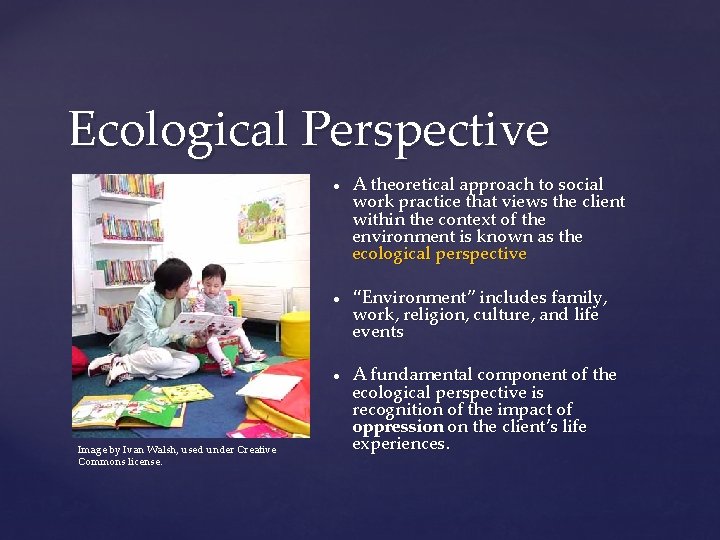
Ecological Perspective ● ● ● Image by Ivan Walsh, used under Creative Commons license. A theoretical approach to social work practice that views the client within the context of the environment is known as the ecological perspective “Environment” includes family, work, religion, culture, and life events A fundamental component of the ecological perspective is recognition of the impact of oppression on the client’s life experiences.
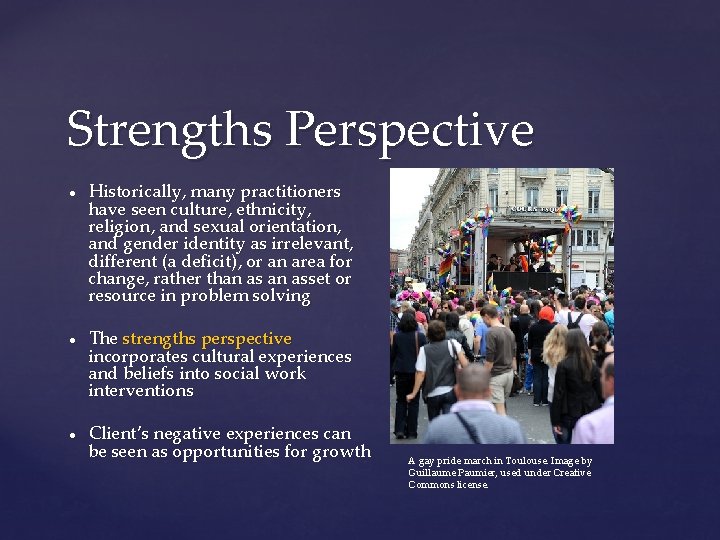
Strengths Perspective ● ● ● Historically, many practitioners have seen culture, ethnicity, religion, and sexual orientation, and gender identity as irrelevant, different (a deficit), or an area for change, rather than asset or resource in problem solving The strengths perspective incorporates cultural experiences and beliefs into social work interventions Client’s negative experiences can be seen as opportunities for growth A gay pride march in Toulouse. Image by Guillaume Paumier, used under Creative Commons license.
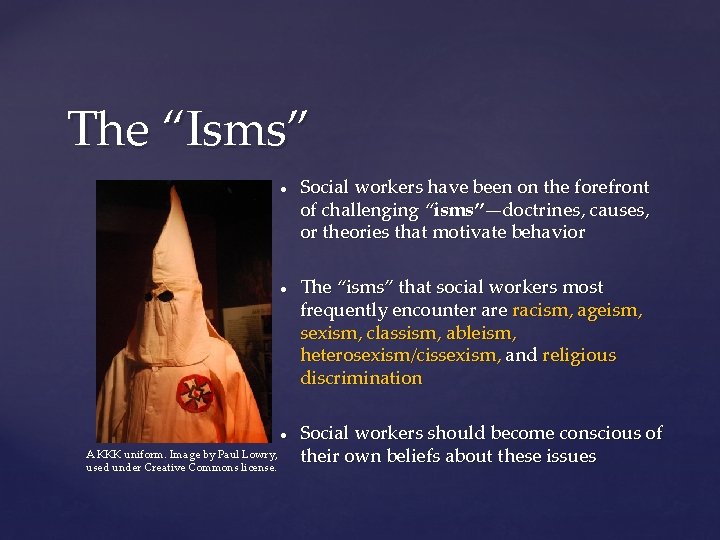
The “Isms” ● ● ● A KKK uniform. Image by Paul Lowry, used under Creative Commons license. Social workers have been on the forefront of challenging “isms”—doctrines, causes, or theories that motivate behavior The “isms” that social workers most frequently encounter are racism, ageism, sexism, classism, ableism, heterosexism/cissexism, and religious discrimination Social workers should become conscious of their own beliefs about these issues
Language and Communication ● Social workers should be mindful of the language that is preferred by the group being addressed ● ● Be aware that terms used by certain groups may not be appropriate for use by outsiders Slang can have different connotations to different listeners; more mainstream language is preferable Clarify pronunciations of names, use of honorifics (Mr. /Mrs. /Ms. ), and use of first or last names with client Use gender neutral terms ● Example “Are you dating anyone? ” or “Do you have a significant other? ” vs “Do you have a boyfriend/girlfriend/husband/wife” ● Avoid words or behaviors with which you are not familiar ● Use person-first language: “person with a disability” instead of “disabled person”
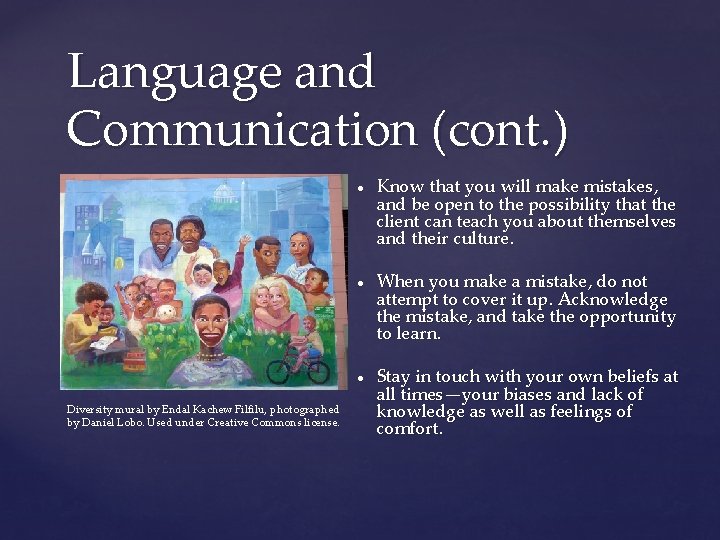
Language and Communication (cont. ) ● ● ● Diversity mural by Endal Kachew Filfilu, photographed by Daniel Lobo. Used under Creative Commons license. Know that you will make mistakes, and be open to the possibility that the client can teach you about themselves and their culture. When you make a mistake, do not attempt to cover it up. Acknowledge the mistake, and take the opportunity to learn. Stay in touch with your own beliefs at all times—your biases and lack of knowledge as well as feelings of comfort.
Resource Videos Is Racism Over Yet? Systemic Racism Videos A Conversation About Growing Up Black Akala on Everyday Racism: What Should We Do? Racism is Real Doll Test
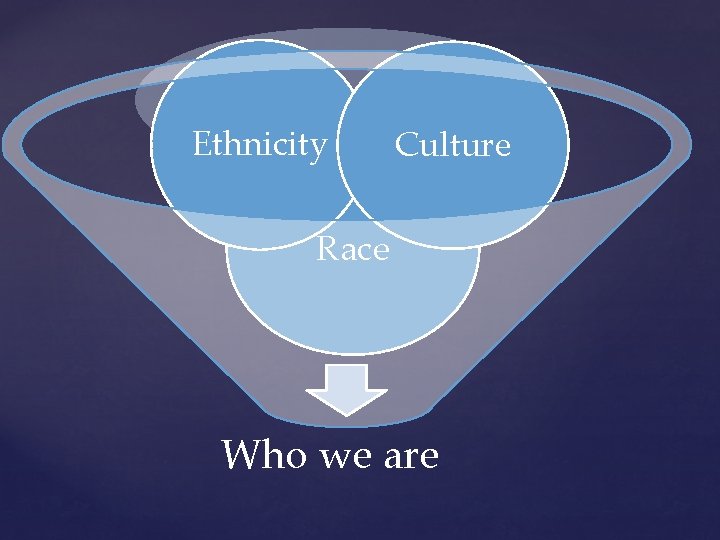
Ethnicity Culture Race Who we are
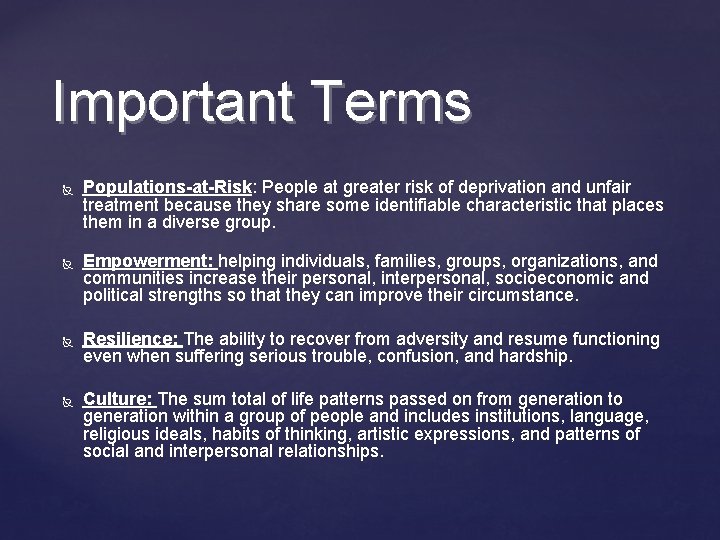
Important Terms Populations-at-Risk: People at greater risk of deprivation and unfair treatment because they share some identifiable characteristic that places them in a diverse group. Empowerment: helping individuals, families, groups, organizations, and communities increase their personal, interpersonal, socioeconomic and political strengths so that they can improve their circumstance. Resilience: The ability to recover from adversity and resume functioning even when suffering serious trouble, confusion, and hardship. Culture: The sum total of life patterns passed on from generation to generation within a group of people and includes institutions, language, religious ideals, habits of thinking, artistic expressions, and patterns of social and interpersonal relationships.
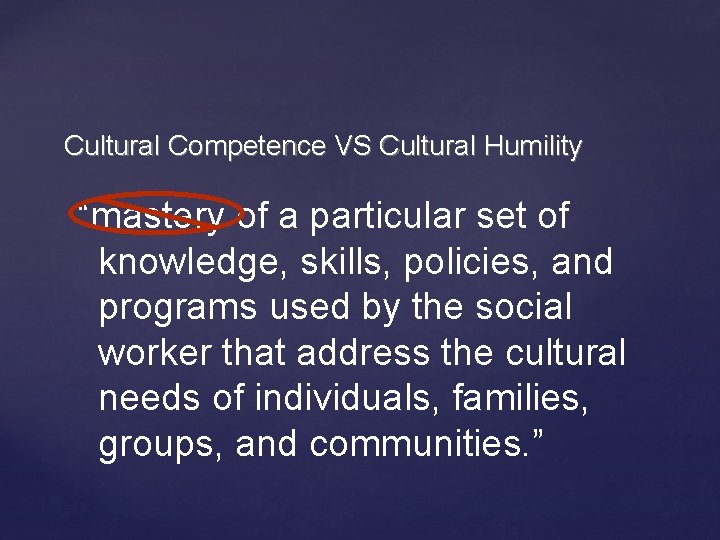
Cultural Competence VS Cultural Humility “mastery of a particular set of knowledge, skills, policies, and programs used by the social worker that address the cultural needs of individuals, families, groups, and communities. ”
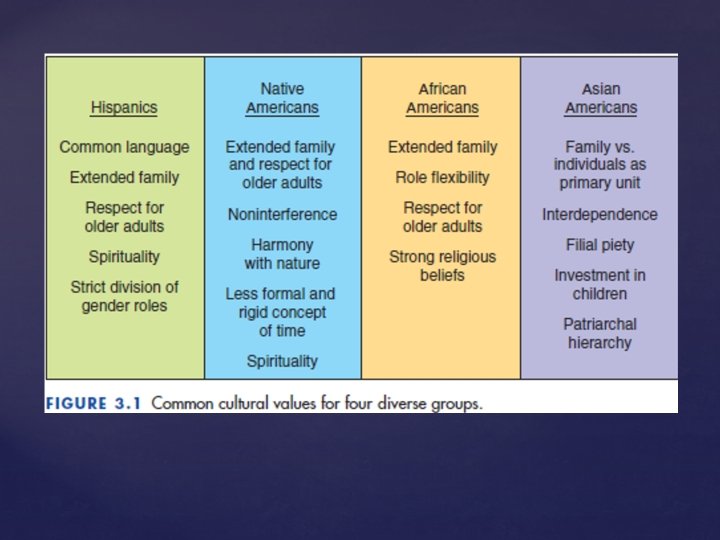
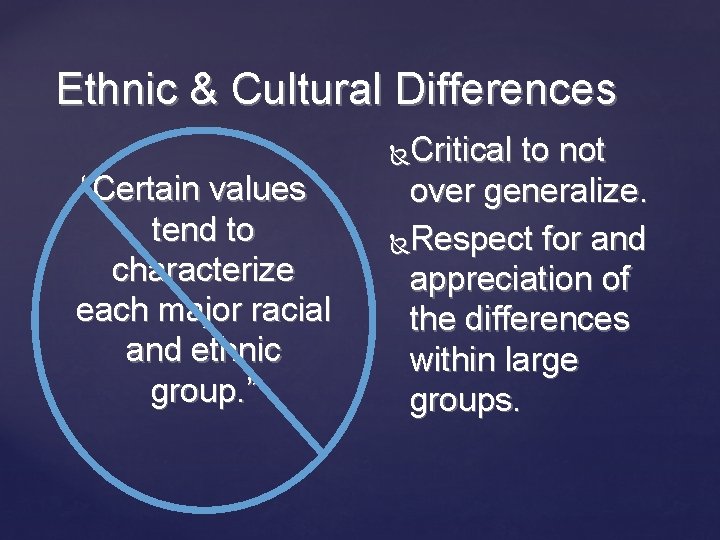
Ethnic & Cultural Differences Critical to not over generalize. Respect for and appreciation of the differences within large groups. “Certain values tend to characterize each major racial and ethnic group. ”
Beyond Cultural Competence Culture is neither a blueprint nor an identity; individuals choose between various cultural options. In our multicultural society, [people] many times choose widely between the options offered by a variety of cultural traditions.
Beyond Cultural Competence It is not possible to predict the beliefs and behaviors of individuals based on their race, ethnicity, or national origin. Individuals' group membership cannot be assumed to indicate their culture because those who share a group label may variously enact culture.
TED Talks The Danger of the Single Story Our lives, our cultures, are composed of many overlapping stories. Novelist Chimamanda Adichie tells the story of how she found her authentic cultural voice -- and warns that if we hear only a single story about another person or country, we risk a critical misunderstanding.
Take a moment to reflect 1. 2. 3. 4. Why does Ms. Adichie believe that single stories are “dangerous”? Have you ever encountered someone who thought they knew or understood you based on knowing someone else’s story? Have you ever been stereotyped? Have you ever made a mistake with someone because of a stereotype you held? What is the take away here?