
Diversity ecological adaptations and seasonality of temperate forest



- Slides: 21
Diversity, ecological adaptations, and seasonality of temperate forest flora. 1. Demonstrator shows specific morphological adaptations of spring flora of decidous forest to specific, temperate climate condition. Author: Dr Bojan Zlatković, Associate professor ___________________________________________________ This project has been funded with support from the European Commission. This publication reflects the views only of the authors, and the Commission cannot be held responsible for any use which may be made of the information contained therein.
NETCHEM Remote Access Laboratory Guide Morphology and composition of spring time herbaceous plants in European deciduous forests – adaptation to sesonality In this exercise, you will: • • • Observe plant structures by using Binocular stereomicroscope Observe plant structures using Camera Observe specific morphology of flowering species from decidous forest ___________________________________________________ This project has been funded with support from the European Commission. This publication reflects the views only of the authors, and the Commission cannot be held responsible for any use which may be made of the information contained therein.
Background Temperate deciduous forest biomes consider plant communities distributed in North and South America, Asia, Southern slopes of the Himalayas and Europe. They have formed under climatic conditions which have great seasonable temperature variability with growth occurring during warm summers and leaf drop in autumn and dormancy during cold winters. These seasonally distinctive communities have diverse life forms that are impacted greatly by the seasonality of their climate, mainly temperature and precipitation rates. These varying and regionally different ecological conditions produce distinctive forest plant communities in different regions. Deciduous plants, including trees, shrubs and herbaceous perennials, are those that lose all of their leaves for part of the year. This process is called abscission. In reference of temperate regions it consider trees and shrubs that seasonally shed leaves, usually in the autumn. The principal factor operating in these forests is the seasonal appearance and disappearance of the canopy. Shade from the canopy limits the growth of many kinds of plants. Many species that are typical of these forests time their growth and flowering to the short period just before the canopy opens; hence, they are known as spring ephemerals. Examples include Scilla bifolia (two-leaf squill) and Anemone ranunculoides (yellow anemone). Most spring ephemerals are insect-pollinated, and the seeds themselves are often transported by ants, a mode of dispersal known as myrmecochory. A smaller number of species is able to grow under the canopy, and even a few that grow during the period when leaves are being lost. Many understory plants have leaf adaptions to cope with low light levels, and the need to exploit moving flecks of light on the forest floor, or many produce swollen subteranean organs, roots, rhizomes or bulbs. Temperate deciduous forests have a great variety of plant species. ___________________________________________________ This project has been funded with support from the European Commission. This publication reflects the views only of the authors, and the Commission cannot be held responsible for any use which may be made of the information contained therein.
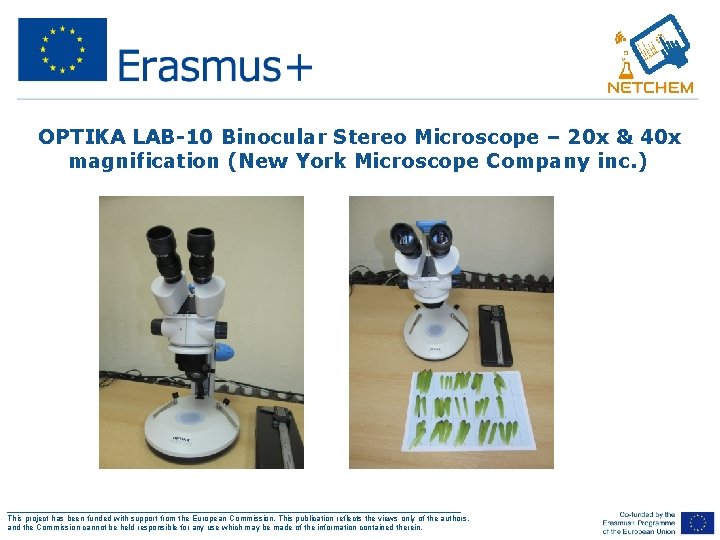
Binocular Stereo Microscope is designed for low magnification observation of samples, typically using light reflected from the surface of an object rather than transmitted through it. Binocular Stereo Microscopes provide the user with an erect (upright and unreserved) stereoscopic (3 -dimensional) image. This is particularly useful for biologists as an essential tool for performing dissections, small parts of flowers or anyone who needs to work on small objects. The binoculare or simple stereo microscope is often used to study the surfaces of solid dry or fresh plant parts or to carry out close work such as plants specific details, that are not easily visible. ___________________________________________________ This project has been funded with support from the European Commission. This publication reflects the views only of the authors, and the Commission cannot be held responsible for any use which may be made of the information contained therein.
OPTIKA LAB-10 Binocular Stereo Microscope – 20 x & 40 x magnification (New York Microscope Company inc. ) ___________________________________________________ This project has been funded with support from the European Commission. This publication reflects the views only of the authors, and the Commission cannot be held responsible for any use which may be made of the information contained therein.
Material For this laboratory exercise, you will need the following material : • Fresh plant material of Scilla bifolia (two-leaf squill), fam. Liliaceae; • Fresh plant material of Anemone ranunculoides (yellow anemone), fam. Ranunculaceae; ___________________________________________________ This project has been funded with support from the European Commission. This publication reflects the views only of the authors, and the Commission cannot be held responsible for any use which may be made of the information contained therein.
Procedure : I. Prepare plant specimens for binoclar stereomicroscopic observations. II. Start your binocular and additional hardware equipment. III. Put the preparation considering steam and undergound parts at the observation table. IV. Turn on the light of the binocular and adjust the intensity. V. Observe plant morphology using different magnifications. VI. Take the images of the certain structures by using camera. ___________________________________________________ This project has been funded with support from the European Commission. This publication reflects the views only of the authors, and the Commission cannot be held responsible for any use which may be made of the information contained therein.
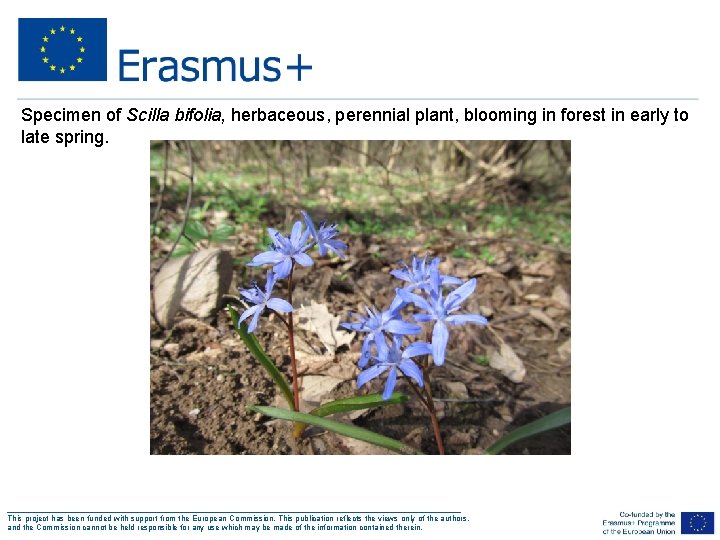
Specimen of Scilla bifolia, herbaceous, perennial plant, blooming in forest in early to late spring. ___________________________________________________ This project has been funded with support from the European Commission. This publication reflects the views only of the authors, and the Commission cannot be held responsible for any use which may be made of the information contained therein.
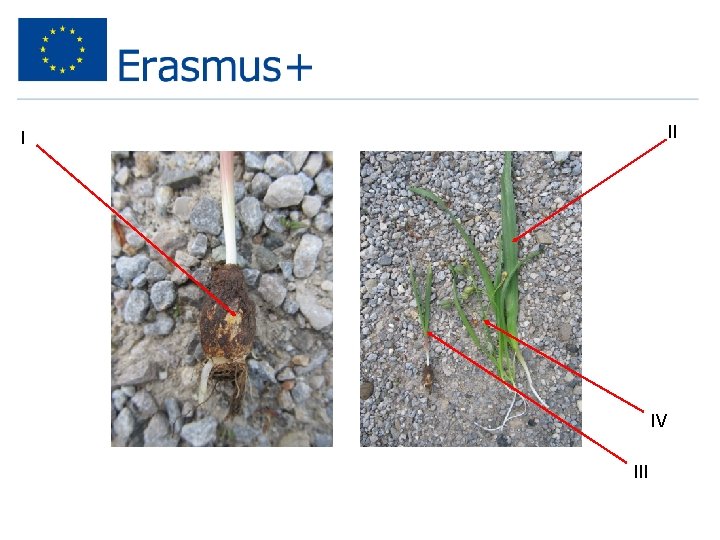
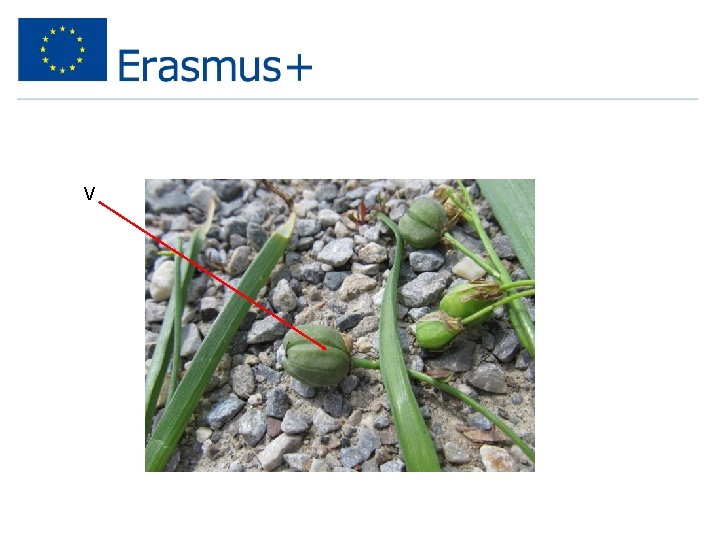
Result I: Based on observation, please note the following adaptations of the plant to the environment: I. Underground bulb, 1– 2 cm (0. 4– 0. 8 in) across. II. Two or rarely three lance-shaped, curved, fleshy and shiny leaves. III. The bases of the leaves clasp up to about the half of the stem (amplexicaul) IV. The flowering stems are erect and unbranched, 10– 20 cm (4– 8 in) high V. The fruit is a capsule 6– 8 mm (0. 2– 0. 3 in) across.
II I IV III
V
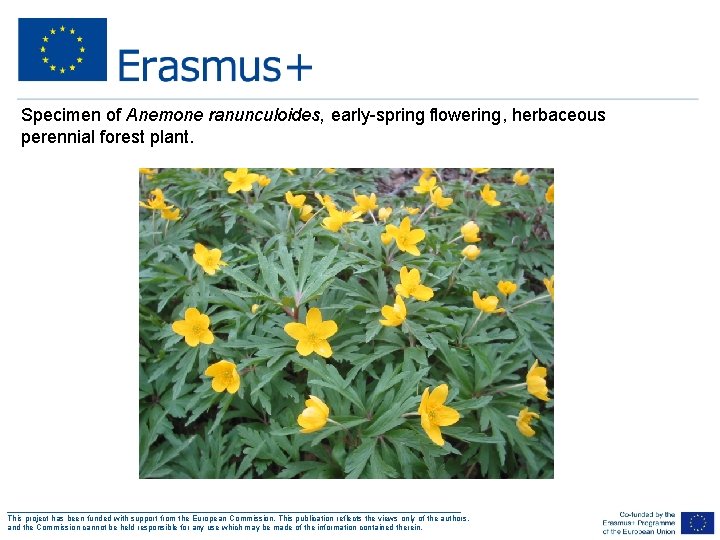
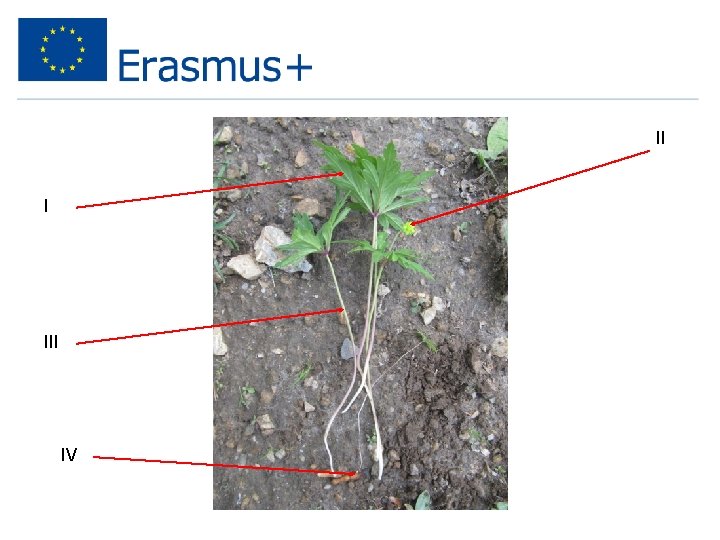
Specimen of Anemone ranunculoides, early-spring flowering, herbaceous perennial forest plant. ___________________________________________________ This project has been funded with support from the European Commission. This publication reflects the views only of the authors, and the Commission cannot be held responsible for any use which may be made of the information contained therein.
Result II: Based on observation, please note the following adaptations of the plant to the environment: I. Compound leaves are palmate or ternate (divided into three lobes) II. Flowers are solitary and fruits, produced on short stems, held above the foliage. III. Longer steam part, below the foliage IV. Strong underground stems - rhizomes
II I III IV
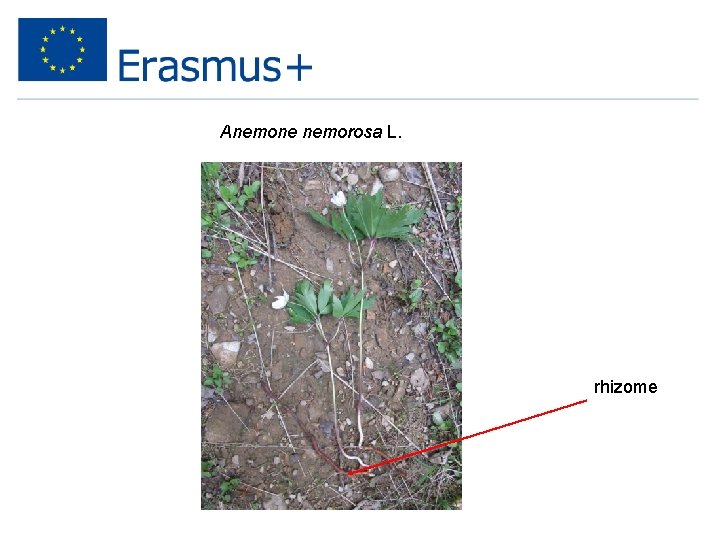
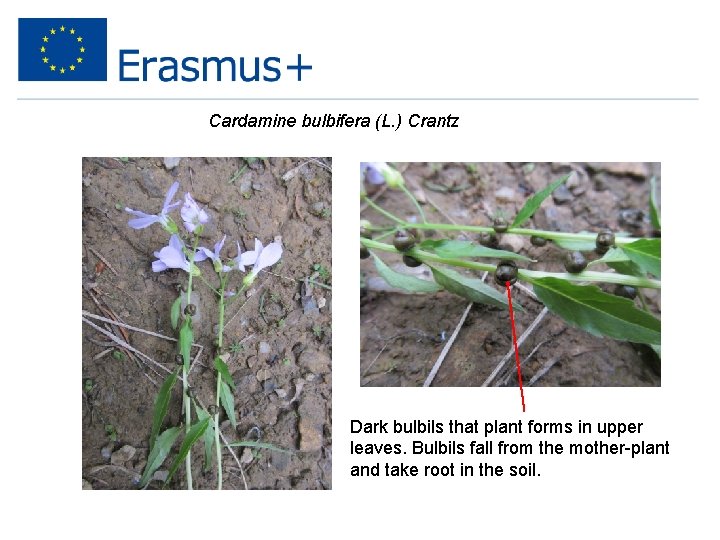
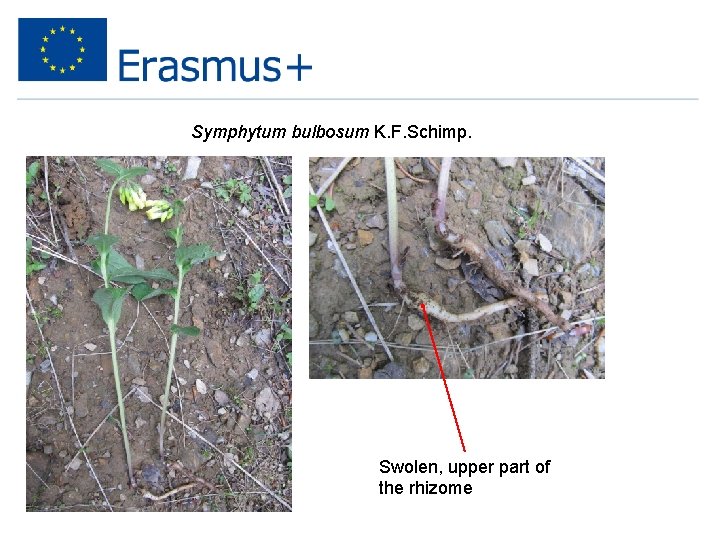
Majority of the spring ephemerals grow from underground root-like stems called rhizomes or bulbs or even steam bulbs, and the foliage dies back down by mid summer (summer dormant). Please note the additional examples: 1. Anemone nemorosa L. 2. Cardamine bulbifera (L. ) Crantz 3. Symphytum bulbosum K. F. Schimp.
Anemone nemorosa L. rhizome
Cardamine bulbifera (L. ) Crantz Dark bulbils that plant forms in upper leaves. Bulbils fall from the mother-plant and take root in the soil.
Symphytum bulbosum K. F. Schimp. Swolen, upper part of the rhizome
Author, Editor and Referee References This remote access laboratory was created thanks to work done primarily at University of Niš. Contributors to this material were: Dr Bojan Zlatković, University of Niš Refereeing of this material was done by: Dr Milan Antonijevic, University of Greenwich Editing into NETCHEM Format and onto NETCHEM platform was completed by: Dr Milan Milošević, University of Niš ___________________________________________________ This project has been funded with support from the European Commission. This publication reflects the views only of the authors, and the Commission cannot be held responsible for any use which may be made of the information contained therein.
References and Supplemental Material The NETCHEM platform was established at the University of Nis in 2016 -2019 through the Erasmus Programme. Please contact a NETCHEM representatives at your institution or visit our website for an expanded contact list. The work included had been led by the NETCHEM staff at your institution. ___________________________________________________ This project has been funded with support from the European Commission. This publication reflects the views only of the authors, and the Commission cannot be held responsible for any use which may be made of the information contained therein.