
Diversion Mechanisms Class 20 Diversion Diversionary principles lie


- Slides: 11
Diversion Mechanisms Class 20
Diversion • Diversionary principles lie deep in the heart of juvenile court ideology and practice sinception • At one time, diversion was seen as balancing need for control and intervention with stigma avoidance – Institutionalized widely in late 1970 s – Research suggested that diversion had little effect on recidivism • Flow control mechanism retained by the juvenile court and its bureaucratic arms for cases that do not fall into the jurisdiction of the prosecutors • At “apprehension” or referral, there is a discretionary moment when either the prosecutor or a juvenile intake officer decides whether to process the case formally or informally. • Youth can be detained prior to screening, use of detention prior to diversion varies
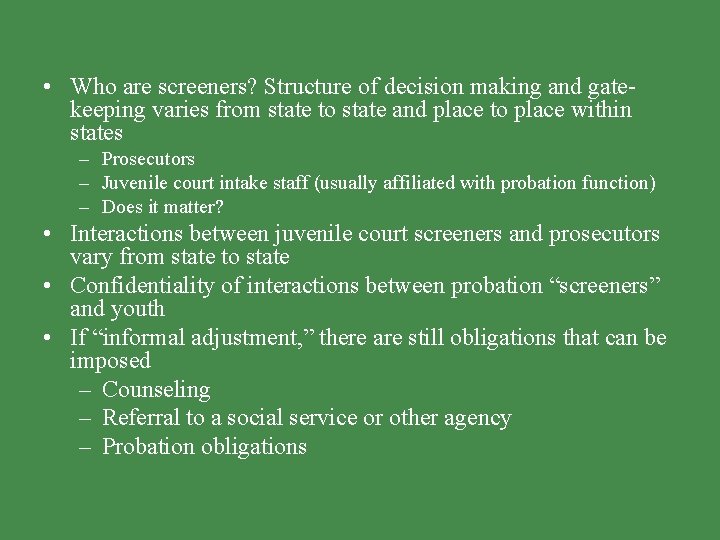
• Who are screeners? Structure of decision making and gatekeeping varies from state to state and place to place within states – Prosecutors – Juvenile court intake staff (usually affiliated with probation function) – Does it matter? • Interactions between juvenile court screeners and prosecutors vary from state to state • Confidentiality of interactions between probation “screeners” and youth • If “informal adjustment, ” there are still obligations that can be imposed – Counseling – Referral to a social service or other agency – Probation obligations
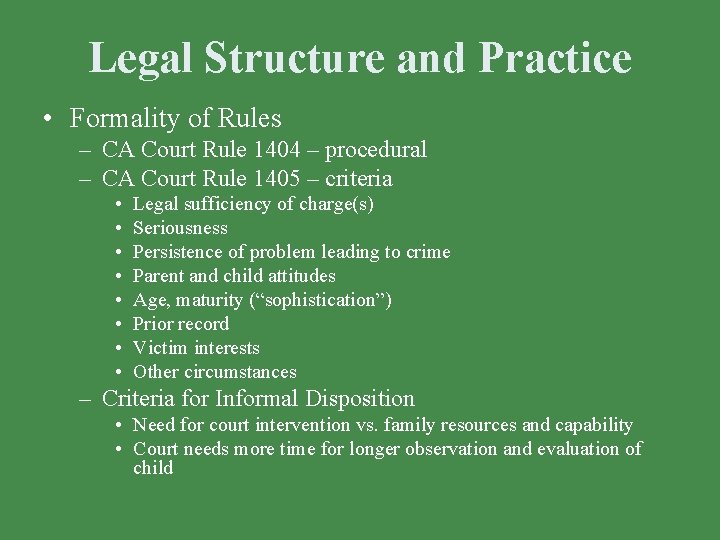
Legal Structure and Practice • Formality of Rules – CA Court Rule 1404 – procedural – CA Court Rule 1405 – criteria • • Legal sufficiency of charge(s) Seriousness Persistence of problem leading to crime Parent and child attitudes Age, maturity (“sophistication”) Prior record Victim interests Other circumstances – Criteria for Informal Disposition • Need for court intervention vs. family resources and capability • Court needs more time for longer observation and evaluation of child
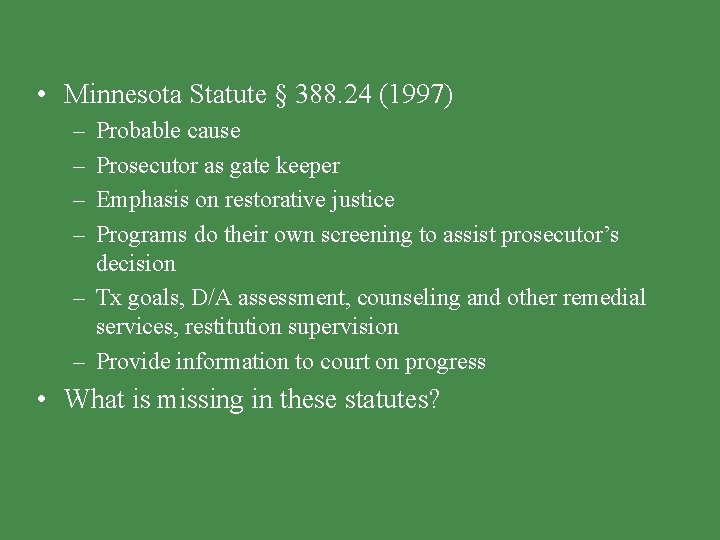
• Minnesota Statute § 388. 24 (1997) – – Probable cause Prosecutor as gate keeper Emphasis on restorative justice Programs do their own screening to assist prosecutor’s decision – Tx goals, D/A assessment, counseling and other remedial services, restitution supervision – Provide information to court on progress • What is missing in these statutes?
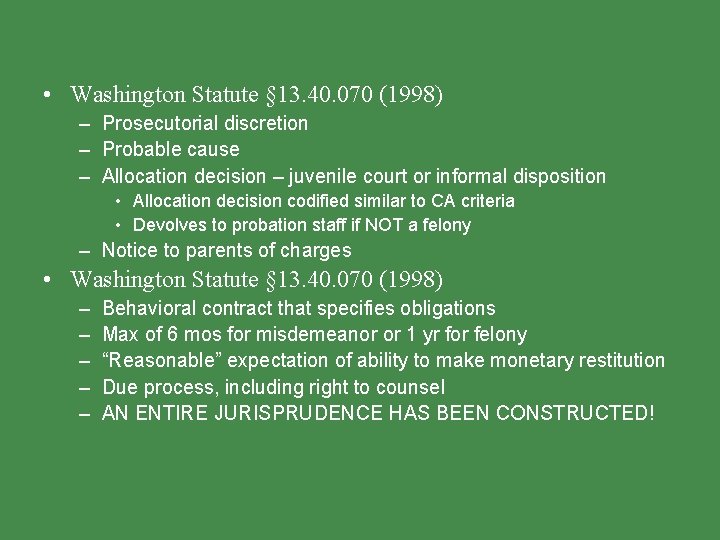
• Washington Statute § 13. 40. 070 (1998) – Prosecutorial discretion – Probable cause – Allocation decision – juvenile court or informal disposition • Allocation decision codified similar to CA criteria • Devolves to probation staff if NOT a felony – Notice to parents of charges • Washington Statute § 13. 40. 070 (1998) – – – Behavioral contract that specifies obligations Max of 6 mos for misdemeanor or 1 yr for felony “Reasonable” expectation of ability to make monetary restitution Due process, including right to counsel AN ENTIRE JURISPRUDENCE HAS BEEN CONSTRUCTED!
Trends • Trend toward formality: filing of juvenile court petition in lieu of informal supervision • Sickmund study (1999): 45% processed informally, 53% of those (27% overall) receive some type of intervention or obligation • Race effects
Social and Legal Tensions • Right to Diversion? Not really, statutes only speak to eligibility – 28 Wash. App 580, 624 P. 2 d 1180 (1981) • Net widening? Defense of net widening? – Special interests of court in child development and welfare – It’s voluntary • Involvement of community agencies in quasi-legal function of supervision and reporting – transfer coercive power to social service or mental health agency • Effectiveness of services, liability of child and family is dependent on capacity of social service agency – Balance of evidence from experiments suggests that diversion is ineffective, if not iatrogenic
• Who is better suited to run a diversion program – prosecutor or court (via probation arm)? – Sound screening decisions – Operational management of diverse network of services – Supervision authority • Does admission of guilt (required in many tx programs) create risk or prejudice in subsequent court actions for this or later charges? • Does juvenile have right to counsel to decide whether to accept a diversion offer? Is waiver “voluntary” and “intelligent”? • Liability of child who rejects diversion offer? Is the youth subject to harsher penalties compared to obligations of diversion program? – Yes (State v Mc. Dowell, 102 Wash. 2 d 341 (1984) – But can’t escalate misdemeanor into a felony charge in lieu of a diversion agreement • Confidentiality of diversion records?
• What should be the length of diversion period? – Longer than would a ‘normal’ disposition span? • When does intensity of services become punitive and subject to procedural due process? • What should be the consequences of failure? • Does diversion, whether successfully completed or not, constitute a “prior”? What is increased liability if failure in diversion for next case? – State v Quiroz, 107 Wash. 2 d 791 (1987) (finding that diversion counts as a “prior” in future court matters as a sentencing enhancement) – But see: In Re D. S. S. , 506 N. W. 2 d 650 (Minn. Ct. Ap. 1993) • How should the termination decision be structured? What is success? Can it be spelled out contractually? Do agencies become powerful quasi-legal actors that determine whethere will be further punishment ? Is this good or bad?
Current Practices • Florida Program • Denver Program • Like Drug Courts? – How is service delivery system regulated? – Accountability diffusion? • Worth the money?