
DIVERSIFIED FISHERY PRODUCTS VALUE ADDITION Breaded and Battered
DIVERSIFIED FISHERY PRODUCTS/ VALUE ADDITION
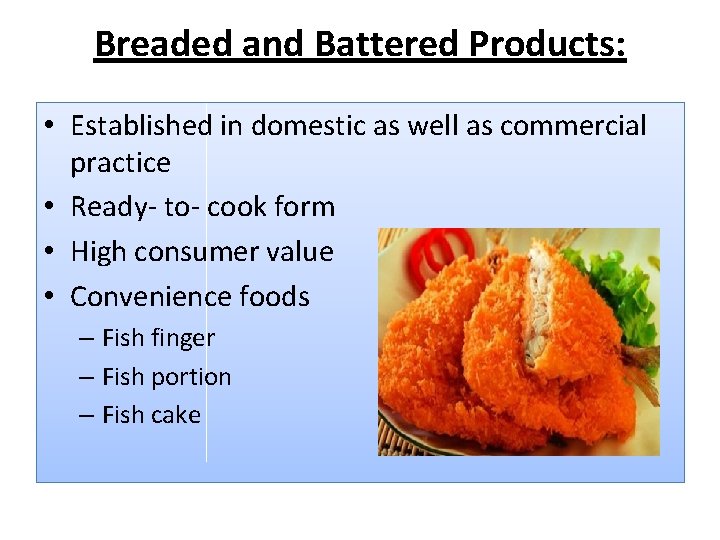
Breaded and Battered Products: • Established in domestic as well as commercial practice • Ready- to- cook form • High consumer value • Convenience foods – Fish finger – Fish portion – Fish cake

The coating process: 1. 2. 3. 4. 5. 6. Predusting Battering Breading Frying Freezing Packaging and storage
1. Predusting ØVery fine, dry, raw flour material that is sprinkled on the moist surface of the frozen or fresh food substrate before any other coating is applied
2. Battering ØBatter is a fluid, basically consisting of flour and water, into which the product is dipped before it is cooked or fried

3. Breading ØBreading is a serial- based coating, often of breadcrumbs. ØBreading is coarse in nature and applied to a moist or battered food product prior to cooking Øconsist of flours, starch and seasonings
4. Frying ØFat is the frying medium ØInfluence the eating quality ØBleached and refined vegetable oils are used
5. Freezing ØFried fish portion for freezing is air cooled ØFreezing is usually performed through spiral freezer and is completed when external temperature of the product is around -10°C.
6. Packaging and storage ØPaperboard carton or a polylined paper bag or poly-bag, which is heat sealed ØThermo- formed containers ØFood-grade materials ØPolyvinylidene chloride, high impact polystyrene (HIP) and high-density polyethylene (HDPE) ØUnaffected by subzero temperatures ØProvide protection to the contents against desiccation and oxidation
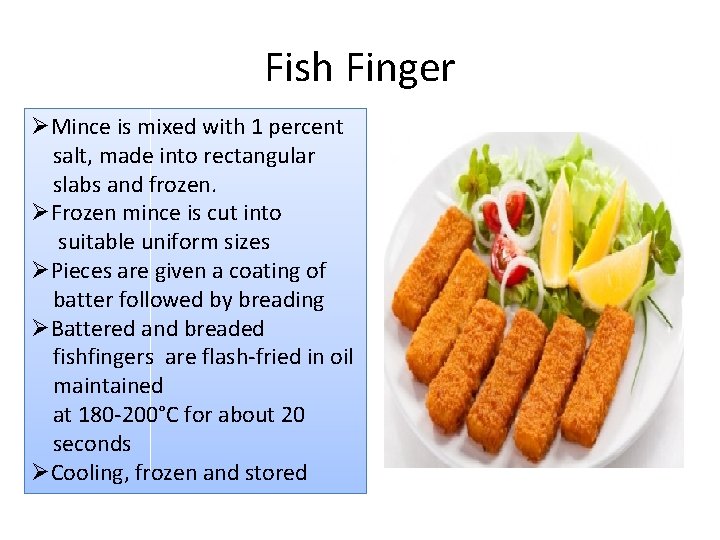
Fish Finger ØMince is mixed with 1 percent salt, made into rectangular slabs and frozen. ØFrozen mince is cut into suitable uniform sizes ØPieces are given a coating of batter followed by breading ØBattered and breaded fishfingers are flash-fried in oil maintained at 180 -200°C for about 20 seconds ØCooling, frozen and stored
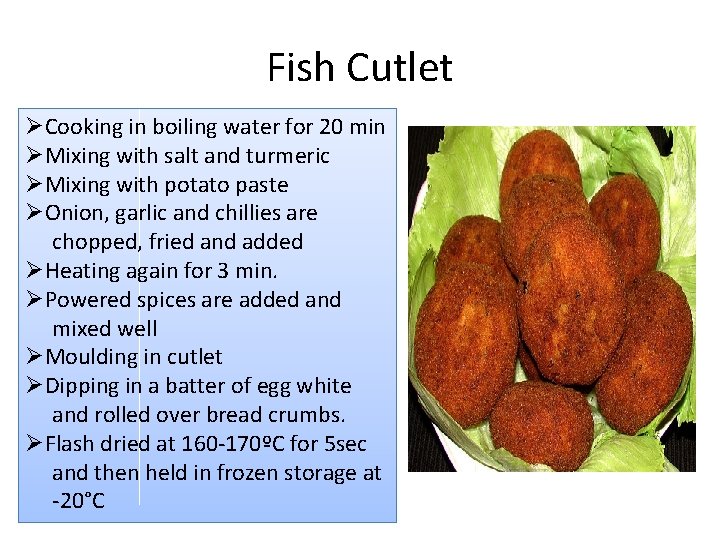
Fish Cutlet ØCooking in boiling water for 20 min ØMixing with salt and turmeric ØMixing with potato paste ØOnion, garlic and chillies are chopped, fried and added ØHeating again for 3 min. ØPowered spices are added and mixed well ØMoulding in cutlet ØDipping in a batter of egg white and rolled over bread crumbs. ØFlash dried at 160 -170ºC for 5 sec and then held in frozen storage at -20°C
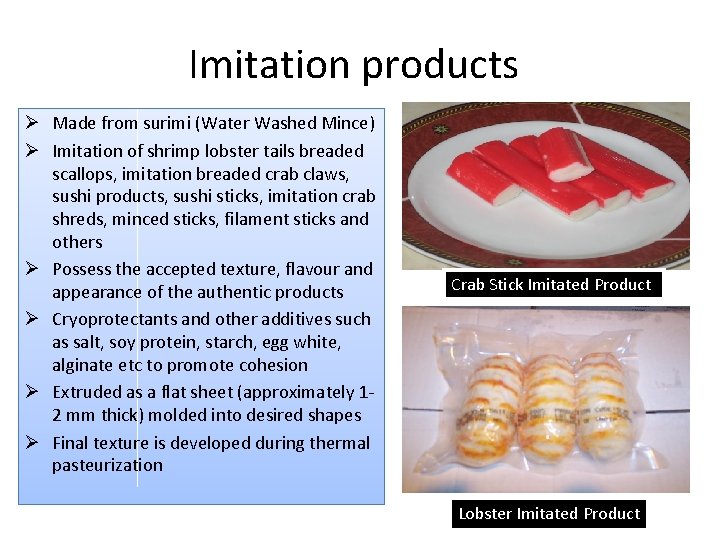
Imitation products Ø Made from surimi (Water Washed Mince) Ø Imitation of shrimp lobster tails breaded scallops, imitation breaded crab claws, sushi products, sushi sticks, imitation crab shreds, minced sticks, filament sticks and others Ø Possess the accepted texture, flavour and appearance of the authentic products Ø Cryoprotectants and other additives such as salt, soy protein, starch, egg white, alginate etc to promote cohesion Ø Extruded as a flat sheet (approximately 12 mm thick) molded into desired shapes Ø Final texture is developed during thermal pasteurization Crab Stick Imitated Product Lobster Imitated Product
HAZARD ANALYSIS AND CRITICAL CONTROL POINT Ø Total quality management system Ø Emphasis on safety Ø Systematic approach to identification, assessment and control of hazards Ø Hazard is controlled or eliminated before it occurs Ø Prevention strategies on known hazards occurring at specific points in the processing schedule
HACCP Concept Ø Hazard analysis Ø Determination of critical control points (CCP) Ø Specification of criteria – Establish target levels and critical limits Ø Establishment of procedure and monitoring system Ø Corrective action Ø Establishment of procedures to verify that the HACCP is working correctly and effectively Ø Documentation and verification
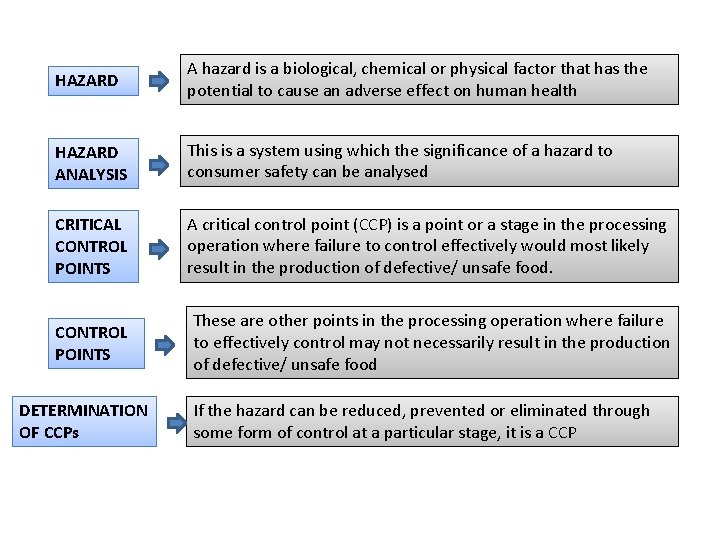
HAZARD A hazard is a biological, chemical or physical factor that has the potential to cause an adverse effect on human health HAZARD ANALYSIS This is a system using which the significance of a hazard to consumer safety can be analysed CRITICAL CONTROL POINTS A critical control point (CCP) is a point or a stage in the processing operation where failure to control effectively would most likely result in the production of defective/ unsafe food. CONTROL POINTS These are other points in the processing operation where failure to effectively control may not necessarily result in the production of defective/ unsafe food DETERMINATION OF CCPs If the hazard can be reduced, prevented or eliminated through some form of control at a particular stage, it is a CCP
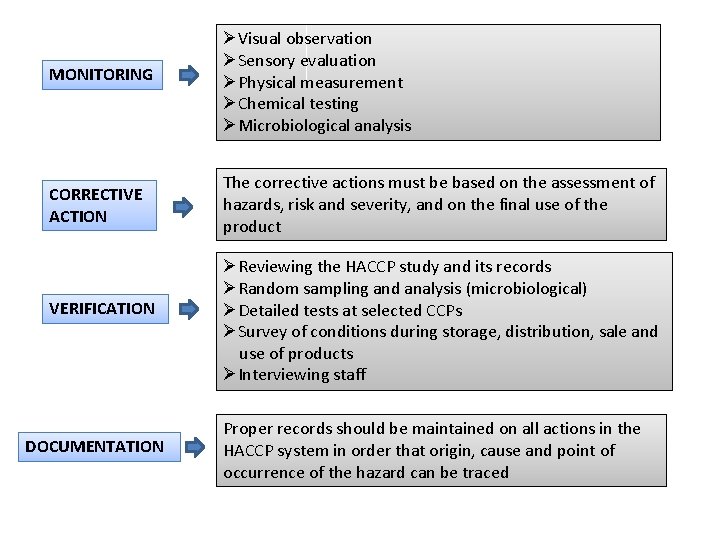
MONITORING ØVisual observation ØSensory evaluation ØPhysical measurement ØChemical testing ØMicrobiological analysis CORRECTIVE ACTION The corrective actions must be based on the assessment of hazards, risk and severity, and on the final use of the product VERIFICATION DOCUMENTATION ØReviewing the HACCP study and its records ØRandom sampling and analysis (microbiological) ØDetailed tests at selected CCPs ØSurvey of conditions during storage, distribution, sale and use of products ØInterviewing staff Proper records should be maintained on all actions in the HACCP system in order that origin, cause and point of occurrence of the hazard can be traced

- Slides: 17