
Diversified Dairy Cash Flow Budgeting Case Study 1
Diversified Dairy Cash Flow Budgeting Case Study 1 Author Information Kevin Bernhardt Farm Management Specialist, UW-Extension and Center for Dairy Profitability and Professor of Agri-Business, UW-Platteville School of Ag Questions: 608 -342 -1365 bernhark@uwplatt. edu
2 Cash Flow Process In 8 Easy Steps
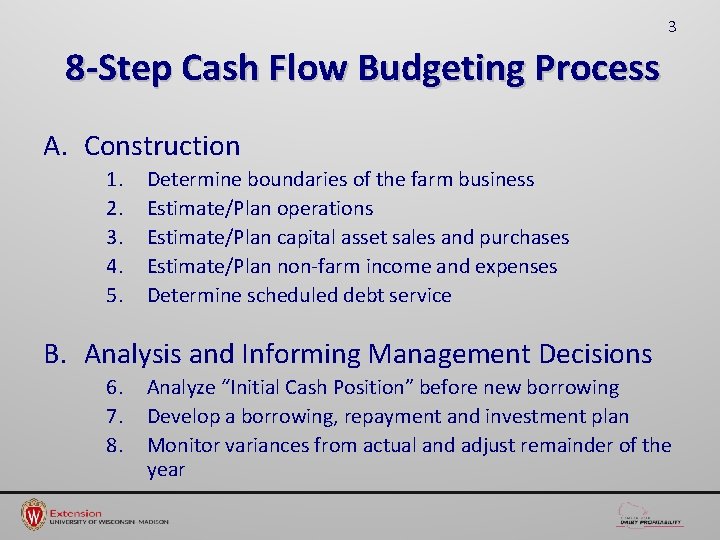
3 8 -Step Cash Flow Budgeting Process A. Construction 1. 2. 3. 4. 5. Determine boundaries of the farm business Estimate/Plan operations Estimate/Plan capital asset sales and purchases Estimate/Plan non-farm income and expenses Determine scheduled debt service B. Analysis and Informing Management Decisions 6. 7. 8. Analyze “Initial Cash Position” before new borrowing Develop a borrowing, repayment and investment plan Monitor variances from actual and adjust remainder of the year
4 Cash Flow Budget Construction 1. Determine the boundaries of the business − The boundaries of the cash flow budget might not stop at the same place as the income statement. o o Personal Non-farm
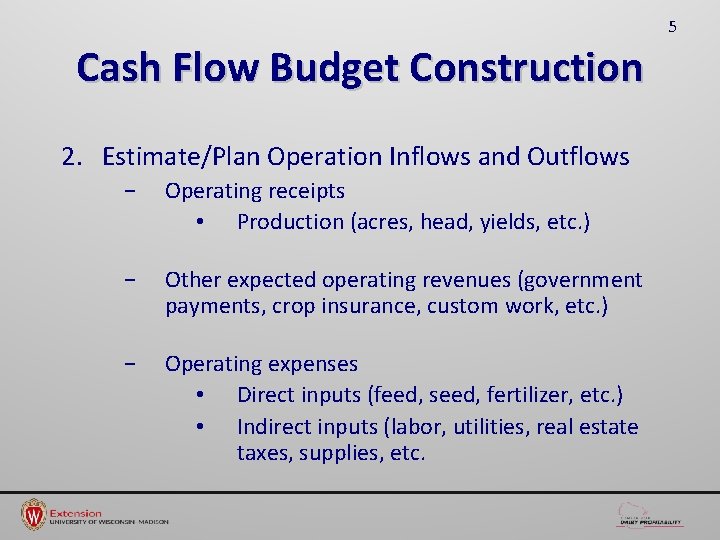
5 Cash Flow Budget Construction 2. Estimate/Plan Operation Inflows and Outflows − Operating receipts • Production (acres, head, yields, etc. ) − Other expected operating revenues (government payments, crop insurance, custom work, etc. ) − Operating expenses • Direct inputs (feed, seed, fertilizer, etc. ) • Indirect inputs (labor, utilities, real estate taxes, supplies, etc.
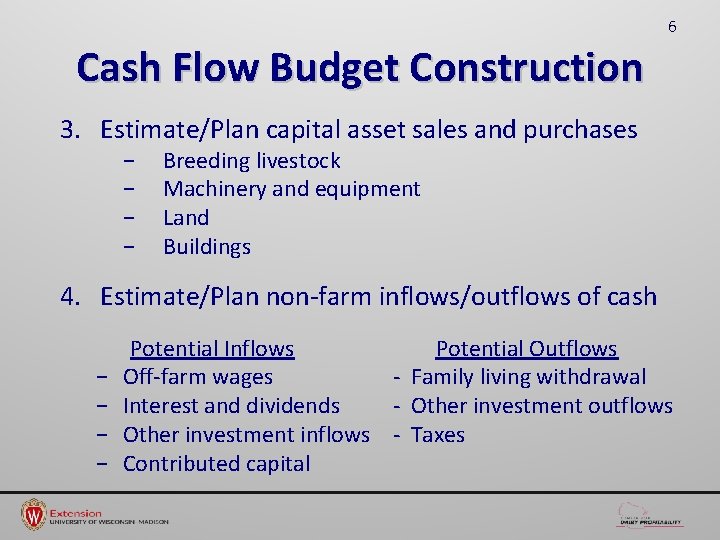
6 Cash Flow Budget Construction 3. Estimate/Plan capital asset sales and purchases − − Breeding livestock Machinery and equipment Land Buildings 4. Estimate/Plan non-farm inflows/outflows of cash − − Potential Inflows Potential Outflows Off-farm wages - Family living withdrawal Interest and dividends - Other investment outflows Other investment inflows - Taxes Contributed capital
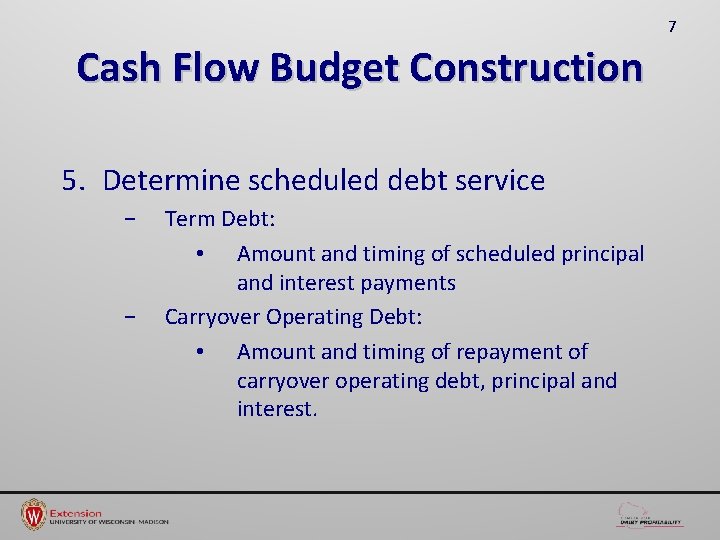
7 Cash Flow Budget Construction 5. Determine scheduled debt service − − Term Debt: • Amount and timing of scheduled principal and interest payments Carryover Operating Debt: • Amount and timing of repayment of carryover operating debt, principal and interest.
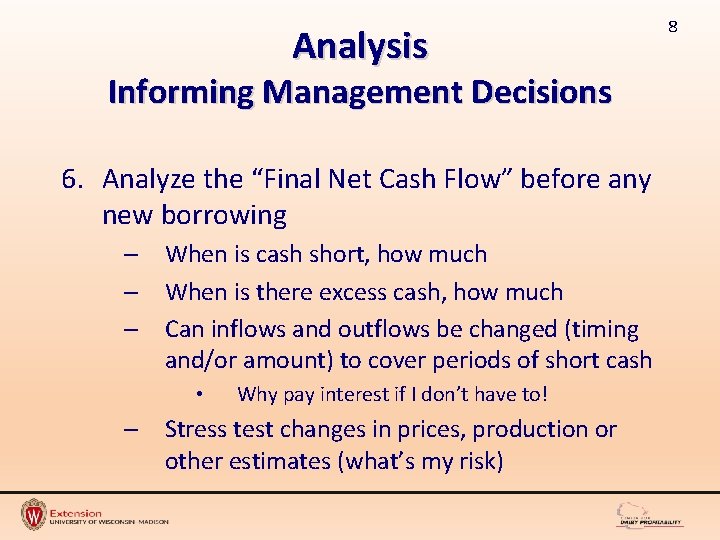
Analysis Informing Management Decisions 6. Analyze the “Final Net Cash Flow” before any new borrowing – When is cash short, how much – When is there excess cash, how much – Can inflows and outflows be changed (timing and/or amount) to cover periods of short cash • Why pay interest if I don’t have to! – Stress test changes in prices, production or other estimates (what’s my risk) 8
Analysis 9 Informing Management Decisions 7. Develop a borrowing, repayment and investment plan – Timing, amount and type of borrowing – Timing and amount of repayment – Timing, amount and type of investing excess cash • • Further debt repayment short-term investment
Analysis 10 Informing Management Decisions 8. Monitor variances and adjust remainder of year − Compare what actually occurred to what was planned and adjust the remainder of the budget accordingly • • Plan for positive cash flow Implement the plan
11 Let’s Practice Diversified Dairy Case Study
Cash Flow Planning for Next Year 12 • Much of the cash flow has already been completed including the actual cash flow from last year (column E). • Your challenge is completing the remainder and, in the process, learning how the cash flow is organized and how to build it. • Note, the blue-shaded cells are the missing pieces needing an entry.
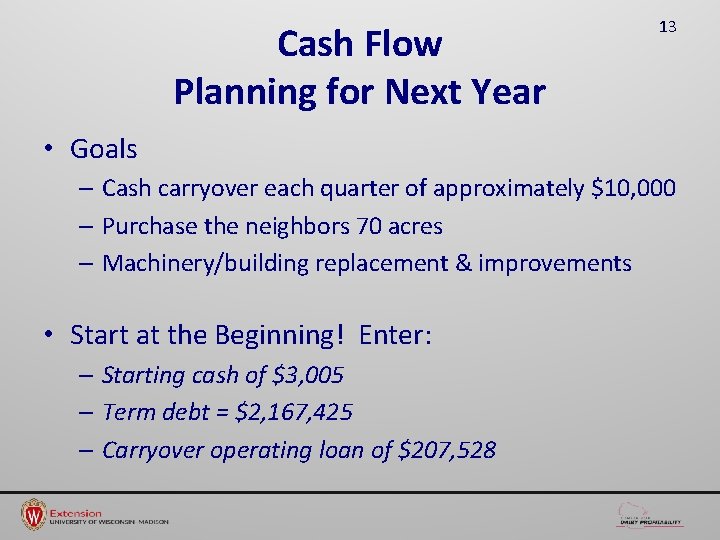
Cash Flow Planning for Next Year 13 • Goals – Cash carryover each quarter of approximately $10, 000 – Purchase the neighbors 70 acres – Machinery/building replacement & improvements • Start at the Beginning! Enter: – Starting cash of $3, 005 – Term debt = $2, 167, 425 – Carryover operating loan of $207, 528
14 Cash Inflows (Revenues)
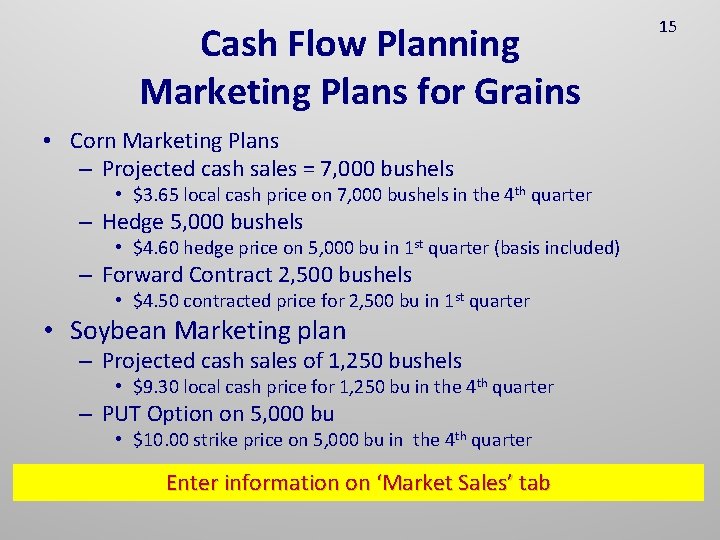
Cash Flow Planning Marketing Plans for Grains • Corn Marketing Plans – Projected cash sales = 7, 000 bushels • $3. 65 local cash price on 7, 000 bushels in the 4 th quarter – Hedge 5, 000 bushels • $4. 60 hedge price on 5, 000 bu in 1 st quarter (basis included) – Forward Contract 2, 500 bushels • $4. 50 contracted price for 2, 500 bu in 1 st quarter • Soybean Marketing plan – Projected cash sales of 1, 250 bushels • $9. 30 local cash price for 1, 250 bu in the 4 th quarter – PUT Option on 5, 000 bu • $10. 00 strike price on 5, 000 bu in the 4 th quarter Enter information on ‘Market Sales’ tab 15
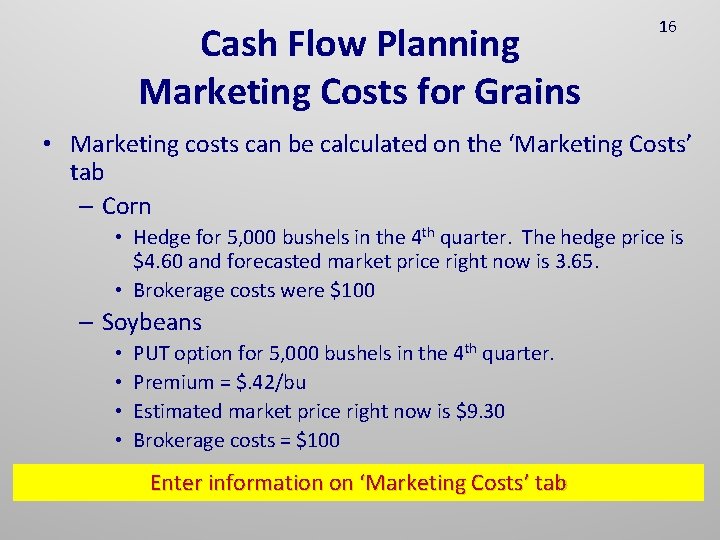
Cash Flow Planning Marketing Costs for Grains 16 • Marketing costs can be calculated on the ‘Marketing Costs’ tab – Corn • Hedge for 5, 000 bushels in the 4 th quarter. The hedge price is $4. 60 and forecasted market price right now is 3. 65. • Brokerage costs were $100 – Soybeans • • PUT option for 5, 000 bushels in the 4 th quarter. Premium = $. 42/bu Estimated market price right now is $9. 30 Brokerage costs = $100 Enter information on ‘Marketing Costs’ tab
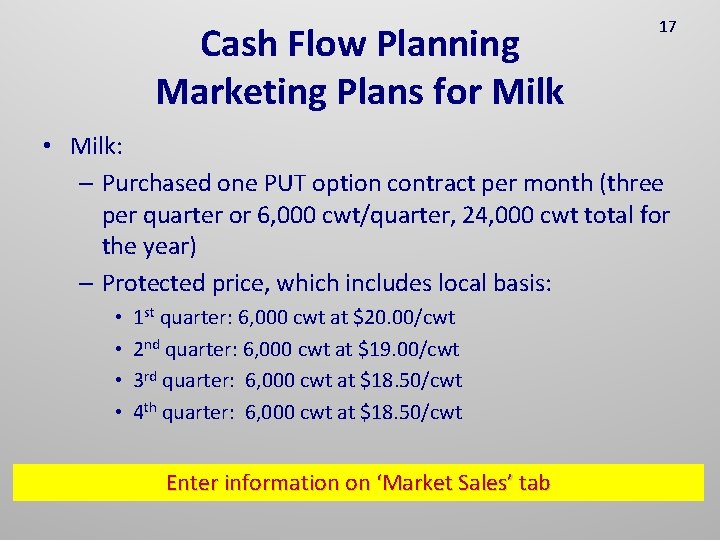
Cash Flow Planning Marketing Plans for Milk 17 • Milk: – Purchased one PUT option contract per month (three per quarter or 6, 000 cwt/quarter, 24, 000 cwt total for the year) – Protected price, which includes local basis: • • 1 st quarter: 6, 000 cwt at $20. 00/cwt 2 nd quarter: 6, 000 cwt at $19. 00/cwt 3 rd quarter: 6, 000 cwt at $18. 50/cwt 4 th quarter: 6, 000 cwt at $18. 50/cwt Enter information on ‘Market Sales’ tab
Cash Flow Planning Marketing Costs for Milk 18 • The marketing costs for the milk options is the premium cost for the options and any brokerage costs. This has already been entered on the ‘Marketing Costs’ tab, but it may be useful to review how marketing costs are entered using the ‘Marketing Costs’ tab.
19 Marketing Plans and Cost Summary • Note that in rows 9, 10 and 11 on the ‘CASH FLOW’ tab, the totals are given for cash revenue generated from grain, milk and market cattle sales. • THIS IS INFORMATION ONLY • Users must use (or ignore) this information to manually enter the total revenue figures in the following rows 12, 13, and 14. • For the case study enter the numbers exactly as the information provides. • Note also that there is some expected wheat sales of 2, 415 in the 3 rd quarter. This is already entered in line 15 (Sales of other market items/products) but is an example of where other operational sales can be entered.
20 Marketing Costs on ‘CASH FLOW’ • Also notice that on the gray-shaded row 71 the information from the ‘Marketing Costs’ tab is provided. • Again, this is information only and users must use or ignore this information, but either way must manually enter their estimate of marketing costs on the following line 72. • Case study users, please enter the information as shown.
Other Cash Inflows from Farm Operations 21 • Cull sales are expected to total $124, 000 for the year based on fairly aggressive culling due to new stock coming in and expected favorable cull cow prices. – The amount per quarter is expected to equivalent. • Use column M to determine the amount of sales per quarter
22 Cash Inflows from Capital Asset Sales • Selling some underutilized equipment – $7, 000 machinery sales, all in 1 st quarter
23 Cash Outflow (Expenses)
24 Cash Outflows for Farm Operations • Most of the expected cash expenses have been entered. Ones yet to enter include: – Cash feed purchases expected to be $250, 000 • Evenly distributed through each quarter – Estimate cash purchases for fertilizer and lime of $28, 500, most of which will actually be for next year’s use, nevertheless it is a cash outflow this year. • Purchase made in the 4 th quarter
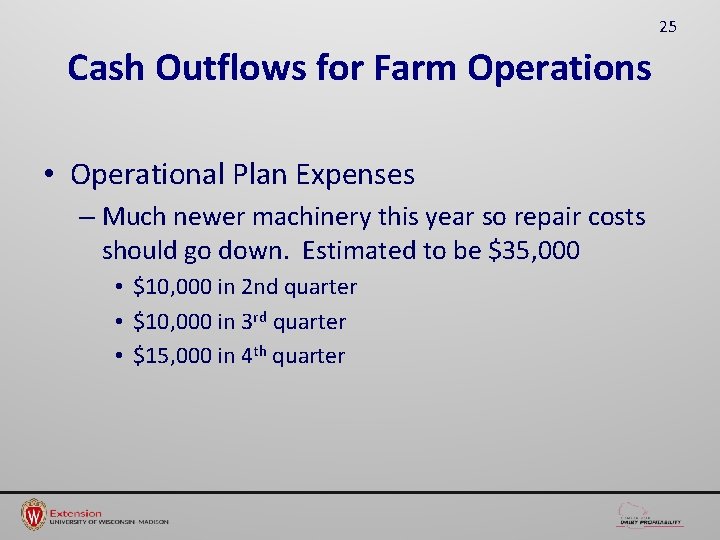
25 Cash Outflows for Farm Operations • Operational Plan Expenses – Much newer machinery this year so repair costs should go down. Estimated to be $35, 000 • $10, 000 in 2 nd quarter • $10, 000 in 3 rd quarter • $15, 000 in 4 th quarter
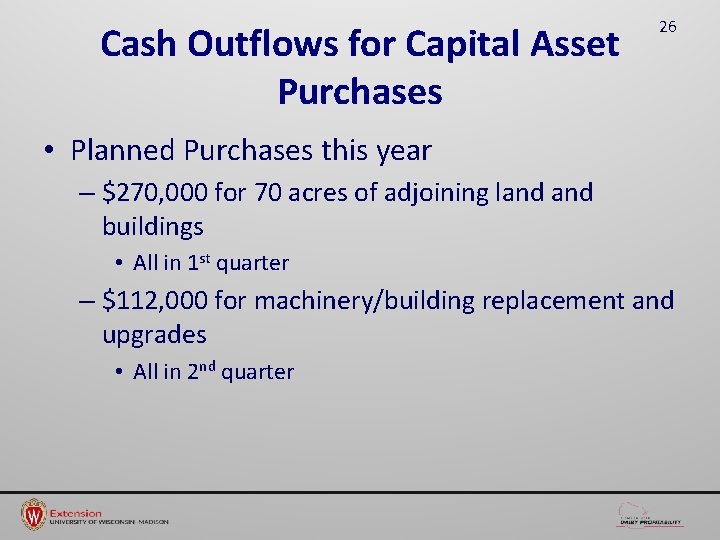
Cash Outflows for Capital Asset Purchases 26 • Planned Purchases this year – $270, 000 for 70 acres of adjoining land buildings • All in 1 st quarter – $112, 000 for machinery/building replacement and upgrades • All in 2 nd quarter
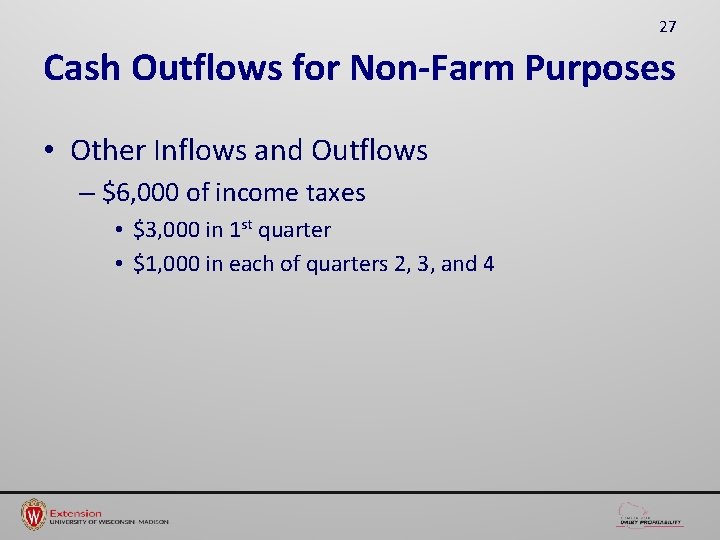
27 Cash Outflows for Non-Farm Purposes • Other Inflows and Outflows – $6, 000 of income taxes • $3, 000 in 1 st quarter • $1, 000 in each of quarters 2, 3, and 4
28 Scheduled Debt Service
Cash Outflows for Scheduled Debt Service 29 • Use the ‘Current Debt Schedule’ tab to determine scheduled debt service. Additional entries for the ‘Current Debt Schedule’ tab include: – In Operating Lines of Credit section • • Description of debt. Risk Line of Credit Last paid on 12/15/2014 Principal balance: $14, 649 all due this next year Scheduled payment date: 2/28/2015 Interest rate of 3. 04% Interest payment: as calculated in the far-right column Principal payment: total balance of $14, 649 Payment in the 1 st quarter
Cash Outflows for Scheduled Debt Service 30 • Additional entries for the ‘Current Debt Schedule’ tab include: – In Term/Installment Loans section (Non-Real Estate) • • Description of debt: FPP Machinery Note Last paid on 2/15/2014 Principal balance: $139, 486 Scheduled payment date: 2/15/2015 Interest rate of 3. 04% Interest payment: as calculated in the far-right column Principal payment this year: $44, 950 Payment in the 1 st quarter
Cash Outflows for Scheduled Debt Service 31 • When the ‘Current Debt Schedule’ tab is completed the results must be transferred to the ‘CASH FLOW’ tab. – Projected totals (column F in ‘CASH FLOW” can be found in the orange-shaded cells of the ‘Current Debt Schedule” – The breakdown by quarter/month is based on columns G, H and K.
32 Initial Results
33 Initial Results • At this point the Cash Flow is complete except for any new borrowing • The Final Net Cash Flow (line 107) shows lots of red, meaning that there needs to be additional cash inflows, less cash outflows or new borrowing • Remember that we purchased land machinery updates, but have not taken out any loans for that or for operating this year – So, before getting to concerned yet, let’s enter some expected (normal) new borrowing to cover operations and new capital asset purchases.
New Borrowing for Capital Asset Purchases – Term Debt 34 • Use Table 2 on ‘Debt and Interest Calculators’ tab to analyze the following – Land purchase: $263, 000 new borrowing, 1 st quarter • Borrow $222, 000 from bank @ 5. 00% for 25 years, payment being analyzed is zero • Borrow $41, 000 from Vernal @ 3. 65% for 8 years, payment being analyzed is zero – Machinery/Bldg upgrade: $112, 000 new borrowing, 2 nd quarter • Borrow $112, 000 at 3. 5% for 7 years – Total of new borrowing: $263, 000+$112, 000 = $375, 000 • Also found in row 24 of Table 2. • Transfer this to ‘CASH FLOW’ in row titled “New Borrowing – Term Debt” with the breakdown by quarter as indicated above.
New Borrowing for Capital Asset Purchases –Term Debt 35 • Note, on the ‘Debt and Interest Calculators’ tab the payment number being analyzed this year is zero. This is because the first payment does not come due until next year. If you want to see what the payment and interest will be next year, then enter a “ 1” in the “Payment Number Being Analyzed” column.
36 New Borrowing for Operating Loan • New operating loan is likely the last step • Remember, the goal is to end each quarter with $10, 000 or greater, that is, the Final Net Cash Flow (line 107) should be $10, 000 or greater.
37 New Borrowing for Operating Loan • At this point, if all is correctly completed, the Final Net Cash Flow is not a positive $10, 000 or greater for quarter 1 – Should be negative $261, 483 • What to do? – Could go back and change the timing of cash inflows and outflows – Could change our plans for operations, capital asset purchase and sales – Etc. – Or, could go to the bank and ask for an operating loan.
38 New Borrowing for Operating Loan • Since the quarter 1 Final Net Cash Flow is negative $261, 483 and since we want a positive $10, 000 then we will round up and ask the bank for a new operating loan of $272, 000 – Enter $272, 000 for “New Borrowing – Operating Loan” for the 1 st quarter.
39 New Borrowing for Operating Loan • Moving on to the 2 nd quarter, the Final Net Cash Flow is once again negative (-53, 898). • So, again we could look at operations, capital asset sales and purchases, etc. to find cash flow, but in this case, they decided to take another draw on the operating loan of $64, 000 – Enter $64, 000 for “New Borrowing –Operating Loan” for the 2 nd quarter
40 CONGRATULATIONS • The Final Net Cash Flow for all quarters is now positive and greater than the goal of $10, 000! • Note, that the third and fourth quarters now have substantial amount of remaining cash • Several options exist for what to do with that cash – Buy capital assets – Pay down debt – Invest – Etc.

41 Any Questions?
- Slides: 41