
Diversification Strategy OUTLINE Introduction The Basic Issues The
Diversification Strategy OUTLINE • Introduction: The Basic Issues • The Trend over Time • Motives for Diversification - Growth and Risk Reduction - Shareholder Value: Porter’s Essential Tests. • Competitive Advantage from Diversification • Diversification and Performance: Empirical Evidence • Relatedness in Diversification
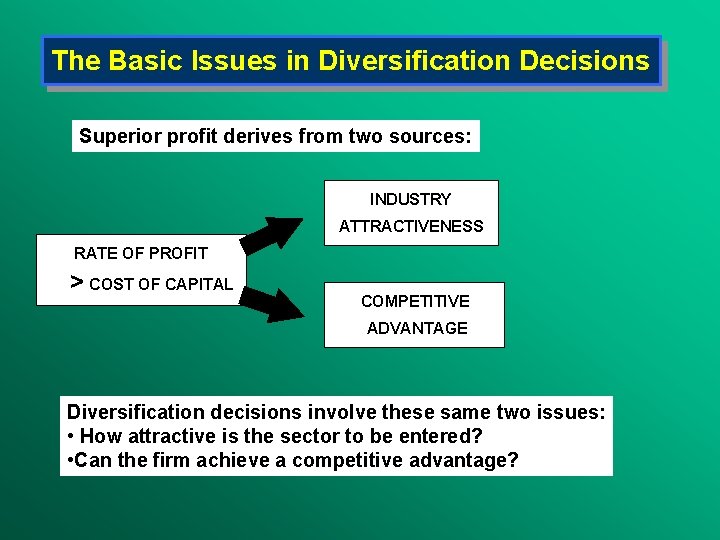
The Basic Issues in Diversification Decisions Superior profit derives from two sources: INDUSTRY ATTRACTIVENESS RATE OF PROFIT > COST OF CAPITAL COMPETITIVE ADVANTAGE Diversification decisions involve these same two issues: • How attractive is the sector to be entered? • Can the firm achieve a competitive advantage?
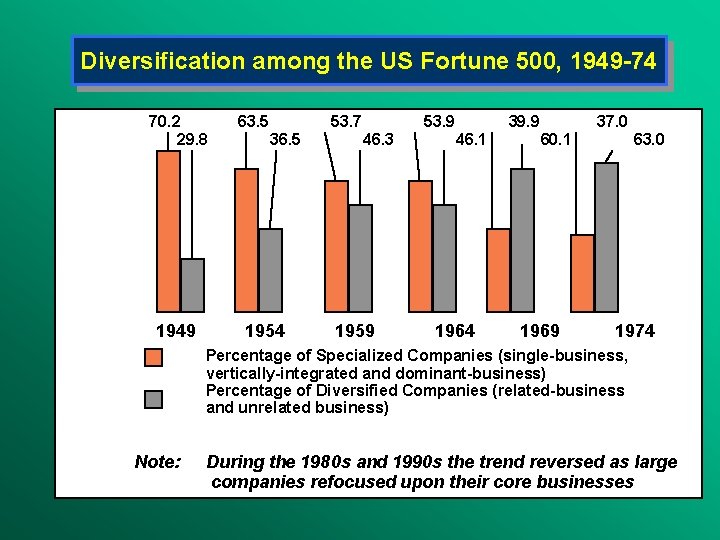
Diversification among the US Fortune 500, 1949 -74 70. 2 29. 8 1949 63. 5 53. 7 36. 5 1954 53. 9 46. 3 1959 39. 9 46. 1 1964 37. 0 60. 1 1969 63. 0 1974 Percentage of Specialized Companies (single-business, vertically-integrated and dominant-business) Percentage of Diversified Companies (related-business and unrelated business) Note: During the 1980 s and 1990 s the trend reversed as large companies refocused upon their core businesses
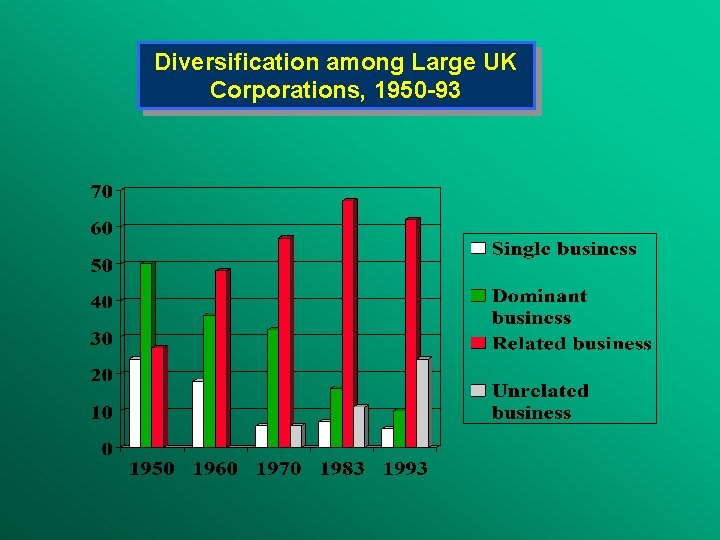
Diversification among Large UK Corporations, 1950 -93
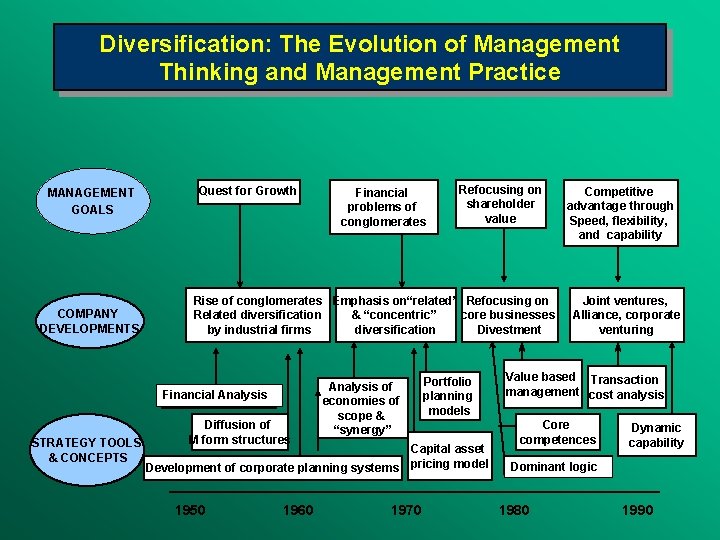
Diversification: The Evolution of Management Thinking and Management Practice MANAGEMENT GOALS COMPANY DEVELOPMENTS Quest for Growth Refocusing on shareholder value Rise of conglomerates Emphasis on“related’ Refocusing on & “concentric” Related diversification core businesses by industrial firms diversification Divestment Financial Analysis STRATEGY TOOLS & CONCEPTS Financial problems of conglomerates Diffusion of M form structures Analysis of economies of scope & “synergy” Portfolio planning models Capital asset pricing model Development of corporate planning systems 1950 1960 1970 Competitive advantage through Speed, flexibility, and capability Joint ventures, Alliance, corporate venturing Value based Transaction management cost analysis Core competences Dynamic capability Dominant logic 1980 1990
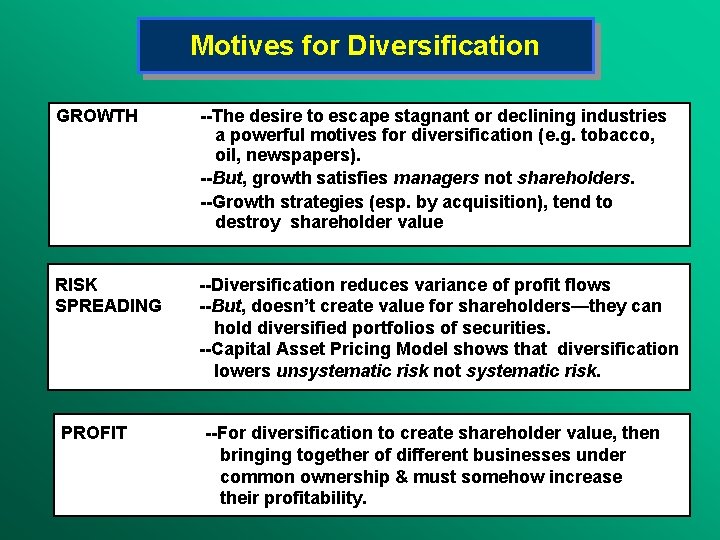
Motives for Diversification GROWTH --The desire to escape stagnant or declining industries a powerful motives for diversification (e. g. tobacco, oil, newspapers). --But, growth satisfies managers not shareholders. --Growth strategies (esp. by acquisition), tend to destroy shareholder value RISK SPREADING --Diversification reduces variance of profit flows --But, doesn’t create value for shareholders—they can hold diversified portfolios of securities. --Capital Asset Pricing Model shows that diversification lowers unsystematic risk not systematic risk. PROFIT --For diversification to create shareholder value, then bringing together of different businesses under common ownership & must somehow increase their profitability.
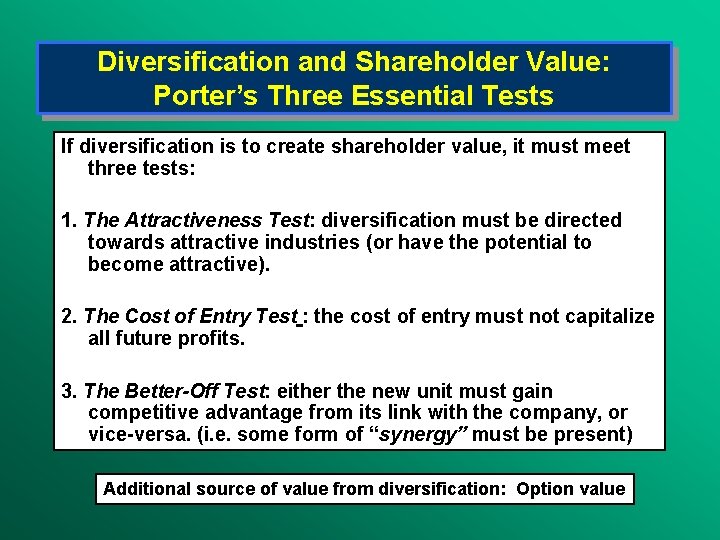
Diversification and Shareholder Value: Porter’s Three Essential Tests If diversification is to create shareholder value, it must meet three tests: 1. The Attractiveness Test: diversification must be directed towards attractive industries (or have the potential to become attractive). 2. The Cost of Entry Test : the cost of entry must not capitalize all future profits. 3. The Better-Off Test: either the new unit must gain competitive advantage from its link with the company, or vice-versa. (i. e. some form of “synergy” must be present) Additional source of value from diversification: Option value
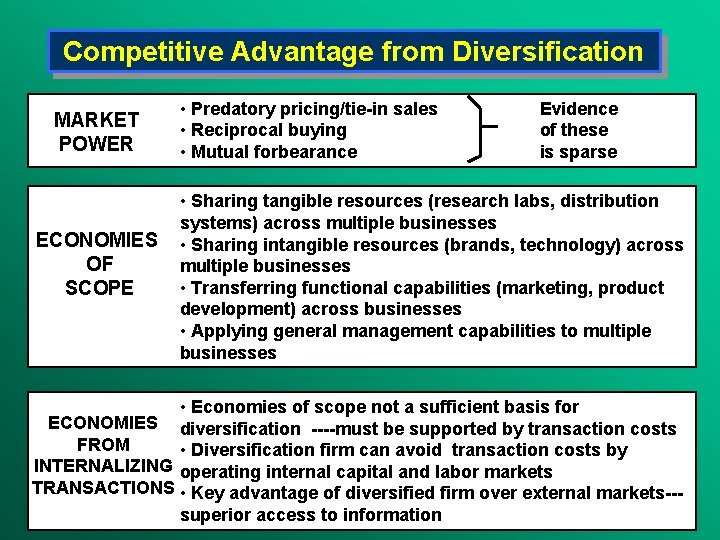
Competitive Advantage from Diversification MARKET POWER ECONOMIES OF SCOPE • Predatory pricing/tie-in sales • Reciprocal buying • Mutual forbearance Evidence of these is sparse • Sharing tangible resources (research labs, distribution systems) across multiple businesses • Sharing intangible resources (brands, technology) across multiple businesses • Transferring functional capabilities (marketing, product development) across businesses • Applying general management capabilities to multiple businesses • Economies of scope not a sufficient basis for ECONOMIES diversification ----must be supported by transaction costs FROM • Diversification firm can avoid transaction costs by INTERNALIZING operating internal capital and labor markets TRANSACTIONS • Key advantage of diversified firm over external markets--superior access to information
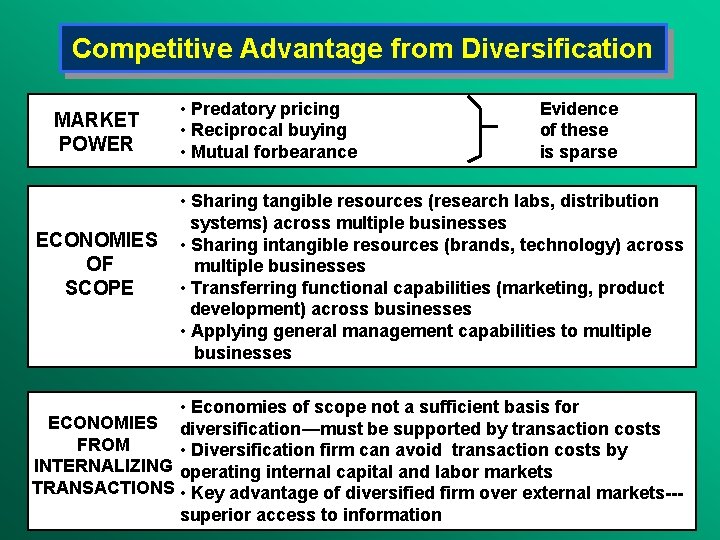
Competitive Advantage from Diversification MARKET POWER ECONOMIES OF SCOPE • Predatory pricing • Reciprocal buying • Mutual forbearance Evidence of these is sparse • Sharing tangible resources (research labs, distribution systems) across multiple businesses • Sharing intangible resources (brands, technology) across multiple businesses • Transferring functional capabilities (marketing, product development) across businesses • Applying general management capabilities to multiple businesses • Economies of scope not a sufficient basis for ECONOMIES diversification—must be supported by transaction costs FROM • Diversification firm can avoid transaction costs by INTERNALIZING operating internal capital and labor markets TRANSACTIONS • Key advantage of diversified firm over external markets--superior access to information
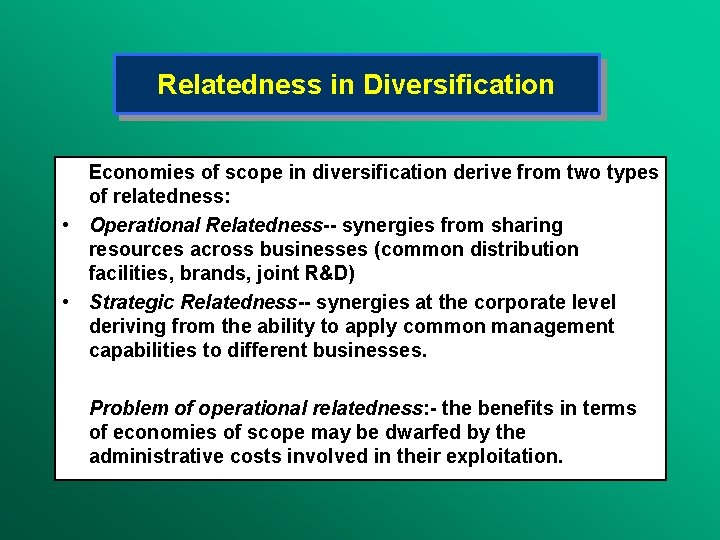
Relatedness in Diversification Economies of scope in diversification derive from two types of relatedness: • Operational Relatedness-- synergies from sharing resources across businesses (common distribution facilities, brands, joint R&D) • Strategic Relatedness-- synergies at the corporate level deriving from the ability to apply common management capabilities to different businesses. Problem of operational relatedness: - the benefits in terms of economies of scope may be dwarfed by the administrative costs involved in their exploitation.
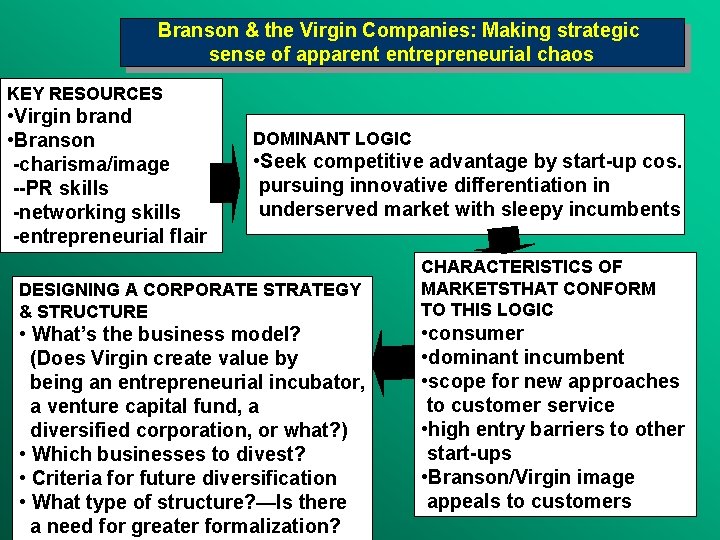
Branson & the Virgin Companies: Making strategic sense of apparent entrepreneurial chaos KEY RESOURCES • Virgin brand • Branson -charisma/image --PR skills -networking skills -entrepreneurial flair DOMINANT LOGIC • Seek competitive advantage by start-up cos. pursuing innovative differentiation in underserved market with sleepy incumbents DESIGNING A CORPORATE STRATEGY & STRUCTURE • What’s the business model? (Does Virgin create value by being an entrepreneurial incubator, a venture capital fund, a diversified corporation, or what? ) • Which businesses to divest? • Criteria for future diversification • What type of structure? —Is there a need for greater formalization? CHARACTERISTICS OF MARKETSTHAT CONFORM TO THIS LOGIC • consumer • dominant incumbent • scope for new approaches to customer service • high entry barriers to other start-ups • Branson/Virgin image appeals to customers
- Slides: 11