
Diverse Learners Co P Building Schoolwide Systems of
Diverse Learners Co. P: Building Schoolwide Systems of Positive Behavior Support Facilitator: Donna Lupatkin Guest: Howard S. Muscott, Ed. D. NH Center for Effective Behavioral Interventions and Supports Date: January 12, 2009
Goals for Today 1. To learn about the fundamental assumptions and beliefs behind PBIS 2. To learn the system, data and practice features of the universal system of PBIS 3. To identify next steps for those schools contemplating implementation

Meet Howard Muscott
Howard’s Background Howard Muscott is director of the New Hampshire Center for Effective Behavioral Interventions and Support, a statewide technical assistance and training network aimed at promoting positive and preventive school discipline systems and improving the emotional well-being of all children. Howard has more than 30 years of experience in education ranging from preschool through high school and higher education. He has been a special education teacher and principal at three schools for students with disabilities. He recently retired as professor of education from Rivier College where he directed the Undergraduate Special Education program and the graduate program in Emotional and Behavioral Disorders for 15 years.

What is PBIS? • PBIS is a systematic framework for improving valued social, emotional, behavioral and learning outcomes for children in K-12 schools. • PBIS uses a broad set of evidence-based systemic and individualized strategies to effectively prevent and respond to problem behavior. • PBIS is a strategic approach in which collaborative teams use effective group processes and data-based decisionmaking to achieve desired outcomes. Muscott & Mann (2007)

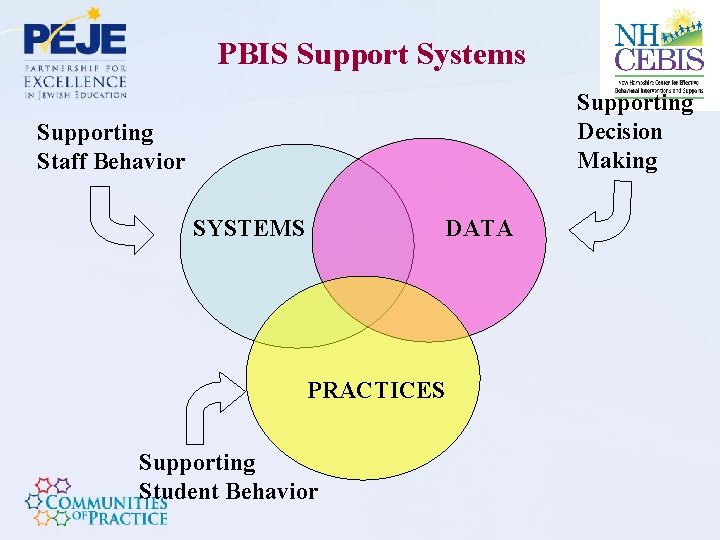
PBIS Support Systems Supporting Decision Making Supporting Staff Behavior DATA SYSTEMS PRACTICES Supporting Student Behavior
What challenges do you experience in terms of school climate and discipline? – Sharon: The main issue is with the handful of kids who do not respond to the typical discipline strategies. – Helen: The students in the top tier, which is a small percent, need different strategies and interventions. The staff and parents interpret this as students not receiving consequences. – Cynthia: The issues that children (mostly in the second group) have are in great measure a reflection of home issues. How do you deal with this? – Rabbi Rodman: At which point do you allow a child to remain in the school? Are they taking away from other students? This is a hard question for a principal to address. – Rivka: How do you get all of the players on board? How do you communicate with parents? How do you help the students buy in to the model?

How the Universal Tier Works
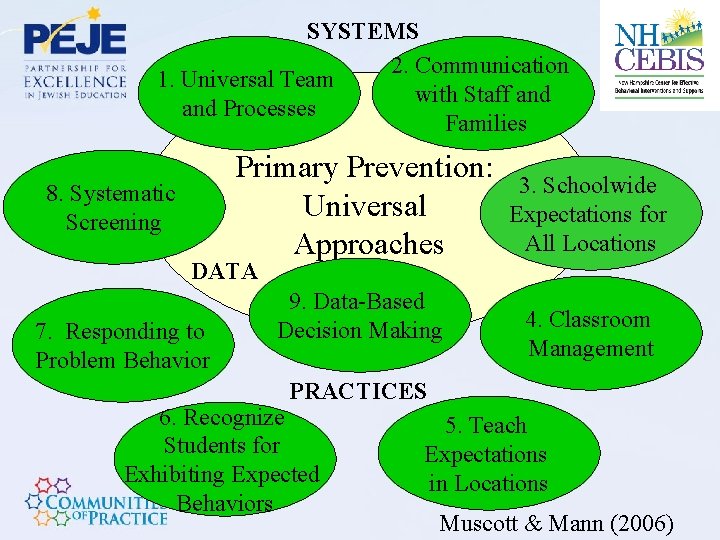
SYSTEMS 2. Communication 1. Universal Team with Staff and Processes Families 8. Systematic Screening Primary Prevention: Universal Approaches 3. Schoolwide Expectations for All Locations DATA 7. Responding to Problem Behavior 9. Data-Based Decision Making 4. Classroom Management PRACTICES 6. Recognize Students for Exhibiting Expected Behaviors 5. Teach Expectations in Locations Muscott & Mann (2006)
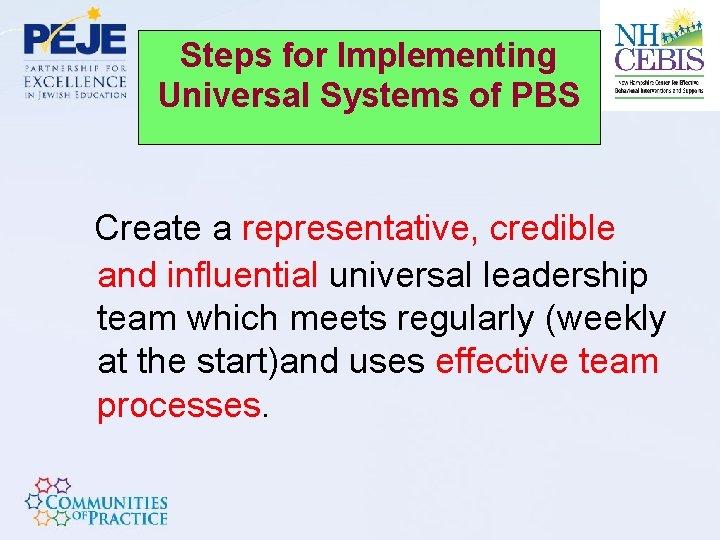
Steps for Implementing Universal Systems of PBS Create a representative, credible and influential universal leadership team which meets regularly (weekly at the start)and uses effective team processes.
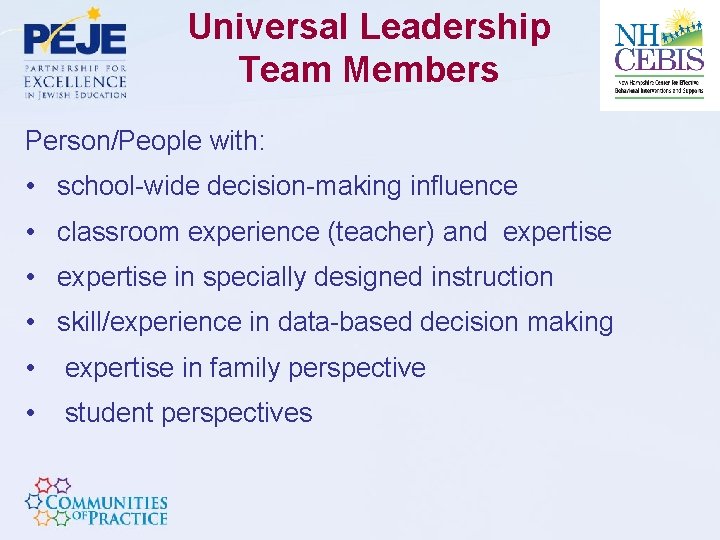
Universal Leadership Team Members Person/People with: • school-wide decision-making influence • classroom experience (teacher) and expertise • expertise in specially designed instruction • skill/experience in data-based decision making • expertise in family perspective • student perspectives
How Teams Work • Identify and agree to ground rules and meeting processes – – • Have a mission that describes purpose – • Meet regularly with full team Group processes maintain the team Team members are committed to the mission Driven by outcomes and action – – Use action planning Individual accountability
Example of Team Expectations and Ground Rules: Belknap-Merrimack Head Start • Stay on topic (be concise, succinct) • Accomplish charge/agenda items • Be positive • Tabled items will be revisited • Build on others’ ideas • Come to consensus • Inform/update absent members • Come prepared to meeting – action items completed • Read agenda at start of meeting
How would you determine who would be on the Universal Leadership Team at your school? – Cynthia: I would have an open process (transparent); give some introduction at a faculty meeting; and/or “invite” some folks. I might offer a way to “earn” joining the effort, which might foster interest. – Rivka: At my school, it’s not that easy to recruit volunteers. Perhaps if there was some type of “carrot” (e. g. , professional development points), it would be easier. – Howard: People will respond if they have real influence and power around leadership. It must be related to the shared outcomes so it is meaningful. When a team goes into a school, they begin the buy-in process. – Rivka: If it’s important to have someone with data-driven decision-making skills, and there is no one with this skill, then maybe the whole team can work to accomplish this. – Howard: Get the right people on the team. Get the right buy-in. Have them learn to work together as a team. Respect must be part of the manner in which people work together.
School Examples
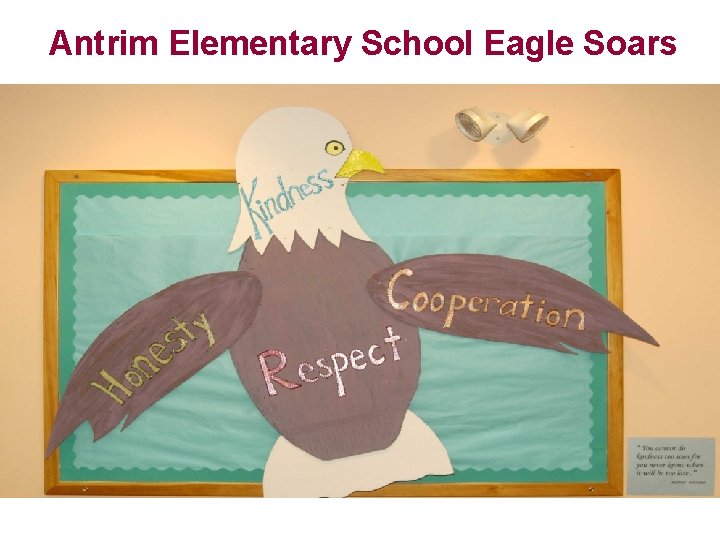
Antrim Elementary School Eagle Soars
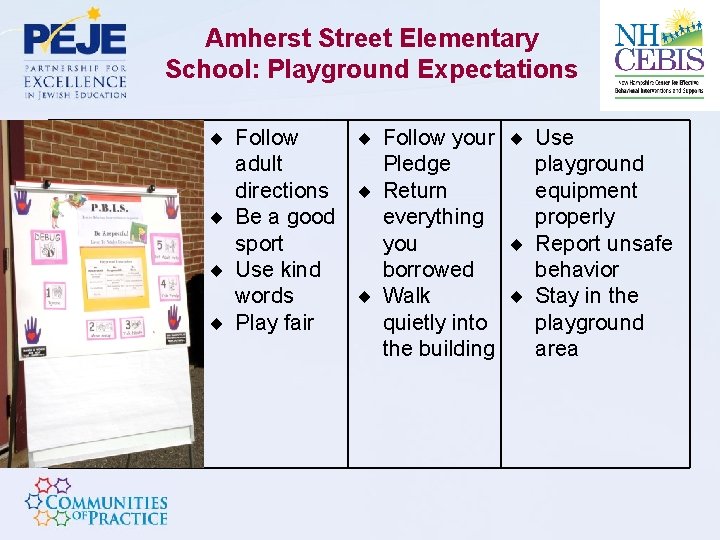
Amherst Street Elementary School: Playground Expectations Playgroun d Follow your Use adult Pledge playground directions Return equipment Be a good everything properly sport you Report unsafe Use kind borrowed behavior words Walk Stay in the Play fair quietly into playground the building area
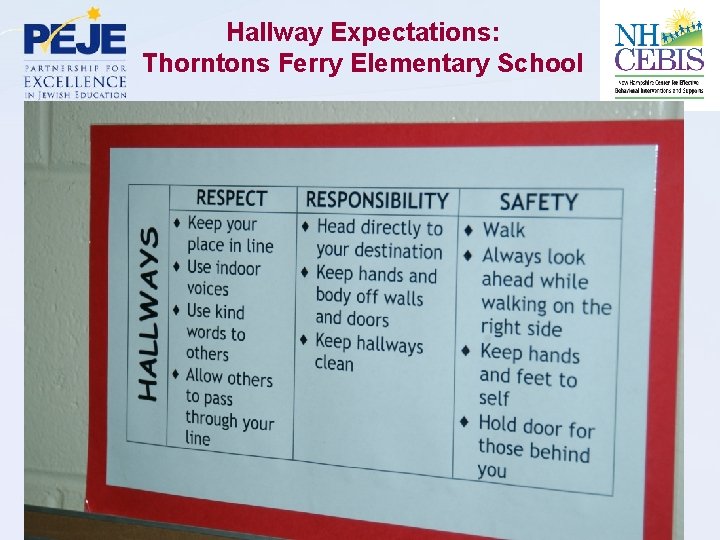
Hallway Expectations: Thorntons Ferry Elementary School
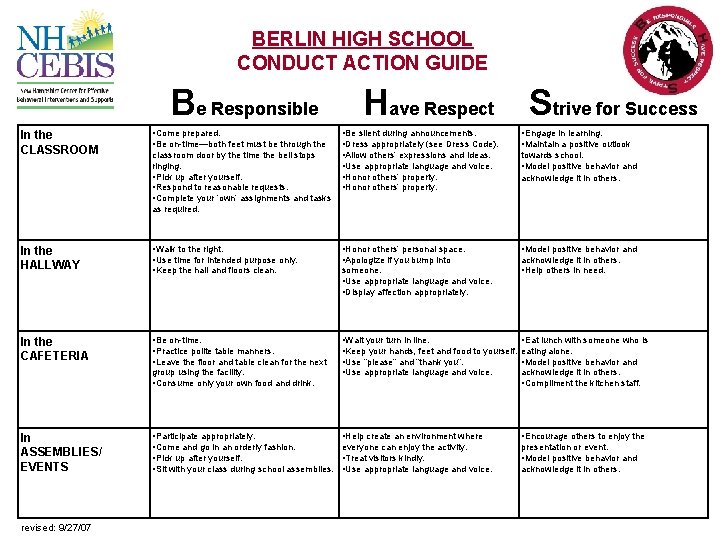
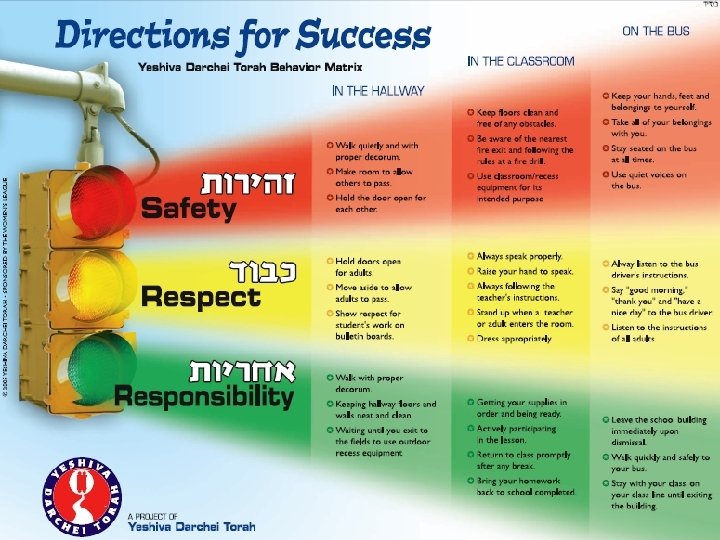
BERLIN HIGH SCHOOL CONDUCT ACTION GUIDE Be Responsible In the CLASSROOM • Come prepared. • Be on-time—both feet must be through the In the HALLWAY In the CAFETERIA • Be silent during announcements. • Dress appropriately (see Dress Code). • Allow others’ expressions and ideas. • Use appropriate language and voice. • Honor others’ property. • Engage in learning. • Maintain a positive outlook • Walk to the right. • Use time for intended purpose only. • Keep the hall and floors clean. • Honor others’ personal space. • Apologize if you bump into • Model positive behavior and • Be on-time. • Practice polite table manners. • Leave the floor and table clean for the next • Wait your turn in line. • Keep your hands, feet and food to yourself. • Use “please” and “thank you”. • Use appropriate language and voice. • Eat lunch with someone who is • Help create an environment where • Encourage others to enjoy the everyone can enjoy the activity. • Treat visitors kindly. • Use appropriate language and voice. presentation or event. • Model positive behavior and acknowledge it in others. classroom door by the time the bell stops ringing. • Pick up after yourself. • Respond to reasonable requests. • Complete your ‘own’ assignments and tasks as required. group using the facility. • Consume only your own food and drink. In ASSEMBLIES/ EVENTS revised: 9/27/07 Have Respect Strive for Success • Participate appropriately. • Come and go in an orderly fashion. • Pick up after yourself. • Sit with your class during school assemblies. someone. • Use appropriate language and voice. • Display affection appropriately. towards school. • Model positive behavior and acknowledge it in others. • Help others in need. eating alone. • Model positive behavior and acknowledge it in others. • Compliment the kitchen staff.
Rolling out the Program Muscott & Mann (2004) Rollout is the design and implementation of a systematic set of plans and procedures for communicating, teaching, and practicing all elements of the universal program or schoolwide discipline system with faculty, students, families and community members.
Rollout Activities • Hold an introductory kick-off event. • Create a schedule to systematically teach all students the program or schoolwide expectations in strategic locations within the school.
Positively Recognize Expected Behavior • Provide specific, verbal acknowledgement using words from the teaching matrix • Provide acknowledgement at a 4: 1 ratio or better of positive to corrective contacts • Provide acknowledgement as quickly after the expected behavior as possible • Focus positive attention on problem routines • Acknowledge at many students as possible
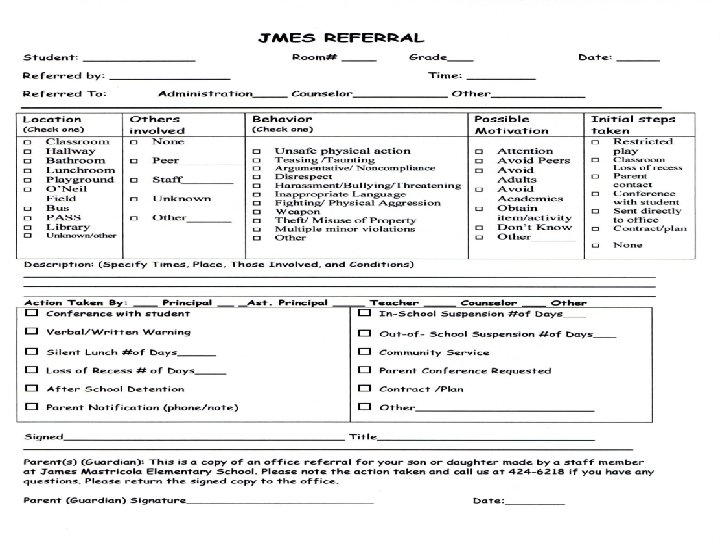
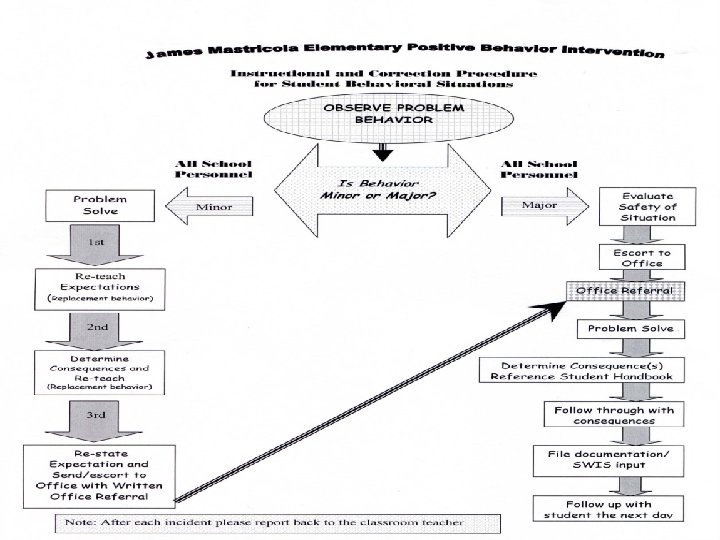
Procedures for Responding to Problem Behavior a. Definitions of Problem Behaviors (Majors vs. Minors) b. Office Discipline Referral Form or Form for Recording Problem Behaviors c. Process for Responding to Problem Behaviors d. Consequences (Punishments, Reteaching) for Problem Behaviors
Majors vs. Minors • Inappropriate language – Inappropriate verbal comments that are not directed toward an individual or group. • Abusive language – Inappropriate verbal messages that include swearing, name calling and profanity overtly directed toward someone.
Why do PBIS school wide? Howard: If people question why do this as a whole school, a response is that we are one school, one community, and we need to work together to be consistent.
Voice from the Field “I was very skeptical about this program at first. I thought, here we go again – another initiative. But I can honestly say that teaching is much easier with PBIS in place – I am now sold on this approach. ” Barbara Condon, elementary school teacher, Merrimack School District
Stages of Implementation Recruitment (September-December) 1. Awareness – Administrator meetings and staff presentations 2. Interest – Gathering information to make informed decision and obtaining commitments Preparation (December-August) 3. Readiness – Constructing the Universal Leadership Team (December) – Initial Training and Technical Assistance (January-August) Initial Implementation Period (September-June) 4. Implementation Formal introduction to students and families Sustaining Implementation 5. Sustainability (July Year 2 -December Year 3) – Training (3 xs/year) with other coaches – TA available during the third year
Resources • Applying Positive Behavioral Support and Functional Behavioral Assessment in Schools by OSEP Center on PBIS at the University of Oregon. • 7 Steps for Developing a Proactive Schoolwide Discipline Plan: A Guide for Principals and Leadership Teams by Geoff Colvin. • Implementing Positive Behavior Support Systems in Early Childhood and Elementary Settings by Melissa Stormont, Timothy J. Lewis, Rebecca Sue Beckner, and Nanci W. Johnson • Building Positive Behavior Support Systems in Schools: Functional Behavioral Assessment by Deanne A. Crone and Robert H. Horner • Parenting With Positive Behavior Support: A Practical Guide to Resolving Your Child's Difficult Behavior by Meme Hieneman, Karen Childs, and Jane Sergay • www. pbis. org; www. pbisillinois. org; http: //www. pbismaryland. org Howard Muscott, Ed. D. Director, NH CEBIS at SERESC 603 -206 -6891; 603 -440 -8141 (cell) www. nhcebis. seresc. net
PEJE wishes to thank Hidden Sparks for their generous support of our Co. P
- Slides: 33