
DIVERSE DISCIPLINES PRESENTATION Stephanie Gustman Maureen Koval Adam



- Slides: 25
DIVERSE DISCIPLINES PRESENTATION Stephanie Gustman Maureen Koval Adam March Deborah Williams
Introduction Phenomenon of Interest: Nursing Leadership Issue: Leadership Potential Problem: Leadership impact on nurse satisfaction Non-nursing Theories: Social Exchange Theory Emotional Intelligence Theory Nursing Theory: Human-to-Human Interaction
Issue Phenomenon of Interest – Nurse Leadership effect on nurse satisfaction Key Behaviors: Communication and Respect Nurse Leader Influence: • Transformational Leadership • Relational Ability • Emotional Intelligence • Servant Leadership
Issue Nurse Satisfaction � � Autonomy Workload Collaboration Teamwork
Exemplar Cases � � Staff nurse perceptions of nurse manager leadership styles and outcomes. (Casida & Parker 2011) Nurses' satisfaction with their work environment and the outcomes of clinical nursing supervision on nurses' experiences of wellbeing (Begat, Ellefesen, & Severinssen 2005)
Non-nursing theories � � Social Exchange Theory Emotional Intelligence Theory
Social Exchange Theory � � Theoretical perspective of Sociology Three main theorists �George C. Homans �Peter Blau �Richard Emerson (Cook & Rice, 2004)
Social Exchange Theory Discipline Influences �Microeconomics �Anthropology �Sociology �Psychology (Cook & Rice, 2004)
Social Exchange Theory � � B. F. Skinner definition Relationships Effect �Homan Individuals on organizations �Blau and Emerson Organizations on individuals (Cook & Rice, 2004)
Social Exchange Theory Theoretical Influences �Behaviorism �Functionalism �Pragmatism �Utilitarianism (Cook & Rice, 2004)
Emotional Intelligence Theory � Salovey and Mayer conceptualized theory of emotional intelligence in 1990 (Smith, Mc. Grath, & Cummings, 2009) � � Classical intelligence as measured by an individual's intelligence quotient (IQ) is not an accurate representation of an individual interacts on a human level with others. Originally used in Psychology
Emotional Intelligence Theory � Definition: “The ability to perceive, appraise and express emotion, access and process emotional information, generate feelings, understand emotional knowledge and regulate emotions for emotional and intellectual growth" (Smith, Mc. Grath, & Cummings, 2009, p. 1626)
Emotional Intelligence Theory Applicable to Nursing Practice Key function in patient interactions • Emotional Intelligence leads to excellent care • May be key to improved patient outcomes • Improved resilience of care givers • Applicable to Nursing Administration Motivate and encourage followers • Form positive relationships • Improve the work environment •
Nursing Theory Human-to-Human Interaction Joyce Travelbee § Interpersonal Aspects of Nursing, 1971 § Explains nurse-patient relationship in specialty area of psychiatric nursing § (Nursing Theory Network, 2011) § Emphasizes caring and emotional aspects of Nursing (Tomey & Alligood, 2006)
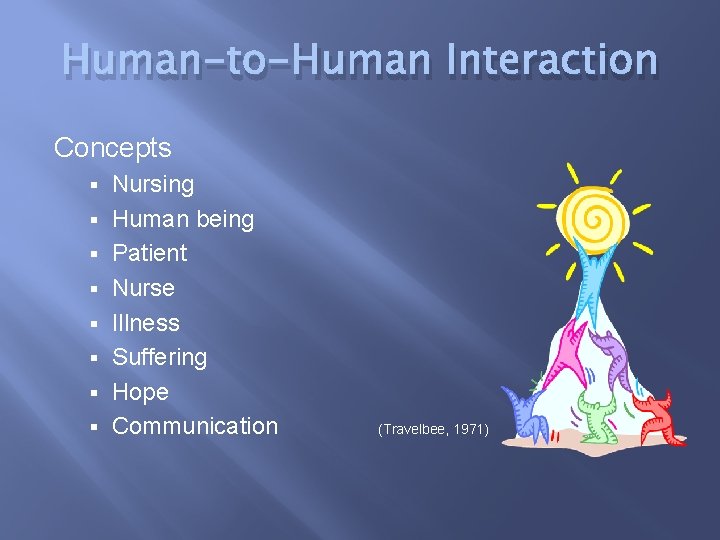
Human-to-Human Interaction Concepts § § § § Nursing Human being Patient Nurse Illness Suffering Hope Communication (Travelbee, 1971)
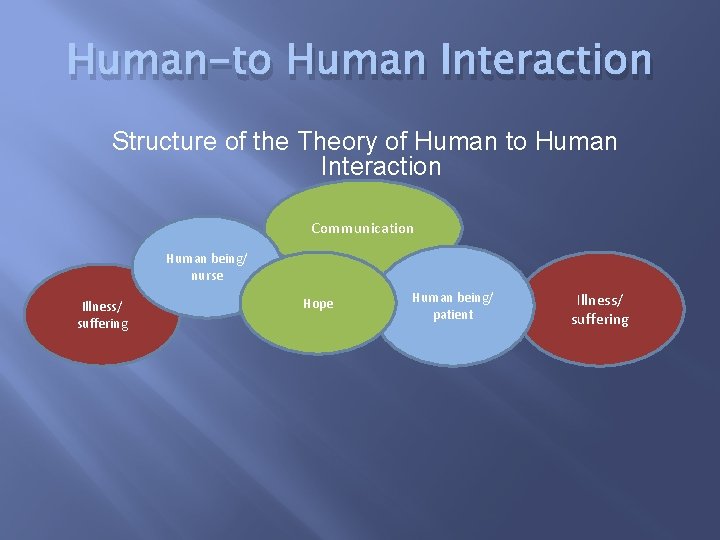
Human-to Human Interaction Structure of the Theory of Human to Human Interaction Illness/ suffering Communication Human being/ nurse Hope Human being/ patient Illness/ suffering
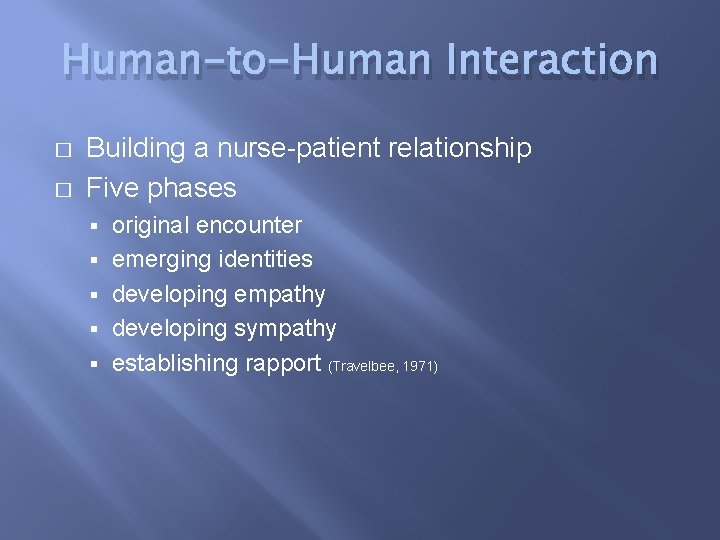
Human-to-Human Interaction � � Building a nurse-patient relationship Five phases § § § original encounter emerging identities developing empathy developing sympathy establishing rapport (Travelbee, 1971)
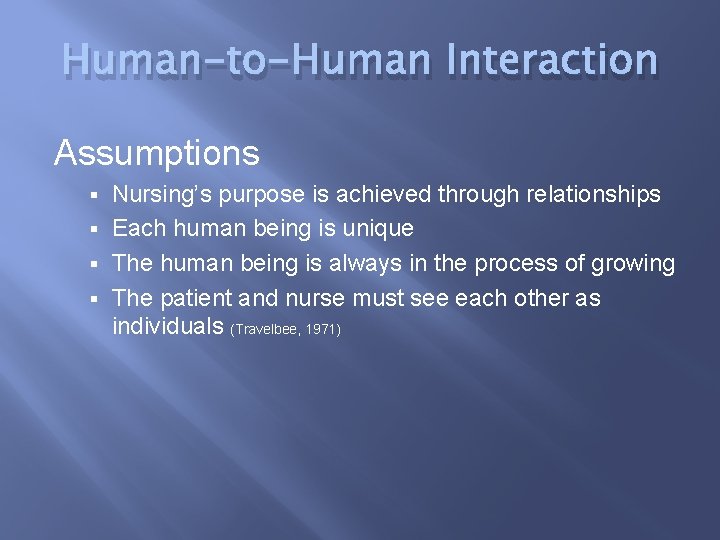
Human-to-Human Interaction Assumptions Nursing’s purpose is achieved through relationships § Each human being is unique § The human being is always in the process of growing § The patient and nurse must see each other as individuals (Travelbee, 1971) §
Human-to-Human Interaction Assumptions § § § Each person will experience suffering/illness Suffering/illness affect a person in many ways Communication is the process used The work of the professional nurse is to establish relationships Relationships are established by going through the five phases (Travelbee, 1971)
Application to Nurse Administrator Role Qualities of effective leaders Open communication § Perceived as giving extra effort (Casida & Parker, § 2011) § Able to build and maintain relationships
Theory Synthesis � � Interactions of disciplines Nurse to Patient � Nurse to Nurse � Leader to Nurse � Satisfaction � Health and well-being � Job performance
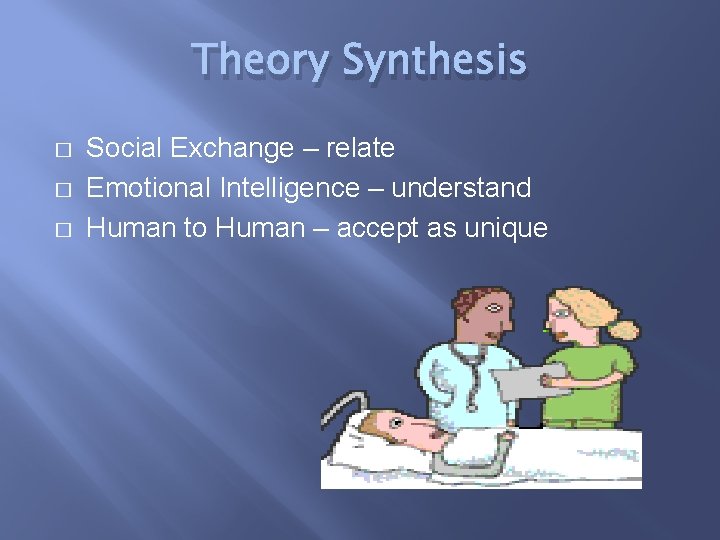
Theory Synthesis � � � Social Exchange – relate Emotional Intelligence – understand Human to Human – accept as unique
Summary � � � Social Exchange Theory Emotional Intelligence Theory Human to Human Theory � Interaction � Collaboration � Satisfaction
References Armonstrong, A. R. , Gallian, R. F. , & Crichley, C. R. (2010). Emotional intelligence and psychological resilience to negative life events. Personality and Individual Differences, 51, 333 -336. Begat, I. , Ellefsen, B. , & Severinsson E. , (2005). Nurses' satisfaction with their work environment and the outcomes of clinical nursing supervision on nurses' experiences of well-being. Journal of Nurse Management, 13(3) 221 -230 Casida, J. & Parker, J. (2011). Staff nurse perception of leadership styles and outcomes. Journal of Nursing Management, 19, 478486. Codier, E. , Kamikawa, C. , & Kooker, B. (2011). The impact of emotional intelligence development on nurse managers. Nursing Administration Quarterly, 35(3), 270 -276. Cook, K. S. , & Rice, E. (2004). Social Exchange Theory. Encyclopedia of Social Theory. (28 Sept. 2011). Retrieved from http: //0 www. sageereference. com. libcat. ferris. edu/view/socialtheor y/n 274. xml>.
References Cont. Gardner, B. D. (2010). Improve RN retention through transformational leadership styles. Nursing Management, 41(8), 8 -12. Retrieved from http: //www. nursingmanagement. com Nursing Theory Network. (2011, September 13). Human to human relationship model. [website] Retrieved from http: //www. nursingtheory. net/mr_humantohumanrelationship. html Smith, K. B. , Mc. Grath, J. , & Cummings, G. G. (2009). Emotional intelligence and nursing: An integrative literature review. International Journal of Nursing Studies, 46, 1624 -1636. Tomey, A. , & Alligood, M. (2006). Nursing theorists and their work. (6 th ed. ). St. Louis, MO: Mosby. Travelbee, J. (1971). Interpersonal aspects of nursing. (2 nd ed. ). Philadelphia: F. A. Davis Company.