
Diverse beginnings a focus on belonging through orientation
Diverse beginnings a focus on belonging through orientation Corinna Ridley – Deakin Student Life Deakin University CRICOS Provider Code: 00113 B
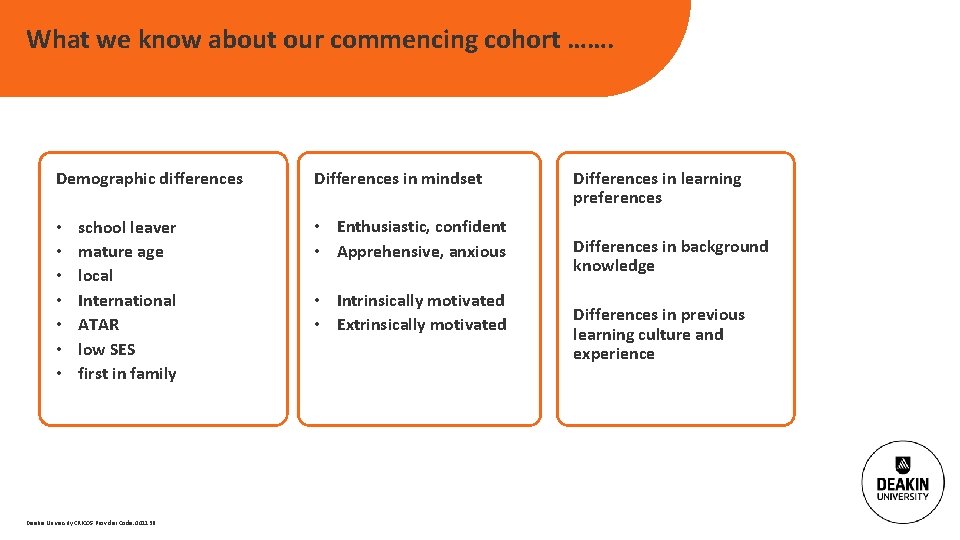
What we know about our commencing cohort ……. Demographic differences • • school leaver mature age local International ATAR low SES first in family Deakin University CRICOS Provider Code: 00113 B Differences in mindset • Enthusiastic, confident • Apprehensive, anxious • Intrinsically motivated • Extrinsically motivated Differences in learning preferences Differences in background knowledge Differences in previous learning culture and experience
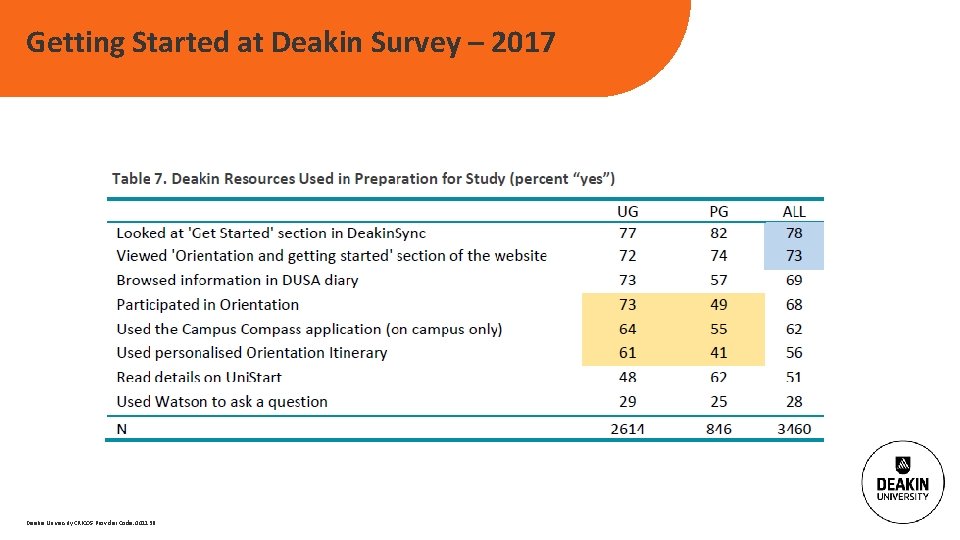
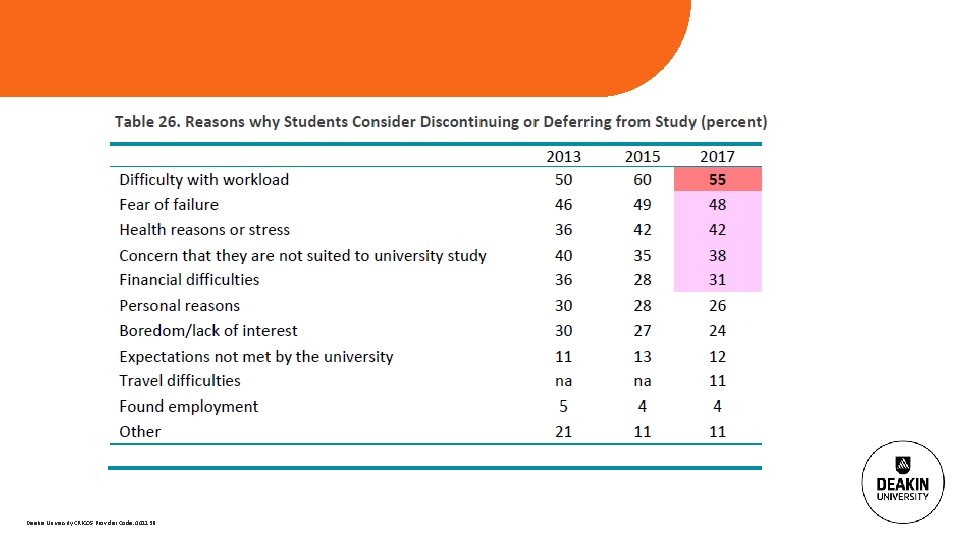
Getting Started at Deakin Survey – 2017 Deakin University CRICOS Provider Code: 00113 B
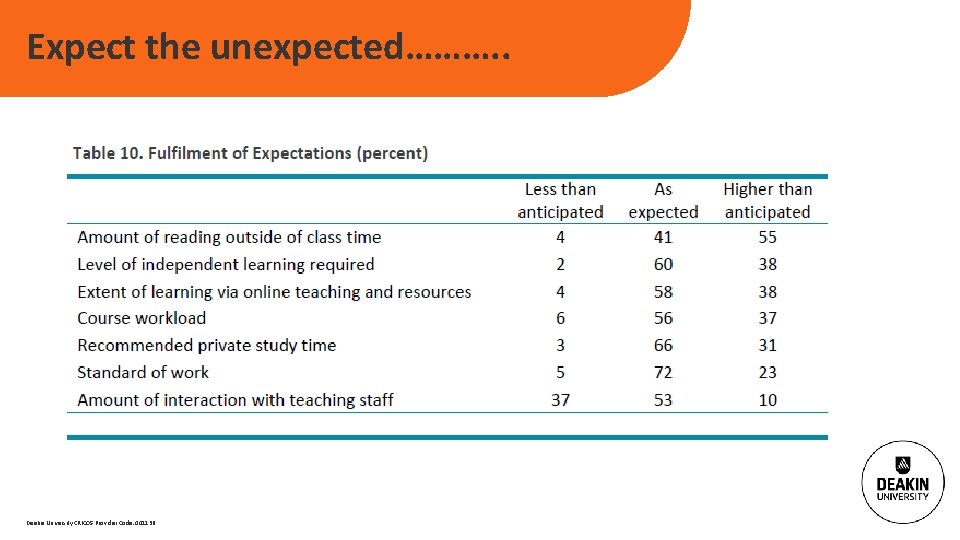
Expect the unexpected………. . Deakin University CRICOS Provider Code: 00113 B
Deakin University CRICOS Provider Code: 00113 B
The Lizzio model - Griffiths University 2006 It is clear that there isn’t “one right way” to design an orientation and transition strategy. Similarly, there aren’t any guaranteed solutions or “magic bullets” that will impact on student retention or engagement. A reading of the available literature does however indicate that there are consistent needs and concerns that students experience as they commence university. Understanding these needs provides a sound basis for designing effective orientation and transition strategies. (1: 2006) Deakin University CRICOS Provider Code: 00113 B
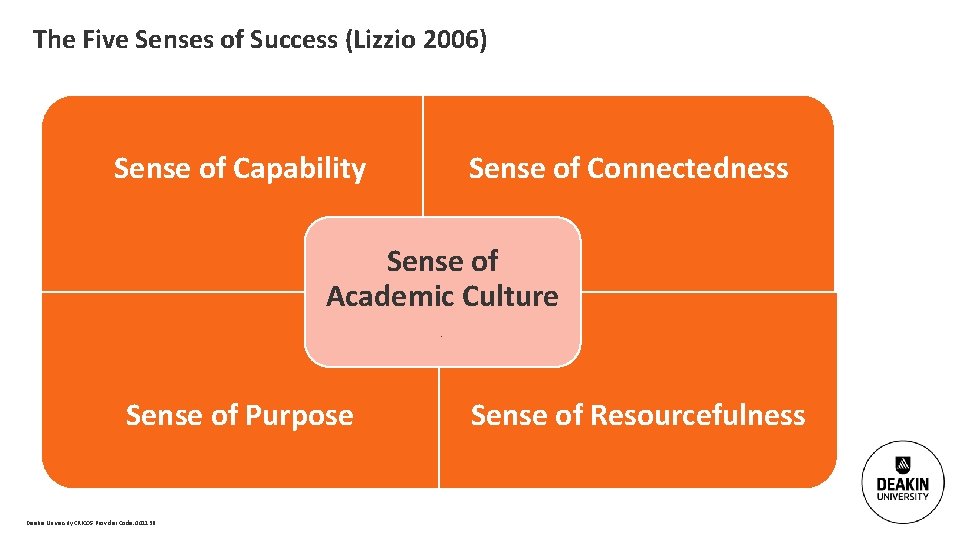
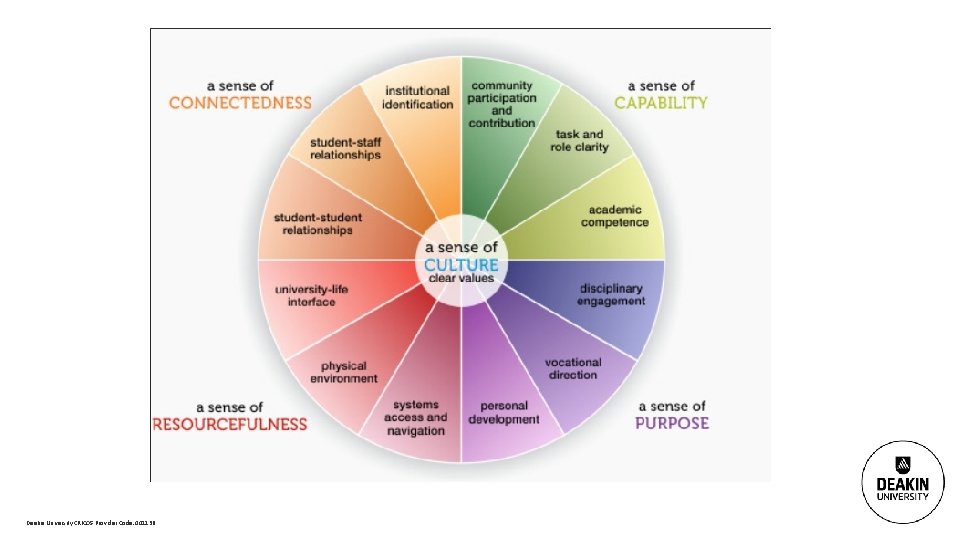
The Five Senses of Success (Lizzio 2006) Sense of Connectedness Sense of Capability Sense of Academic Culture. Sense of Purpose Deakin University CRICOS Provider Code: 00113 B Sense of Resourcefulness
Deakin University CRICOS Provider Code: 00113 B
The challenge…… How do we provide opportunities for students to reflect on and develop across all 5 senses during their early weeks at university in ways that acknowledge individual differences? Deakin University CRICOS Provider Code: 00113 B
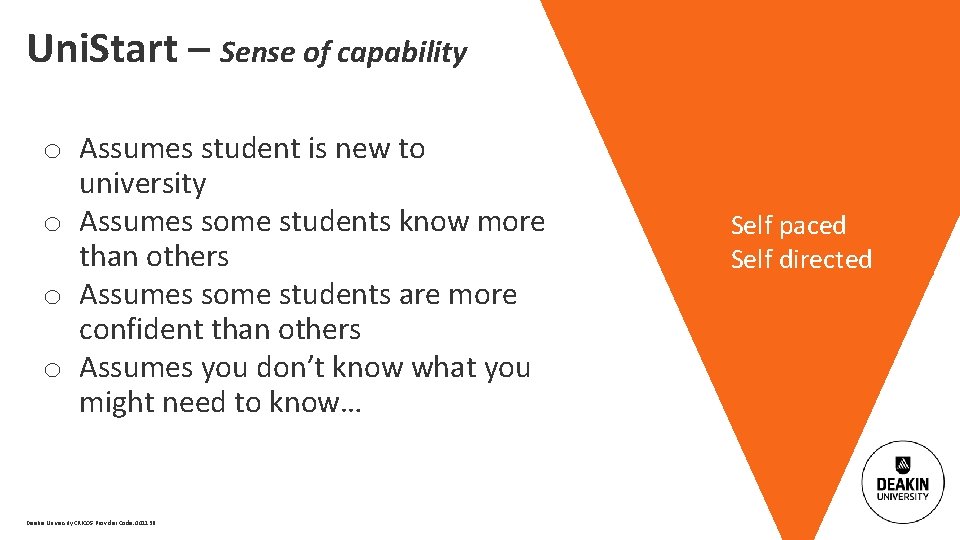
Uni. Start – Sense of capability o Assumes student is new to university o Assumes some students know more than others o Assumes some students are more confident than others o Assumes you don’t know what you might need to know… Deakin University CRICOS Provider Code: 00113 B Self paced Self directed
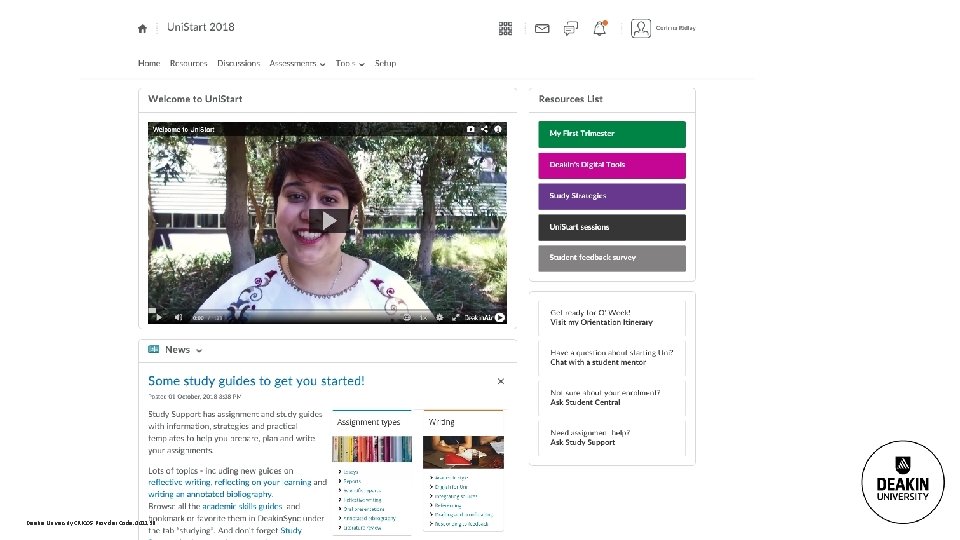
Deakin University CRICOS Provider Code: 00113 B
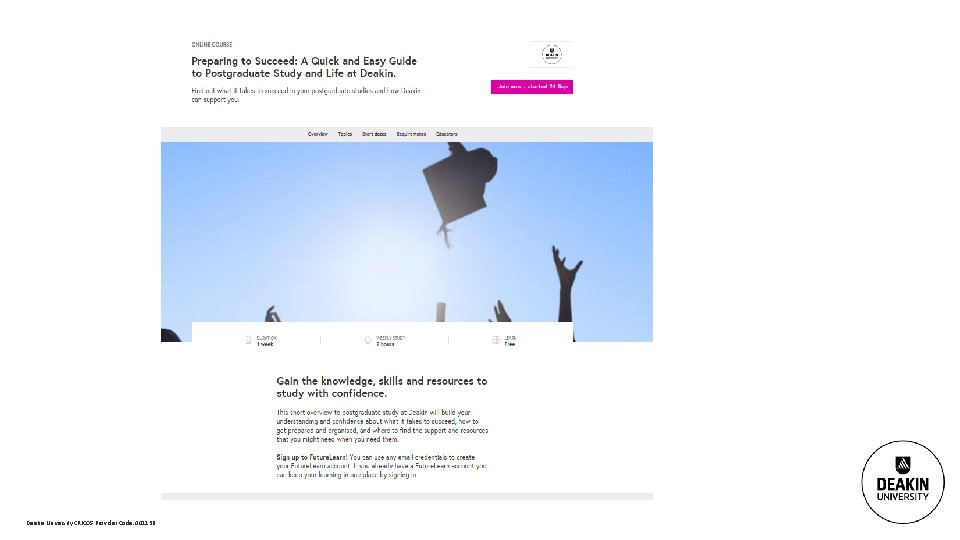
Prepare to Succeed An orientation program for Post Graduate students who could be: o Recent Deakin students o New to Deakin o Recently completed a degree/completed a degree 5+ years ago o Completed a degree in Australia/overseas Deakin University CRICOS Provider Code: 00113 B o Working full time/part time in related profession o Working full time/part time in an unrelated profession
Deakin University CRICOS Provider Code: 00113 B

Deakin University CRICOS Provider Code: 00113 B
Building Student Engagement and Belonging in Higher Education at a time of change – Liz Thomas 2012 At the individual level ‘belonging’ recognises students’ subjective feelings of relatedness or connectedness to the institution. ……. It may relate “the extent to which students feel personally accepted, Belonging may be characterised by regular contact and the perception that interpersonal relationships have stability, affective concern, and are ongoing (Baumeister and Leary, 1995). Thus interpersonal relations are essential for satisfying the need to belong. (12: 2006) Deakin University CRICOS Provider Code: 00113 B Bourdieu and Passeron’s (1977) theories of cultural capital and habitus view the problem structurally, as being embedded in the way that higher education institutions function. …… Educational institutions have an identifiable habitus (Reay, David and Ball, 2001), which incorporates practices that mutually shape and reshape the institutions with their students, their communities and the wider socio-economic cultures of their catchment areas (Reay, David and Ball, 2001, para 1. 3). Students whose habitus is at odds with that of their higher education institution may feel that they do not fit in, that their social and cultural practices are inappropriate and that their tacit knowledge is undervalued, and they may be more inclined to withdraw early (Thomas, 2002). ( 13: 2006)
So what works? Effective interventions start preentry, and have an emphasis on engagement and an overt academic purpose. They develop peer networks and friendships, create links with academic members of staff, provide key information, shape realistic expectations, improve academic skills, develop students’ confidence, demonstrate future relevance and nurture belonging. (15: 2006) Deakin University CRICOS Provider Code: 00113 B
The Success Coach Program for commencing UG Cloud students Aims to: • build sense of connectedness, capability and resourcefulness • increase engagement and sense of belonging • Assist students to navigate the online learning landscape Deakin University CRICOS Provider Code: 00113 B
Who are success coaches? • Success coaches are experienced later years students from the same or similar discipline • Success coaches email all students in the group every week from 2 weeks before O week to week 8 • Invite questions/queries/ comments from students • Respond to questions/queries/ comments by email and/or phone or skype Deakin University CRICOS Provider Code: 00113 B
A key premise of the program is that the student and coach can relate as peers, share common experiences, and the more experienced student can help break down barriers to seeking help, connecting the new student with university supports and with peers.
Mentoring essentials? The advantages and challenges of the online environment Peer mentoring – a two way relationship is central Email – a ‘one way’ communication model ? Peer mentoring - not just giving advice ? Guest (2000) argued that mentoring is a long-term process, involves sharing experiences and offering encouragement, provides the mentee (protégé) with a way of developing insight through reflection, and is a two-way relationship that results in mutual learning. Guest 2000 cited in Shrestha et al (2009: 116)
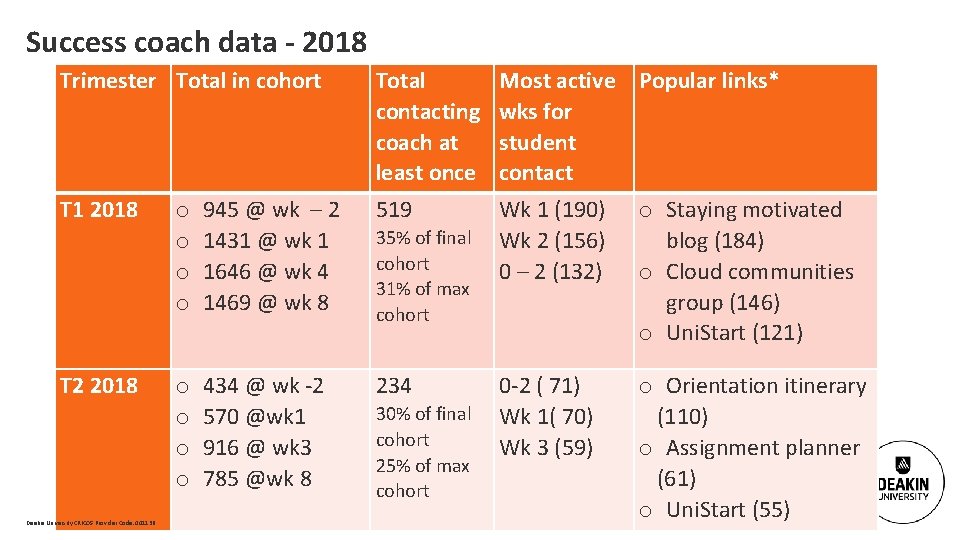
Success coach data - 2018 Trimester Total in cohort Total contacting coach at least once T 1 2018 519 o o 945 @ wk – 2 1431 @ wk 1 1646 @ wk 4 1469 @ wk 8 Most active Popular links* wks for student contact Wk 1 (190) 35% of final Wk 2 (156) cohort 0 – 2 (132) 31% of max cohort T 2 2018 Deakin University CRICOS Provider Code: 00113 B o o 434 @ wk -2 570 @wk 1 916 @ wk 3 785 @wk 8 234 0 -2 ( 71) 30% of final Wk 1( 70) cohort Wk 3 (59) 25% of max cohort o Staying motivated blog (184) o Cloud communities group (146) o Uni. Start (121) o Orientation itinerary (110) o Assignment planner (61) o Uni. Start (55)
Other initiatives Unified orientation project – what messages do all students need? Which channels are best for that communication? Customised orientation for HDR students, pathway students, International students, Cloud students Personalised orientation itinerary
What’s next ? Transition toolkit – to assist academic staff to embed activities that build students’ ‘sense of capability’ into early units of study. Success coaches for other cohorts ? Graduate Certificate in Humanitatirun Leadership Deakin Accelerate students
References Lizzio, A. (2006). Designing an orientation and transition strategy for commencing students. Retrieved from http: //www. griffith. edu. au/__data/assets/pdf_file/0008/51875/Alfs-5 -Senors. Paper-FYEProject E. Thomas ( 2012) Building student engagement and belonging in Higher Education at a time of change: final report from the What Works? Student Retention & Success - Higher Education Academy Shrestha, Celayne Heaton; May, Steve; Edirisingha, Palitha; Burke, Linda; Linsey, Tim ( 2009) From Face-to-Face to e-Mentoring: Does the "e" Add Any Value for Mentors? International Journal of Teaching and Learning in Higher Education, v 20 n 2 p 116 -124 2009
- Slides: 24