
Divergent Discovery Style Presented by Dallas Morrison Dave
Divergent Discovery Style Presented by: Dallas Morrison Dave Dubois Ashley Wry
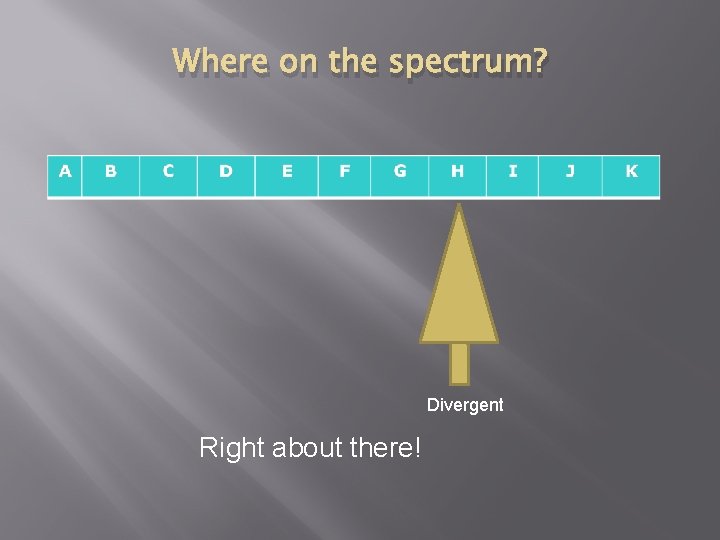
Where on the spectrum? Divergent Right about there!
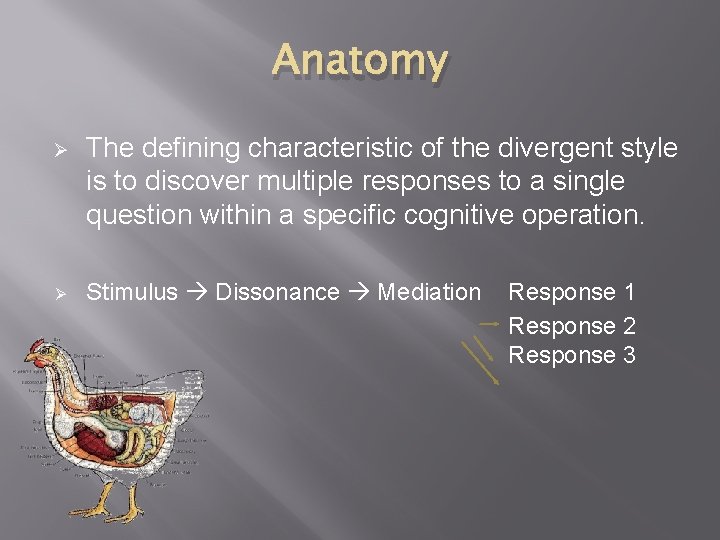
Anatomy Ø Ø The defining characteristic of the divergent style is to discover multiple responses to a single question within a specific cognitive operation. Stimulus Dissonance Mediation Response 1 Response 2 Response 3
Anatomy � Role of the teacher: - Make decisions about the question to be asked. - To accept the responses. - To serve as a source of verification in particular subject matter tasks.
Anatomy � Role of the learner: - To make the nine impact decisions of the practice style. - To produce divergent responses. - To ascertain the validity of the responses. - To serve as a source of verification in particular subject matter tasks.
Anatomy � � � Pre-impact - Teacher makes the decisions. Impact - Learner makes the decisions. Post-impact - Learners make assessment decisions appropriate to the task selected.
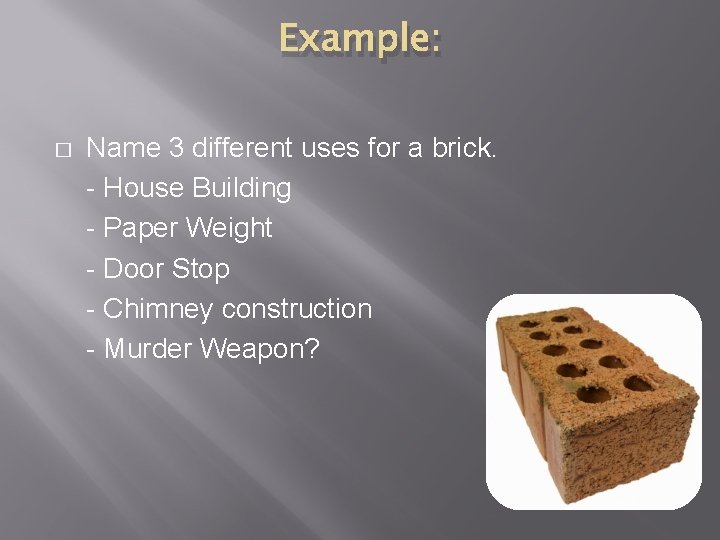
Example: � Name 3 different uses for a brick. - House Building - Paper Weight - Door Stop - Chimney construction - Murder Weapon?
The Objectives Subjective: � To discover and produce multiple responses or solutions to a question or problem � To experience divergent production in specific cognitive operations � To expand content boundaries to discover that alternative possibilities can exist in any content � To view some aspects within content as developing and evolving, rather than static � To develop the ability to verify solutions and organize them for specific purposes
The Objectives Behavioral: � To engage in divergent discovery – the production of multiple responses that can satisfy a stimulus � To activate divergent thinking in the cognitive operations designated by the stimulus � To become sufficiently emotionally, cognitively, and socially secure to move beyond memory to risk producing alternative ideas � To accept that an individual can approach problems or issues in different ways � To tolerate others’ ideas � To feel the emotional and cognitive energy that the production of ideas can generate Reduction Process
Implementation What to do? � Indicate the cognitive operation � Indicate the subject matter parameters so that the developmental focus and intent are clear. � Indicate a specific quantity that seeks divergent responses. � Ask questions such as… - Can you…? - How many ways can you…? - Okay, but what else…?
Implementation What to avoid? � Permitting learner to choose the cognitive focus (production vs. reproduction) � Large questions or situations. � Terms like. . . � Make up your own activities � Do your own movements � See what you can do with
Description of an Episode � � � Teacher sets scene by describing divergent production in it introduces the learners to their role. The teacher presents the subject matter focus and the question. Any relative parameters are given and learners disperse to begin producing multiple solutions. Teacher offers neutral feedback and invites numerous responses from the learners. Corrective feedback is used only when responses do not conform to the original question. At the end of this episode the teacher gathers the learners to discuss their participation in the divergent process.
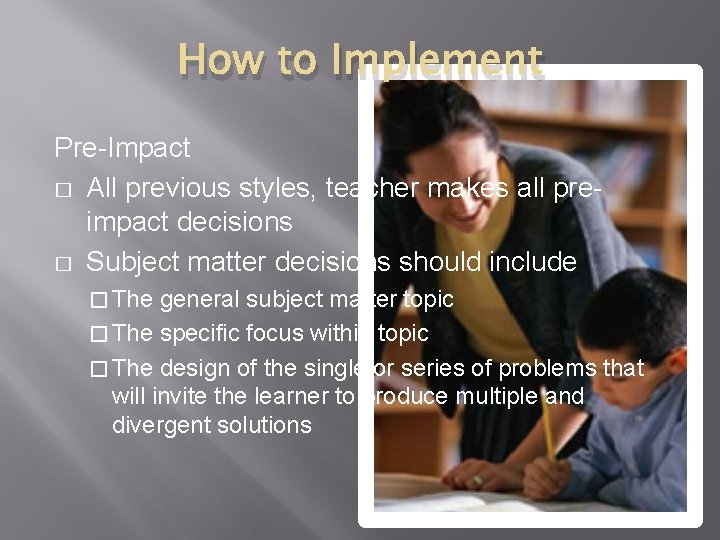
How to Implement Pre-Impact � All previous styles, teacher makes all preimpact decisions � Subject matter decisions should include � The general subject matter topic � The specific focus within topic � The design of the single or series of problems that will invite the learner to produce multiple and divergent solutions
How to Implement Impact � Due to the implications and the subject matter demands of the divergent style there can be differences in implementation � While some tasks merit a single episode others require a series of tasks or themes to be explored � Others may require insertion of episode of reproduction styles before learners can meaningfully explore content in the divergent style � Despite these differences all configuration demands the learners to discover other alternative designs within the content
Questions? Happy Easter!!
- Slides: 15