
Diurnal and Annual Modulation of Cold Dark Matter
- Slides: 25
Diurnal and Annual Modulation of Cold Dark Matter Signals Ling Fu-Sin IDM 2004, Edinburgh, Sept. 8 th 2004 in collaboration with Pierre Sikivie & Stuart Wick, Phys. Rev. D 66, 023504 (2002) (astro-ph/0203448) astro-ph/0405231
Outline o o o Motivations Solar wakes Axion signal modulation WIMP signal modulation Conclusions
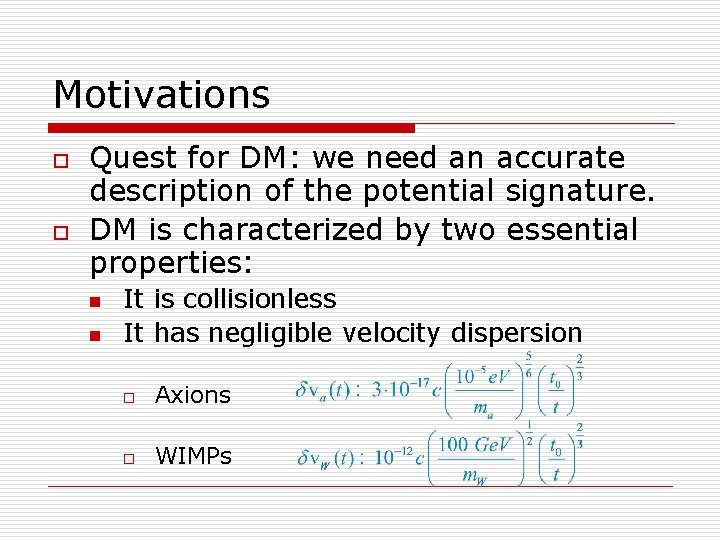
Motivations o o Quest for DM: we need an accurate description of the potential signature. DM is characterized by two essential properties: n n It is collisionless It has negligible velocity dispersion o Axions o WIMPs
Solar wakes
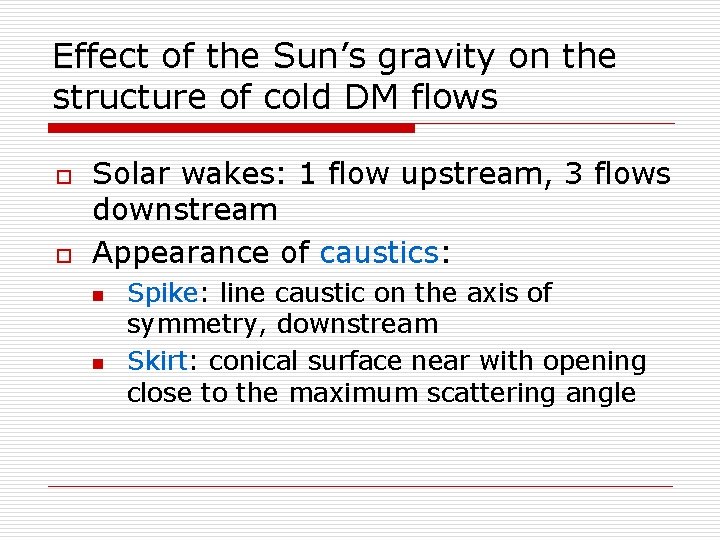
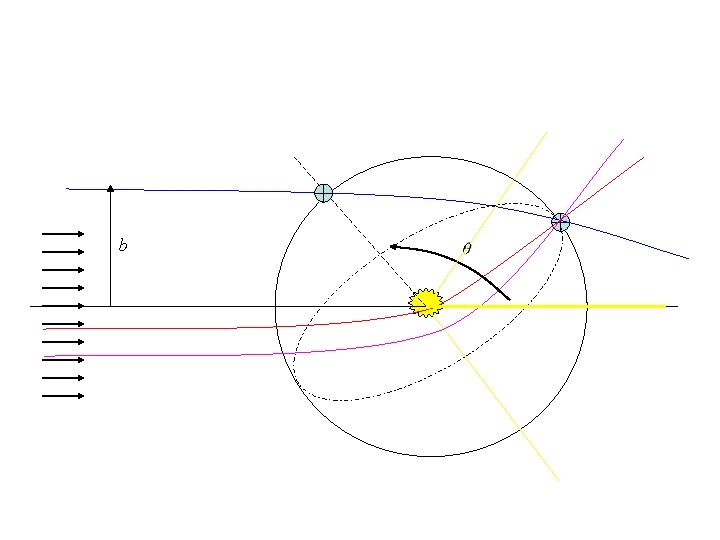
Effect of the Sun’s gravity on the structure of cold DM flows o o Solar wakes: 1 flow upstream, 3 flows downstream Appearance of caustics: n n Spike: line caustic on the axis of symmetry, downstream Skirt: conical surface near with opening close to the maximum scattering angle
b
Impact parameter vs. polar angle
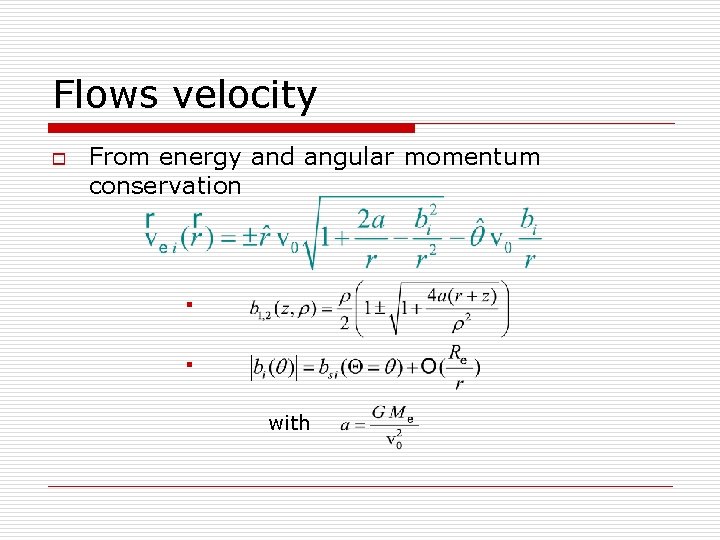
Flows velocity o From energy and angular momentum conservation § § with
Flows velocity modulation (on Earth)
Flows velocity modulation Distortion near the spike Flow 4+
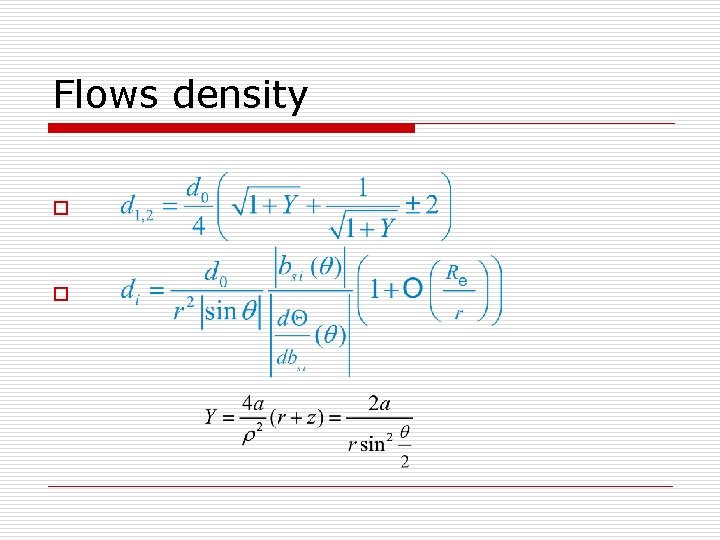
Flows density o o
Flow density modulation (on Earth) Flow 10+
Axion Signal Modulation
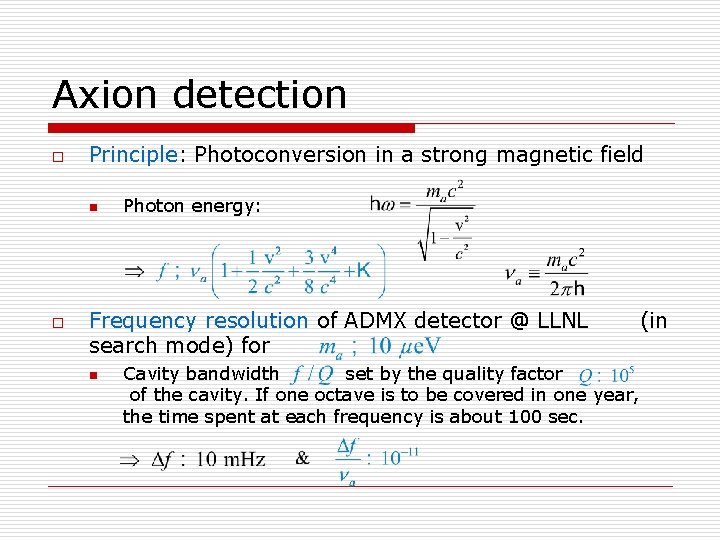
Axion detection o Principle: Photoconversion in a strong magnetic field n o Photon energy: Frequency resolution of ADMX detector @ LLNL search mode) for n (in Cavity bandwidth set by the quality factor of the cavity. If one octave is to be covered in one year, the time spent at each frequency is about 100 sec.
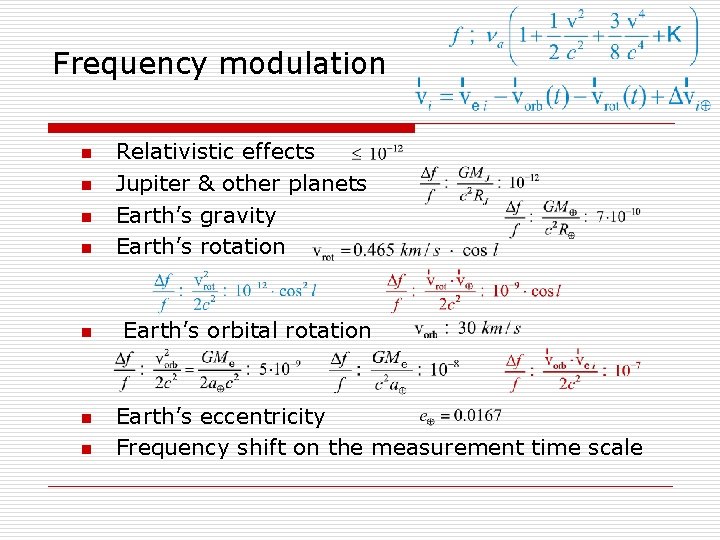
Frequency modulation n Relativistic effects Jupiter & other planets Earth’s gravity Earth’s rotation n Earth’s orbital rotation n n Earth’s eccentricity Frequency shift on the measurement time scale
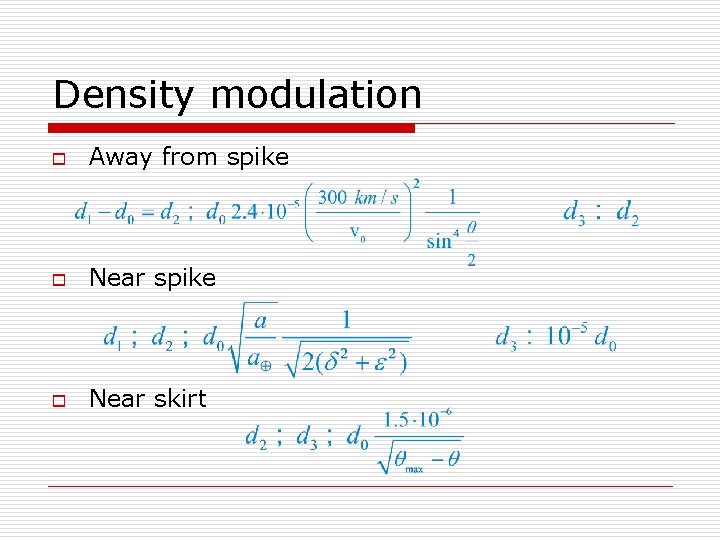
Density modulation o Away from spike o Near skirt
WIMP Signal Modulation
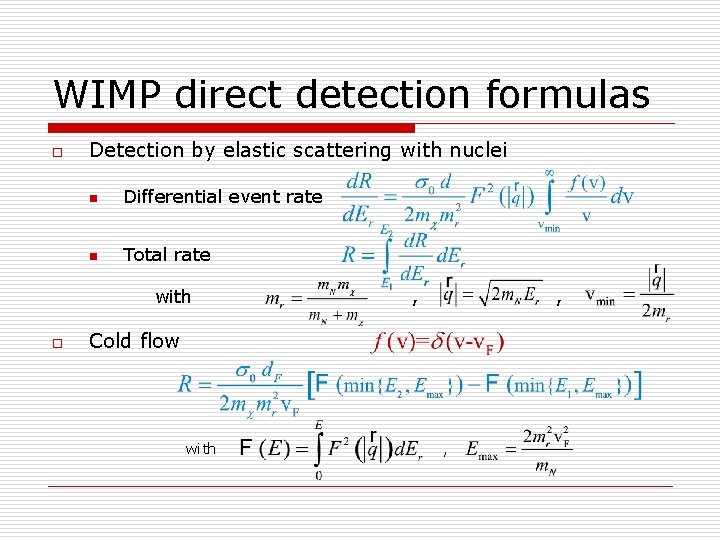
WIMP direct detection formulas o Detection by elastic scattering with nuclei n Differential event rate n Total rate with o , , Cold flow with ,
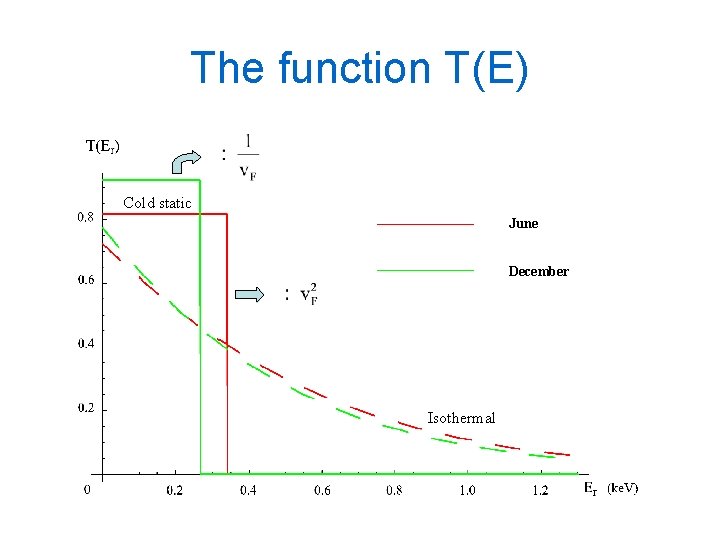
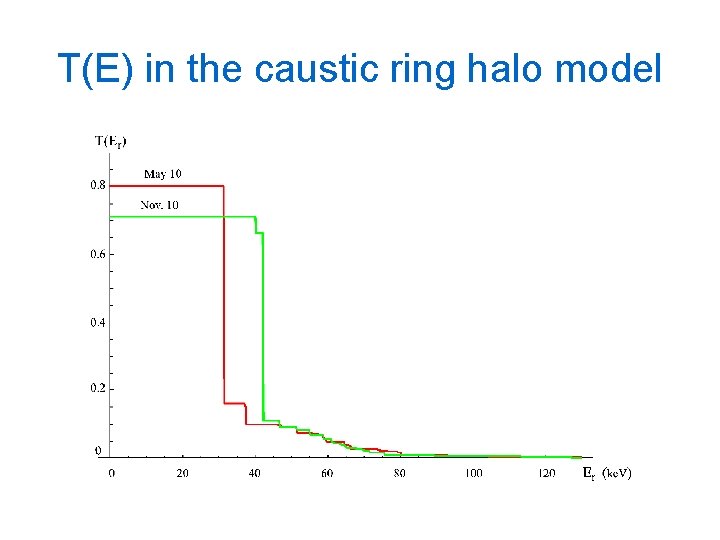
The function T(E) Cold static June December Isothermal
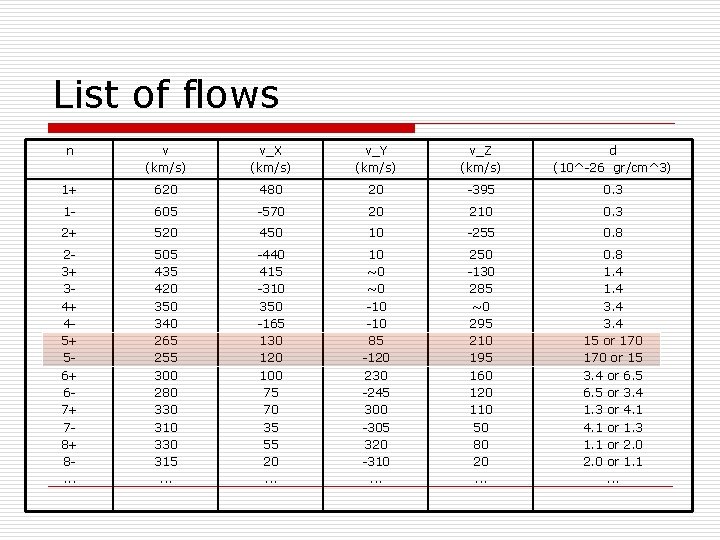
The WIMP Signal modulation for the Caustic ring halo model and the DAMA result Caustic ring halo model: self similar infall halo model with a large number of flows corresponding to particles falling in and out for the nth time P. Sikivie et al. , PRD 56(1997)1863. P. Sikivie, PLB 567(2003).
List of flows n v (km/s) v_X (km/s) v_Y (km/s) v_Z (km/s) d (10^-26 gr/cm^3) 1+ 620 480 20 -395 0. 3 1 - 605 -570 20 210 0. 3 2+ 520 450 10 -255 0. 8 23+ 34+ 45+ 56+ 67+ 78+ 8. . . 505 435 420 350 340 265 255 300 280 330 315. . . -440 415 -310 350 -165 130 120 100 75 70 35 55 20. . . 10 ~0 ~0 -10 85 -120 230 -245 300 -305 320 -310. . . 250 -130 285 ~0 295 210 195 160 120 110 50 80 20. . . 0. 8 1. 4 3. 4 15 or 170 or 15 3. 4 or 6. 5 or 3. 4 1. 3 or 4. 1 or 1. 3 1. 1 or 2. 0 or 1. 1. . .
T(E) in the caustic ring halo model
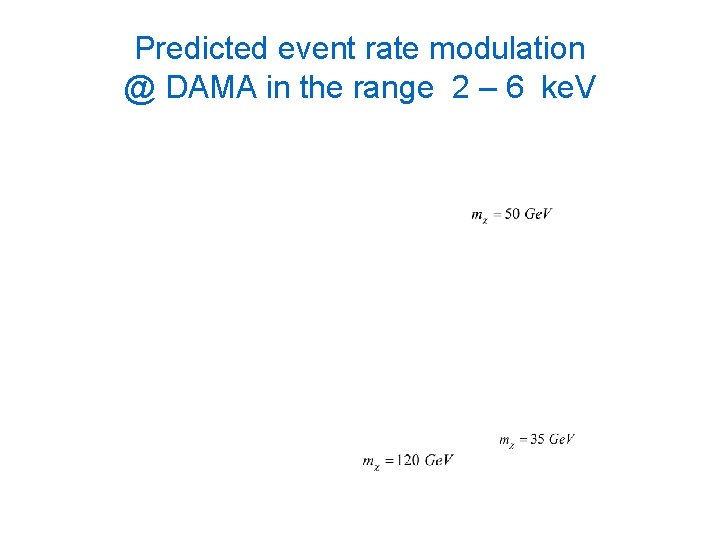
Predicted event rate modulation @ DAMA in the range 2 – 6 ke. V
Conclusions o DM is collisionless and has negligible velocity dispersion. These features determine the shape of its signal in a detector. n n o Axion: narrow peak in frequency WIMP: plateau in the differential event rate The presence of caustics is potentially crucial for DM discovery.
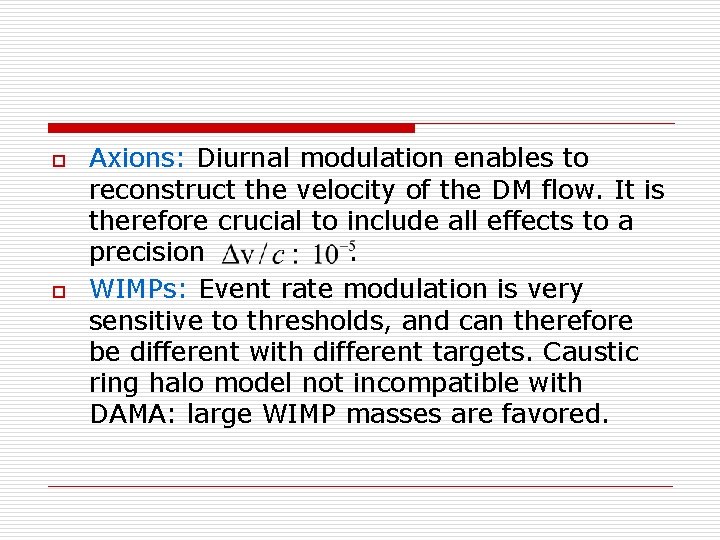
o o Axions: Diurnal modulation enables to reconstruct the velocity of the DM flow. It is therefore crucial to include all effects to a precision. WIMPs: Event rate modulation is very sensitive to thresholds, and can therefore be different with different targets. Caustic ring halo model not incompatible with DAMA: large WIMP masses are favored.