
District Area Service Positions Presented by Area 81
District & Area Service Positions Presented by Area 81 Copyright © Area 81 Alcoholics Anonymous All rights reserved
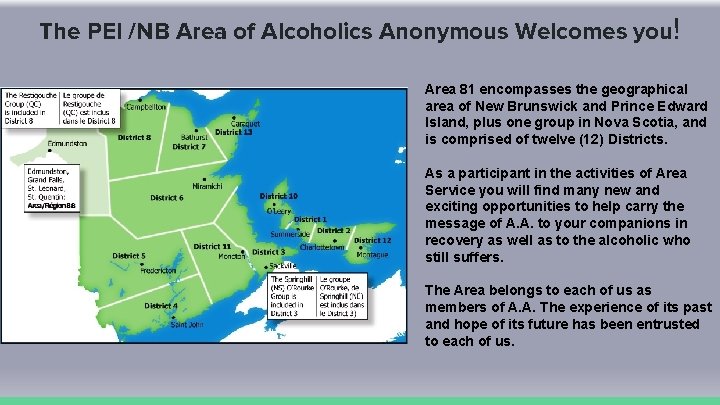
The PEI /NB Area of Alcoholics Anonymous Welcomes you! Area 81 encompasses the geographical area of New Brunswick and Prince Edward Island, plus one group in Nova Scotia, and is comprised of twelve (12) Districts. As a participant in the activities of Area Service you will find many new and exciting opportunities to help carry the message of A. A. to your companions in recovery as well as to the alcoholic who still suffers. The Area belongs to each of us as members of A. A. The experience of its past and hope of its future has been entrusted to each of us.

Alcoholics Anonymous is comprised of 93 Areas in the U. S. and Canada
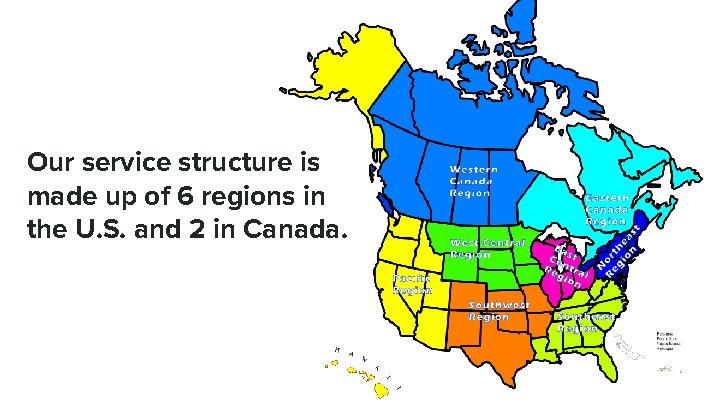
Our service structure is made up of 6 regions in the U. S. and 2 in Canada.
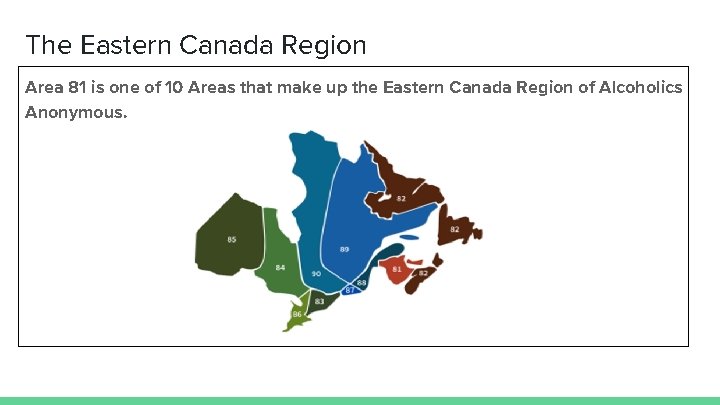
The Eastern Canada Region Area 81 is one of 10 Areas that make up the Eastern Canada Region of Alcoholics Anonymous.
The Area Assembly General Service Representatives (G. S. R. s ), District Committee Members (D. C. M. s), & Area Officers make up the Area 81 Assembly. There are 4 Area meetings per year; The Spring & Fall Assemblies Assembly (normally held in May and October), are weekend events, which include Area business meeting, AA (in both French & English) & Al-Anon meetings, banquet, and lots of fellowship. The Pre. Conference Session in March & the Summer Sharing Session in August are to be one day events, with Area business only being conducted. Any A. A. member may attend, and in many areas members are encouraged to attend assemblies as a way of encouraging them to become active in general service.
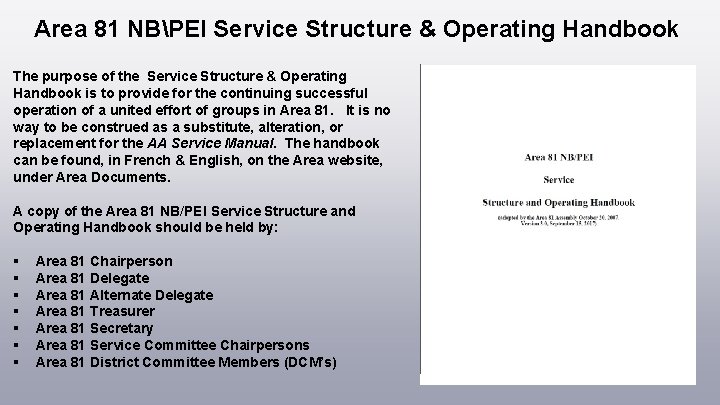
Area 81 NBPEI Service Structure & Operating Handbook The purpose of the Service Structure & Operating Handbook is to provide for the continuing successful operation of a united effort of groups in Area 81. It is no way to be construed as a substitute, alteration, or replacement for the AA Service Manual. The handbook can be found, in French & English, on the Area website, under Area Documents. A copy of the Area 81 NB/PEI Service Structure and Operating Handbook should be held by: § § § § Area 81 Chairperson Area 81 Delegate Area 81 Alternate Delegate Area 81 Treasurer Area 81 Secretary Area 81 Service Committee Chairpersons Area 81 District Committee Members (DCM’s)
Following is a list of positions you will find as part of the District Structure. All of these positions, and their responsibilities, can be found in the A. A. SERVICE MANUAL.
GENERAL SERVICE REPRESENTATIVE (GSR) MAY BE THE MOST IMPORTANT JOB IN A. A.
The GSR Preamble We are the General Service Representatives. We are the link in the chain of communication for our groups with the General Service Conference and the world of A. A. We realize the ultimate authority in A. A. is a loving God as He may express Himself in our group conscience. As trusted servants, our job is to bring information to our groups in order that they may reach an informed group conscience. In passing along this group conscience, we are helping to maintain the unity and strength so vital to our fellowship. Let us, therefore, have the patience and tolerance to listen to others share, the courage to speak up when we have something to share, and the wisdom to do what is right for our groups as a whole.
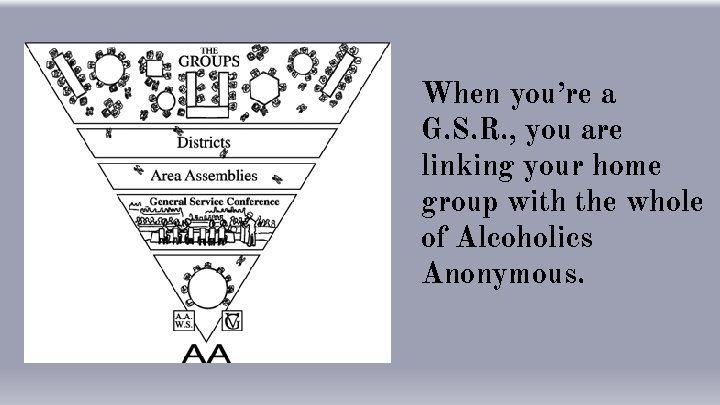
When you’re a G. S. R. , you are linking your home group with the whole of Alcoholics Anonymous.
CONGRATULATIONS! WHAT AN HONOR TO BE A TRUSTED SERVANT! AS SUCH, RESPONSIBILITIES TO YOUR GROUP INCLUDE: • Giving monthly reports to group informing them of District and Area events/concerns, including service opportunities; • Representing your group at District and Area functions; • Voicing/Voting group’s conscience at the District & Area meetings based on informed discussions of issues; • Educating yourself and your group on the A. A. Service Structure; and • Attending Area Spring & Fall assemblies.
YOUR ROLE AT MONTHLY DISTRICT GSR MEETINGS (It’s more than just picking up flyers!) • Become informed about District, Area and GSO business and events. • Discover what our various committees are doing within A. A. and the community. • Learn about where and how your group contributions are being spent. • Voice/Vote group’s conscience. • Share thoughts/ideas/concerns about A. A. business. • On minor business known as “housekeeping issues, ” make decisions based on knowledge of group’s will. (Commonly referred to as Right of Decision- Concept Three. ) • BRING A FRIEND AND MAKE IT FUN!
If you cannot make it to a commitment as the GSR for your group, you should make sure that your Alternate GSR can. Alternate GSRs are elected by a group to serve in the absence of their regular GSR. They do not have a vote at the District meeting unless their GSR is not present, but they are encouraged to attend any of the meetings the GSR attends.

It was suggested I get a Service Sponsor. But I already have a Sponsor. What’s the difference? A Service Sponsor is simply a person with service experience whom you can ask questions about service-related issues. He or she can be but does not have to be your Step Sponsor. He/she should be somebody who has been in service a while and is well-versed in the Traditions and Concepts.

THE 12 TRADITIONS “Our Traditions are a guide to better ways of working and living, and they are to the group survival what A. A. ’s Twelve Steps are to each member’s sobriety and peace of mind… Most individuals cannot recover unless there is a group. The group must survive or the individual will not. ” - Co-founder Bill W. The Traditions are the guidelines to help the groups function effectively. The Twelve Traditions - Short Form p-28 The Twelve Traditions Illustrated p-43 The Twelve Traditions - Long Form SMF-187 Bill W. ’s essays on the Traditions can be found in the book, Twelve Steps and Twelve Traditions In Alcoholics Anonymous Comes of Age, Bill W. tells how A. A. started, how the Steps & Traditions evolved, and how the Fellowship grew and spread overseas.

The 12 Concepts “The ‘Twelve Concepts of World Service’ reveal the evolution by which it [A. A. ’s world service structure] has arrived in its present form, and they detail the present reasoning on which our operation stands today. These Concepts therefore aim to record the ‘why’ of our service structure in such a fashion that the highly valuable experience of the past, and the lessons we have drawn from that experience, can never be forgotten or lost. ” - from Bill W. ’s Introduction to the first printing of “Twelve Concepts for World Service” The Twelve Concepts - Short Form The Twelve Concepts for World Service Illustrated p-8 The text of the complete Concepts is printed in The A. A. Service Manual/Twelve Concepts for World Service (BM-31).
The D. C. M. : The Key Element Between Group Reps and The Area Service Structure The D. C. M. ’s job is primarily that of two-way communication. The D. C. M. : • Regularly attends all District and Area meetings as well as area assemblies. • Receives reports from the groups through G. S. R. s and through frequent personal contacts with groups in the district. • Assists the delegate in obtaining group information in time to meet the deadline for A. A. directories. • Keeps G. S. R. s informed about Conference activities • Makes sure that G. S. R. s are acquainted with The A. A. Service Manual, the Twelve Concepts for World Service, the G. S. O. bulletin Box 4 -5 -9, workbooks and guidelines from G. S. O. , and any other service material.
• Votes according to District’s Group Conscience on Area motions • Voices questions and/or concerns at Area meetings • Gives conference report if the delegate cannot be present, and invites the delegate to regular district meetings. • Helps G. S. R. s make interesting reports to groups, and encourages them to bring new A. A. members to service events. • Keeps groups informed about Conference-approved books and pamphlets. • Organizes workshops and/or sharing sessions on service activities. • Regularly keeps in touch with the alternate D. C. M. and the delegate • Brings Traditions problems to the attention of the delegate. • Makes a regular practice of talking to groups (new and old) on the responsibilities of general service work.
District Chair Person: The primary responsibility of the Chairperson is to ensure the monthly business meeting is conducted efficiently • Chairs the monthly General Service Representative meeting in accordance with Roberts' Rules of Order, while keeping the meeting focus on AA's primary purpose of carrying the message to the still sick and suffering. • Prepares meeting agenda based on the previous month's minutes and the submission of new business proposals. • Schedules and chairs a monthly District Officers meeting which meets prior to the District meeting. (The District Officers meeting discusses and reviews operational issues affecting the business of the District, and reviews the upcoming agenda. ) • Relies on AA's Traditions and Concepts to help resolve questions or conflicts, which may arise. • Works closely with other Officers and District Committee Members • Forms Ad Hoc committees to review special concerns as required. • Has one vote at District General Service Representative Meetings
District Treasurer • Opens a non-interest bearing checking account requiring two signatures on all checks; submits and updates a signature card to authorise four signatures (Treasurer, Chairperson, Recording Secretary and another district officer) • Assists in the preparation and presentation of the annual budget. Prepares and distributes budget request forms. • Provides contribution envelopes for distribution to groups. • Maintains a record of and deposits moneys received • Maintains a record of and pays all authorized expenses. • Balances checkbook. • Prepares and distributes a monthly written report which includes the “to date” budget line-item balances.
• Also is prepared for a semi-annual review of Records by the Finance Review Committee held prior to the June and December GSR meetings. • Keeps a file of important materials and reports, as well as any helpful information to turn over to the next treasurer. • Must submit a budget and attend the annual budget meeting. • Has one vote at District General Service Representative meeting
District Recording Secretary • Records and transcribes minutes of the District meeting, paying particular attention to the wording of all motions, voting results and attendance. • Provides copies of the minutes (monthly), copies of the Group Donation Guidelines (quarterly), and copies of the District Service Guidelines (yearly), to the District meeting. • Keeps an up-to-date mailing list of GSR's, DCMs and Alternates, Special Service Chairpersons and Representatives, District and Area Officers. • Takes roll call at the monthly district meeting. • Serves on the District Finance Review Committee. • Keeps a file of important materials and reports, as well as any helpful information to turn over to a newly elected Recording Secretary. • Must submit a budget to the Treasurer and attend the annual budget meeting. • Has one vote at District General Service Representative meeting.
What do Special Service Committee Chairs do? The Special Service Committees work in different ways with specific focuses on the same goal, to inform potential alcoholics about recovery through Alcoholics Anonymous. The Chairs share the following responsibilities: • Attending the monthly meeting with their committee. • Reporting the work being done by their committee both in the District and Area wide. • Brings suggestions from their District to the Area meeting. • Present a budget to the District and work within it. • Helping man table at Area and District events
How do Special Service Committee Chairs work? The work of the Committees is endless. How then do they know where to start? ● The first step is to understand the what your Committee does. This can be done by: ○ Reading the workbook if there is one. ○ Asking the Area chair for that Committee. ○ Asking the previous Chair. ● Create goals of your own. ● Ask others at your District what they would like to see. ● Build on the work done previously. ● Form a sub committee to help you.
Answering Service “When anyone, anywhere, reaches out for help I want the hand of A. A. always to be there, and for that I am responsible. ” The District Answering Service Chair is the contact between the Groups and who actually answers the phone, either A. A. Members or a paid answering service. The Chair is responsible for • Gathering 12 th step volunteers • Forward requests to appropriate service committee • Reports to the district
Website Most Areas, and some districts, have their own websites. The purpose of these websites is to carry the message of Alcoholics Anonymous by providing a resource on the Internet where information can be obtained about Alcoholics Anonymous in general and, in our case, in relation to Area 81, New Brunswick & Prince Edward Island. Check out the Area 81 website! Check out the District 2 website! Check out the District 5 website!
Public Information - PI Have you ever talked to someone who was not in A. A. about A. A. ? If so you have done PI work. Public Information (P. I. ) in Alcoholics Anonymous means carrying the message of recovery to the still-suffering alcoholic by informing the general public about the A. A. program. We carry the message by getting in touch with and responding to the media, schools, industry, and other organizations which can report on the nature and purpose of A. A. and what it can do for alcoholics.
Cooperation with the Professional Community - CPC Your service committee can bring the A. A. message to professionals and to students at professional schools in your community, helping them to understand how and why A. A. works. A. A. has always valued friends in all professional fields. These associations have been mutually beneficial and completely in keeping with the A. A. Traditions. Members of C. P. C. committees inform professionals and future professionals about A. A. — what we are, where we are, what we can do, and what we cannot do. They attempt to establish better communication between A. A. s and professionals, and to find simple, effective ways of cooperating without affiliating. Cooperating with nonalcoholic professionals is an effective way to carry the message to the sick alcoholic. Such people often meet the alcoholic in places where A. A. is not present. Through professionals, alcoholics may be reached who might otherwise never find the program, or they may be reached sooner with the help of informed non‑A. A. s.
Accessibilities - Special Needs, Languages, and Remote Communities While there are no special A. A. members there are many members who have special needs. This would include those who may be hearing-, visually-, or speech-impaired, those who are homebound, chronically ill, those who use wheelchairs, walkers or crutches, and those who are developmentally disabled or who suffer from brain damage, stroke, etc. Whatever their disability or particular challenge to receiving the A. A. message may be, it is hoped that they would never be excluded from A. A. meetings, Twelve Step work or A. A. service. Some Areas have a variety of help for those impaired. Events in some Areas have translation into spanish and Sign Language for those who need it. We have Literature in languages other than english as well as in braille.
Corrections and Treatment Corrections work is an opportunity to carry the A. A. message to the confined alcoholic who wants to live sober, one day at a time behind bars. An active corrections committee is a vital link to prisons and jails, providing professionals and other workers in correctional facilities with information about A. A. , literature, and guidelines for setting up A. A. groups on the inside. See the Corrections Workbook from AAWS for more information
Corrections and Treatment A. A. s who carry the message into treatment facilities and outpatient settings continue to follow the path for sobriety laid out by A. A. ’s co-founders. These A. A. s help alcoholics in treatment recover through the A. A. program and find happy, useful, sober lives. The active Treatment Committee provides information about A. A. , as well as literature and guidelines for setting up A. A. meetings in treatment facilities and outpatient settings. See the Treatment Workbook from AAWS for more information
A. A. Grapevine is the international journal of Alcoholics Anonymous. Written, edited, illustrated, and read by A. A. members and others interested in the A. A. program of recovery from alcoholism, the Grapevine is a lifeline linking one alcoholic to another. Widely known as a “meeting in print, ” the A. A. Grapevine communicates the experience, strength, and hope of its contributors and reflects a broad geographic spectrum of current A. A. experience with recovery, unity, and service. Founded in 1944, the Grapevine does not receive group contributions, but is supported entirely through magazine subscription sales and additional income derived from the sale of related items. Grapevine Representatives are the link between AA Grapevine and the groups. It's a fun way to get involved! Let people know how they can participate by sending in stories, art work, or jokes When asked bring Grapevine literature to Group, District and Area events.
Area Committee The Area Committee is comprised of the DCM’s of each District in Area 81 and the following Area Officers: • • • Delegate Area Chairperson Secretary Treasurer Alternate Delegate Alternate Area Chair Registrar Archivist Web Manager Translation Chair Literature & Grapevine Chair Corrections Chair In addition, the Chairperson of each Area Committee is also a voting member of Area Committee and Assembly meetings, and, as such, is expected to be at each one. Duties and responsibilities can be found in the Area 81 Service Structure & Operating Handbook.
Area Delegate § The Delegate’s Primary responsibility is to serve as the link between the General Service Office and the A. A. groups in the Area. This will enable the Delegate to attend the Conference in New York prepared to carry the collective group conscience of A. A. groups in NB/PEI, and to report back to the Area the news and information of Alcoholics Anonymous worldwide. § The Delegate is expected to attend all area service meetings and assemblies. § The Delegate keeps the Alternate Delegate fully informed. § The Delegate’s other duties are outlined in the A. A. Service Manual
Area Alternate Delegate § The Alternate Delegate serves in the absence of the Delegate and is expected to be prepared to assume these duties § She/He is expected to attend all area service meetings and serve as Roundup and Conference chair for the Area. § The Alternate Delegate’s other duties are outlined in the A. A. Service Manual. § The Alternate Delegate may also assume other duties at the request of the Area committee or Assembly.
Area Chairperson § The Area Chairperson is the presiding officer of the Area. § Responsible for the preparation of agendas and chairing Area Assemblies § Keeps the Alternate Area Chairperson fully informed of Area Activities. § Performs other duties of the Area Chair as outlined in the A. A. Service Manual Alternate Area Chairperson § The Alternate Area Chairperson will keep up to date on Area activities and perform the duties of the Area Chair when requested to do so.
Area Treasurer § The Area Treasurer is responsible for keeping track of the Area’s financial matters. § The paying of accounts and maintaining of accurate records of the Area’s financial condition. § The Area Treasurer is responsible for the bookkeeping for the Area. § The Area Treasurer may assume other duties at the direction of the Area Committee
Area Secretary § The Primary responsibility of the Area Secretary is to take the minutes at Area and Assembly meetings and report in a timely fashion an accurate record of these activities to the Area Committee. The minutes should be distributed within two (2) weeks of any meeting. § The Area Secretary is responsible for maintaining an up to date Mailing list of all Area officers and DCMs. § The Secretary will provide a copy of all Area meeting minutes to the Area Archivist for safekeeping. § The Secretary may assume other duties at the direction of the Area Committee
Area Registrar § The Area Registrar is the liaison between the Area and the General Service Office (GSO) for communicating information about groups and meetings to and from GSO. § The Registrar is responsible for an annual comparison of GSO and Area Databases § The Area Registrar will attend all Area Assemblies and Committee meetings. § Updated information is sent to GSO along with copies of Group Change forms and New Group forms. § The Area Registrar may assume other duties at the direction of the Area Committee. § The Area Registrar will review the Area web site for content and request any changes that are not deemed appropriate for the Area web site.
Area Archives Committee § The Purpose of the Archives Committee is to preserve the history of A. A. in Area 81. § The committee maintains records, memorabilia, and other items from our past so that, we as a fellowship remember our history, growth, successes and failures. This will help our A. A. members better understand issues we may be currently considering, because in all likelihood the issue has come up before and we can learn from our past experiences. § The committee also maintains records of District and group histories, enabling it to provide any group or member who wishes to learn more about a group or district. § The committee gathers many items of historical value to A. A. in Area 81 from throughout the Area, preserves, catalogues, and stores these items so they will not deteriorate over time. § The Archives Chair will attend all Area Assemblies and Committee meetings with a display from the Archives, readily available to all A. A members to peruse during the Area Assembly meeting.
Area Corrections Committee § The purpose of the Corrections committee is to coordinate the work of districts, groups, or individual A. A. members who are interested in carrying the message of recovery to alcoholics who are incarcerated. § The committee works with districts and groups in the coordination of A. A. meetings taking place in correctional facilities and works to encourage A. A. districts and groups to support the correctional meetings. § The committee will also coordinate the collection of conference approved literature for distribution to inmates. § The G. S. O. Correctional Facilities Workbook provides information about the running of successful meetings in correctional facilities and how to establish positive relations with correctional facilities administrators and staff. (see also, the A. A. Guidelines for Correctional Facilities Committees. )
Area Treatment Facilities Committee § The purpose of the Treatment Facilities committee is to coordinate the work of districts, groups, or individual A. A members who are interested in carrying the message of recovery to alcoholics in treatment facilities. § Also, to set up means of “bridging the gap” from the treatment facility to an A. A. group in the individual’s home community. § Committee members contact treatment Facility administrators to discuss ways A. A. can cooperate with the facility, staying within the facilities guidelines while adhering to A. A. ’s Twelve Traditions. § The G. S. O. Treatment Facilities Workbook provides information about how to run successful meetings in Treatment facilities and how to establish positive relations with treatment facilities administrators. § And how to develop a “bridging the gap” program.
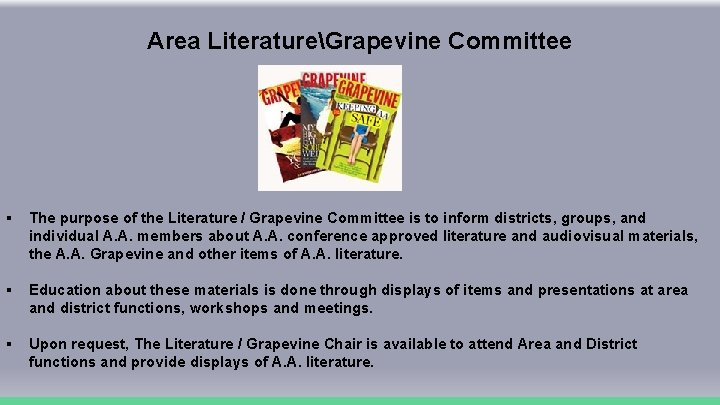
Area LiteratureGrapevine Committee § The purpose of the Literature / Grapevine Committee is to inform districts, groups, and individual A. A. members about A. A. conference approved literature and audiovisual materials, the A. A. Grapevine and other items of A. A. literature. § Education about these materials is done through displays of items and presentations at area and district functions, workshops and meetings. § Upon request, The Literature / Grapevine Chair is available to attend Area and District functions and provide displays of A. A. literature.
Area CPCPI Committee § The purpose of the Public Information/Cooperation with the Professional Community Committee is to convey information about Alcoholics Anonymous to the general public, including the media. § Outreach to alcoholics is also done through informing members of the professional community such as clergy, therapists, medical professionals etc. about A. A. § The committee may participate in community activities to provide information to the general public about A. A. § The committee also handles media requests, such as television and radio appearances, keeping in mind A. A. ’s Twelve Traditions, most especially, the tradition of Anonymity at the level of press, radio, television and film. § On request, the committee provides speakers and information about A. A. to organizations such as schools or civic groups. § Workbooks and numerous pamphlets are available to assist the committee. § At the area level, the committee is principally geared toward assisting district PI/CPC committees, but it may also provide direct service if the need arises.
Area Web Manager a). The primary responsibility of the Web Manager includes maintaining the operation and content of the Area Web Site. b). The Web Manager also collects email sent to the “Web Manager” E-mail address, info@area 81 aa. ca, and processes E-mail in the spirit of Area service. The Area Web Manager is to serve as a trusted servant and will attend Area Assemblies and Committee meetings. c). The content of the Area Web Site includes such materials as Current Area Meeting Lists, as provided by the Districts, upcoming events, and other announcements that serve the Area and its’ members. District Meeting Lists are to be uploaded to the Area 81 website within two weeks of submission to the Web Manager d). The NB/PEI Area Assembly (Area 81) Web Site will be the voice of Alcoholics Anonymous for Area 81 on the public internet. Its editors will be primarily accountable to Area 81 as a whole. Within the bounds of friendliness and good taste, the Web Site will enjoy perfect freedom of speech on all matters directly pertaining to Alcoholics Anonymous within Area 81. Like the A. A. movement it is to mirror, there will be one central purpose; the Web Site will try to carry the message to alcoholics and practice the A. A. principles in all its affairs.
e). Area 81 respects the privacy and security of visitors to the Area’s website. We inform our visitors of measures to achieve this in the Policy Statement on the site. We observe all A. A. ’s principles and Traditions, and as “anonymity is the “spiritual foundation of all our traditions” we practice anonymity on A. A. web sites at all times. An A. A. web site is a public medium, which has the potential for reaching the broadest possible audience, and therefore, requires the same safeguards that we use at the level of press, radio, television and films.
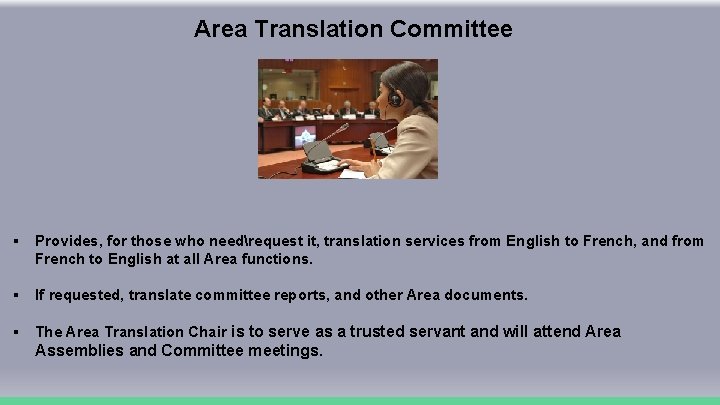
Area Translation Committee § Provides, for those who needrequest it, translation services from English to French, and from French to English at all Area functions. § If requested, translate committee reports, and other Area documents. § The Area Translation Chair is to serve as a trusted servant and will attend Area Assemblies and Committee meetings.
Ad Hoc Committee(s) § Separate from Area Committees, the Assembly may create an ad hoc committee to examine a specific issue or project. Ad Hoc committees exist for only that period in which they are examining the issue or item for which it was created. Generally, an ad hoc committee is an information gathering group that presents its findings to the Area. § Ad Hoc committees may form recommendations, but they themselves do not take actions. Any actions proposed by an ad hoc committee will be considered by the Area prior to any action being taken. § The chairperson of an ad hoc committee, generally a member of the Area Committee, is appointed by the Area Chair. Ad hoc Committee Chairpersons are not voting members of the Assembly by virtue of their position as ad hoc committee chair. Ad hoc committee membership and size is flexible to accommodate the scope or the issue or project.
Area 81 Officers E-Mail As per the Area 81 Service Structure and Operating Handbook, and further to the motion voted on and passed at the Spring Assembly in Charlottetown, on June 8 th, 2019, that reads as follows: That all Area 81 Officers use Area e-mail addresses for purpose of transition and continuity, effective January 1, 2020, Any Area 81 Officer, when conducting Area 81 business via e-mail, is required to use an e-mail address ending in @area 81 aa. ca. The purpose being that outgoing officers, when leaving their position, shall pass on all information to the incoming officer, creating a smooth and continuous transition for that position. The Area 81 Web Manager will work with all incoming and outgoing officers to ensure that the transition runs smoothly. It also removes the risk of one’s personal anonymity being compromised.
The Web Manager will also ensure that all passwords used by outgoing officers will be deleted, and new ones created for the incoming officer. The Web Manager may, if necessary, ask another, qualified, member to help in this task. The qualified member should have some experience in accessing the Area 81 portal (including, but not limited to, creating new accounts, applying permissions for accounts, etc. ), and be approved by the Area 81 Committee as a whole. In accordance with this newly adopted by-law, this document has been created by Area 81 to show all officers how to access their newly formed e-mail address, either via webmail, or by an email client (such as Microsoft Outlook, Mozilla Thunderbird, Windows Mail etc). This document should always be available for Area 81 Officers, as part of our Service Structure & Operating Handbook. For security purposes, passwords should follow specific criteria: 1. Be at least 8 characters long 2. Contain at least one upper case letter 3. Contain at least one number The completed document will be available for all Area Officers at my table at the completion of this presentation.
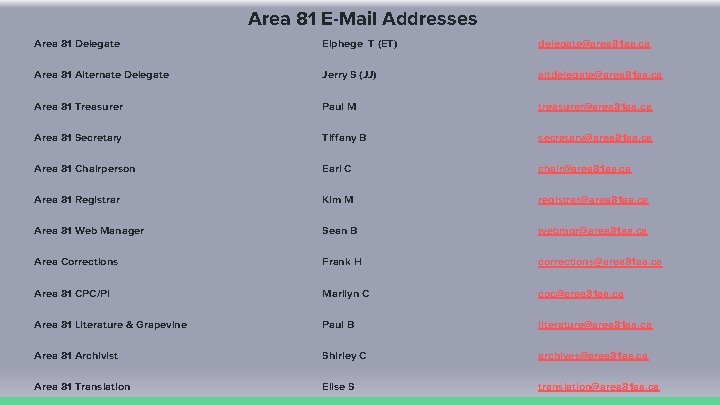
Area 81 E-Mail Addresses Area 81 Delegate Elphege T (ET) delegate@area 81 aa. ca Area 81 Alternate Delegate Jerry S (JJ) altdelegate@area 81 aa. ca Area 81 Treasurer Paul M treasurer@area 81 aa. ca Area 81 Secretary Tiffany B secretary@area 81 aa. ca Area 81 Chairperson Earl C chair@area 81 aa. ca Area 81 Registrar Kim M registrar@area 81 aa. ca Area 81 Web Manager Sean B webmgr@area 81 aa. ca Area Corrections Frank H corrections@area 81 aa. ca Area 81 CPC/PI Marilyn C cpc@area 81 aa. ca Area 81 Literature & Grapevine Paul B literature@area 81 aa. ca Area 81 Archivist Shirley C archives@area 81 aa. ca Area 81 Translation Elise S translation@area 81 aa. ca
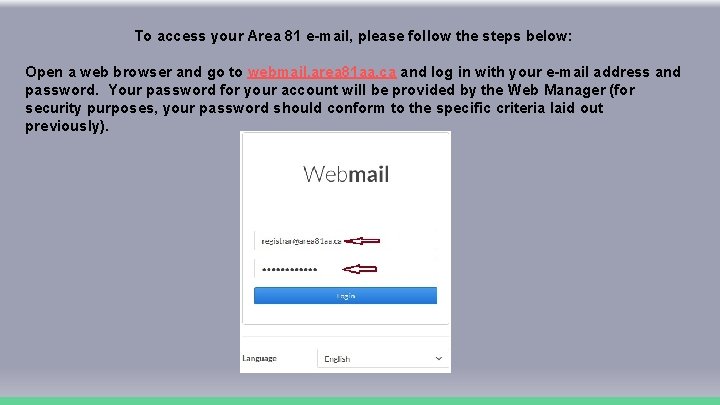
To access your Area 81 e-mail, please follow the steps below: Open a web browser and go to webmail. area 81 aa. ca and log in with your e-mail address and password. Your password for your account will be provided by the Web Manager (for security purposes, your password should conform to the specific criteria laid out previously).
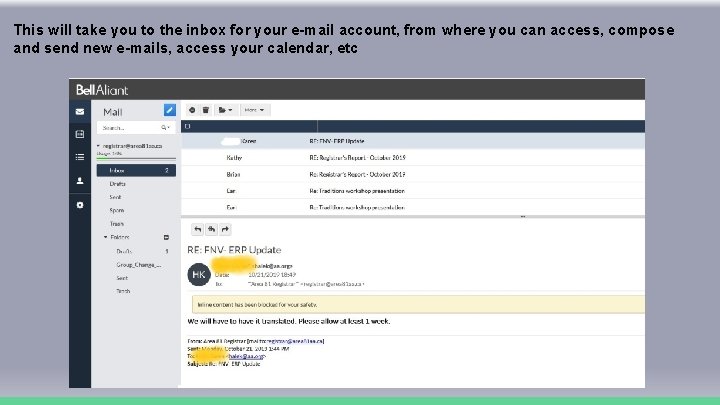
This will take you to the inbox for your e-mail account, from where you can access, compose and send new e-mails, access your calendar, etc

On the left-hand side of your page, you will see a column with icons. Each icon has a specific task associated with it: Click this icon to compose a new e-mail Click this icon to access your calendar Click this icon to create a new task, or access an already existing task Click this icon to access, edit, or add contact details Click this icon to accessedit your e-mail settings
Setting Up E-Mail on your PC, Tablet, or Smart Phone All e-mail accounts should be set up using IMAP, to ensure that you can access all e-mails, across all platforms (PC, Web, Tablet, or phone). Your Area 81 e-mail account can easily be setup on your PC, tablet or smart phone using the following settings: Incoming Server - mail. area 81 aa. ca Outgoing Server – mail. area 81 aa. ca Incoming Mail Port - Port: 993 Outgoing Mail Port - 465 Incoming Mail Username - yourposition@area 81 aa. ca Incoming Mail Password - Use provided password Should you require help setting this up, please ask the Web Manager, or a qualified member, and they will provide assistance.

We hope you have found this presentation informative. We wish you success as a trusted servant of Alcoholics Anonymous, and of Area 81. We hope that your experience helps to enhance your sobriety, as much as it has ours. This presentation is neither endorsed, nor approved, by Alcoholics Anonymous World Services Inc. nor is it affiliated in any way with Alcoholics Anonymous World Services Inc. This presentation, and the information it provides, is intended solely as an information tool for AA members or anyone else wishing to know more about service work in Area 81, NBPEI of Alcoholics Anonymous
- Slides: 57