
District 10 Lake County Melissa De Boer Sheila
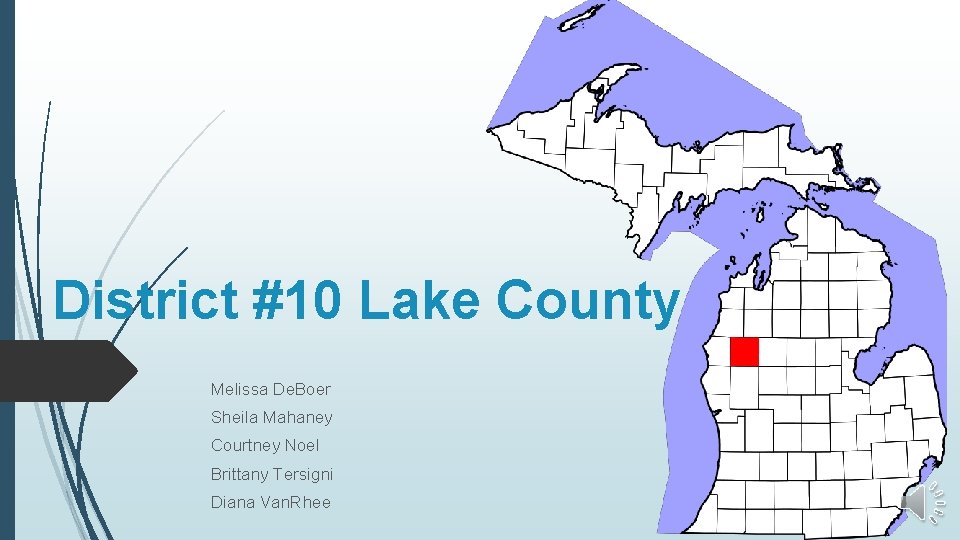
District #10 Lake County Melissa De. Boer Sheila Mahaney Courtney Noel Brittany Tersigni Diana Van. Rhee
Objective To analyze a community, assessing the needs, strengths and weaknesses, and identify a community problem based on analysis. A NANDA nursing diagnosis will be assigned and interventions will be planned and executed. Long and short term evaluations will be assessed to determine effectiveness of the programs outlined in the interventions.
Assessment Strengths Weaknesses
Strengths Dial-a–ride program (Yates-dial-a-ride, n. d. ). Baldwin Family Center of Diversity, scholarship program (District Health Department #10, 2013 b). Family planning services (District Health Department #10, 2013 a). Education at the District 10 Health department (District Health Department #10, 2013 b). Baldwin Community Schools Scholarship Program (Mlive, 2009). $180, 000(2012 -13) allocated for District 10 -for pregnancy prevention programs (District Health Department #10, 2013 b).
Weaknesses The Teen Pregnancy-Rate: Lake County has a pregnancy rate of 64. 8 per 1000 teens in comparison to other Michigan counties whose rate is 48. 3 per 1000 (District Health Department #10, 2014). The Unemployment Rate: The unemployment rate in Lake County is higher than the Michigan average with the rate being 12. 7 compared to 8. 7 (District Health Department #10, 2014). The Poverty Rate: The rate of people living below poverty in Lake County is also higher than those in other Michigan counties 24. 1% compared to 16. 3% (District Health Department #10, 2014). Lack of Education: 80. 8% of individuals have a high school education with only 8. 2% achieving a Bachelor’s degree (District Health Department #10, 2014). Increased PCP Per Patient Ratios In Lake County 5, 758 people are assigned per primary healthcare provider in comparison to 1, 271 people per provider in other counties (District Health Department #10, 2014). Lack of PCP’s: 18. 8% of individuals in Lake County do not have a primary care provider as compared to other counties in which 13. 2% do not have a primary care provider (District Health Department#10, 2014). Low diversity: 85. 8% of residents are white, non -Hispanics (Lake County Master Plan, 2014)
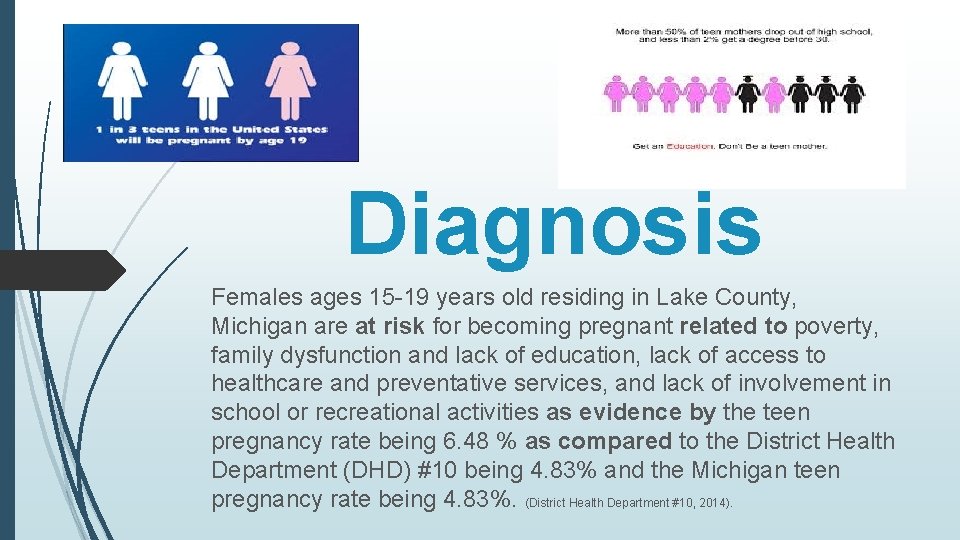
Diagnosis Females ages 15 -19 years old residing in Lake County, Michigan are at risk for becoming pregnant related to poverty, family dysfunction and lack of education, lack of access to healthcare and preventative services, and lack of involvement in school or recreational activities as evidence by the teen pregnancy rate being 6. 48 % as compared to the District Health Department (DHD) #10 being 4. 83% and the Michigan teen pregnancy rate being 4. 83%. (District Health Department #10, 2014).

Mueke Model (Mueke, 1984) Ineffective Community Coping Risk of: Teenage Pregnancies Among: females ages 15 -19 years old that reside in Lake County. Related to: poverty related to the high unemployment rate, lack of access to healthcare and prevention, households with decreased education and single parents, and lack of activities/interests to keep the teenage population “busy”. As demonstrated by: the teen pregnancy rate being 6. 48 % as compared to the DHD #10 being 4. 83% and the Michigan teen pregnancy rate being 4. 83% (District Health Department #10, 2013 a).
Ecological Model This model has been effective in previous health promotion and prevention in safer sex practices The Ecological Model suggests that behavioral change in people needs to be considered in a broader social context, including developmental history, psychological characteristics, interpersonal relationships, physical environment, and culture. It has been proven to be more inclusive with behavior change (Harkness and De. Marco, 2012)
PLANNING Resources Needed The Planning Group School administration Money School nurses Local Health Department School Nurses Community Health Nurses Local business support School Administration Building/space for after school programs Grants from local, state, and federal levels Volunteers
Evidence-Based Practice for Choosing the Implementations Adolescents involved in school and recreational activities are less likely to become teen parents (Office of Adolescent Health, 2014). Teens are more likely to have children if their mothers obtain a high school education with no college course work (Office of Adolescent Health, 2014). According to the Office of Adolescent Health (2014) adolescents who grow up in communities with high unemployment rates and high levels of poverty are more likely to become teen parents. The Center for Disease Control and Prevention (2012) stated 13. 1% of teens involved in the Pregnancy Risk Assessment Monitoring System (PRAMS) between 2004 and 2008 cited lack of access to healthcare as a reason for not using protection during sexual intercourse which resulted in subsequent pregnancy. Less than half of teen mothers ever graduate from high school and fewer than 2% earn a college degree by age 30. (Stay. Teen. org) Effective programs contain: curriculum-based education, service learning, youth development, parent programs, and broad, community-wide attendance (thenationalcampaign. org).
Expected Outcomes for NANDA Ineffective Community Coping r/t high percentage of teenage pregnancies in Lake County • Inform the local community of the amount of teenagers that are getting pregnant in the local schools and communities. - Awareness of the problem • Develop a plan of action to decrease the amount of teenage pregnancies in Lake County • Plan and strategize ways of evaluating teenage pregnancies and revise the objectives if needed. • Update the community on reduction rates of teen pregnancy
IMPLEMENTATIO N
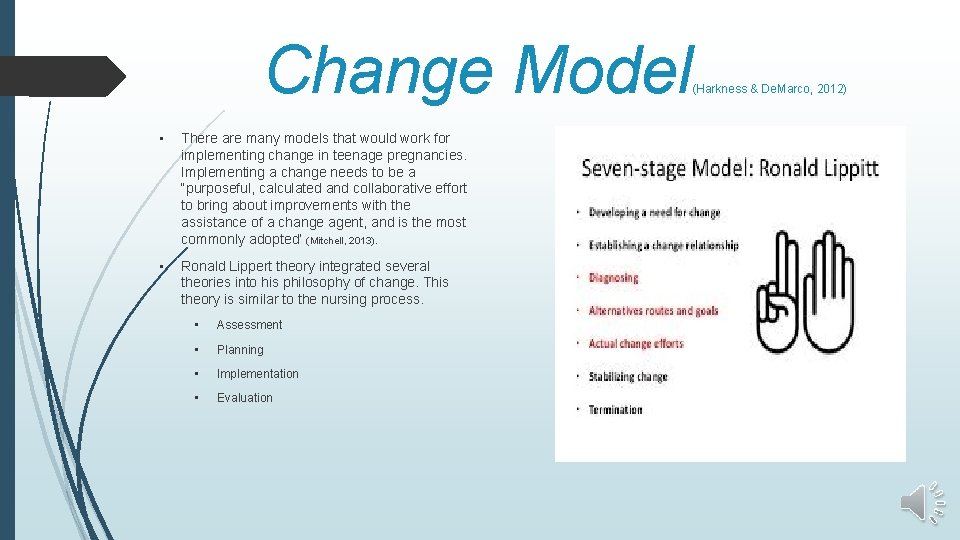
Change Model • There are many models that would work for implementing change in teenage pregnancies. Implementing a change needs to be a “purposeful, calculated and collaborative effort to bring about improvements with the assistance of a change agent, and is the most commonly adopted’ (Mitchell, 2013). • Ronald Lippert theory integrated several theories into his philosophy of change. This theory is similar to the nursing process. • Assessment • Planning • Implementation • Evaluation (Harkness & De. Marco, 2012)
Primary Interventions • Develop a mentorship program for the teenage girls (14 -19) that are pregnant. The support group could meet at an individual’s home or after school- this is done so the teen moms can be with their peers and feel accepted. This program would also provide resources about what to expect during pregnancy and parenting. This will equip the teens with resources and knowledge. • Provide an outlet for teenage girls and educate them on what healthy relationships are : this helps build their self -esteem and self worth. This also encourages participation in extra curricular activities. • Provide information on safe sex , abstinence, and provide resources on local hospitals and clinics that offer classes on human sexuality and childbirth classes: this will empower the teens to be able to make educated choices. • Start education of sexual health at the middle school level and stress the importance of healthy relationships. Implement programs that encourage abstinence- and safe sex. • Include support from teachers and parents- education- One program specific to parents would be FTT (families talking together)- this program equips parents with skills to effectively communicate with their teenage daughter/son about delaying sex at an early age. This also includes talking with their teen about birth control and contraception(National Campaign)- reinforces communication
• • Primary Interventions Continued Keeping’ it REAL and REAL men- this program identifies males and females and provides communication about sex and related topics Enlist the community in helping prevent teen pregnancies. Engage in getting grants at the local, state and federal levels- At the county level, (Lake) the economy is depressed and has limited resources – therefore enlisting the local churches of Lake County and surrounding counties to financially support health fairs and educational seminars encouraging abstinence and programs specific to healthy relationships. Reach out to Yates Dial – a – ride (Local transportation for Lake County) for partnership in transportation of pregnant teens to support groups or medical appointments. Apply for Michigan Family Independence Program from the State of Michigan. This grant provides temporary assistance to pregnant women to help develop relevant education and training programs. – (This grant comes though MI works)
Secondary Interventions • Provide local community support and engage in health fairs and community centers • Engage in the local and surrounding business for support. • Reaching out to the community and providing transportation for the teenagers to make their appointments or support groups. • Contact a local gym and request free teen open gym hours to promote healthy activity. This activity would be ran by local volunteers once per week.

EVALUATION
Long-Term Evaluation Ø A decrease in teenage pregnancy rate by 5% in the next five years.
Short-Term Evaluation • A survey will be conducted of the participants in the after school programs to determine effectiveness. • A survey regarding the use or disuse of the Yates Dial-A-Ride program.
Summary Assessment/Problem: Address the increased rate of teenage pregnancy in Lake County Diagnosis: Ineffective Community Coping Planning: Use EBP to determine appropriate programs and interventions Interventions: Primary and secondary interventions implemented Evaluation: Long and short term goals evaluated to determine effectiveness
Resources Centers for Disease Control and Prevention. (2012). Prepregnancy contraceptive use among teens with unintended pregnancies resulting in live births-pregnancy risk assessment monitoring system (PRAMS) 2004 -2008. Retrieved from http: //www. cdc. gov/mmwr/preview/mmwrhtml/mm 6102 a 1. htm District Health Department #10. (2013 a). Family Planning. Retrieved from http: //dhd 10. org/index. php/family-planning-landing District Health Department # 10. (2013 b). Teen Pregnancy Prevention. Retrieved from http: //dhd 10. org/teen-pregnancy-prevention District Health Department #10. (2014). Lake County health profile summary 2013. Retrieved from http: //dhd 10. org/images/Summary__Lake_Chartbook_Feb_25_2014. pdf Harkness, G. A. & De. Marco, R. F. (2012). Community and Public Health Nursing Practice: Evidence for Practice. Wolters Kluwer/Lippincott, Williams & Wilkins: Philadelphia. Lake County Planning Commission. (2014). Lake County recreation plan. Retrieved from http: //www. lakecounty-michigan. com Mlive. (2009). Tiny Michigan town of Baldwin to promise scholarships to all. Retrieved from http: //www. mlive. com/news/index. ssf/2009/09/tiny_michigan_town_of_baldwin. html Mitchell, G. , (2013, April). Selecting the best theory to implement planned change. Nursing Management, 20(1) p. 32 -37
Resources Continued Mueke, M. A. (1984). Community health diagnosis in nursing. Public Health Nursing, 1(1), p. 23 -25 NANDA Nursing Diagnosis. (2014). Ineffective community coping. Retrieved from http: //www. nandanursingdiagnosis. org/nursing-diagnosis-ineffective-community-coping Office of Adolescent Health. (2014). Trends in teen pregnancy and childbearing. Retrieved from http: //www. hhs. gov/ash/oah/adolescent-health-topics/reproductive-health/teen-pregnancy/trends. html Stay Teen. (2014). Teen pregnancy: Stay informed. Retrieved from http: //stayteen. org The National Campaign. (2014). Preventing teen pregnancy through outreach and engagement. Retrieved from http: //www. thenationalcampaign. org US Department of Health. (2014). Teen Pregnancy. Retrieved from www. hhs. gov/ash/oah. oah-initiatives World Health Organization. (2014). Adolescent Pregnancy. Retrieved from http: //www. who. int/mediacentre/factsheets/fs 364/en/ Yates-dial-a-ride. (n. d. ) About us. Retrieved from http: //yatesdialaride. com/yates_dial-a-ride_002. htm
- Slides: 22